Fine-grained topological structures hidden in Fermi sea
Pith reviewed 2026-05-15 08:39 UTC · model grok-4.3
The pith
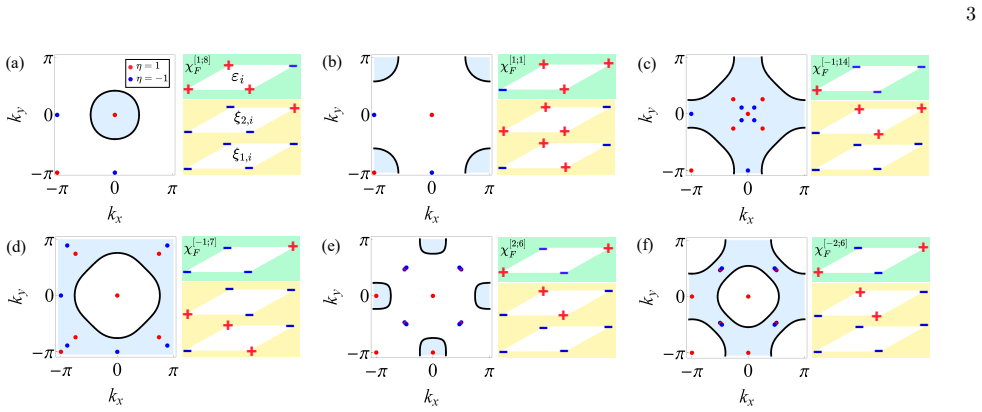
Fermi seas with identical Euler characteristic can possess distinct fine-grained topologies distinguished by a structural resolution factor.
A machine-rendered reading of the paper's core claim, the machinery that carries it, and where it could break.
Core claim
Characterizing Fermi sea topology solely by χ_F is insufficient. Fermi seas with identical χ_F exhibit fundamentally different fine-grained topological structures that cannot be connected without a Lifshitz transition. The structural resolution factor encodes this hidden structure. Topological superconducting phases inherit the fine-grained Fermi sea topology, with differences giving rise to anomalous gapless boundary states at interfaces between metal/superconductor heterojunctions.
What carries the argument
The structural resolution factor that captures fine-grained Fermi sea topologies beyond the Euler characteristic χ_F.
If this is right
- Superconductors derived from the Fermi sea inherit its fine-grained topological structures.
- Differences in inherited structures produce anomalous gapless boundary states at heterojunction interfaces.
- Fine-grained structures remain distinct even when χ_F is the same and require Lifshitz transitions to connect.
- The topological properties of the Fermi sea extend directly to its interacting superconducting phases.
Where Pith is reading between the lines
- Interface experiments between differently resolved superconductors could detect these states to confirm the factor.
- The approach may generalize to other many-body phases built on the same Fermi sea.
- Applying the resolution factor in three dimensions could uncover additional hidden structures in real materials.
Load-bearing premise
The structural resolution factor correctly encodes the fine-grained topologies and superconducting phases inherit them unchanged under the attractive Hubbard interaction.
What would settle it
Construct two Fermi seas with the same χ_F but different structural resolution factors, derive their superconductors, and verify whether their interface exhibits gapless states only for mismatched factors.
Figures



read the original abstract
The geometry of Fermi sea hosts a unique form of quantum topology that governs the conductance quantization of metal and is characterized by the Euler characteristic $\chi_F$, offering a new perspective in the study of topological quantum matter. Here, we discover that characterizing Fermi sea topology solely by $\chi_F$ is insufficient: Fermi seas with identical $\chi_F$ can exhibit fundamentally different fine-grained topological structures that cannot be connected without a Lifshitz transition. To encode this hidden structure, we introduce a structural resolution factor that captures the fine-grained Fermi sea topologies beyond $\chi_F$, revealing the deeper topological information within the Fermi sea. Considering the attractive Hubbard interaction of electrons on Fermi surfaces, we further demonstrate that the resulting topological superconducting phases can inherit the fine-grained Fermi sea topology of their parent metallic bands, with differences in these structures giving rise to anomalous gapless boundary states at the interface between two metal/superconductor heterojunctions. This work opens an avenue for understanding the topological richness of Fermi sea.
Editorial analysis
A structured set of objections, weighed in public.
Referee Report
Summary. The manuscript claims that the Euler characteristic χ_F alone is insufficient to characterize Fermi-sea topology, since Fermi seas sharing the same χ_F can possess distinct fine-grained structures that cannot be continuously deformed into one another without a Lifshitz transition. It introduces a structural resolution factor to encode these hidden structures and asserts that, under attractive Hubbard interactions, the resulting topological superconducting phases inherit the parent metallic fine-grained topology, producing anomalous gapless boundary states at interfaces between heterojunctions with differing resolution factors.
Significance. If the central claims are rigorously established, the work would demonstrate that standard Euler-characteristic classification misses important topological distinctions within the Fermi sea, with direct consequences for conductance quantization and for the design of superconducting heterostructures hosting protected interface modes. The structural resolution factor, if shown to be a true invariant, could become a useful diagnostic tool in mesoscopic topology.
major comments (3)
- [§3] §3 (definition of structural resolution factor): the manuscript must supply an explicit formula or algorithmic construction for the resolution factor together with a proof that it remains invariant under all smooth deformations that preserve Fermi-surface connectivity and genus; without this, the claim that it distinguishes structures with identical χ_F is not load-bearing.
- [§5] §5 (attractive Hubbard mapping): the assertion that the Bogoliubov-de Gennes spectrum inherits the metallic resolution factor unchanged requires an explicit demonstration that the pairing term introduces no additional gap closings or lattice-induced modifications capable of altering the fine-grained topology; the current sketch does not rule out such effects.
- [§6] §6 (interface states): the anomalous gapless boundary states are attributed to differences in the resolution factor, yet no calculation or topological index is provided showing that these states are protected precisely by the resolution-factor mismatch rather than by conventional band-inversion or interface-potential effects.
minor comments (2)
- [Abstract] The abstract and introduction should include at least one concrete lattice model (e.g., specific tight-binding parameters) where two Fermi seas share χ_F but differ in the resolution factor, to make the insufficiency claim immediately verifiable.
- [Notation] Notation: the symbol χ_F is used both for the Euler characteristic and, implicitly, for its fine-grained refinement; a distinct symbol or subscript for the resolution factor would improve clarity.
Simulated Author's Rebuttal
We thank the referee for the careful reading of our manuscript and the constructive comments. We address each of the major points below, indicating the revisions we will make to strengthen the paper.
read point-by-point responses
-
Referee: [§3] §3 (definition of structural resolution factor): the manuscript must supply an explicit formula or algorithmic construction for the resolution factor together with a proof that it remains invariant under all smooth deformations that preserve Fermi-surface connectivity and genus; without this, the claim that it distinguishes structures with identical χ_F is not load-bearing.
Authors: We appreciate this suggestion for improving the rigor. In the revised manuscript, we will include an explicit algorithmic construction for the structural resolution factor, defined as the minimal number of additional generators needed to describe the homology of the Fermi surface beyond the Euler characteristic. We will prove its invariance under smooth deformations that preserve connectivity and genus by showing that such deformations correspond to isotopies that do not change the relevant Betti numbers. This will be added to §3 with a dedicated subsection. revision: yes
-
Referee: [§5] §5 (attractive Hubbard mapping): the assertion that the Bogoliubov-de Gennes spectrum inherits the metallic resolution factor unchanged requires an explicit demonstration that the pairing term introduces no additional gap closings or lattice-induced modifications capable of altering the fine-grained topology; the current sketch does not rule out such effects.
Authors: We agree that the current presentation is a sketch and requires more detail. In the revision, we will provide an explicit mapping showing that the BdG Hamiltonian for weak pairing can be adiabatically connected to the normal-state Hamiltonian without gap closings that affect the fine-grained topology. We will demonstrate that the resolution factor is preserved because the pairing term acts as a perturbation that gaps the spectrum uniformly without altering the underlying Fermi surface topology. Lattice effects will be addressed by considering the continuum limit and showing invariance for smooth surfaces. revision: yes
-
Referee: [§6] §6 (interface states): the anomalous gapless boundary states are attributed to differences in the resolution factor, yet no calculation or topological index is provided showing that these states are protected precisely by the resolution-factor mismatch rather than by conventional band-inversion or interface-potential effects.
Authors: This is a valid point. We will revise §6 to include a concrete calculation for a 1D interface model between two heterojunctions with different resolution factors but no band inversion. We will define a topological index as the absolute difference in the resolution factors, which counts the number of protected gapless modes. Numerical diagonalization of the interface Hamiltonian will be added to confirm the protection against potential perturbations. revision: yes
Circularity Check
No significant circularity; derivation introduces independent structural factor
full rationale
The paper defines a new structural resolution factor to distinguish Fermi seas sharing the same Euler characteristic χ_F, then claims inheritance of this factor under attractive Hubbard pairing. No equations or self-citations are provided that reduce the factor or the inheritance claim to a fitted input, self-definition, or prior author result by construction. The abstract presents the factor as an encoding of hidden structure rather than a renaming or statistical fit, and the superconducting inheritance is stated as a demonstration. Without load-bearing reductions visible in the given text, the chain remains self-contained.
Axiom & Free-Parameter Ledger
axioms (1)
- domain assumption Fermi sea geometry is characterized by the Euler characteristic χ_F
invented entities (1)
-
structural resolution factor
no independent evidence
Reference graph
Works this paper leans on
-
[1]
K. v. Klitzing, G. Dorda, and M. Pepper, New method for high-accuracy determination of the fine-structure con- stant based on quantized Hall resistance, Phys. Rev. Lett. 45, 494 (1980)
work page 1980
-
[2]
D. C. Tsui, H. L. Stormer, and A. C. Gossard, Two- dimensional magnetotransport in the extreme quantum limit, Phys. Rev. Lett.48, 1559 (1982)
work page 1982
-
[3]
M. Z. Hasan and C. L. Kane, Colloquium: topological insulators, Rev. Mod. Phys.82, 3045 (2010)
work page 2010
-
[4]
X.-L. Qi and S.-C. Zhang, Topological insulators and su- perconductors, Rev. Mod. Phys.83, 1057 (2011)
work page 2011
-
[5]
Wen, Colloquium: Zoo of quantum-topological phases of matter, Rev
X.-G. Wen, Colloquium: Zoo of quantum-topological phases of matter, Rev. Mod. Phys.89, 041004 (2017)
work page 2017
-
[6]
R. B. Laughlin, Quantized Hall conductivity in two di- mensions, Phys. Rev. B23, 5632 (1981)
work page 1981
-
[7]
D. J. Thouless, M. Kohmoto, M. P. Nightingale, and M. den Nijs, Quantized hall conductance in a two- dimensional periodic potential, Phys. Rev. Lett.49, 405 (1982)
work page 1982
-
[8]
C.-K. Chiu, J. C. Y. Teo, A. P. Schnyder, and S. Ryu, Classification of topological quantum matter with sym- metries, Rev. Mod. Phys.88, 035005 (2016)
work page 2016
-
[9]
Kitaev, Periodic table for topological insulators and superconductors, AIP Conf
A. Kitaev, Periodic table for topological insulators and superconductors, AIP Conf. Proc.1134, 22 (2009)
work page 2009
-
[10]
L. Fidkowski and A. Kitaev, Topological phases of fermions in one dimension, Phys. Rev. B83, 075103 (2011)
work page 2011
-
[11]
Fu, Topological crystalline insulators, Phys
L. Fu, Topological crystalline insulators, Phys. Rev. Lett. 106, 106802 (2011)
work page 2011
-
[12]
T. Morimoto and A. Furusaki, Topological classification with additional symmetries from Clifford algebras, Phys. Rev. B88, 125129 (2013)
work page 2013
-
[13]
K. Shiozaki and M. Sato, Topology of crystalline insu- lators and superconductors, Phys. Rev. B90, 165114 (2014)
work page 2014
-
[14]
Y. Ren, Z. Qiao, and Q. Niu, Topological phases in two- dimensional materials: a review, Rep. Prog. Phys.79, 066501 (2016)
work page 2016
-
[15]
R. Landauer, Spatial variation of currents and fields due to localized scatterers in metallic conduction, IBM J. Res. Dev.1, 223 (1957)
work page 1957
-
[16]
D. S. Fisher and P. A. Lee, Relation between conductivity and transmission matrix, Phys. Rev. B23, 6851 (1981)
work page 1981
-
[17]
B¨ uttiker, Four-terminal phase-coherent conductance, Phys
M. B¨ uttiker, Four-terminal phase-coherent conductance, Phys. Rev. Lett.57, 1761 (1986)
work page 1986
-
[18]
A. D. Stone and A. Szafer, What is measured when you measure a resistance?—The Landauer formula revisited, IBM J. Res. Dev.32, 384 (1988)
work page 1988
-
[19]
B. J. Van Wees, H. Van Houten, C. W. J. Beenakker, J. G. Williamson, L. P. Kouwenhoven, D. Van der Marel, and C. T. Foxon, Quantized conductance of point con- tacts in a two-dimensional electron gas, Phys. Rev. Lett. 60, 848 (1988)
work page 1988
- [20]
-
[21]
I. van Weperen, S. R. Plissard, E. P. Bakkers, S. M. Frolov, and L. P. Kouwenhoven, Quantized conductance in an insb nanowire, Nano Lett.13, 387 (2013)
work page 2013
- [22]
-
[23]
Kane, Quantized nonlinear conductance in ballistic metals, Phys
C. Kane, Quantized nonlinear conductance in ballistic metals, Phys. Rev. Lett.128, 076801 (2022)
work page 2022
-
[24]
P. M. Tam, M. Claassen, and C. L. Kane, Topological multipartite entanglement in a Fermi liquid, Phys. Rev. X12, 031022 (2022)
work page 2022
-
[25]
P. M. Tam and C. L. Kane, Probing Fermi sea topology by Andreev state transport, Phys. Rev. Lett.130, 096301 (2023)
work page 2023
-
[26]
P. M. Tam, C. De Beule, and C. L. Kane, Topological andreev rectification, Phys. Rev. B107, 245422 (2023)
work page 2023
-
[27]
P. M. Tam and C. L. Kane, Topological density correla- tions in a Fermi gas, Phys. Rev. B109, 035413 (2024)
work page 2024
- [28]
- [29]
-
[30]
F. Yang and H. Zhai, Quantized nonlinear transport with ultracold atoms, Quantum6, 857 (2022)
work page 2022
-
[31]
Zhang, Quantized topological response in trapped 6 quantum gases, Phys
P. Zhang, Quantized topological response in trapped 6 quantum gases, Phys. Rev. A107, L031305 (2023)
work page 2023
-
[32]
F. Yang and X. Li, Quantized nonlinear transport and its breakdown in fermi gases with berry curvature, Phys. Rev. B113, 075431 (2026)
work page 2026
-
[33]
G. E. Volovik, Exotic lifshitz transitions in topological materials, Phys. Usp.61, 89 (2018)
work page 2018
-
[34]
H. D. Scammell and M. S. Scheurer, Tunable super- conductivity and m¨ obius fermi surfaces in an inversion- symmetric twisted van der waals heterostructure, Phys. Rev. Lett.130, 066001 (2023)
work page 2023
-
[35]
Y. Zeng, A. Bastianello, S. Dhar, Z. Wang, X. Yu, M. Horvath, G. E. Astrakharchik, Y. Guo, H.-C. N¨ agerl, and M. Landini, Realization of fractional fermi seas, arXiv:2602.17657 (2026)
work page Pith review arXiv 2026
-
[36]
A. Bastianello, Y. Zeng, S. Dhar, Z. Wang, X. Yu, M. Horvath, G. E. Astrakharchik, Y. Guo, H.-C. N¨ agerl, and M. Landini, Exotic critical states as fractional fermi seas in the one-dimensional bose gas, arXiv:2602.17656 (2026)
- [37]
-
[38]
X.-J. Liu, K. T. Law, and T. K. Ng, Realization of 2D spin-orbit interaction and exotic topological orders in cold atoms, Phys. Rev. Lett.112, 086401 (2014)
work page 2014
-
[39]
T. F. J. Poon and X.-J. Liu, From a semimetal to a chiral fulde-ferrell superfluid, Phy. Rev. B97, 020501 (2018)
work page 2018
- [40]
-
[41]
F. Yang, X. Li, and C. Li, Euler-Chern correspondence via topological superconductivity, Phys. Rev. Research 5, 033073 (2023)
work page 2023
-
[42]
Jia, Generic reduction theory for fermi sea topology in metallic systems, Phys
W. Jia, Generic reduction theory for fermi sea topology in metallic systems, Phys. Rev. B111, 155115 (2025)
work page 2025
-
[43]
J. W. Milnor,Morse theory, Vol. 51 (Princeton University Uress, 1963)
work page 1963
- [44]
-
[45]
I. M. Lifshitz, Anomalies of electron characteristics of a metal in the high pressure region, Sov. Phys. JETP11, 1130 (1960)
work page 1960
-
[46]
See Supplemental Material for the details
-
[47]
X.-L. Qi, T. L. Hughes, and S.-C. Zhang, Chiral topolog- ical superconductor from the quantum hall state, Phys. Rev. B82, 184516 (2010)
work page 2010
-
[48]
B. A. Bernevig,Topological insulators and topological su- perconductors(Princeton university press, 2013)
work page 2013
-
[49]
M. Sato and Y. Ando, Topological superconductors: a review, Rep. Prog. Phys.80, 076501 (2017)
work page 2017
-
[50]
C. Chan, L. Zhang, T. F. J. Poon, Y.-P. He, Y.-Q. Wang, and X.-J. Liu, Generic theory for majorana zero modes in 2d superconductors, Phys. Rev. Lett.119, 047001 (2017)
work page 2017
-
[51]
Hatsugai, Chern number and edge states in the integer quantum hall effect, Phys
Y. Hatsugai, Chern number and edge states in the integer quantum hall effect, Phys. Rev. Lett.71, 3697 (1993)
work page 1993
-
[52]
M. Sato and S. Fujimoto, Topological phases of noncen- trosymmetric superconductors: Edge states, majorana fermions, and non-abelian statistics, Phys. Rev. B79, 094504 (2009)
work page 2009
- [53]
-
[54]
A. A. Soluyanov and D. Vanderbilt, Wannier representa- tion of𭟋 2 topological insulators, Phys. Rev. B83, 035108 (2011)
work page 2011
-
[55]
M. Taherinejad, K. F. Garrity, and D. Vanderbilt, Wan- nier center sheets in topological insulators, Phys. Rev. B 89, 115102 (2014)
work page 2014
-
[56]
W. A. Benalcazar, B. A. Bernevig, and T. L. Hughes, Electric multipole moments, topological multipole mo- ment pumping, and chiral hinge states in crystalline in- sulators, Phys. Rev. B96, 245115 (2017)
work page 2017
-
[57]
I. T. Rosen, E. J. Fox, X. Kou, L. Pan, K. L. Wang, and D. Goldhaber-Gordon, Chiral transport along magnetic domain walls in the quantum anomalous hall effect, npj Quantum Materials2, 69 (2017)
work page 2017
-
[58]
Y.-F. Zhao, R. Zhang, J. Cai, D. Zhuo, L.-J. Zhou, Z.-J. Yan, M. H. Chan, X. Xu, and C.-Z. Chang, Creation of chiral interface channels for quantized transport in mag- netic topological insulator multilayer heterostructures, Nat. Comm.14, 770 (2023)
work page 2023
- [59]
-
[60]
M. Liu, W. Wang, A. R. Richardella, A. Kandala, J. Li, A. Yazdani, N. Samarth, and N. P. Ong, Large discrete jumps observed in the transition between chern states in a ferromagnetic topological insulator, Sci. Adv.2, e1600167 (2016)
work page 2016
-
[61]
Y. Wan, J. Li, and Q. Liu, Topological magnetoelectric response in ferromagnetic axion insulators, Nat. Sci. Rev. 11, nwac138 (2024)
work page 2024
-
[62]
Q. Yan, H. Li, H. Jiang, Q.-F. Sun, and X. Xie, Rules for dissipationless topotronics, Sci. Adv.10, eado4756 (2024)
work page 2024
- [63]
-
[64]
M. Eschrig, J. Kopu, J. C. Cuevas, and G. Sch¨ on, The- ory of half-metal/superconductor heterostructures, Phys. Rev. Lett.90, 137003 (2003)
work page 2003
-
[65]
Fine-grained topological structures hidden in Fermi sea
S. B. Chung, H.-J. Zhang, X.-L. Qi, and S.-C. Zhang, Topological superconducting phase and majorana fermions in half-metal/superconductor heterostructures, Phys. Rev. B84, 060510 (2011). 7 Supplementary Material for “Fine-grained topological structures hidden in Fermi sea” In this Supplementary Material, we provide the details of the fine-grained Fermi se...
work page 2011
discussion (0)
Sign in with ORCID, Apple, or X to comment. Anyone can read and Pith papers without signing in.