The typicality of symmetry-induced entanglement
Pith reviewed 2026-05-15 06:53 UTC · model grok-4.3
The pith
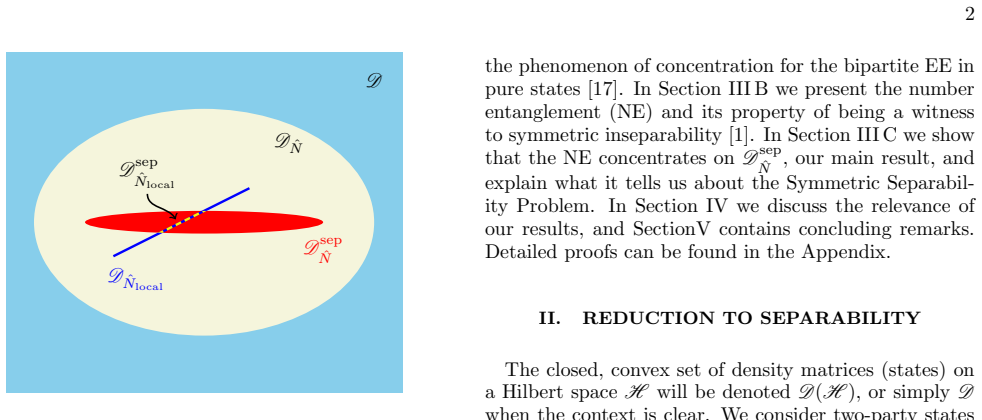
A conserved charge makes almost all separable states fail to decompose into charge-conserving parts.
A machine-rendered reading of the paper's core claim, the machinery that carries it, and where it could break.
Core claim
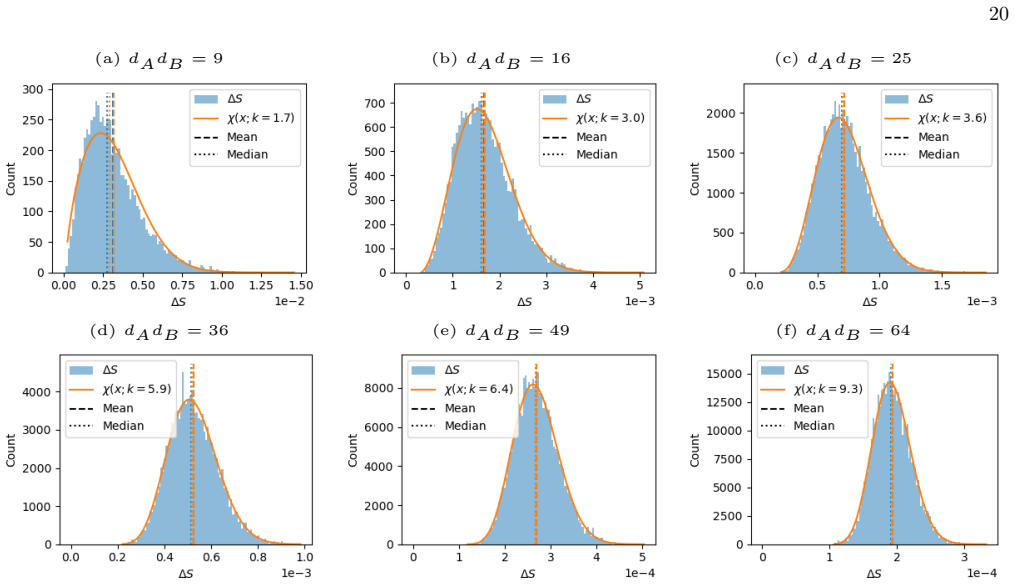
On random states, the Symmetric Separability Problem is answered negatively with probability one for almost all N. Most symmetric and separable states are actually far from being symmetrically separable, with the number entanglement featuring Gaussian concentration around a strictly positive mean value.
What carries the argument
The number entanglement witness, which quantifies the failure of a symmetric state to admit a decomposition into charge-conserving product states.
If this is right
- Any quantum task that assumes separability under a superselection rule will typically encounter hidden entanglement induced by the charge constraint.
- The volume of the set of states that are both separable and symmetrically separable is negligible compared with the full separable set once N is fixed.
- The complexity of deciding symmetric separability is expected to be hard in the same regimes where ordinary separability is hard.
- Multiparty states without a common reference frame will generically require charge-entanglement resources even when they appear separable in the usual sense.
Where Pith is reading between the lines
- Symmetry constraints of this kind may serve as a generic source of entanglement that is easier to prepare than ordinary entangled states.
- Protocols that certify entanglement or separability must incorporate an explicit check for the symmetric decomposition when a conserved charge is present.
- The same concentration phenomenon could appear in other symmetry-protected settings, such as particle-number or angular-momentum superselection.
Load-bearing premise
The results rest on a particular probability measure for random states and on the number entanglement witness correctly detecting every failure of symmetric separability.
What would settle it
Explicitly construct, for some fixed N greater than one, a symmetric separable state whose number entanglement evaluates to zero, or compute the distribution of number entanglement on small-dimensional systems and find that it does not concentrate away from zero.
Figures



read the original abstract
In the presence of a globally conserved charge $N$, a natural question is whether a given separable state can be separated into charge-conserving components. We dub this problem the Symmetric Separability Problem (SSP). On random states, the SSP is answered negatively with probability one for almost all $N$. Using a witness to the failure of symmetric separability, namely the number entanglement (NE) introduced in arXiv:2110.09388, we show that most symmetric and separable states are actually far from being symmetrically separable, with the NE featuring Gaussian concentration around a strictly positive mean value. We discuss some consequences of our results for quantum tasks in the presence of a superselection rule or in the absence of a common reference frame. Progress is made on the question of the size of the separable space constrained by $N$. We also touch upon the question of the complexity of SSP, and multiparty entanglement.
Editorial analysis
A structured set of objections, weighed in public.
Referee Report
Summary. The manuscript investigates the Symmetric Separability Problem (SSP) for bipartite states subject to a globally conserved charge N. It claims that, under a natural measure on random states, the SSP is answered negatively with probability one for almost all N. Employing the number entanglement (NE) witness imported from arXiv:2110.09388, the authors show that NE on symmetric separable states exhibits Gaussian concentration around a strictly positive mean, implying that most such states lie far from the symmetrically separable set. The work also discusses consequences for quantum tasks under superselection rules or without a common reference frame, and reports progress on the dimension of the N-constrained separable set together with remarks on the complexity of SSP.
Significance. If the central claims are substantiated, the result supplies a probabilistic characterization of symmetry-induced entanglement and sharply constrains the effective size of the separable set under charge conservation. The Gaussian concentration statement is a strong, quantitative typicality result with direct implications for reference-frame-free quantum information processing. The manuscript makes explicit use of concentration-of-measure techniques and builds on an existing witness, which are positive features when the witness's detection properties are fully characterized.
major comments (2)
- [§3] §3 (main typicality theorem): The probability-one claim that SSP fails for almost all random states rests on NE serving as a complete detector of symmetric-separability failure. Because NE is introduced only as a witness (NE > 0 implies failure), the argument does not rule out a positive-measure set of states with NE = 0 that nevertheless violate SSP; this would undermine the measure-zero statement for the symmetrically separable set. An independent argument that the kernel of NE coincides with the symmetrically separable states, or an explicit bound on the undetected set, is required.
- [§2.2] §2.2 (definition of the typicality measure): The measure on random symmetric states is taken from prior work without re-derivation of its invariance properties or concentration constants under the N-conservation constraint. The Gaussian concentration result for NE therefore inherits any hidden assumptions of that measure; the dependence on N and the precise scaling of the variance with system size should be stated explicitly.
minor comments (2)
- [Abstract] Abstract: the phrase 'almost all N' is used without specifying the range or probability measure on N; a brief clarification would help readers.
- [§2] Notation: the symbol for the symmetric-separable set is introduced without an explicit equation number; adding Eq. (X) would improve traceability when the set is later compared with the NE kernel.
Simulated Author's Rebuttal
We thank the referee for the careful and constructive review. We address the major comments point by point below, providing the strongest honest defense of the manuscript while making revisions where they improve clarity.
read point-by-point responses
-
Referee: [§3] §3 (main typicality theorem): The probability-one claim that SSP fails for almost all random states rests on NE serving as a complete detector of symmetric-separability failure. Because NE is introduced only as a witness (NE > 0 implies failure), the argument does not rule out a positive-measure set of states with NE = 0 that nevertheless violate SSP; this would undermine the measure-zero statement for the symmetrically separable set. An independent argument that the kernel of NE coincides with the symmetrically separable states, or an explicit bound on the undetected set, is required.
Authors: We thank the referee for highlighting this subtlety. Because NE is a valid witness, every symmetrically separable state necessarily satisfies NE = 0, so the symmetrically separable set is contained in the kernel of NE. The Gaussian concentration result establishes that the set where NE > 0 has measure one, hence the kernel {NE = 0} has measure zero. It follows immediately that the symmetrically separable set, being a subset of a measure-zero set, itself has measure zero. Any additional states that may lie in the kernel but outside the symmetrically separable set (the undetected set) are likewise contained in the measure-zero kernel and do not affect the conclusion. The probability-one claim therefore holds on the basis of the one-sided implication alone. We will insert a short clarifying paragraph in §3 emphasizing the subset relation. revision: partial
-
Referee: [§2.2] §2.2 (definition of the typicality measure): The measure on random symmetric states is taken from prior work without re-derivation of its invariance properties or concentration constants under the N-conservation constraint. The Gaussian concentration result for NE therefore inherits any hidden assumptions of that measure; the dependence on N and the precise scaling of the variance with system size should be stated explicitly.
Authors: We agree that the presentation would benefit from greater explicitness. In the revised manuscript we will add a concise re-statement of the measure’s invariance properties under the global N-conservation constraint (drawing directly from the cited prior work) and will record the explicit N-dependence of the concentration parameters, including the scaling of the variance with total system size. These additions will appear in §2.2 and will not alter the technical arguments. revision: yes
Circularity Check
No circularity: typicality analysis is independent of imported witness
full rationale
The paper imports the number entanglement witness as an established tool from prior work and applies it to compute concentration properties under a chosen measure on random states. No step redefines the witness in terms of the new typicality result, fits parameters to the target distribution and renames the output a prediction, or relies on a self-citation chain whose validity is presupposed by the present derivation. The probability-one claim is presented as a direct consequence of the witness properties plus the measure, without internal reduction to the paper's own inputs.
Axiom & Free-Parameter Ledger
axioms (2)
- domain assumption Quantum states are described by density operators on a finite-dimensional Hilbert space with a globally conserved charge operator N.
- domain assumption Number entanglement serves as a witness for failure of symmetric separability.
Lean theorems connected to this paper
-
IndisputableMonolith/Cost/FunctionalEquation.leanwashburn_uniqueness_aczel unclear?
unclearRelation between the paper passage and the cited Recognition theorem.
Using a witness to the failure of symmetric separability, namely the number entanglement (NE) introduced in arXiv:2110.09388, we show that most symmetric and separable states are actually far from being symmetrically separable, with the NE featuring Gaussian concentration around a strictly positive mean value.
-
IndisputableMonolith/Foundation/RealityFromDistinction.leanreality_from_one_distinction unclear?
unclearRelation between the paper passage and the cited Recognition theorem.
On random states, the SSP is answered negatively with probability one for almost all N.
What do these tags mean?
- matches
- The paper's claim is directly supported by a theorem in the formal canon.
- supports
- The theorem supports part of the paper's argument, but the paper may add assumptions or extra steps.
- extends
- The paper goes beyond the formal theorem; the theorem is a base layer rather than the whole result.
- uses
- The paper appears to rely on the theorem as machinery.
- contradicts
- The paper's claim conflicts with a theorem or certificate in the canon.
- unclear
- Pith found a possible connection, but the passage is too broad, indirect, or ambiguous to say the theorem truly supports the claim.
Reference graph
Works this paper leans on
-
[1]
Reducing SSP to QSP Aseparablestate onH A ⊗H B is a mixture of factored states, ρ= X i piρA,i ⊗ρ B,i,(A1) whereρ A,i andρ B,i are densities onAandB, respectively. For an observable ˆNonA∪B, we say that a separable state (A1) issymmetrically separable for ˆNif [ρA,i ⊗ρ B,i, ˆN] = 0,∀i.(A2) Obviously, symmetric separability for ˆNimplies [ρ, ˆN] = 0. We den...
-
[2]
2.D ˆN is the set of fixed points ofG ˆN :ρ=G ˆN[ρ]iffρ∈D ˆN
It sends densities to ˆN-symmetric densities :G ˆN[D]⊂D ˆN ={ρ∈D: [ρ,ˆn] = 0for allˆn∈ ˆN}. 2.D ˆN is the set of fixed points ofG ˆN :ρ=G ˆN[ρ]iffρ∈D ˆN. 3.G ˆN[D] =D ˆN. 4.G ˆN is idempotent,G 2 ˆN =G ˆN. 11 5.G ˆN :D→D ˆN is a retraction. 6.G ˆN =G ˆnM ◦ · · · ◦ Gˆn1, where the ordering of the (commuting)ˆn j ∈ ˆNis immaterial. All these properties can ...
-
[3]
ThenG:D→D ˆN× is a retraction onto the densities with conserved chargeN ANB
ˆN= ˆN× ={ ˆNA ⊗ ˆNB}on the one-dimensional torusT 1 =S 1. ThenG:D→D ˆN× is a retraction onto the densities with conserved chargeN ANB
-
[4]
ThenG:D→D ˆN+ is a retraction onto the densities with conserved chargeN A +N B
ˆN= ˆN+ ={ ˆNA ⊗1 B + 1A ⊗ ˆNB}on the one-dimensional torusT 1 =S 1. ThenG:D→D ˆN+ is a retraction onto the densities with conserved chargeN A +N B
-
[5]
ThenG:D→D ˆNlocal is a retraction onto the densities with conserved chargesN A andN B
ˆN= ˆNlocal ={ ˆNA ⊗1 B,1 A ⊗ ˆNB}on the two-dimensional torusT 2. ThenG:D→D ˆNlocal is a retraction onto the densities with conserved chargesN A andN B. Proposition 10.∆S ˆN(ρ)≡0onD ˆNlocal . Proof.ρ∈D ˆNlocal impliesρ| ˆNA =ρ. Inspection of the proof of Proposition 8 gives the next result. Proposition 11.If ˆN= ˆN× or ˆN= ˆN+, thenD symsep ˆN =D symsep ...
-
[6]
The density corresponding to a pure state|ψ⟩will be writtenψ=|ψ⟩⟨ψ|
Background : Concentration of EE The von Neumann entropy of a stateρ(pure or mixed) is S(ρ) =−Tr(ρlogρ).(A15) We consider bipartite states inH A ⊗H B, whereH A andH B have respective dimensionsd A andd B. The density corresponding to a pure state|ψ⟩will be writtenψ=|ψ⟩⟨ψ|. The partial trace of a state (pure or mixed) will be denotedρ A = TrBρ. The biparti...
-
[7]
Concentration of NE Letρbe a density ofH A ⊗H B, and let ˆNA be an observable onA. The nonselective measurement of ˆNA results in the stateρ| ˆNA =P NA ΠNA ρΠNA, where ΠNA is the projector onto the sector of chargeN A. Thenumber entanglement (NE) [1] ofρwith respect to ˆNA is ∆S ˆN(ρ) =S(ρ| ˆNA )−S(ρ).(A22) Note that on pure states, ∆S ˆN(ϕ) =S(ϕ| ˆNA ). ...
-
[8]
Concentration of symmetry-induced entanglement inD sep ˆN In order to apply the concentration of NE, Proposition 19, to the problem of symmetric separability, we restrict our attention to the setD sep ˆN . BecauseD sep ˆN is a closed convex set 6, it has an (integer) purification dimension p-dimD sep ˆN =D, and a purifying manifoldχ 0, as defined in the p...
-
[9]
Z. Ma, C. Han, Y. Meir, and E. Sela, Phys. Rev. A105, 042416 (2022)
work page 2022
-
[10]
B. Zeng, X. Chen, D. Zhou, and X.-G. Wen,Quantum Information Meets Quantum Matter(Springer New York, NY, 2015)
work page 2015
-
[11]
M. A. Nielsen and I. L. Chuang,Quantum Computation and Quantum Information: 10th Anniversary Edition(Cambridge University Press, 2010)
work page 2010
-
[12]
C. Bennett and G. Brassard, inProceedings of IEEE International Conference on Computers, Systems and Signal Process- ing, Vol. 1 (1984) pp. 175–179. 21 (a) dAdB = 4 (b) dA dB = 16 (c) dA dB = 64 (d) dAdB = 4 (e) dA dB = 16 (f) dAdB = 64 Figure 6. Distribution of NE values for multi-qubit states. Each subsystemA,Bsupportsqqubits for a total dimension dAdB ...
work page 1984
-
[13]
C. H. Bennett, G. Brassard, C. Cr´ epeau, R. Jozsa, A. Peres, and W. K. Wootters, Phys. Rev. Lett.70, 1895 (1993)
work page 1993
-
[14]
Shor, inProceedings 35th Annual Symposium on Foundations of Computer Science(1994) pp
P. Shor, inProceedings 35th Annual Symposium on Foundations of Computer Science(1994) pp. 124–134
work page 1994
-
[15]
L. K. Grover, inProceedings of the Twenty-Eighth Annual ACM Symposium on Theory of Computing, STOC ’96 (Associ- ation for Computing Machinery, New York, NY, USA, 1996) p. 212–219
work page 1996
- [16]
-
[17]
D. Bouwmeester, J.-W. Pan, K. Mattle, M. Eibl, H. Weinfurter, and A. Zeilinger, Nature390, 575 (1997)
work page 1997
- [18]
-
[19]
Contextuality supplies the `magic' for quantum computation , url =
M. Howard, J. Wallman, V. Veitch, and J. Emerson, Nature510(2014), 10.1038/nature13460
-
[20]
L. Gurvits, inProceedings of the Thirty-Fifth Annual ACM Symposium on Theory of Computing, STOC ’03 (Association for Computing Machinery, New York, NY, USA, 2003) p. 10–19
work page 2003
- [21]
-
[22]
K. Zyczkowski and H.-J. Sommers, Journal of Physics A: Mathematical and General34, 7111 (2001)
work page 2001
-
[23]
On the volume of the set of mixed entangled states
K. Zyczkowski, P. Horodecki, A. Sanpera, and M. Lewenstein, Phys. Rev. A58, 883 (1998), arXiv:quant-ph/9804024
work page internal anchor Pith review Pith/arXiv arXiv 1998
-
[24]
On the volume of the set of mixed entangled states II
K. Zyczkowski, Phys. Rev. A60, 3496 (1999), arXiv:quant-ph/9902050
work page internal anchor Pith review Pith/arXiv arXiv 1999
- [25]
-
[26]
Ledoux,The Concentration of Measure Phenomenon(American Mathematical Society, 2001)
M. Ledoux,The Concentration of Measure Phenomenon(American Mathematical Society, 2001)
work page 2001
-
[27]
W. M. Boothby,An introduction to differentiable manifolds and Riemannian geometry(Academic Press, Elsevier Science, 1975)
work page 1975
-
[28]
S. D. Bartlett, T. Rudolph, and R. W. Spekkens, Rev. Mod. Phys.79, 555 (2007)
work page 2007
-
[29]
K. Macieszczak, E. Levi, T. Macri, I. Lesanovsky, and J. Garrahan, Physical Review A99(2019), 10.1103/Phys- RevA.99.052354
- [30]
- [31]
- [32]
-
[33]
M. J. Bremner, C. Mora, and A. Winter, Phys. Rev. Lett.102, 190502 (2009)
work page 2009
- [34]
- [35]
- [36]
- [37]
- [38]
-
[39]
S. Das, S. B¨ auml, M. Winczewski, and K. Horodecki, Phys. Rev. X11, 041016 (2021). 22
work page 2021
- [40]
- [41]
- [42]
-
[43]
R. Y. Wen and A. Kempf, Journal of Physics A: Mathematical and Theoretical56, 335302 (2023)
work page 2023
- [44]
- [45]
-
[46]
S. J. Szarek, Phys. Rev. A72, 032304 (2005)
work page 2005
-
[47]
R. B. Lockhart and M. J. Steiner, Phys. Rev. A65, 022107 (2002)
work page 2002
-
[48]
Hayashi,Quantum Information: An Introduction(Springer Berlin, Heidelberg, 2006)
M. Hayashi,Quantum Information: An Introduction(Springer Berlin, Heidelberg, 2006)
work page 2006
- [49]
-
[50]
H. Shapourian, S. Liu, J. Kudler-Flam, and A. Vishwanath, PRX Quantum2, 030347 (2021)
work page 2021
-
[51]
S. L. Braunstein, Physics Letters A219, 169 (1996)
work page 1996
-
[52]
M. J. Hall, Physics Letters A242, 123 (1998)
work page 1998
-
[53]
Manolescu, inNotices of the International Congress of Chinese Mathematicians, Vol
C. Manolescu, inNotices of the International Congress of Chinese Mathematicians, Vol. 2 (2014) pp. 21–23
work page 2014
- [54]
discussion (0)
Sign in with ORCID, Apple, or X to comment. Anyone can read and Pith papers without signing in.