Recognition: 2 theorem links
· Lean TheoremAnalytic Study of p-Bessel Functions: Fractional Calculus, Integral Representations, and Complex Extensions
Pith reviewed 2026-05-15 01:40 UTC · model grok-4.3
The pith
p-Bessel functions admit a hierarchical structure via Erdélyi-Kober fractional derivatives, explicit integral representations, and complex extensions via Poisson formulas.
A machine-rendered reading of the paper's core claim, the machinery that carries it, and where it could break.
Core claim
The p-Bessel functions J^[p]_(ω,ϕ) form a family that can be generated recursively from base cases by Erdélyi-Kober fractional derivatives, possess explicit real-analytic integral representations adapted to the p-circle geometry, and admit analytic continuation into the complex plane through Poisson-type integral formulas. These properties establish the functions as new oscillatory kernels distinct from classical Bessel functions and furnish the analytic infrastructure needed for applications to p-circle lattice-point problems.
What carries the argument
The p-Bessel function J^[p]_(ω,ϕ), defined originally by Fourier analysis on domains bounded by p-circles with 0 < p ≤ 2 and 2/p a natural number, and reorganized hierarchically by Erdélyi-Kober fractional derivatives together with Poisson integral extensions.
If this is right
- The functions now possess real-analytic integral representations that support direct study of axis-dependent asymptotics.
- Poisson-type formulas provide a concrete route for complex extension and continuation.
- The constructions supply a rigorous framework for anisotropic oscillatory phenomena.
- The analytic properties lay the foundation for applications to lattice-point discrepancies in p-circle domains.
Where Pith is reading between the lines
- The same fractional-calculus hierarchy may be adaptable to other families of kernels defined by Fourier transforms on non-Euclidean boundaries.
- The integral representations could be used to derive new addition theorems or recurrence relations that parallel those of classical Bessel functions.
- Verification of the representations against direct numerical Fourier integrals on sample astroid-type domains would provide an immediate consistency check.
Load-bearing premise
The p-Bessel functions are taken as already defined by Fourier analysis on the indicated p-circle domains.
What would settle it
Numerical evaluation of the derived integral representations for a concrete p-value, frequency, and phase that fails to recover the original Fourier coefficients computed directly on the p-circle domain.
Figures
read the original abstract
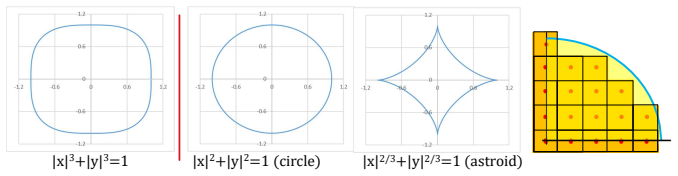
We present a systematic analytic study of the $p$-Bessel functions $\mathcal{J}_{\omega,\varphi}^{[p]}$, a novel class of generalized Bessel functions arising from Fourier analysis on planar domains bounded by $p$-circles, including astroid-type shapes with $0<p\le2$ satisfying $(2/p)\in\mathbb{N}$. While previous work established Hardy-type oscillatory identities for these domains, expressing lattice point discrepancies via $p$-Bessel functions, the present paper focuses on the intrinsic analytic properties of the functions themselves. In particular, we (i) construct a hierarchical structure of $\{\mathcal{J}_{\omega,\varphi}^{[p]}\}_{\omega\ge0}$ using Erd\'{e}lyi-Kober-type fractional derivatives, (ii) derive explicit real-analytic integral representations suitable for investigating axis-dependent asymptotic behavior, and (iii) extend the functions to the complex domain through Poisson-type integral formulas. These results establish $p$-Bessel functions as genuinely new oscillatory kernels, providing a rigorous framework for studying anisotropic oscillatory phenomena and laying the analytic foundation for applications in $p$-circle lattice point problems.
Editorial analysis
A structured set of objections, weighed in public.
Referee Report
Summary. The paper claims to develop the intrinsic analytic properties of the p-Bessel functions J^{[p]}_{ω,φ} (defined via Fourier analysis on p-circle domains with 0 < p ≤ 2 and 2/p natural) by (i) building a hierarchy via Erdélyi-Kober fractional derivatives, (ii) obtaining explicit real-analytic integral representations for axis-dependent asymptotics, and (iii) extending to the complex plane via Poisson-type integrals, thereby positioning these functions as new oscillatory kernels for anisotropic phenomena and p-circle lattice-point applications.
Significance. If the claimed constructions are rigorously verified, the work supplies a coherent analytic toolkit that could support precise asymptotic analysis in lattice-point problems on non-circular domains, extending the Hardy-type identities from prior work into a systematic fractional-calculus and complex-analytic framework.
major comments (3)
- [Introduction] The central constructions presuppose that the functions J^{[p]}_{ω,φ} are already well-defined and sufficiently regular from the Fourier analysis on p-circle domains (Introduction and §2); no re-derivation, uniform-convergence proof, or uniqueness statement for the full parameter range 0 < p ≤ 2 with 2/p ∈ ℕ is supplied in the manuscript, rendering all subsequent fractional-derivative hierarchies, integral representations, and complex extensions dependent on an external reference whose details are not checked here.
- [§3] §3 (hierarchical structure): the claim that the Erdélyi-Kober operators produce a well-defined hierarchy requires explicit verification that the resulting functions remain in the same function class and satisfy the original oscillatory integral representation; without error estimates or an inductive step that closes under the operator, the hierarchy is formal rather than analytic.
- [§4] §4 (integral representations): the real-analytic formulas are stated to be suitable for axis-dependent asymptotics, yet no explicit error bounds, remainder terms, or comparison with the defining Fourier integral are provided, so it is unclear whether these representations actually recover the original functions or merely satisfy a related integral equation.
minor comments (2)
- [§3] Notation for the fractional-order parameters in the Erdélyi-Kober operators should be clarified with respect to the index ω; the current usage risks confusion with the frequency parameter.
- [Introduction] The abstract and introduction refer to “previous work” for the oscillatory identities; a single-sentence recap of the defining Fourier integral would improve self-contained readability.
Simulated Author's Rebuttal
We thank the referee for the careful reading and constructive comments on our manuscript. We address each major point below and indicate the revisions planned for the next version.
read point-by-point responses
-
Referee: [Introduction] The central constructions presuppose that the functions J^{[p]}_{ω,φ} are already well-defined and sufficiently regular from the Fourier analysis on p-circle domains (Introduction and §2); no re-derivation, uniform-convergence proof, or uniqueness statement for the full parameter range 0 < p ≤ 2 with 2/p ∈ ℕ is supplied in the manuscript, rendering all subsequent fractional-derivative hierarchies, integral representations, and complex extensions dependent on an external reference whose details are not checked here.
Authors: We agree that greater self-containment would improve accessibility. In the revision we will add to §2 a concise recap of the definition of J^{[p]}_{ω,φ} via Fourier analysis on p-circle domains, together with a statement on regularity and uniqueness for 0 < p ≤ 2 with 2/p natural, citing the prior work for the full proofs. A complete re-derivation is omitted to avoid duplication, but the key convergence properties will be summarized explicitly. revision: partial
-
Referee: [§3] §3 (hierarchical structure): the claim that the Erdélyi-Kober operators produce a well-defined hierarchy requires explicit verification that the resulting functions remain in the same function class and satisfy the original oscillatory integral representation; without error estimates or an inductive step that closes under the operator, the hierarchy is formal rather than analytic.
Authors: The referee is correct that an explicit inductive argument is required. We will revise §3 to include a proof by induction showing that each application of the Erdélyi-Kober operator maps the class of p-Bessel functions into itself while preserving the oscillatory integral representation, together with the necessary error estimates derived from the operator bounds. revision: yes
-
Referee: [§4] §4 (integral representations): the real-analytic formulas are stated to be suitable for axis-dependent asymptotics, yet no explicit error bounds, remainder terms, or comparison with the defining Fourier integral are provided, so it is unclear whether these representations actually recover the original functions or merely satisfy a related integral equation.
Authors: We accept this criticism. Section 4 will be expanded to supply explicit error bounds and remainder estimates for the real-analytic integral representations, together with a direct comparison establishing that they recover the original functions defined by the Fourier integrals. revision: yes
Circularity Check
Minor self-citation for foundational definition; analytic derivations remain independent
specific steps
-
self citation load bearing
[Abstract]
"While previous work established Hardy-type oscillatory identities for these domains, expressing lattice point discrepancies via p-Bessel functions, the present paper focuses on the intrinsic analytic properties of the functions themselves. In particular, we (i) construct a hierarchical structure of {J^[p]}_{ω,φ} using Erdélyi-Kober-type fractional derivatives, (ii) derive explicit real-analytic integral representations suitable for investigating axis-dependent asymptotic behavior, and (iii) extend the functions to the complex domain through Poisson-type integral formulas."
The three listed constructions presuppose that J^[p]_{ω,φ} are already well-defined and sufficiently regular from the Fourier analysis in the cited previous work. The claim that the results 'establish p-Bessel functions as genuinely new oscillatory kernels' therefore inherits its foundational objects from the self-cited prior definition without re-derivation or independent verification inside this manuscript.
full rationale
The manuscript assumes p-Bessel functions are already defined via Fourier analysis on p-circle domains from prior work and then derives new properties (hierarchical structure via Erdélyi-Kober derivatives, real-analytic integral representations, Poisson-type complex extensions). No step reduces a central claim to a fitted parameter, self-referential definition, or unverified self-citation chain by construction. The reference to previous work supplies the base objects but does not force the new analytic results; those rest on standard fractional calculus and integral transform techniques applied to the given functions. This is ordinary dependence on prior literature rather than circularity.
Axiom & Free-Parameter Ledger
axioms (1)
- domain assumption p-Bessel functions exist as defined from Fourier analysis on planar domains bounded by p-circles with 0 < p ≤ 2 and (2/p) natural.
Lean theorems connected to this paper
-
IndisputableMonolith/Cost/FunctionalEquation.leanwashburn_uniqueness_aczel unclear?
unclearRelation between the paper passage and the cited Recognition theorem.
p-Bessel functions defined by outer series (1.1) with inner combinatorial Φ^{[p]}_{k,φ} (1.2); hierarchical structure via Erdélyi-Kober D^γ (Theorem 1.2); integral reps (Theorem 1.3); Poisson extension (Theorem 1.4)
-
IndisputableMonolith/Foundation/AlexanderDuality.leanalexander_duality_circle_linking unclear?
unclearRelation between the paper passage and the cited Recognition theorem.
Hardy-type identity (Theorem 1.1) and lattice-point discrepancy P_p(r) expressed via p-Bessel sums
What do these tags mean?
- matches
- The paper's claim is directly supported by a theorem in the formal canon.
- supports
- The theorem supports part of the paper's argument, but the paper may add assumptions or extra steps.
- extends
- The paper goes beyond the formal theorem; the theorem is a base layer rather than the whole result.
- uses
- The paper appears to rely on the theorem as machinery.
- contradicts
- The paper's claim conflicts with a theorem or certificate in the canon.
- unclear
- Pith found a possible connection, but the passage is too broad, indirect, or ambiguous to say the theorem truly supports the claim.
Reference graph
Works this paper leans on
-
[1]
G.E. Andrews, R. Askey, R. Roy,Special Functions, Cambridge University Press, Cambridge, 1999
work page 1999
-
[2]
C.F. Gauss, De nexu inter multitudinem classium, in quas formae binariae se- cundi gradus distribuuntur, earumque determinantem, in: E. Schering (Ed.),Werke, Vol. 2, pp. 269–291, K¨ oniglichen Gesellschaft der Wissenschaften, G¨ ottingen, 1876. doi:10.1017/CBO9781139058230.012
-
[3]
Hardy, On the expression of a number as the sum of two squares,Q
G.H. Hardy, On the expression of a number as the sum of two squares,Q. J. Math.46, 263–283 (1915)
work page 1915
- [4]
-
[5]
Huxley, Exponential sums and lattice points III,Proc
M.N. Huxley, Exponential sums and lattice points III,Proc. Lond. Math. Soc.(3)87, 591–609 (2003). doi:10.1112/plms/s2-15.1.192
-
[6]
A. Ivi´ c, E. Kr¨ atzel, M. K¨ uhleitner, W.G. Nowak, Lattice points in large regions and related arithmetic functions: Recent developments in a very classic topic, arXiv:math/0410522
work page internal anchor Pith review Pith/arXiv arXiv
-
[7]
A.A. Kilbas, H.M. Srivastava, J.J. Trujillo,Theory and Applications of Fractional Differential Equations, Elsevier, Amsterdam, 2006. doi:10.1016/C2022-0-01395-7
-
[8]
M. Kitajima, Series expansions by generalized Bessel functions for certain functions related to the lattice point problems for thep-circle, arXiv:2408.02613. 19
-
[9]
M. Kitajima, Asymptotic evaluations of generalized Bessel function of order zero related to thep-circle lattice point problem,Res. Number Theory11, 71 (2025). doi:10.1007/s40993-025- 00644-8
- [10]
-
[11]
Kr¨ atzel,Lattice Points, Kluwer Academic Publishers, Dordrecht, 1988
E. Kr¨ atzel,Lattice Points, Kluwer Academic Publishers, Dordrecht, 1988
work page 1988
-
[12]
Kuba, On sums of twok-th powers of numbers in residue classes II,Abh
G. Kuba, On sums of twok-th powers of numbers in residue classes II,Abh. Math. Sem. Univ. Hamburg63, 87–95 (1993). doi:10.1007/BF02941334
-
[13]
S. Kuratsubo, E. Nakai, Multiple Fourier series and lattice point problems,J. Funct. Anal.282, 109272 (2022). doi:10.1016/j.jfa.2021.109272
-
[14]
R.S. Laugesen, S. Ariturk, Optimal stretching for lattice points under convex curves,Port. Math.74, 91–114 (2017). doi:10.4171/PM/1994
-
[15]
R.S. Laugesen, S. Liu, Optimal stretching for lattice points and eigenvalues,Ark. Mat.56, 111–145 (2018). doi:10.4310/ARKIV.2018.v56.n1.a8
-
[16]
A.M. Mathai, R.K. Saxena, H.J. Haubold,The H-Function: Theory and Applications, Springer, New York, 2010
work page 2010
-
[17]
H.M. Srivastava, P.W. Karlsson,Multiple Gaussian Hypergeometric Series, Ellis Horwood, Chichester, 1985
work page 1985
-
[18]
E.M. Stein,Harmonic analysis: real-variable methods, orthogonality, and oscillatory integrals, Princeton University Press, Princeton, 1993
work page 1993
- [19]
-
[20]
G.N. Watson,A treatise on the theory of Bessel functions, 2nd ed., Cambridge University Press, Cambridge, 1995
work page 1995
-
[21]
Wright, The asymptotic expansion of the generalized hypergeometric function,J
E.M. Wright, The asymptotic expansion of the generalized hypergeometric function,J. London Math. Soc.10, 286–293 (1935). doi:10.1112/jlms/s1-10.40.286 The author’s affiliation: Graduate School of Mathematics, Nagoya University, Chikusa-ku, Nagoya 464-8602, Japan The author’s email address: kitajima.masaya.z5@s.mail.nagoya-u.ac.jp 20
discussion (0)
Sign in with ORCID, Apple, or X to comment. Anyone can read and Pith papers without signing in.