Recognition: no theorem link
Tracing Star Formation in Quasar Hosts via [O II] λ3727: A Kinematically Consistent Approach
Pith reviewed 2026-05-15 01:22 UTC · model grok-4.3
The pith
Kinematic decomposition shows [O II] emission in quasars is mostly from star formation.
A machine-rendered reading of the paper's core claim, the machinery that carries it, and where it could break.
Core claim
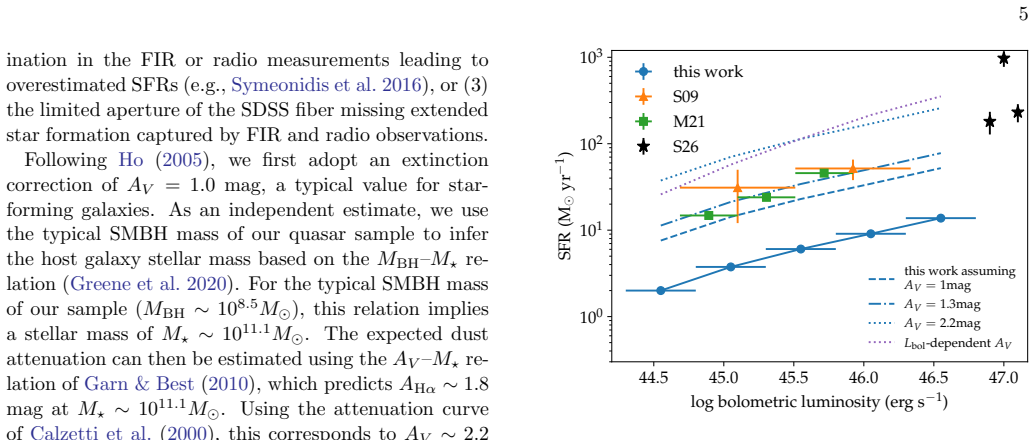
By performing a kinematically consistent decomposition of the [O II] λ3727 and [Ne V] λ3426 lines, we show that the AGN contribution to [O II] is weak, so that [O II] can be used to trace star formation rates in quasar hosts. Applying this to SDSS quasars reveals a tight correlation between mean star formation rate and bolometric luminosity, with luminosity being the dominant parameter compared to black hole mass or Eddington ratio.
What carries the argument
Kinematically consistent decomposition that assumes the AGN components of [O II] and [Ne V] share identical velocity profiles.
If this is right
- Mean star formation rate rises with quasar bolometric luminosity.
- Luminosity is the strongest single predictor of star formation rate among luminosity, black hole mass, and Eddington ratio.
- Star formation and black hole accretion are coupled through their common dependence on cold gas supply.
Where Pith is reading between the lines
- If the kinematic assumption remains valid at higher redshifts, the same subtraction could be applied to JWST or ELT spectra of distant quasars.
- Allowing the dust correction to vary with luminosity could change the reported strength of the SFR-luminosity relation.
- Cross-checks against independent star-formation indicators such as far-infrared luminosity would test whether the [O II]-derived rates are unbiased.
Load-bearing premise
The AGN-driven parts of [O II] and [Ne V] have identical kinematic profiles, and a single dust-extinction correction applies across all luminosities.
What would settle it
Finding that the velocity profiles of [Ne V] and the residual AGN component of [O II] differ significantly in a sizable sample of individual quasars would invalidate the subtraction.
Figures


read the original abstract
Measuring star formation in quasar host galaxies is crucial for understanding the coevolution of supermassive black holes (SMBHs) and galaxies, yet remains observationally challenging due to severe contamination from active galactic nucleus (AGN) emission. In this work, we present a new method to robustly isolate the AGN contribution to the [O II] $\lambda$3727 emission line in quasars, based on a kinematically consistent decomposition of [O II] and the high-ionization [Ne V] $\lambda$3426 line. We find that the [O II] emission in quasars is primarily dominated by star formation, with only a weak AGN contribution, and thus can be reliably used as a tracer of star formation in quasar hosts. Applying this technique to a large sample of Sloan Digital Sky Survey quasars, we derive mean SFRs as a function of bolometric luminosity. We find a tight correlation between mean SFR and luminosity. Further analysis, assuming a constant dust extinction correction to [O II] emission, shows that luminosity is the primary parameter most strongly associated with star formation, rather than SMBH mass or Eddington ratio. This supports the scheme in which star formation and black hole accretion are closely linked through their common dependence on the cold gas supply.
Editorial analysis
A structured set of objections, weighed in public.
Referee Report
Summary. The paper introduces a kinematically consistent decomposition method that uses the [Ne V] λ3426 line profile as a template to subtract the AGN contribution from the [O II] λ3727 line in SDSS quasar spectra. It concludes that [O II] emission is primarily dominated by star formation with only weak AGN contribution, permitting its use as a reliable SFR tracer. Applying the method yields a tight correlation between mean SFR and bolometric luminosity; under a constant dust-extinction correction, luminosity emerges as the dominant parameter over SMBH mass or Eddington ratio, supporting coevolution via shared cold-gas supply.
Significance. If the decomposition is shown to be robust, the technique supplies a practical observational tool for quantifying star formation in quasar hosts despite AGN contamination, directly addressing a long-standing obstacle in SMBH-galaxy coevolution studies. The reported SFR–L_bol relation and the ranking of luminosity as the primary driver furnish falsifiable predictions for gas-supply models. The kinematic-consistency approach is a clear methodological advance over purely empirical line-ratio methods.
major comments (2)
- [Methods (kinematic decomposition)] Methods section describing the kinematic decomposition: the central assumption that the AGN-excited [O II] velocity profile, dispersion, and non-Gaussian wings are identical to those of [Ne V] is adopted without quantitative tests or discussion of possible radial or geometric differences between the high-ionization [Ne V] zone and the lower-ionization [O II] gas that can be AGN-excited; any mismatch systematically biases the residual SF fraction and therefore the claimed “primarily star-formation dominated” result.
- [Results (SFR–L_bol analysis)] Results section on the SFR–L_bol relation and parameter ranking: the conclusion that luminosity is the primary driver (rather than M_BH or Eddington ratio) rests on a luminosity-independent constant dust-extinction correction applied to [O II]; no justification or sensitivity test for this assumption is provided, yet it directly propagates into the reported dependence and the tightness of the correlation.
minor comments (2)
- [Abstract] Abstract and §4: the phrase “tight correlation” is used without quoting a numerical coefficient, scatter, or p-value; adding these quantities would strengthen the claim.
- [Throughout] Figure captions and text: line wavelengths are sometimes written as [O II] λ3727 and sometimes without the λ symbol; consistent notation would improve readability.
Simulated Author's Rebuttal
We thank the referee for their constructive and insightful comments, which have helped clarify several aspects of our analysis. We address each major comment below and will revise the manuscript to incorporate the suggested improvements.
read point-by-point responses
-
Referee: Methods section describing the kinematic decomposition: the central assumption that the AGN-excited [O II] velocity profile, dispersion, and non-Gaussian wings are identical to those of [Ne V] is adopted without quantitative tests or discussion of possible radial or geometric differences between the high-ionization [Ne V] zone and the lower-ionization [O II] gas that can be AGN-excited; any mismatch systematically biases the residual SF fraction and therefore the claimed “primarily star-formation dominated” result.
Authors: We acknowledge the referee's concern regarding the need for explicit quantitative validation of the kinematic template assumption. The [Ne V] line is selected because its high ionization potential (97.1 eV) ensures it is excited exclusively by the AGN, providing a clean kinematic template for the narrow-line region. Our decomposition yields [O II] residuals whose luminosities correlate tightly with independent star-formation indicators and show no residual dependence on Eddington ratio, supporting the dominance of star formation. Nevertheless, we agree that additional tests are required to quantify possible biases from radial or geometric differences. In the revised manuscript we will add a new subsection presenting profile-fitting statistics across luminosity bins, Monte Carlo simulations of stratified NLR geometries, and an assessment of the resulting uncertainty in the star-formation fraction. revision: yes
-
Referee: Results section on the SFR–L_bol relation and parameter ranking: the conclusion that luminosity is the primary driver (rather than M_BH or Eddington ratio) rests on a luminosity-independent constant dust-extinction correction applied to [O II]; no justification or sensitivity test for this assumption is provided, yet it directly propagates into the reported dependence and the tightness of the correlation.
Authors: We thank the referee for highlighting the impact of the constant extinction assumption. This approximation is adopted as a first-order correction because the sample spans a narrow redshift range and individual Balmer-decrement measurements are unavailable for the majority of objects. The primary result—the tight mean SFR–L_bol correlation—is obtained prior to the parameter-ranking step and is therefore insensitive to the precise value of the correction. In the revision we will include a dedicated sensitivity analysis in which the extinction is varied by ±0.5 mag around the adopted value; we will show that the ranking of bolometric luminosity as the dominant parameter remains unchanged and will discuss the limitations of the assumption explicitly. revision: yes
Circularity Check
No circularity; kinematic decomposition rests on stated physical assumptions rather than self-referential inputs
full rationale
The paper's derivation begins with observed SDSS spectra, applies a kinematic decomposition that subtracts an AGN [O II] component scaled from the [Ne V] profile under the explicit assumption of identical velocity fields, isolates the residual as star-formation emission, and then reports mean SFR versus bolometric luminosity. This chain is driven by the external premise that the AGN contributions share kinematics and that dust correction is luminosity-independent; neither premise is fitted from the target SFR-L_bol relation nor defined in terms of the output. No equations reduce the claimed result to a renamed fit, no self-citation supplies a uniqueness theorem, and no ansatz is smuggled via prior work. The method is therefore self-contained against the input spectra and the stated assumptions.
Axiom & Free-Parameter Ledger
free parameters (1)
- constant dust extinction correction
axioms (1)
- domain assumption [Ne V] λ3426 originates exclusively from the AGN and shares the same kinematic profile as the AGN component of [O II] λ3727
Reference graph
Works this paper leans on
-
[1]
1 This result may hold primarily for massive galaxies; subsequent studies extending to lower-mass systems have found a clear stellar-mass dependence(e.g. Yang et al. 2018; Torbaniuk et al. 2024)
work page 2018
-
[2]
Alexander, D. M., & Hickox, R. C. 2012, NewAR, 56, 93, doi: 10.1016/j.newar.2011.11.003
-
[3]
Alexander, D. M., Hickox, R. C., Aird, J., et al. 2025, NewAR, 101, 101733, doi: 10.1016/j.newar.2025.101733 8
-
[4]
The Dust Content and Opacity of Actively Star-Forming Galaxies
Calzetti, D., Armus, L., Bohlin, R. C., et al. 2000, ApJ, 533, 682, doi: 10.1086/308692
work page internal anchor Pith review doi:10.1086/308692 2000
-
[5]
Chen, Z., He, Z., Ho, L. C., et al. 2022, Nature Astronomy, 6, 339, doi: 10.1038/s41550-021-01561-3 De Robertis, M. M., & Osterbrock, D. E. 1984, ApJ, 286, 171, doi: 10.1086/162585
-
[6]
Dong, X. Y., & Wu, X.-B. 2016, ApJ, 824, 70, doi: 10.3847/0004-637X/824/2/70
-
[7]
Garn, T., & Best, P. N. 2010, MNRAS, 409, 421, doi: 10.1111/j.1365-2966.2010.17321.x
-
[8]
Greene, J. E., Strader, J., & Ho, L. C. 2020, ARA&A, 58, 257, doi: 10.1146/annurev-astro-032620-021835
-
[9]
Harrison, C. M. 2017, Nature Astronomy, 1, 0165, doi: 10.1038/s41550-017-0165
-
[10]
Hickox, R. C., Mullaney, J. R., Alexander, D. M., et al. 2014, ApJ, 782, 9, doi: 10.1088/0004-637X/782/1/9
-
[11]
Ho, L. C. 2005, ApJ, 629, 680, doi: 10.1086/431643
-
[12]
Hopkins, P. F., Hernquist, L., Cox, T. J., et al. 2006, ApJS, 163, 1, doi: 10.1086/499298
work page internal anchor Pith review doi:10.1086/499298 2006
-
[13]
Kennicutt, Jr., R. C. 1998, ARA&A, 36, 189, doi: 10.1146/annurev.astro.36.1.189
work page internal anchor Pith review doi:10.1146/annurev.astro.36.1.189 1998
-
[14]
Kewley, L. J., Geller, M. J., & Jansen, R. A. 2004, AJ, 127, 2002, doi: 10.1086/382723
-
[15]
Lyke, B. W., Higley, A. N., McLane, J. N., et al. 2020, ApJS, 250, 8, doi: 10.3847/1538-4365/aba623
-
[16]
Macfarlane, C., Best, P. N., Sabater, J., et al. 2021, MNRAS, 506, 5888, doi: 10.1093/mnras/stab1998
-
[17]
2018, MNRAS, 480, 5203, doi: 10.1093/mnras/sty2201
Maddox, N. 2018, MNRAS, 480, 5203, doi: 10.1093/mnras/sty2201
-
[18]
R., Daddi, E., B´ ethermin, M., et al
Mullaney, J. R., Daddi, E., B´ ethermin, M., et al. 2012, ApJL, 753, L30, doi: 10.1088/2041-8205/753/2/L30
-
[19]
Osterbrock, D. E., & Ferland, G. J. 2006, Astrophysics of gaseous nebulae and active galactic nuclei
work page 2006
-
[20]
2014, Research in Astronomy and Astrophysics, 14, 913, doi: 10.1088/1674-4527/14/8/002
Peng, Z.-X., Chen, Y.-M., Gu, Q.-S., & Zhang, K. 2014, Research in Astronomy and Astrophysics, 14, 913, doi: 10.1088/1674-4527/14/8/002
-
[21]
Pradhan, A. K., Montenegro, M., Nahar, S. N., & Eissner, W. 2006, MNRAS, 366, L6, doi: 10.1111/j.1745-3933.2005.00119.x
-
[22]
Serjeant, S., & Hatziminaoglou, E. 2009, MNRAS, 397, 265, doi: 10.1111/j.1365-2966.2009.14431.x
-
[23]
2020, ApJ, 899, 112, doi: 10.3847/1538-4357/aba8a1
Treister, E. 2020, ApJ, 899, 112, doi: 10.3847/1538-4357/aba8a1
-
[24]
D., Lamareille, F., Maier, C., et al
Silverman, J. D., Lamareille, F., Maier, C., et al. 2009, ApJ, 696, 396, doi: 10.1088/0004-637X/696/1/396
-
[25]
D., Daddi, E., Tan, Q.-H., et al
Silverman, J. D., Daddi, E., Tan, Q.-H., et al. 2026, MNRAS, 546, stag167, doi: 10.1093/mnras/stag167
-
[26]
2022, A&A, 659, A123, doi: 10.1051/0004-6361/202040122
Singha, M., Husemann, B., Urrutia, T., et al. 2022, A&A, 659, A123, doi: 10.1051/0004-6361/202040122
-
[27]
Stanley, F., Harrison, C. M., Alexander, D. M., et al. 2015, MNRAS, 453, 591, doi: 10.1093/mnras/stv1678
-
[28]
Symeonidis, M., Giblin, B. M., Page, M. J., et al. 2016, MNRAS, 459, 257, doi: 10.1093/mnras/stw667
-
[29]
2024, MNRAS, 527, 12091, doi: 10.1093/mnras/stad3965
Torbaniuk, O., Paolillo, M., D’Abrusco, R., et al. 2024, MNRAS, 527, 12091, doi: 10.1093/mnras/stad3965
-
[30]
Tremonti, C. A., Heckman, T. M., Kauffmann, G., et al. 2004, ApJ, 613, 898, doi: 10.1086/423264
-
[31]
2006, ApJ, 650, 57, doi: 10.1086/506376 Vanden Berk, D
Tsuzuki, Y., Kawara, K., Yoshii, Y., et al. 2006, ApJ, 650, 57, doi: 10.1086/506376 Vanden Berk, D. E., Richards, G. T., Bauer, A., et al. 2001, AJ, 122, 549, doi: 10.1086/321167
-
[32]
2018, A&A, 620, A193, doi: 10.1051/0004-6361/201732495 V´ eron-Cetty, M
Vergani, D., Garilli, B., Polletta, M., et al. 2018, A&A, 620, A193, doi: 10.1051/0004-6361/201732495 V´ eron-Cetty, M. P., Joly, M., & V´ eron, P. 2004, A&A, 417, 515, doi: 10.1051/0004-6361:20035714
-
[33]
2022, ApJS, 263, 42, doi: 10.3847/1538-4365/ac9ead
Wu, Q., & Shen, Y. 2022, ApJS, 263, 42, doi: 10.3847/1538-4365/ac9ead
-
[34]
C., Zhuang, M.-Y., & Shangguan, J
Xie, Y., Ho, L. C., Zhuang, M.-Y., & Shangguan, J. 2021, ApJ, 910, 124, doi: 10.3847/1538-4357/abe404
-
[35]
Yang, G., Brandt, W. N., Vito, F., et al. 2018, MNRAS, 475, 1887, doi: 10.1093/mnras/stx2805
-
[36]
1988, Astrophysical Letters and Communications, 27, 275
Zheng, W. 1988, Astrophysical Letters and Communications, 27, 275
work page 1988
-
[37]
Zhuang, M.-Y., & Ho, L. C. 2019, ApJ, 882, 89, doi: 10.3847/1538-4357/ab340d
-
[38]
Zhuang, M.-Y., Ho, L. C., & Shangguan, J. 2021, ApJ, 906, 38, doi: 10.3847/1538-4357/abc94d
discussion (0)
Sign in with ORCID, Apple, or X to comment. Anyone can read and Pith papers without signing in.