Recognition: no theorem link
Uncertainty Quantification for Distribution-to-Distribution Flow Matching in Scientific Imaging
Pith reviewed 2026-05-15 01:07 UTC · model grok-4.3
The pith
Bayesian Stochastic Flow Matching disentangles aleatoric and epistemic uncertainty in distribution-to-distribution generative models.
A machine-rendered reading of the paper's core claim, the machinery that carries it, and where it could break.
Core claim
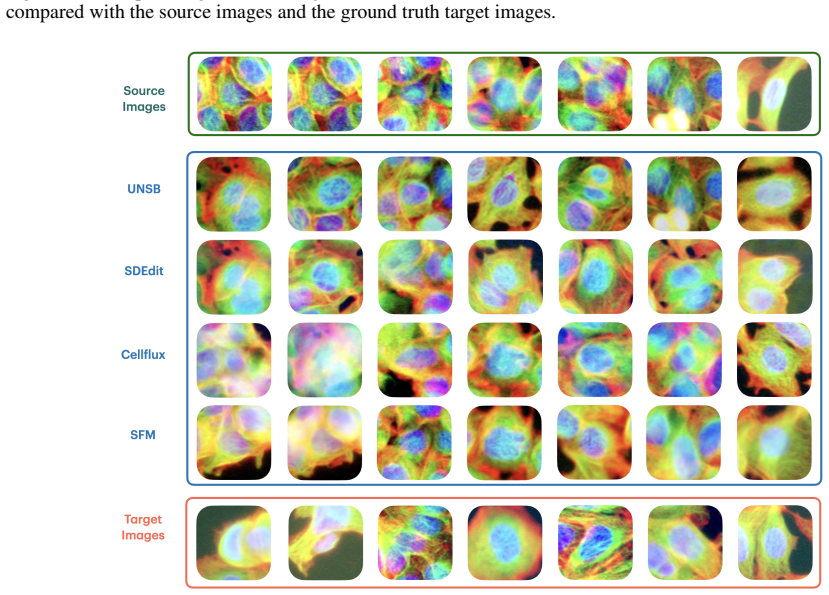
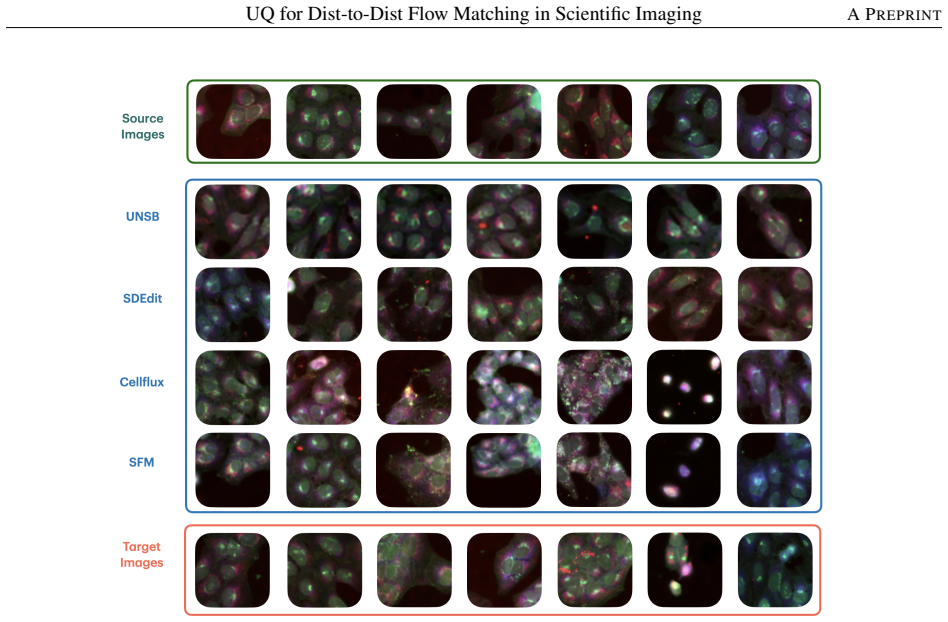
The central claim is that Stochastic Flow Matching augments deterministic flows with a diffusion term to improve generalization to unseen scenarios in distribution-to-distribution tasks, and that the MCD-Antithetic Bayesian approach yields effective anomaly scores for out-of-distribution detection while disentangling aleatoric from epistemic uncertainty. Experiments on cellular imaging datasets BBBC021 and JUMP plus brain fMRI data from the Theory of Mind task demonstrate that the stochastic component enhances reliability across conditions and that the sampling method improves accountability through better anomaly detection.
What carries the argument
Bayesian Stochastic Flow Matching (BSFM), which integrates Stochastic Flow Matching (SFM) that adds a diffusion term to deterministic flows for better generalization, together with MCD-Antithetic sampling that combines Monte Carlo dropout and antithetic sampling to generate scalable anomaly scores.
If this is right
- SFM improves reliability of generated cellular perturbation responses across varied experimental setups.
- MCD-Antithetic produces anomaly scores that enhance detection of cases where predictions may be unreliable.
- The disentangled uncertainties allow separate handling of data noise versus model limitations in medical image translation tasks.
- The framework supports accountable use of distribution-to-distribution models on fMRI data under diverse conditions.
Where Pith is reading between the lines
- The same stochastic augmentation might apply to flow matching in non-imaging domains such as molecular structure generation.
- High epistemic uncertainty regions identified by the method could guide targeted data collection to reduce model ignorance.
- Integration with existing calibration techniques could further tighten the separation between the two uncertainty types.
Load-bearing premise
The assumption that augmenting deterministic flows with a diffusion term improves generalization to new experimental conditions and that MCD-Antithetic sampling reliably produces effective anomaly scores.
What would settle it
A controlled comparison on held-out imaging data from new labs or devices showing no gain in generalization metrics for SFM or no improvement in out-of-distribution detection accuracy for MCD-Antithetic relative to standard deterministic flow matching baselines.
Figures



read the original abstract
Distribution-to-distribution generative models support scientific imaging tasks ranging from modeling cellular perturbation responses to translating medical images across conditions. Trustworthy generation requires both reliability (generalization across labs, devices, and experimental conditions) and accountability (detecting out-of-distribution cases where predictions may be unreliable). Uncertainty quantification (UQ) based approaches serve as promising candidates for these tasks, yet UQ for distribution-to-distribution generative models remains underexplored. We present a unified UQ framework, Bayesian Stochastic Flow Matching (BSFM), that disentangles aleatoric and epistemic uncertainty. The Stochastic Flow Matching (SFM) component augments deterministic flows with a diffusion term to improve model generalization to unseen scenarios. For UQ, we develop a scalable Bayesian approach -- MCD-Antithetic -- that combines Monte Carlo Dropout with sample-efficient antithetic sampling to produce effective anomaly scores for out-of-distribution detection. Experiments on cellular imaging (BBBC021, JUMP) and brain fMRI (Theory of Mind) across diverse scenarios show that SFM improves reliability while MCD-Antithetic enhances accountability.
Editorial analysis
A structured set of objections, weighed in public.
Referee Report
Summary. The paper proposes a unified uncertainty quantification framework called Bayesian Stochastic Flow Matching (BSFM) for distribution-to-distribution generative models in scientific imaging. It introduces Stochastic Flow Matching (SFM) by augmenting deterministic flow-matching with an explicit diffusion term to improve generalization to unseen scenarios, and develops MCD-Antithetic (Monte Carlo Dropout combined with antithetic sampling) to disentangle aleatoric and epistemic uncertainty while producing anomaly scores for out-of-distribution detection. Experiments on cellular imaging datasets (BBBC021, JUMP) and brain fMRI (Theory of Mind) across diverse conditions are reported to demonstrate gains in reliability and accountability.
Significance. If the central claims are substantiated, this would represent a meaningful advance in trustworthy generative modeling for scientific domains, supplying a practical method to separate uncertainty types in flow-based models and thereby supporting better generalization across labs/devices and reliable anomaly detection in high-stakes imaging tasks.
major comments (2)
- [Stochastic Flow Matching formulation (likely §3 or §4)] The manuscript asserts that augmenting the deterministic flow-matching objective with a diffusion term (SFM) leaves the learned conditional distribution unchanged in the limit while cleanly isolating an aleatoric component; however, no derivation of the modified continuity equation or proof that the added stochasticity does not bias the velocity field is provided, which is load-bearing for the disentanglement claim.
- [Experimental results (likely §5)] Experiments on BBBC021 and JUMP report aggregate improvements in reliability without an ablation that holds model capacity fixed and removes only the learned diffusion schedule; this omission prevents attribution of gains specifically to SFM rather than increased expressivity.
minor comments (2)
- [Abstract] The abstract introduces 'MCD-Antithetic' and 'BSFM' without a brief parenthetical definition or reference to the defining equations, which reduces immediate readability.
- [Methods and Experiments] Notation for the diffusion schedule and antithetic sampling variance reduction is not introduced with sufficient clarity before the experimental tables, making it difficult to interpret the reported anomaly scores.
Simulated Author's Rebuttal
We thank the referee for their insightful comments, which have helped us improve the clarity and rigor of our work. We address each major comment in detail below and outline the revisions we plan to make.
read point-by-point responses
-
Referee: [Stochastic Flow Matching formulation (likely §3 or §4)] The manuscript asserts that augmenting the deterministic flow-matching objective with a diffusion term (SFM) leaves the learned conditional distribution unchanged in the limit while cleanly isolating an aleatoric component; however, no derivation of the modified continuity equation or proof that the added stochasticity does not bias the velocity field is provided, which is load-bearing for the disentanglement claim.
Authors: We thank the referee for pointing out the need for a formal derivation. The current version of the manuscript introduces the SFM formulation in Section 3 and demonstrates its empirical benefits, but we agree that including a derivation of the modified continuity equation is essential to substantiate the claim that the conditional distribution remains unchanged in the limit and that the stochastic term isolates the aleatoric uncertainty without biasing the velocity field. In the revised manuscript, we will add this derivation, showing how the stochastic process corresponds to a Fokker-Planck equation that reduces to the deterministic flow-matching case under the appropriate scaling, thereby preserving the target distribution while allowing for explicit modeling of aleatoric noise. This will directly support the disentanglement in the BSFM framework. revision: yes
-
Referee: [Experimental results (likely §5)] Experiments on BBBC021 and JUMP report aggregate improvements in reliability without an ablation that holds model capacity fixed and removes only the learned diffusion schedule; this omission prevents attribution of gains specifically to SFM rather than increased expressivity.
Authors: We acknowledge that the experiments as presented report overall performance gains without a capacity-controlled ablation isolating the effect of the diffusion schedule. To address this, we will include an additional ablation study in the revised version. Specifically, we will train models with identical architectures and parameter counts, comparing the deterministic flow-matching baseline against the SFM variant (with the learned diffusion schedule) on the BBBC021 and JUMP datasets. This will allow us to attribute improvements specifically to the stochastic augmentation rather than general increases in model capacity or expressivity. We expect this to further validate the SFM component. revision: yes
Circularity Check
No significant circularity; claims rest on experimental results rather than self-referential definitions
full rationale
The abstract and description introduce BSFM, SFM (augmenting flows with diffusion), and MCD-Antithetic without exhibiting any equations, fitted parameters, or continuity-equation derivations that reduce the claimed disentanglement or generalization improvement to the inputs by construction. No self-citation load-bearing steps, uniqueness theorems, or ansatz smuggling are visible. The skeptic concern about missing derivations for the modified continuity equation is a correctness or completeness issue, not a circularity reduction. The paper's central claims are therefore treated as independent of any tautological fit or renaming.
Axiom & Free-Parameter Ledger
axioms (1)
- domain assumption Augmenting deterministic flow matching with a diffusion term improves generalization to unseen experimental conditions
invented entities (2)
-
Bayesian Stochastic Flow Matching (BSFM)
no independent evidence
-
MCD-Antithetic
no independent evidence
Forward citations
Cited by 1 Pith paper
-
Divergence is Uncertainty: A Closed-Form Posterior Covariance for Flow Matching
In flow matching, the uncertainty of the clean data given the current state is exactly the divergence of the velocity field (up to a known scalar).
Reference graph
Works this paper leans on
-
[1]
Lemar Abdi, Amaan Valiuddin, Francisco Caetano, Christiaan Viviers, and Fons van der Sommen. Zero-shot image anomaly detection using generative foundation models.arXiv preprint arXiv:2507.22692, 2025. 3
-
[2]
Stochastic Interpolants: A Unifying Framework for Flows and Diffusions
Michael S Albergo, Nicholas M Boffi, and Eric Vanden-Eijnden. Stochastic interpolants: A unifying framework for flows and diffusions.arXiv preprint arXiv:2303.08797, 2023. 5
work page internal anchor Pith review Pith/arXiv arXiv 2023
-
[3]
Fuat Arslan, Bilal Kabas, Onat Dalmaz, Muzaffer Ozbey, and Tolga C ¸ ukur. Self-consistent recursive diffusion bridge for medical image translation.Medical Image Analysis, 106:103747, 2025. 1, 3
work page 2025
-
[4]
Diffusion models with implicit guid- ance for medical anomaly detection
Cosmin I Bercea, Benedikt Wiestler, Daniel Rueckert, and Julia A Schnabel. Diffusion models with implicit guid- ance for medical anomaly detection. InInternational Conference on Medical Image Computing and Computer- Assisted Intervention, pages 211–220. Springer, 2024. 3
work page 2024
-
[5]
Shedding light on large generative networks: Estimating epistemic uncertainty in diffusion models
Lucas Berry, Axel Brando, and David Meger. Shedding light on large generative networks: Estimating epistemic uncertainty in diffusion models. InThe 40th Conference on Uncertainty in Artificial Intelligence, 2024. 3
work page 2024
-
[6]
Protecting scientific integrity in an age of generative ai, 2024
Wolfgang Blau, Vinton G Cerf, Juan Enriquez, Joseph S Francisco, Urs Gasser, Mary L Gray, Mark Greaves, Barbara J Grosz, Kathleen Hall Jamieson, Gerald H Haug, et al. Protecting scientific integrity in an age of generative ai, 2024. 1
work page 2024
-
[7]
Peter D Caie, Rebecca E Walls, Alexandra Ingleston-Orme, Sandeep Daya, Tom Houslay, Rob Eagle, Mark E Roberts, and Neil O Carragher. High-content phenotypic profiling of drug response signatures across distinct cancer cells.Molecular cancer therapeutics, 9(6):1913–1926, 2010. 7, 14
work page 1913
-
[8]
Matthew Chan, Maria Molina, and Chris Metzler. Estimating epistemic and aleatoric uncertainty with a single model.Advances in Neural Information Processing Systems, 37:109845–109870, 2024. 3
work page 2024
-
[9]
Srinivas Niranj Chandrasekaran, Jeanelle Ackerman, Eric Alix, D Michael Ando, John Arevalo, Melissa Ben- nion, Nicolas Boisseau, Adriana Borowa, Justin D Boyd, Laurent Brino, et al. Jump cell painting dataset: morphological impact of 136,000 chemical and genetic perturbations.BioRxiv, pages 2023–03, 2023. 7, 14
work page 2023
-
[10]
Sungik Choi, Hankook Lee, Honglak Lee, and Moontae Lee. Projection regret: Reducing background bias for novelty detection via diffusion models.Advances in Neural Information Processing Systems, 36:19230–19245,
-
[11]
Valentin De Bortoli, James Thornton, Jeremy Heng, and Arnaud Doucet. Diffusion schr ¨odinger bridge with applications to score-based generative modeling.Advances in neural information processing systems, 34:17695– 17709, 2021. 3 10 UQ for Dist-to-Dist Flow Matching in Scientific ImagingA PREPRINT
work page 2021
-
[12]
Diffusion model guided sampling with pixel-wise aleatoric uncer- tainty estimation
Michele De Vita and Vasileios Belagiannis. Diffusion model guided sampling with pixel-wise aleatoric uncer- tainty estimation. In2025 IEEE/CVF Winter Conference on Applications of Computer Vision (WACV), pages 3844–3854. IEEE, 2025. 3
work page 2025
-
[13]
Canberk Ekmekci and Mujdat Cetin. Conformalized generative bayesian imaging: An uncertainty quantification framework for computational imaging.arXiv preprint arXiv:2504.07696, 2025. 3
-
[14]
Score-based diffusion models as principled priors for inverse imaging
Berthy T Feng, Jamie Smith, Michael Rubinstein, Huiwen Chang, Katherine L Bouman, and William T Free- man. Score-based diffusion models as principled priors for inverse imaging. InProceedings of the IEEE/CVF International Conference on Computer Vision, pages 10520–10531, 2023. 3
work page 2023
-
[15]
Towards understanding and quantifying uncertainty for text-to-image generation
Gianni Franchi, Nacim Belkhir, Dat Nguyen Trong, Guoxuan Xia, and Andrea Pilzer. Towards understanding and quantifying uncertainty for text-to-image generation. InProceedings of the Computer Vision and Pattern Recognition Conference, pages 8062–8072, 2025. 3
work page 2025
-
[16]
Dropout as a bayesian approximation: Representing model uncertainty in deep learning
Yarin Gal and Zoubin Ghahramani. Dropout as a bayesian approximation: Representing model uncertainty in deep learning. Ininternational conference on machine learning, pages 1050–1059. PMLR, 2016. 6
work page 2016
-
[17]
Diffusion for out-of-distribution detection on road scenes and beyond
Silvio Galesso, Philipp Schr ¨oppel, Hssan Driss, and Thomas Brox. Diffusion for out-of-distribution detection on road scenes and beyond. InEuropean Conference on Computer Vision, pages 110–126. Springer, 2024. 3
work page 2024
-
[18]
Ruiyuan Gao, Chenchen Zhao, Lanqing Hong, and Qiang Xu. Diffguard: Semantic mismatch-guided out- of-distribution detection using pre-trained diffusion models. InProceedings of the IEEE/CVF International Conference on Computer Vision, pages 1579–1589, 2023. 3
work page 2023
-
[19]
Denoising diffusion models for out-of-distribution detection
Mark S Graham, Walter HL Pinaya, Petru-Daniel Tudosiu, Parashkev Nachev, Sebastien Ourselin, and Jorge Car- doso. Denoising diffusion models for out-of-distribution detection. InProceedings of the IEEE/CVF Conference on Computer Vision and Pattern Recognition, pages 2948–2957, 2023. 3
work page 2023
-
[20]
Unsupervised 3d out-of-distribution detection with latent diffusion models
Mark S Graham, Walter Hugo Lopez Pinaya, Paul Wright, Petru-Daniel Tudosiu, Yee H Mah, James T Teo, H Rolf J¨ager, David Werring, Parashkev Nachev, Sebastien Ourselin, et al. Unsupervised 3d out-of-distribution detection with latent diffusion models. InInternational Conference on Medical Image Computing and Computer- Assisted Intervention, pages 446–456. ...
work page 2023
-
[21]
A new monte carlo technique: antithetic variates
John Michael Hammersley and Keith William Morton. A new monte carlo technique: antithetic variates. In Mathematical proceedings of the Cambridge philosophical society, volume 52, pages 449–475. Cambridge Uni- versity Press, 1956. 6
work page 1956
-
[22]
Alvin Heng, Harold Soh, et al. Out-of-distribution detection with a single unconditional diffusion model.Ad- vances in Neural Information Processing Systems, 37:43952–43974, 2024. 3
work page 2024
-
[23]
Classifier-Free Diffusion Guidance
Jonathan Ho and Tim Salimans. Classifier-free diffusion guidance.arXiv preprint arXiv:2207.12598, 2022. 4
work page internal anchor Pith review Pith/arXiv arXiv 2022
-
[24]
Yue Huang, Chujie Gao, Siyuan Wu, Haoran Wang, Xiangqi Wang, Yujun Zhou, Yanbo Wang, Jiayi Ye, Jiawen Shi, Qihui Zhang, et al. On the trustworthiness of generative foundation models: Guideline, assessment, and perspective.arXiv preprint arXiv:2502.14296, 2025. 1
-
[25]
Generative uncertainty in diffusion models.arXiv preprint arXiv:2502.20946, 2025
Metod Jazbec, Eliot Wong-Toi, Guoxuan Xia, Dan Zhang, Eric Nalisnick, and Stephan Mandt. Generative uncertainty in diffusion models.arXiv preprint arXiv:2502.20946, 2025. 3
-
[26]
Fbnetgen: Task-aware gnn-based fmri analysis via functional brain network generation
Xuan Kan, Hejie Cui, Joshua Lukemire, Ying Guo, and Carl Yang. Fbnetgen: Task-aware gnn-based fmri analysis via functional brain network generation. InInternational conference on medical imaging with deep learning, pages 618–637. PMLR, 2022. 1, 3
work page 2022
-
[27]
Beomsu Kim, Gihyun Kwon, Kwanyoung Kim, and Jong Chul Ye. Unpaired image-to-image translation via neural schr\” odinger bridge.arXiv preprint arXiv:2305.15086, 2023. 3, 7
-
[28]
Eunwoo Kim, Un Yang, Cheol Lae Roh, and Stefano Ermon. Unsupervised anomaly detection using diffusion trend analysis for display inspection.arXiv preprint arXiv:2407.09578, 2024. 3
-
[29]
Polina Kirichenko, Pavel Izmailov, and Andrew G Wilson. Why normalizing flows fail to detect out-of- distribution data.Advances in neural information processing systems, 33:20578–20589, 2020. 8
work page 2020
-
[30]
Siqi Kou, Lei Gan, Dequan Wang, Chongxuan Li, and Zhijie Deng. Bayesdiff: Estimating pixel-wise uncertainty in diffusion via bayesian inference.arXiv preprint arXiv:2310.11142, 2023. 3, 7
-
[31]
Junbeom Kwon, Jungwoo Seo, Heehwan Wang, Taesup Moon, Shinjae Yoo, and Jiook Cha. Predicting task-related brain activity from resting-state brain dynamics with fmri transformer.Imaging Neuroscience, 3:imag a 00440, 2025. 1, 3
work page 2025
-
[32]
Yunxiang Li, Hua-Chieh Shao, Xiao Liang, Liyuan Chen, Ruiqi Li, Steve Jiang, Jing Wang, and You Zhang. Zero-shot medical image translation via frequency-guided diffusion models.IEEE transactions on medical imaging, 43(3):980–993, 2023. 1, 3 11 UQ for Dist-to-Dist Flow Matching in Scientific ImagingA PREPRINT
work page 2023
-
[33]
Jasper Linmans, Gabriel Raya, Jeroen van der Laak, and Geert Litjens. Diffusion models for out-of-distribution detection in digital pathology.Medical Image Analysis, 93:103088, 2024. 3
work page 2024
-
[34]
Flow Matching for Generative Modeling
Yaron Lipman, Ricky TQ Chen, Heli Ben-Hamu, Maximilian Nickel, and Matt Le. Flow matching for generative modeling.arXiv preprint arXiv:2210.02747, 2022. 2, 3
work page internal anchor Pith review Pith/arXiv arXiv 2022
-
[35]
Yaron Lipman, Marton Havasi, Peter Holderrieth, Neta Shaul, Matt Le, Brian Karrer, Ricky TQ Chen, David Lopez-Paz, Heli Ben-Hamu, and Itai Gat. Flow matching guide and code.arXiv preprint arXiv:2412.06264,
work page internal anchor Pith review Pith/arXiv arXiv
-
[36]
Flow Straight and Fast: Learning to Generate and Transfer Data with Rectified Flow
Xingchao Liu, Chengyue Gong, and Qiang Liu. Flow straight and fast: Learning to generate and transfer data with rectified flow.arXiv preprint arXiv:2209.03003, 2022. 4
work page internal anchor Pith review Pith/arXiv arXiv 2022
-
[37]
Unsupervised out-of-distribution detection with diffusion inpainting
Zhenzhen Liu, Jin Peng Zhou, Yufan Wang, and Kilian Q Weinberger. Unsupervised out-of-distribution detection with diffusion inpainting. InInternational Conference on Machine Learning, pages 22528–22538. PMLR, 2023. 3
work page 2023
-
[38]
Wesley J Maddox, Pavel Izmailov, Timur Garipov, Dmitry P Vetrov, and Andrew Gordon Wilson. A simple baseline for bayesian uncertainty in deep learning.Advances in neural information processing systems, 32,
-
[39]
SDEdit: Guided Image Synthesis and Editing with Stochastic Differential Equations
Chenlin Meng, Yutong He, Yang Song, Jiaming Song, Jiajun Wu, Jun-Yan Zhu, and Stefano Ermon. Sdedit: Guided image synthesis and editing with stochastic differential equations.arXiv preprint arXiv:2108.01073,
work page internal anchor Pith review Pith/arXiv arXiv
-
[40]
Alessandro Palma, Fabian J Theis, and Mohammad Lotfollahi. Predicting cell morphological responses to per- turbations using generative modeling.Nature Communications, 16(1):505, 2025. 8
work page 2025
-
[41]
Contrastive learning for unpaired image-to- image translation
Taesung Park, Alexei A Efros, Richard Zhang, and Jun-Yan Zhu. Contrastive learning for unpaired image-to- image translation. InEuropean conference on computer vision, pages 319–345. Springer, 2020. 3
work page 2020
-
[42]
Hilary Richardson, Grace Lisandrelli, Alexa Riobueno-Naylor, and Rebecca Saxe. Development of the social brain from age three to twelve years.Nature communications, 9(1):1027, 2018. 7, 15
work page 2018
-
[43]
Diffusion schr¨odinger bridge matching
Yuyang Shi, Valentin De Bortoli, Andrew Campbell, and Arnaud Doucet. Diffusion schr¨odinger bridge matching. Advances in Neural Information Processing Systems, 36:62183–62223, 2023. 3
work page 2023
-
[44]
Eigenscore: Ood detection using covariance in diffusion models.arXiv preprint arXiv:2510.07206, 2025
Shirin Shoushtari, Yi Wang, Xiao Shi, M Salman Asif, and Ulugbek S Kamilov. Eigenscore: Ood detection using covariance in diffusion models.arXiv preprint arXiv:2510.07206, 2025. 3
-
[45]
Score-Based Generative Modeling through Stochastic Differential Equations
Yang Song, Jascha Sohl-Dickstein, Diederik P Kingma, Abhishek Kumar, Stefano Ermon, and Ben Poole. Score- based generative modeling through stochastic differential equations.arXiv preprint arXiv:2011.13456, 2020. 5
work page internal anchor Pith review Pith/arXiv arXiv 2011
-
[46]
Shiye Su, Yuhui Zhang, Linqi Zhou, Rajesh Ranganath, and Serena Yeung-Levy. Three forms of stochastic injection for improved distribution-to-distribution generative modeling.arXiv preprint arXiv:2510.06634, 2025. 3
-
[47]
How to trust your diffusion model: A convex optimization approach to conformal risk control
Jacopo Teneggi, Matthew Tivnan, Web Stayman, and Jeremias Sulam. How to trust your diffusion model: A convex optimization approach to conformal risk control. InInternational Conference on Machine Learning, pages 33940–33960. PMLR, 2023. 3
work page 2023
-
[48]
Zihui Wu, Yu Sun, Yifan Chen, Bingliang Zhang, Yisong Yue, and Katherine Bouman. Principled probabilistic imaging using diffusion models as plug-and-play priors.Advances in Neural Information Processing Systems, 37:118389–118427, 2024. 3
work page 2024
-
[49]
Yutong Xie and Quanzheng Li. Measurement-conditioned denoising diffusion probabilistic model for under- sampled medical image reconstruction. InInternational Conference on Medical Image Computing and Computer-Assisted Intervention, pages 655–664. Springer, 2022. 3
work page 2022
-
[50]
Hui Zhang, Zheng Wang, Dan Zeng, Zuxuan Wu, and Yu-Gang Jiang. Diffusionad: Norm-guided one-step denoising diffusion for anomaly detection.IEEE Transactions on Pattern Analysis and Machine Intelligence,
-
[51]
Understanding failures in out-of-distribution detection with deep generative models
Lily Zhang, Mark Goldstein, and Rajesh Ranganath. Understanding failures in out-of-distribution detection with deep generative models. InInternational Conference on Machine Learning, pages 12427–12436. PMLR, 2021. 8
work page 2021
-
[52]
Cellflux: Simulating cellular morphology changes via flow matching
Yuhui Zhang, Yuchang Su, Chenyu Wang, Tianhong Li, Zoe Wefers, Jeffrey Nirschl, James Burgess, Daisy Ding, Alejandro Lozano, Emma Lundberg, et al. Cellflux: Simulating cellular morphology changes via flow matching. arXiv preprint arXiv:2502.09775, 2025. 1, 2, 3, 4, 7, 8
-
[53]
Guided flows for generative modeling and decision making.arXiv preprint arXiv:2311.13443, 2023
Qinqing Zheng, Matt Le, Neta Shaul, Yaron Lipman, Aditya Grover, and Ricky TQ Chen. Guided flows for generative modeling and decision making.arXiv preprint arXiv:2311.13443, 2023. 4 12 UQ for Dist-to-Dist Flow Matching in Scientific ImagingA PREPRINT
-
[54]
Denoising diffusion bridge models.arXiv preprint arXiv:2309.16948, 2023
Linqi Zhou, Aaron Lou, Samar Khanna, and Stefano Ermon. Denoising diffusion bridge models.arXiv preprint arXiv:2309.16948, 2023. 3
-
[55]
Unpaired image-to-image translation using cycle- consistent adversarial networks
Jun-Yan Zhu, Taesung Park, Phillip Isola, and Alexei A Efros. Unpaired image-to-image translation using cycle- consistent adversarial networks. InProceedings of the IEEE international conference on computer vision, pages 2223–2232, 2017. 3 13 UQ for Dist-to-Dist Flow Matching in Scientific ImagingA PREPRINT A Proof of Proposition 4.1 Proof.We prove that t...
work page 2017
discussion (0)
Sign in with ORCID, Apple, or X to comment. Anyone can read and Pith papers without signing in.