Dark energy and accelerating cosmological evolution in a Universe with a Weylian boundary
Pith reviewed 2026-05-15 00:55 UTC · model grok-4.3
The pith
Adding a non-metric Weylian boundary to the Einstein-Hilbert action produces effective geometric dark energy that drives late-time cosmic acceleration.
A machine-rendered reading of the paper's core claim, the machinery that carries it, and where it could break.
Core claim
Within the framework of the Einstein-Hilbert action with a Weylian boundary described by non-metric geometry, the field equations are generalized to incorporate the Weyl vector and its covariant derivatives. In a flat FLRW cosmology, these lead to modified Friedmann equations containing extra terms that function as an effective dark energy. Imposing a Barboza-Alcaniz parametrization for the dark energy equation of state allows numerical solutions that align closely with late-time observational data and the Lambda-CDM paradigm.
What carries the argument
The non-metric Weylian boundary term added to the Einstein-Hilbert action, which introduces contributions from the Weyl vector and its derivatives to produce effective dark energy.
Load-bearing premise
The boundary of the Einstein-Hilbert action admits a non-metric Weyl geometry whose vector and derivatives generate the observed dark energy effects.
What would settle it
High-precision measurements of the cosmic expansion history, such as supernova luminosity distances or baryon acoustic oscillation scales, that deviate significantly from the numerical solutions of the generalized Friedmann equations would disprove the model's viability.
Figures
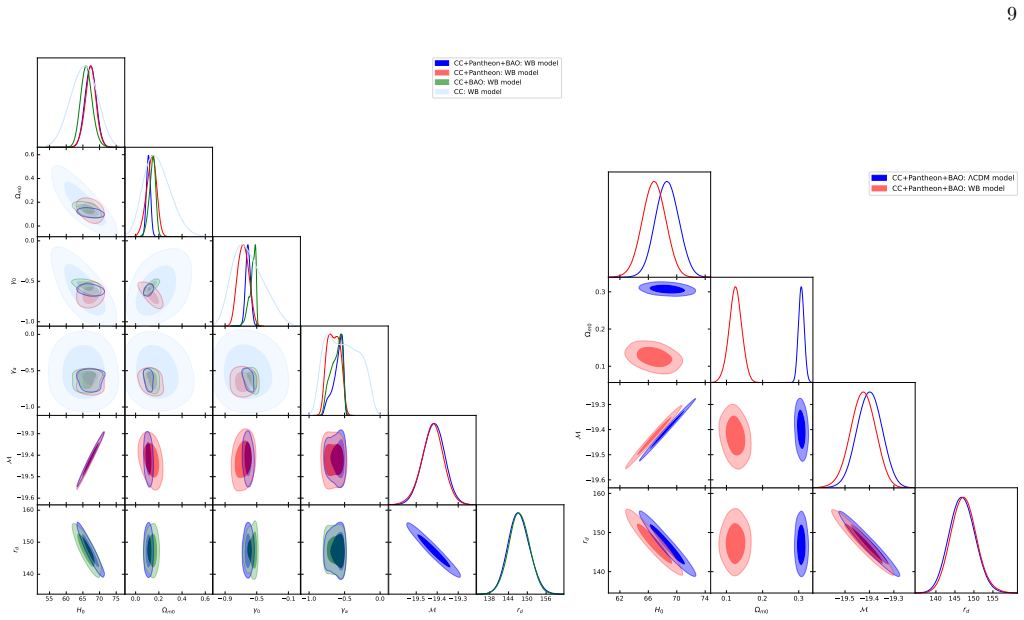


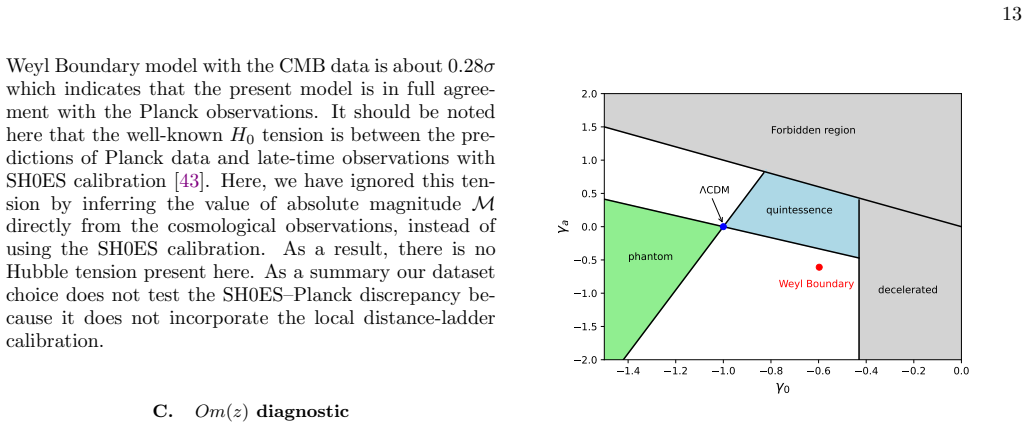
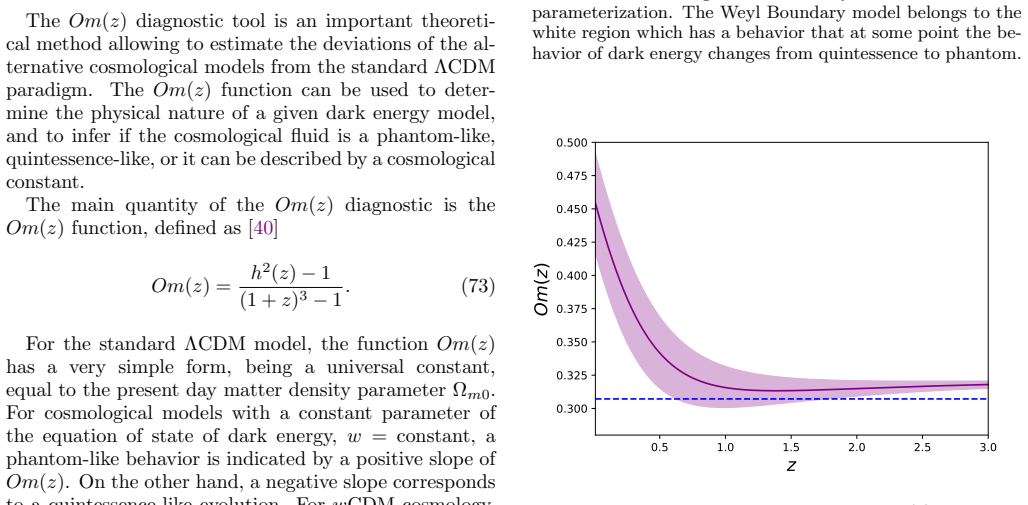
read the original abstract
We investigate the influence of boundary terms in gravitational field theories, by considering that in the Einstein-Hilbert action the boundary can be described by a non-metric Weyl-type geometry. The gravitational action and the the field equations, are thus generalized to include new geometrical terms, coming from the non-metric nature of the boundary, and depending on the Weyl vector, and its covariant derivatives. The field equations obtained within this framework generalize the standard Einstein equations by including in their mathematical structure the Weyl vector, and its covariant derivatives. As an applications of the general formalism we investigate the cosmological evolution in a flat FLRW geometry. We obtain the generalized Friedmann equations, which contain extra terms depending on the Weyl vector and its derivatives, arising due to the presence of the Weylian boundary, and which describe an effective, time dependent dark energy. By imposing to the dark energy an equation of state parameter of the Barboza-Alcaniz type, the Friedmann equations can be solved numerically. We compare the predictions of the Weylian boundary gravitational theory with late-time observational data and the predictions of the $\Lambda$CDM paradigm. Our results show that the Weylian boundary cosmological models give a good description of the observational data, and they can reproduce almost exactly the predictions of the $\Lambda$CDM paradigm. Hence, the extension of gravitational theories through the addition of Weylian boundary terms, in which dark energy has a purely geometric origin, emerges as a viable alternative to standard general relativity.
Editorial analysis
A structured set of objections, weighed in public.
Referee Report
Summary. The manuscript proposes generalizing the Einstein-Hilbert action by modeling its boundary with a non-metric Weyl-type geometry. This introduces additional geometric terms depending on the Weyl vector and its covariant derivatives into the field equations. For a flat FLRW cosmology the resulting generalized Friedmann equations contain extra contributions that are interpreted as an effective, time-dependent dark energy. By imposing a Barboza-Alcaniz parametrization on the dark-energy equation of state, the equations are solved numerically and shown to fit late-time observational data while reproducing the predictions of the LambdaCDM model to high accuracy.
Significance. If the central derivation can be completed without external parametrization, the work would supply a concrete geometric mechanism for late-time acceleration that originates entirely from boundary modifications rather than an added cosmological constant or scalar field. The numerical comparison with data and the close match to LambdaCDM already demonstrate phenomenological viability; explicit credit is due for the reproducible numerical solutions and direct data confrontation.
major comments (1)
- [Abstract and cosmological applications] Abstract and the section deriving the cosmological equations: the effective dark energy is introduced by imposing a Barboza-Alcaniz equation-of-state parametrization to permit numerical integration, rather than being derived from the evolution of the Weyl vector and its derivatives that appear in the generalized Friedmann equations. Because this step is not shown to follow from the boundary-modified field equations, the claim that dark energy has a purely geometric origin remains unestablished.
Simulated Author's Rebuttal
We thank the referee for the careful reading of our manuscript and the constructive feedback. We address the single major comment below and have made partial revisions to improve clarity on the role of the parametrization while preserving the geometric derivation of the effective dark energy terms.
read point-by-point responses
-
Referee: [Abstract and cosmological applications] Abstract and the section deriving the cosmological equations: the effective dark energy is introduced by imposing a Barboza-Alcaniz equation-of-state parametrization to permit numerical integration, rather than being derived from the evolution of the Weyl vector and its derivatives that appear in the generalized Friedmann equations. Because this step is not shown to follow from the boundary-modified field equations, the claim that dark energy has a purely geometric origin remains unestablished.
Authors: We agree that the Barboza-Alcaniz parametrization is imposed to enable numerical integration and data comparison rather than being obtained by solving a closed dynamical system for the Weyl vector. The generalized Friedmann equations themselves are derived directly from the boundary-modified action and contain extra geometric contributions proportional to the Weyl vector and its covariant derivatives; these contributions are interpreted as the effective dark energy. The parametrization is adopted as a standard phenomenological ansatz for the equation-of-state evolution of this effective component, allowing us to confront the model with observations in the same manner used in many other modified-gravity cosmologies. In the revised manuscript we have added an explicit statement in the abstract and in the cosmological section clarifying that the parametrization is an effective description of the geometric terms, and we have included a short discussion of possible future routes to deriving the Weyl-vector dynamics from the field equations without external input. This addresses the concern without changing the central claim that the extra terms originate geometrically from the Weylian boundary. revision: partial
Circularity Check
Imposition of Barboza-Alcaniz parametrization on effective DE rather than derivation from Weyl vector
specific steps
-
fitted input called prediction
[Abstract]
"By imposing to the dark energy an equation of state parameter of the Barboza-Alcaniz type, the Friedmann equations can be solved numerically. We compare the predictions of the Weylian boundary gravitational theory with late-time observational data and the predictions of the ΛCDM paradigm."
The generalized Friedmann equations are stated to contain extra terms from the Weyl vector that describe an effective dark energy. Imposing the Barboza-Alcaniz parametrization on that effective dark energy supplies the functional form needed for numerical solution and data comparison; the resulting agreement with observations is therefore forced by the externally chosen parametrization rather than derived from the boundary geometry.
full rationale
The paper derives generalized Friedmann equations containing extra Weyl-vector terms that are presented as an effective, time-dependent dark energy of purely geometric origin. However, to obtain numerical solutions and compare with data, the equation-of-state parameter of this effective dark energy is externally imposed to be of Barboza-Alcaniz form. This step is not shown to follow from the dynamics of the Weyl vector or the boundary-modified field equations; the subsequent numerical match to observations and to ΛCDM is therefore a direct consequence of the imposed parametrization rather than an independent prediction of the geometric model. The central claim that the Weylian boundary supplies a viable geometric alternative therefore reduces to a fitted functional form.
Axiom & Free-Parameter Ledger
free parameters (2)
- Weyl-vector amplitude and derivative scales
- Barboza-Alcaniz equation-of-state parameters
axioms (2)
- domain assumption The boundary contribution to the Einstein-Hilbert action admits a non-metric Weyl geometry
- standard math Cosmological spacetime is described by flat FLRW geometry
invented entities (1)
-
Weyl vector arising from the boundary
no independent evidence
Reference graph
Works this paper leans on
- [1]
-
[2]
The cosmographic parameters 8
-
[3]
Dark energy and accelerating cosmological evolution in a Universe with a Weylian boundary
Matter and dark energy density parameters 10 C.Om(z) diagnostic 13 V. Conclusions and final remarks 14 VI. Acknowledgments 14 References 14 ∗ tiberiu.harko@aira.astro.ro † s.shahidi@du.ac.ir I. INTRODUCTION A long standing problem in general relativity is the boundary value problem of the Einstein-Hilbert varia- tional principle. The problem is related to...
work page internal anchor Pith review Pith/arXiv arXiv 2026
-
[4]
obs” are the observational values “th
Dimensionless representation Now, let us perform the following transformation to a set of dimensionless variables (τ,¯ρ,¯ω0) τ=H 0t, H=H 0h,¯ρ m = κ2ρm 3H2 0 , ω 0 =H 0¯ω0, (47) and then transform to the redshift coordinatez, defined as 1 +z= 1 a .(48) Since the Weyl vector comes from the boundary, there is no equation of motion for it. In this paper, in ...
-
[5]
The cosmographic parameters The concordance between the theoretical predictions of the Weyl boundary cosmological model and the obser- vations can also be further investigated by considering higher order derivatives of the Hubble parameter. The cosmographic parameters are important (theoretically) observational quantities that can help in discriminating b...
-
[6]
The matter density parameter.In Fig
Matter and dark energy density parameters a. The matter density parameter.In Fig. 5 we have plotted the behavior the matter density parameters Ωm = ¯ρm/h2 andω 1 as functions of the redshiftz. As one can see from these Figures, although the matter is not conserved in this model, the behavior is not very dif- ferent from the ΛCDM case, represented by the d...
work page 2018
-
[7]
With our definitions, positive result favors Weyl Boundary while negative re- sult favors ΛCDM model
in which|lnB WΛ |<1 indicated inconclusive ev- idence, 1<|lnB WΛ |<2.5 indicated weak evidence, 2.5<|lnB WΛ |<5 corresponds to moderate evidence and|lnB WΛ |>5 indicates moderate evidence in favor of the model with higher evidence. With our definitions, positive result favors Weyl Boundary while negative re- sult favors ΛCDM model. In Table III we have su...
work page 2018
-
[8]
G. W. Gibbons and S. W. Hawking, Phys. Rev. D15, 2752 (1977)
work page 1977
-
[9]
J. W. York, Foundations of Physics16, pages 249 (1986)
work page 1986
-
[10]
C. G. Boehmer and E. Jensko, Phys. Rev. D104, 024010 (2021)
work page 2021
-
[11]
C. G. Boehmer and E. Jensko, J. Math. Phys.64, 082505 (2023)
work page 2023
-
[12]
C. G. Boehmer and A. d’Alfonso del Sordo, General Rel- ativity and Gravitation56, 75 (2024)
work page 2024
-
[13]
J. S. Ridao, M. Bellini, Astrophys. Space Sci.357, 94 (2015)
work page 2015
-
[14]
J. S. Ridao, M. Bellini, Phys. Lett. B751, 565 (2015)
work page 2015
-
[15]
R. Hernandez-Jimenez, C. Moreno, M. Bellini, C. Ortiz, Phys. Dark Univ.38, 101137 (2022)
work page 2022
-
[16]
J. M. Nester and H.-J. Yo, Chin. J. Phys.37, 113 (1999)
work page 1999
-
[17]
J. Beltran Jimenez, L. Heisenberg, and T. S. Koivisto, JCAP08, 039 (2018). 15
work page 2018
-
[18]
J. Beltran Jimenez, L. Heisenberg, and T. Koivisto, Phys. Rev. D 98, 044048 (2018)
work page 2018
- [19]
- [20]
-
[21]
S. D. Sadatian and S. M. R. Hosseini, Physics of the Dark Universe47, 101737 (2025)
work page 2025
-
[22]
Paliathanasis, New Astronomy120, 102426 (2025)
A. Paliathanasis, New Astronomy120, 102426 (2025)
work page 2025
-
[23]
G. Murtaza, A. De, T.-H. Loo, Y. K. Goh, and H. H. Liew, Annals of Physics480, 170086 (2025)
work page 2025
-
[24]
S. R. Bhoyar and Y. B. Ingole, New Astronomy118, 102386 (2025)
work page 2025
-
[25]
A. Samaddar, and S. S. Surendra, Journal of High Energy Astrophysics48, 100404 (2025)
work page 2025
-
[26]
Shaily, J. K. Singh, M. Tyagi, and J. R. L. Santos, Physics of the Dark Universe48, 101946 (2025)
work page 2025
-
[27]
A. Samaddar and S. S. Singh, Physics of the Dark Uni- verse47, 101792 (2025)
work page 2025
-
[28]
S. Capozzielloa, V. De Falco and C. Ferrara, Eur. Phys. J. C83, 915 (2023)
work page 2023
-
[29]
S. A. Kadam, N. P. Thakkar, and B. Mishra, Eur. Phys. J. C83, 809 (2023)
work page 2023
-
[30]
Paliathanasis, Physics of the Dark Universe43, 101388 (2024)
A. Paliathanasis, Physics of the Dark Universe43, 101388 (2024)
work page 2024
-
[31]
S. V. Lohakare and B. Mishra, The Astrophysical Journal 978, 26 (2025)
work page 2025
-
[32]
T. M. Matei and T. Harko, Physics of the Dark Universe 46, 101578 (2024)
work page 2024
-
[33]
L. D. Landau and E. M. Lifshitz, The Classical Theory of Fields, Butterworth-Heinemann, Oxford, 1999
work page 1999
-
[34]
H. Weyl, Sitzungsberichte der K¨ oniglich Preussischen Akademie der Wissenschaften zu Berlin, 465 (1918)
work page 1918
-
[35]
D. M. Ghilencea, Eur. Phys. J. C83, 176 (2023)
work page 2023
-
[36]
D. M. Ghilencea, The European Physical Journal C83, 176 (2023)
work page 2023
-
[37]
C. Condeescu, D. M. Ghilencea, and A. Micu, European Physical Journal C84, 292 (2024)
work page 2024
-
[38]
D. M. Ghilencea, Physical Review D111, 085019 (2025)
work page 2025
- [39]
-
[40]
C. Romero, J.B. Fonseca-Neto, and M. L. Pucheu, Class. Quantum Grav.29, 155015 (2012)
work page 2012
-
[41]
E. M. Barboza Jr. and J. S. Alcaniz, Phys. Lett. B 666, 415 (2008)
work page 2008
- [42]
- [43]
- [44]
-
[45]
DESI DR2 Results II: Measurements of Baryon Acoustic Oscillations and Cosmological Constraints
DESI Collaboration: M. Abdul-Karim, et. al, arXiv:2503.14738 [astro-ph.CO]
work page internal anchor Pith review Pith/arXiv arXiv
-
[46]
F. Y. Wang, Z. G. Dai, and S. Qi, A& A507, 53 (2009)
work page 2009
- [47]
-
[48]
H. Jeffreys, “The theory of probability”, Oxford Univer- sity Press 1961
work page 1961
-
[49]
N. Aghanim et al. (Planck Collaboration), Astron. As- trophys. 641 (2020) A6
work page 2020
-
[50]
A. G. Riess et al. (SH0ES Collaboration), Astrophys. J. Lett. 934 (2022) L7
work page 2022
discussion (0)
Sign in with ORCID, Apple, or X to comment. Anyone can read and Pith papers without signing in.