Performance Analysis of Tri-Sector Reflector Antennas for HAPS-Based Cellular Networks
Pith reviewed 2026-05-15 00:55 UTC · model grok-4.3
The pith
Tri-sector reflector antennas on HAPS platforms are mainly limited by inter-cell interference, with configuration and altitude as key design parameters.
A machine-rendered reading of the paper's core claim, the machinery that carries it, and where it could break.
Core claim
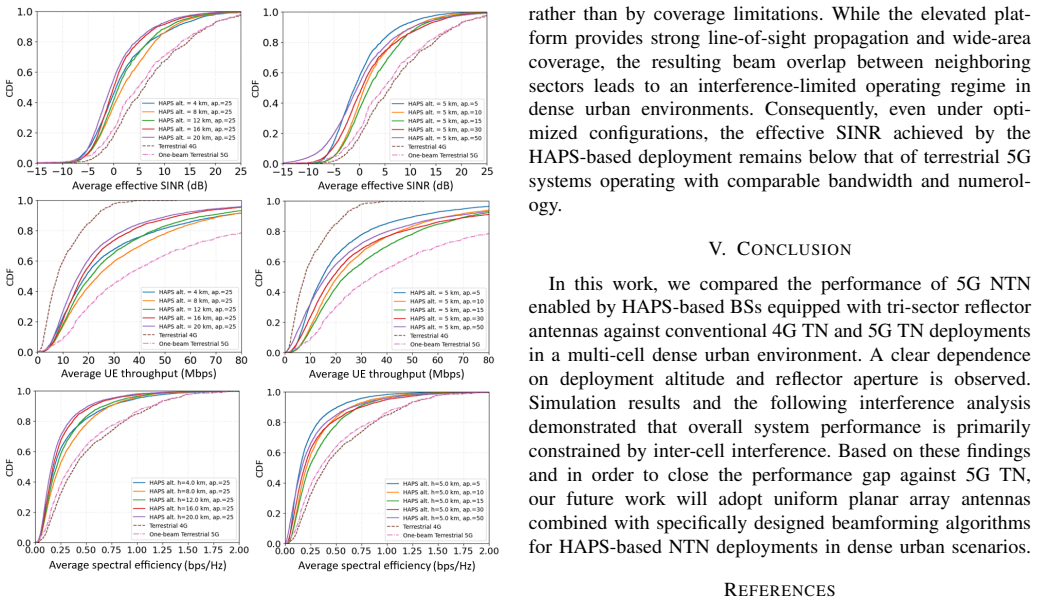
Using simulation results for average effective downlink SINR and average user throughput, together with interference analysis, the paper demonstrates that the reflector-based HAPS architecture is primarily constrained by inter-cell interference, while the combination of reflector configuration and deployment altitude represents a key design parameter.
What carries the argument
Tri-sectoral reflector antenna configuration on HAPS base stations, which shapes sector coverage and controls the spatial distribution of interference in multicell deployments.
If this is right
- Inter-cell interference must be addressed explicitly when deploying reflector-equipped HAPS base stations.
- Joint optimization of reflector geometry and platform altitude directly affects achievable SINR and throughput.
- HAPS performance in dense urban areas deviates from terrestrial network behavior primarily due to interference patterns.
- Design choices for reflectors and altitude offer concrete levers to improve effective downlink performance.
Where Pith is reading between the lines
- Dynamic altitude adjustment during operation could further reduce interference beyond static configurations.
- The interference-limited regime may favor frequency reuse patterns or coordination techniques tailored to aerial platforms.
- Similar reflector-based designs could be tested on lower-altitude platforms such as UAVs for localized coverage.
Load-bearing premise
The simulation models for propagation, user distribution, and antenna patterns in a dense urban multicell environment accurately capture real-world conditions and interference statistics.
What would settle it
Direct field measurements of downlink SINR and throughput from a real HAPS reflector deployment at multiple altitudes in dense urban terrain would falsify the central claim if they show inter-cell interference is not the dominant limit or if reflector configuration and altitude produce negligible changes.
Figures


read the original abstract
The increasing demand for ubiquitous, highcapacity mobile connectivity has driven cellular systems to explore beyond-terrestrial deployments. In this paper, we present a system-level performance evaluation of fifth-generation (5G) non-terrestrial network (NTN) enabled by high-altitude platform station (HAPS)-based base stations (BSs) equipped with tri-sectoral reflector antennas against fourth-generation (4G) terrestrial network (TN) and 5G TN deployments in a multicell dense urban environment. Using the simulation results comprising the average effective downlink signal-to-interference-plus-noise ratio (SINR) and the average user throughput, along with the subsequent interference analysis, we demonstrate that the reflector-based HAPS architecture is primarily constrained by inter-cell interference, while the combination of reflector configuration and deployment altitude represents a key design parameter.
Editorial analysis
A structured set of objections, weighed in public.
Referee Report
Summary. The manuscript presents a system-level simulation study of 5G NTN deployments using HAPS equipped with tri-sector reflector antennas in a multicell dense urban environment. It compares average effective downlink SINR and user throughput against 4G TN and 5G TN baselines and concludes that the reflector-based HAPS architecture is primarily constrained by inter-cell interference, with reflector configuration and deployment altitude serving as the key design parameters.
Significance. If the underlying propagation, antenna, and user-distribution models prove representative, the work supplies concrete guidance on interference management and altitude/reflector trade-offs for HAPS-based cellular systems, an area of growing practical interest for NTN coverage extension.
major comments (2)
- [Simulation Setup] Simulation Setup (presumed section describing propagation and antenna models): the interference-dominance conclusion rests on specific choices for path-loss exponents, shadowing variance, user spatial distribution, and tri-sector reflector patterns, yet the manuscript provides neither comparison to 3GPP NTN channel models nor any sensitivity sweeps over plausible parameter ranges; without these, the headline finding cannot be considered robust.
- [Results] Results section (SINR and throughput plots): reported averages lack error bars, confidence intervals, or Monte-Carlo repetition counts, so it is impossible to judge whether the observed inter-cell interference dominance is statistically distinguishable from noise or intra-cell effects under the chosen modeling assumptions.
minor comments (1)
- [Abstract] Abstract: the phrase 'subsequent interference analysis' is not linked to any explicit quantitative metric beyond the already-mentioned SINR and throughput figures.
Simulated Author's Rebuttal
We thank the referee for the insightful comments on our manuscript. We address each major comment below and indicate the revisions we will make to improve the robustness and clarity of our results.
read point-by-point responses
-
Referee: [Simulation Setup] Simulation Setup (presumed section describing propagation and antenna models): the interference-dominance conclusion rests on specific choices for path-loss exponents, shadowing variance, user spatial distribution, and tri-sector reflector patterns, yet the manuscript provides neither comparison to 3GPP NTN channel models nor any sensitivity sweeps over plausible parameter ranges; without these, the headline finding cannot be considered robust.
Authors: Our simulation setup employs a standard dense urban path-loss model with parameters tuned for HAPS altitudes, as described in Section III-A. We agree that additional validation against 3GPP NTN channel models would enhance robustness. In the revised manuscript, we will add a comparison to the 3GPP NTN models and include sensitivity sweeps over path-loss exponents and shadowing variances to show the persistence of inter-cell interference dominance. revision: yes
-
Referee: [Results] Results section (SINR and throughput plots): reported averages lack error bars, confidence intervals, or Monte-Carlo repetition counts, so it is impossible to judge whether the observed inter-cell interference dominance is statistically distinguishable from noise or intra-cell effects under the chosen modeling assumptions.
Authors: We appreciate this observation. In the revised version, we will report the number of Monte-Carlo repetitions performed for each result and add error bars to the SINR and throughput plots to indicate the statistical variability and confidence intervals. revision: yes
Circularity Check
No circularity in simulation-based interference analysis
full rationale
The paper derives its central claim—that the reflector-based HAPS architecture is primarily constrained by inter-cell interference and that reflector configuration plus altitude is a key design parameter—directly from system-level simulation outputs of average effective downlink SINR and user throughput. No step in the presented chain reduces by construction to a fitted parameter, self-definition, or load-bearing self-citation; the interference-dominance conclusion follows from comparing simulated signal, interference, and noise components under the chosen models. The derivation remains self-contained against the external simulation assumptions and does not invoke uniqueness theorems or ansatzes that loop back to the target result.
Axiom & Free-Parameter Ledger
Lean theorems connected to this paper
-
IndisputableMonolith/Cost/FunctionalEquation.leanwashburn_uniqueness_aczel unclear?
unclearRelation between the paper passage and the cited Recognition theorem.
Using the simulation results comprising the average effective downlink signal-to-interference-plus-noise ratio (SINR) and the average user throughput, along with the subsequent interference analysis, we demonstrate that the reflector-based HAPS architecture is primarily constrained by inter-cell interference
-
IndisputableMonolith/Foundation/DimensionForcing.leanalexander_duality_circle_linking unclear?
unclearRelation between the paper passage and the cited Recognition theorem.
the combination of reflector configuration and deployment altitude represents a key design parameter
What do these tags mean?
- matches
- The paper's claim is directly supported by a theorem in the formal canon.
- supports
- The theorem supports part of the paper's argument, but the paper may add assumptions or extra steps.
- extends
- The paper goes beyond the formal theorem; the theorem is a base layer rather than the whole result.
- uses
- The paper appears to rely on the theorem as machinery.
- contradicts
- The paper's claim conflicts with a theorem or certificate in the canon.
- unclear
- Pith found a possible connection, but the passage is too broad, indirect, or ambiguous to say the theorem truly supports the claim.
Reference graph
Works this paper leans on
-
[1]
Bridging earth and space: A survey on haps for non-terrestrial networks,
G. Svistunov, A. Akhtarshenas, D. L ´opez-P´erez, M. Giordani, G. Geraci, and H. Yanikomeroglu, “Bridging earth and space: A survey on haps for non-terrestrial networks,”arXiv:2510.19731, 2025
work page internal anchor Pith review arXiv 2025
-
[2]
Technical Specification Group Radio Access Network; Study on New Radio (NR) to support non-terrestrial networks, 3GPP TR38.811, Sept
-
[3]
Ericsson Mobility Report, November 2025,
Ericsson, “Ericsson Mobility Report, November 2025,” Nov. 2025. https://www.ericsson.com/en/reports-and-papers/mobility-report/ reports/november-2025 Accessed: 29-Jan-2026
work page 2025
-
[4]
Haps for 6g: Expanding the connectivity landscape,
HAPS Alliance, “Haps for 6g: Expanding the connectivity landscape,” tech. rep., HAPS Alliance, Mar. 2026. White paper; accessed: 13-Apr- 2026
work page 2026
-
[5]
Multi-HAPS network implementation within 3GPP’s NTN framework for 5G and beyond,
O. Anicho, P. Charlesworth, G. Baicher, and A. Nagar, “Multi-HAPS network implementation within 3GPP’s NTN framework for 5G and beyond,”IJICTA, vol. 7, no. 1, pp. 7–12, 2021
work page 2021
-
[6]
High altitude platform stations (HAPS): Architecture and system performance,
Y . Xing, F. Hsieh, A. Ghosh, and T. S. Rappaport, “High altitude platform stations (HAPS): Architecture and system performance,” in Proc. IEEE Veh. Tech. Conference (VTC), pp. 1–6, June 2021
work page 2021
-
[7]
Performance analysis of multiple high altitude platform stations cellular network coverage,
J. Lee, T.-Y . Kim, and J.-H. Kim, “Performance analysis of multiple high altitude platform stations cellular network coverage,” inProc. IEEE Int. Conf. on Inf. and Comm. Tech. Conv. (ICTC), pp. 1242–1244, Oct. 2023
work page 2023
-
[8]
Interference coordination method for integrated HAPS-terrestrial networks,
W. Liu, X. Hou, L. Chen, Y . Hokazono, and J. Zhao, “Interference coordination method for integrated HAPS-terrestrial networks,” inProc. IEEE Veh. Tech. Conference (VTC), pp. 1–6, June 2022
work page 2022
-
[9]
A. A. Shamsabadi, A. Yadav, and H. Yanikomeroglu, “Enhancing next-generation urban connectivity: Is the integrated HAPS-terrestrial network a solution?,”IEEE Commun. Lett., vol. 28, pp. 1112–1116, Feb. 2024
work page 2024
-
[10]
System design of gigabit HAPS mobile communications,
Y . Shibata, N. Kanazawa, M. Konishi, K. Hoshino, Y . Ohta, and A. Nagate, “System design of gigabit HAPS mobile communications,” IEEE Access, vol. 8, pp. 157995–158007, Aug. 2020
work page 2020
-
[11]
Y . Shibata, W. Takabatake, K. Hoshino, A. Nagate, and T. Ohtsuki, “Haps cell design method for coverage extension considering coexis- tence on terrestrial mobile networks,”IEEE Access, vol. 12, pp. 55506– 55520, 2024
work page 2024
-
[12]
Study on channel model for frequencies from 0.5 to 100 GHz, 3GPP TR38.901, Mar. 2024. v.18.0
work page 2024
-
[13]
ITU-R, “Propagation data and prediction methods required for the design of earth-space telecommunication systems,” Recommendation P.618-14, International Telecommunication Union, December 2021
work page 2021
-
[14]
A geometry-based modelling approach for the line-of-sight probability in UA V communications,
A. Saboor, E. Vinogradov, Z. Cui, A. Al-Hourani, and S. Pollin, “A geometry-based modelling approach for the line-of-sight probability in UA V communications,”IEEE O.J. on Commun., vol. 5, pp. 364–378, Dec. 2024
work page 2024
-
[15]
ITU-R, “Propagation data and prediction methods required for the design of terrestrial broadband radio access systems operating in a frequency range from 3 ghz to 60 GHz,” Recommendation P.1410-6, International Telecommunication Union, Aug 2023
work page 2023
discussion (0)
Sign in with ORCID, Apple, or X to comment. Anyone can read and Pith papers without signing in.