Boundary Floquet Control of Bulk non-Hermitian Systems
Pith reviewed 2026-05-15 00:27 UTC · model grok-4.3
The pith
Arbitrarily weak boundary Floquet driving reconstructs bulk quasienergy spectra and dynamics in non-Hermitian systems with skin effect.
A machine-rendered reading of the paper's core claim, the machinery that carries it, and where it could break.
Core claim
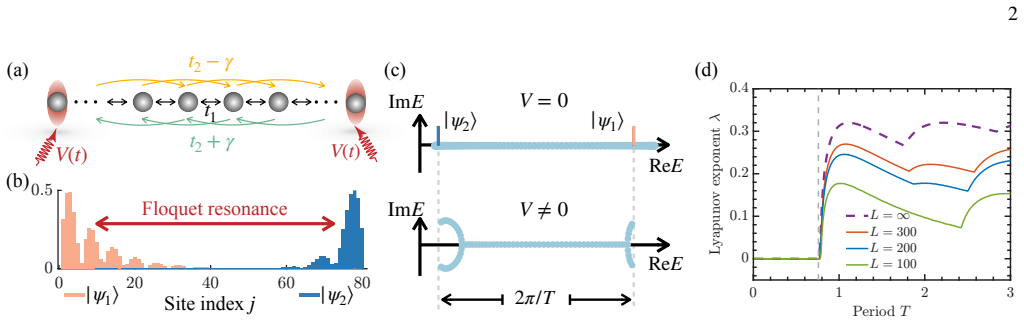
Boundary perturbations are generally irrelevant for bulk properties in the thermodynamic limit, as they are edge-confined and subextensive. In boundary-driven systems that exhibit the non-Hermitian skin effect, however, arbitrarily weak boundary Floquet driving reconstructs bulk quasienergy spectra and dynamics. A Floquet non-Bloch band theory is developed that extends generalized Brillouin-zone methods to boundary-driven systems at arbitrary driving frequencies, overcoming the absence of a general framework beyond high-frequency approximations. In representative models the driving frequency tunes non-Bloch parity-time symmetry breaking while its amplitude serves as a finite-size control.
What carries the argument
Floquet non-Bloch band theory, which adapts the generalized Brillouin zone to boundary-driven Floquet systems at arbitrary frequencies to capture skin-effect-induced reconstruction of bulk spectra.
If this is right
- Bulk quasienergy spectra and dynamics become tunable solely through boundary parameters.
- Driving frequency directly controls the onset of non-Bloch parity-time symmetry breaking.
- Driving amplitude functions as an effective finite-size parameter for the system.
- Boundary Floquet control supplies a general method for manipulating bulk properties in driven open systems.
Where Pith is reading between the lines
- The same boundary-control principle may extend to other non-Hermitian transport phenomena such as exceptional-point dynamics.
- Experimental setups could use weak periodic edge fields to steer large-scale skin modes without direct bulk access.
- Higher-dimensional or interacting generalizations could uncover additional frequency-dependent control knobs.
- The approach contrasts with conventional Hermitian Floquet engineering by relying on skin-effect localization rather than resonant bulk driving.
Load-bearing premise
The non-Hermitian skin effect must be present and the Floquet non-Bloch band theory must remain valid at arbitrary frequencies without high-frequency approximations.
What would settle it
Apply weak boundary Floquet driving to a non-Hermitian lattice known to possess skin effect and measure whether the bulk quasienergy spectrum matches the predicted reconstruction; the same drive applied to a Hermitian lattice should leave the bulk spectrum unchanged.
Figures


read the original abstract
Boundary perturbations are generally irrelevant for bulk properties in the thermodynamic limit, as they are edge-confined and subextensive. We show that this expectation breaks down in boundary-driven systems exhibiting the non-Hermitian skin effect, where arbitrarily weak boundary Floquet driving reconstructs bulk quasienergy spectra and dynamics. We develop a Floquet non-Bloch band theory that extends generalized Brillouin-zone methods to boundary-driven systems at arbitrary driving frequencies, overcoming the lack of a general framework beyond high-frequency approximations. With representative single- and two-band models, we demonstrate that the boundary driving frequency tunes non-Bloch parity-time symmetry breaking, while its amplitude acts as a finite-size control parameter. Our work establishes boundary Floquet control as a general route for manipulating bulk properties, opening a new avenue for dynamical engineering in driven open systems.
Editorial analysis
A structured set of objections, weighed in public.
Referee Report
Summary. The paper claims that in non-Hermitian systems with the skin effect, boundary perturbations—which are normally irrelevant for bulk properties in the thermodynamic limit—can reconstruct bulk quasienergy spectra and dynamics when driven by arbitrarily weak boundary Floquet driving. The authors develop a Floquet non-Bloch band theory that extends generalized Brillouin-zone methods to time-periodic boundary-driven systems at arbitrary driving frequencies (overcoming high-frequency approximation limitations), and demonstrate with single- and two-band models that the driving frequency tunes non-Bloch PT symmetry breaking while its amplitude serves as a finite-size control parameter.
Significance. If the central result holds, this establishes boundary Floquet control as a general route for manipulating bulk properties in driven open systems. The development of a Floquet non-Bloch band theory valid at arbitrary frequencies would be a notable advance, extending non-Hermitian skin-effect physics and Floquet engineering beyond existing high-frequency frameworks, with potential implications for dynamical control in open quantum systems.
major comments (2)
- [§3] §3 (Floquet non-Bloch band theory): The central claim that the theory holds at arbitrary driving frequencies requires an explicit derivation showing that the generalized Brillouin zone contour deformation incorporates time-periodic boundary terms exactly, without implicit averaging or high-frequency assumptions. The step defining the non-Bloch wavevector selection for the driven case (likely around the contour integral or characteristic equation) must be shown to remain valid without reduction to an effective static problem.
- [§4] §4 (representative models): The demonstration that arbitrarily weak boundary driving reconstructs bulk spectra relies on the non-Hermitian skin effect being present; the finite-size scaling analysis should explicitly confirm that the reconstruction persists as system size increases to the thermodynamic limit, rather than being a finite-size artifact.
minor comments (2)
- [Throughout] Notation for quasienergies and Floquet modes should be standardized across sections to avoid ambiguity between static and driven cases.
- [Figures] Figure captions for the single- and two-band models should include the specific parameter values and driving amplitudes used in each panel.
Simulated Author's Rebuttal
We thank the referee for their careful reading of our manuscript and for the constructive comments, which have helped us strengthen the presentation of the Floquet non-Bloch band theory and the supporting numerical evidence. We address each major comment below and have revised the manuscript accordingly.
read point-by-point responses
-
Referee: [§3] §3 (Floquet non-Bloch band theory): The central claim that the theory holds at arbitrary driving frequencies requires an explicit derivation showing that the generalized Brillouin zone contour deformation incorporates time-periodic boundary terms exactly, without implicit averaging or high-frequency assumptions. The step defining the non-Bloch wavevector selection for the driven case (likely around the contour integral or characteristic equation) must be shown to remain valid without reduction to an effective static problem.
Authors: We agree that an explicit derivation without hidden approximations is essential. In the revised manuscript we have substantially expanded Section 3. We now derive the Floquet non-Bloch band theory directly from the time-periodic boundary conditions by constructing the full time-evolution operator over one driving period and obtaining the characteristic equation for the complex wavevectors. The generalized Brillouin-zone contour is determined by requiring that the product of the Floquet-mode amplitudes satisfies the open-boundary condition exactly; this step uses the exact monodromy matrix and does not invoke any high-frequency averaging or effective static Hamiltonian. We have added an explicit calculation of the contour deformation for both the single-band and two-band models, confirming that the non-Bloch wavevector selection criterion remains valid at arbitrary frequencies. revision: yes
-
Referee: [§4] §4 (representative models): The demonstration that arbitrarily weak boundary driving reconstructs bulk spectra relies on the non-Hermitian skin effect being present; the finite-size scaling analysis should explicitly confirm that the reconstruction persists as system size increases to the thermodynamic limit, rather than being a finite-size artifact.
Authors: We thank the referee for this important observation. The original manuscript showed results for representative finite sizes but lacked a systematic scaling study. In the revised version we have added finite-size scaling data in Section 4 for both models. For system sizes up to N=200 we plot the quasienergy spectra and the deviation from the thermodynamic-limit prediction obtained from the Floquet non-Bloch theory. The reconstruction of the bulk spectrum remains stable with increasing N, and the required driving amplitude scales consistently with the inverse localization length of the skin effect, confirming that the effect survives in the thermodynamic limit rather than being a finite-size artifact. revision: yes
Circularity Check
No significant circularity; derivation self-contained
full rationale
The paper develops a Floquet non-Bloch band theory by extending generalized Brillouin-zone methods to boundary-driven non-Hermitian systems at arbitrary frequencies, explicitly overcoming high-frequency approximation limits. The central claim that weak boundary driving reconstructs bulk spectra is demonstrated via representative single- and two-band models without any reduction to fitted parameters, self-definitional equations, or load-bearing self-citations in the provided text. The non-Hermitian skin effect is invoked as an established premise rather than derived within the paper, and no equations collapse predictions to inputs by construction. The derivation chain therefore remains independent and externally falsifiable through the model demonstrations.
Axiom & Free-Parameter Ledger
axioms (2)
- domain assumption Non-Hermitian skin effect is present in the representative models
- standard math Floquet theory applies to open boundary-driven non-Hermitian systems
Lean theorems connected to this paper
-
IndisputableMonolith/Cost/FunctionalEquation.leanwashburn_uniqueness_aczel unclear?
unclearRelation between the paper passage and the cited Recognition theorem.
We develop a Floquet non-Bloch band theory that extends generalized Brillouin-zone methods to boundary-driven systems at arbitrary driving frequencies... the Floquet GBZ is fixed by the equal-modulus condition for the middle pair |β̃_(2ℓ₀+1)M(E)| = |β̃_(2ℓ₀+1)M+1(E)|
-
IndisputableMonolith/Foundation/RealityFromDistinction.leanreality_from_one_distinction unclear?
unclearRelation between the paper passage and the cited Recognition theorem.
the boundary driving frequency tunes non-Bloch parity-time symmetry breaking
What do these tags mean?
- matches
- The paper's claim is directly supported by a theorem in the formal canon.
- supports
- The theorem supports part of the paper's argument, but the paper may add assumptions or extra steps.
- extends
- The paper goes beyond the formal theorem; the theorem is a base layer rather than the whole result.
- uses
- The paper appears to rely on the theorem as machinery.
- contradicts
- The paper's claim conflicts with a theorem or certificate in the canon.
- unclear
- Pith found a possible connection, but the passage is too broad, indirect, or ambiguous to say the theorem truly supports the claim.
Reference graph
Works this paper leans on
- [1]
-
[2]
A. Eckardt, Colloquium: Atomic quantum gases in periodi- cally driven optical lattices, Reviews of Modern Physics89, 011004 (2017)
work page 2017
-
[3]
M. S. Rudner and N. H. Lindner, Band structure engineering and non-equilibrium dynamics in floquet topological insula- tors, Nature Reviews Physics2, 229 (2020)
work page 2020
-
[4]
N. H. Lindner, G. Refael, and V . Galitski, Floquet topological insulator in semiconductor quantum wells, Nature Physics7, 490 (2011)
work page 2011
-
[5]
T. Kitagawa, E. Berg, M. Rudner, and E. Demler, Topologi- cal characterization of periodically driven quantum systems, Phys. Rev. B82, 235114 (2010)
work page 2010
-
[6]
C. H. Lee, W. W. Ho, B. Yang, J. Gong, and Z. Papi´c, Floquet mechanism for non-abelian fractional quantum hall states, Physical review letters121, 237401 (2018)
work page 2018
-
[7]
M. S. Rudner, N. H. Lindner, E. Berg, and M. Levin, Anoma- lous edge states and the bulk-edge correspondence for periodi- cally driven two-dimensional systems, Phys. Rev. X3, 031005 (2013)
work page 2013
-
[8]
J. Cayssol, B. D ´ora, F. Simon, and R. Moessner, Floquet topological insulators, Physica Status Solidi (RRL)–Rapid Re- search Letters7, 101 (2013)
work page 2013
-
[9]
L. Li, C. H. Lee, and J. Gong, Realistic floquet semimetal with exotic topological linkages between arbitrarily many nodal loops, Physical review letters121, 036401 (2018)
work page 2018
- [10]
-
[11]
N. Goldman and J. Dalibard, Periodically driven quantum systems: Effective hamiltonians and engineered gauge fields, Physical review X4, 031027 (2014)
work page 2014
-
[12]
A. Stegmaier, A. Fritzsche, R. Sorbello, M. Greiter, H. Brand, 6 C. Barko, M. Hofer, U. Schwingenschl¨ogl, R. Moessner, C. H. Lee, A. Szameit, A. Al `u, T. Kießling, and R. Thomale, Topo- logical edge states in the frequency dimension and their re- alization with floquet electrical circuits, Phys. Rev. Res.7, 043118 (2025)
work page 2025
-
[13]
D. A. Abanin, W. De Roeck, and F. m. c. Huveneers, Exponen- tially slow heating in periodically driven many-body systems, Phys. Rev. Lett.115, 256803 (2015)
work page 2015
-
[14]
D. A. Abanin, W. De Roeck, W. W. Ho, and F. m. c. Hu- veneers, Effective hamiltonians, prethermalization, and slow energy absorption in periodically driven many-body systems, Phys. Rev. B95, 014112 (2017)
work page 2017
-
[15]
D. V . Else, B. Bauer, and C. Nayak, Prethermal phases of mat- ter protected by time-translation symmetry, Phys. Rev. X7, 011026 (2017)
work page 2017
-
[16]
A. Rubio-Abadal, M. Ippoliti, S. Hollerith, D. Wei, J. Rui, S. L. Sondhi, V . Khemani, C. Gross, and I. Bloch, Floquet prethermalization in a bose-hubbard system, Phys. Rev. X10, 021044 (2020)
work page 2020
-
[17]
W. W. Ho, T. Mori, D. A. Abanin, and E. G. Dalla Torre, Quan- tum and classical floquet prethermalization, Annals of Physics 454, 169297 (2023)
work page 2023
-
[18]
V . Khemani, A. Lazarides, R. Moessner, and S. L. Sondhi, Phase structure of driven quantum systems, Phys. Rev. Lett. 116, 250401 (2016)
work page 2016
-
[19]
D. V . Else, B. Bauer, and C. Nayak, Floquet time crystals, Phys. Rev. Lett.117, 090402 (2016)
work page 2016
- [20]
-
[21]
V . Khemani, R. Moessner, and S. L. Sondhi, A brief history of time crystals, arXiv preprint arXiv:1910.10745 (2019)
-
[22]
D. V . Else, C. Monroe, C. Nayak, and N. Y . Yao, Discrete time crystals, Annual Review of Condensed Matter Physics11, 467 (2020)
work page 2020
-
[23]
M. P. Zaletel, M. Lukin, C. Monroe, C. Nayak, F. Wilczek, and N. Y . Yao, Colloquium: Quantum and classical discrete time crystals, Rev. Mod. Phys.95, 031001 (2023)
work page 2023
-
[24]
S. Aeschlimann, S. A. Sato, R. Krause, M. Ch ´avez-Cervantes, U. De Giovannini, H. H ¨ubener, S. Forti, C. Coletti, K. Hanff, K. Rossnagel, A. Rubio, and I. Gierz, Survival of flo- quet–bloch states in the presence of scattering, Nano Letters 21, 5028 (2021)
work page 2021
-
[25]
Y . Wang, H. Steinberg, P. Jarillo-Herrero, and N. Gedik, Ob- servation of floquet-bloch states on the surface of a topological insulator, Science342, 453 (2013)
work page 2013
-
[26]
M. Merboldt, M. Sch ¨uler, D. Schmitt, J. P. Bange, W. Ben- necke, K. Gadge, K. Pierz, H. W. Schumacher, D. Momeni, D. Steil,et al., Observation of floquet states in graphene, Na- ture Physics21, 1093 (2025)
work page 2025
- [27]
- [28]
-
[29]
P. Frey and S. Rachel, Realization of a discrete time crys- tal on 57 qubits of a quantum computer, Science advances8, eabm7652 (2022)
work page 2022
-
[30]
L. B. Nguyen, Y . Kim, A. Hashim, N. Goss, B. Marinelli, B. Bhandari, D. Das, R. K. Naik, J. M. Kreikebaum, A. N. Jordan,et al., Programmable heisenberg interactions between floquet qubits, Nature Physics20, 240 (2024)
work page 2024
- [31]
-
[32]
O. Katz, L. Feng, D. Porras, and C. Monroe, Floquet control of interactions and edge states in a programmable quantum simulator, Nature Communications16, 8815 (2025)
work page 2025
-
[33]
R. Shen, F. Qin, J.-Y . Desaules, Z. Papi ´c, and C. H. Lee, Enhanced many-body quantum scars from the non-Hermitian Fock skin effect, Phys. Rev. Lett.133, 216601 (2024)
work page 2024
-
[34]
N. U. Koyluoglu, N. Maskara, J. Feldmeier, and M. D. Lukin, Floquet engineering of interactions and entanglement in peri- odically driven rydberg chains, Phys. Rev. Lett.135, 113603 (2025)
work page 2025
-
[35]
Z. Fedorova, C. J ¨org, C. Dauer, F. Letscher, M. Fleischhauer, S. Eggert, S. Linden, and G. von Freymann, Limits of topo- logical protection under local periodic driving, Light: Science & Applications8, 63 (2019)
work page 2019
-
[36]
B. Mukherjee, R. Melendrez, M. Szyniszewski, H. J. Changlani, and A. Pal, Emergent strong zero mode through local floquet engineering, Phys. Rev. B109, 064303 (2024)
work page 2024
-
[37]
W. Berdanier, M. Kolodrubetz, R. Vasseur, and J. E. Moore, Floquet dynamics of boundary-driven systems at criticality, Phys. Rev. Lett.118, 260602 (2017)
work page 2017
- [38]
-
[39]
T. c. v. Prosen, Exact nonequilibrium steady state of a strongly driven openxxzchain, Phys. Rev. Lett.107, 137201 (2011)
work page 2011
-
[40]
T. c. v. Prosen, Openxxzspin chain: Nonequilibrium steady state and a strict bound on ballistic transport, Phys. Rev. Lett. 106, 217206 (2011)
work page 2011
-
[41]
G. T. Landi, D. Poletti, and G. Schaller, Nonequilibrium boundary-driven quantum systems: Models, methods, and properties, Rev. Mod. Phys.94, 045006 (2022)
work page 2022
-
[42]
G. Teza, R. Yaacoby, and O. Raz, Relaxation shortcuts through boundary coupling, Phys. Rev. Lett.131, 017101 (2023)
work page 2023
-
[43]
G. Teza, J. Bechhoefer, A. Lasanta, O. Raz, and M. Vucelja, Speedups in nonequilibrium thermal relaxation: Mpemba and related effects, Physics Reports1164, 1 (2026)
work page 2026
-
[44]
C. Paletta and T. Prosen, Integrability of open boundary driven quantum circuits, SciPost Phys.18, 027 (2025)
work page 2025
- [45]
-
[46]
E. J. Bergholtz, J. C. Budich, and F. K. Kunst, Exceptional topology of non-Hermitian systems, Rev. Mod. Phys.93, 015005 (2021)
work page 2021
-
[47]
N. Okuma and M. Sato, Non-Hermitian topological phenom- ena: A review, Annual Review of Condensed Matter Physics 14, 83 (2023)
work page 2023
-
[49]
C. H. Lee and R. Thomale, Anatomy of skin modes and topology in non-Hermitian systems, Phys. Rev. B99, 201103 (2019)
work page 2019
-
[50]
F. K. Kunst, E. Edvardsson, J. C. Budich, and E. J. Bergholtz, Biorthogonal bulk-boundary correspondence in non-Hermitian systems, Phys. Rev. Lett.121, 026808 (2018)
work page 2018
-
[51]
R. Lin, T. Tai, L. Li, and C. H. Lee, Topological non-Hermitian skin effect, Frontiers of Physics18, 53605 (2023)
work page 2023
-
[52]
K. Ding, C. Fang, and G. Ma, Non-Hermitian topology and exceptional-point geometries, Nature Reviews Physics4, 745 7 (2022)
work page 2022
- [53]
- [54]
-
[55]
R. Yang, J. W. Tan, T. Tai, J. M. Koh, L. Li, S. Longhi, and C. H. Lee, Designing non-hermitian real spectra through elec- trostatics, Science Bulletin67, 1865 (2022)
work page 2022
-
[56]
H.-Y . Wang, F. Song, and Z. Wang, Amoeba formulation of non-bloch band theory in arbitrary dimensions, Phys. Rev. X 14, 021011 (2024)
work page 2024
- [57]
-
[58]
S. Yao, F. Song, and Z. Wang, Non-hermitian chern bands, Phys. Rev. Lett.121, 136802 (2018)
work page 2018
- [59]
-
[60]
L. Xiao, T. Deng, K. Wang, G. Zhu, Z. Wang, W. Yi, and P. Xue, Non-Hermitian bulk–boundary correspondence in quantum dynamics, Nature Physics16, 761 (2020)
work page 2020
- [61]
-
[62]
S. Weidemann, M. Kremer, T. Helbig, T. Hofmann, A. Stegmaier, M. Greiter, R. Thomale, and A. Szameit, Topo- logical funneling of light, Science368, 311 (2020)
work page 2020
- [63]
-
[64]
L. Li, C. H. Lee, and J. Gong, Geometric characterization of non-hermitian topological systems through the singularity ring in pseudospin vector space, Physical Review B100, 075403 (2019)
work page 2019
-
[65]
F. Song, S. Yao, and Z. Wang, Non-hermitian skin effect and chiral damping in open quantum systems, Phys. Rev. Lett.123, 170401 (2019)
work page 2019
-
[66]
T. Haga, M. Nakagawa, R. Hamazaki, and M. Ueda, Liouvil- lian skin effect: Slowing down of relaxation processes without gap closing, Phys. Rev. Lett.127, 070402 (2021)
work page 2021
-
[67]
Longhi, Probing non-Hermitian skin effect and non-Bloch phase transitions, Phys
S. Longhi, Probing non-Hermitian skin effect and non-Bloch phase transitions, Phys. Rev. Res.1, 023013 (2019)
work page 2019
-
[68]
T.-H. Yang and C. Fang, Real-time edge dynamics of non- hermitian lattices, Phys. Rev. Lett.135, 186401 (2025)
work page 2025
- [69]
-
[70]
Longhi, Self-healing of non-Hermitian topological skin modes, Phys
S. Longhi, Self-healing of non-Hermitian topological skin modes, Phys. Rev. Lett.128, 157601 (2022)
work page 2022
-
[71]
W.-T. Xue, Y .-M. Hu, F. Song, and Z. Wang, Non-Hermitian edge burst, Phys. Rev. Lett.128, 120401 (2022)
work page 2022
-
[72]
Z. Gu, H. Gao, H. Xue, J. Li, Z. Su, and J. Zhu, Transient non-hermitian skin effect, Nature Communications13, 7668 (2022)
work page 2022
-
[73]
S. Longhi, Non-Bloch PT symmetry breaking in non- Hermitian photonic quantum walks, Optics Letters44, 5804 (2019)
work page 2019
-
[74]
L. Xiao, T. Deng, K. Wang, Z. Wang, W. Yi, and P. Xue, Ob- servation of non-Bloch parity-time symmetry and exceptional points, Phys. Rev. Lett.126, 230402 (2021)
work page 2021
- [75]
-
[76]
F. Qin, R. Shen, L. Li, and C. H. Lee, Kinked linear response from non-hermitian cold-atom pumping, Physical Review A 109, 053311 (2024)
work page 2024
- [77]
- [78]
-
[79]
M. Yang and C. H. Lee, Reversing non-hermitian skin accu- mulation with a non-local transverse switch, arXiv preprint arXiv:2509.02686 (2025)
-
[80]
M. Yang and C. H. Lee, Beyond symmetry protection: Ro- bust feedback-enforced edge states in non-hermitian stacked quantum spin hall systems, arXiv preprint arXiv:2507.17295 (2025)
-
[81]
C. C. Wanjura, M. Brunelli, and A. Nunnenkamp, Topological framework for directional amplification in driven-dissipative cavity arrays, Nature communications11, 3149 (2020)
work page 2020
discussion (0)
Sign in with ORCID, Apple, or X to comment. Anyone can read and Pith papers without signing in.