Recognition: 1 theorem link
· Lean TheoremMagnetic Connectivity in the Time-Dependent Corona and Heliosphere
Pith reviewed 2026-05-15 00:27 UTC · model grok-4.3
The pith
Time-dependent models of the solar corona and heliosphere generate magnetic connectivities that match observed strahl electron patterns, unlike steady-state versions.
A machine-rendered reading of the paper's core claim, the machinery that carries it, and where it could break.
Core claim
Time-dependent, flux-evolutionary MHD models show that magnetic connectivity changes with distance from the Sun and over time, with interchange reconnection producing folded field lines. The resulting connectivities are roughly consistent with statistical strahl occurrence rates for unidirectional outward, bidirectional, and inward-directed electrons, while the corresponding steady-state models are not.
What carries the argument
Time-dependent flux-evolutionary MHD models of the coupled corona and heliosphere, using strahl electron directions as proxies for open, closed, and folded magnetic connectivities.
Load-bearing premise
Strahl electron directions provide a direct proxy for magnetic connectivity type without significant interference from scattering or acceleration processes.
What would settle it
In-situ strahl measurements at 1 AU from a specific solar rotation that show occurrence rates clearly different from those produced by the time-dependent model at the same location and time.
Figures


read the original abstract
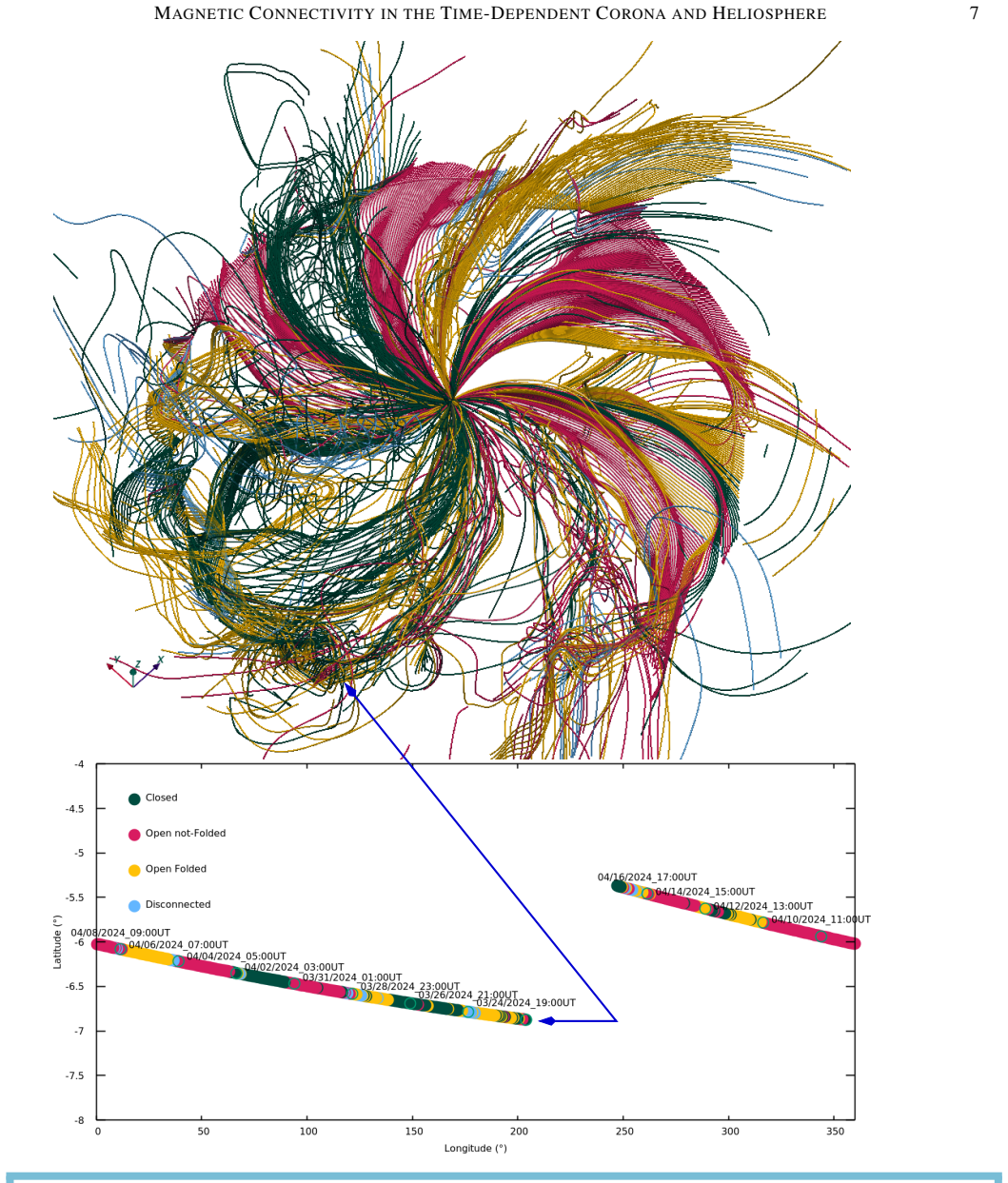
Magnetic flux fills the heliosphere, expands outward from the solar corona, and is fundamentally related to the structure and dynamics of the solar corona and solar wind. Open magnetic flux and the fast wind are thought to originate from open magnetic field lines in coronal holes. Less understood processes in the streamer belt and the boundaries of coronal holes, associated with the more variable slow wind, may be formed by interchange reconnection between open and closed magnetic flux. Interchange reconnection is thought to give rise to field lines that are "folded," i.e. that turn back on themselves. The properties of strahl electrons measured in the solar wind give clues to the heliospheric magnetic connectivity. Unidirectionally outward strahl indicates open field lines, while bidirectional strahl is associated with closed magnetic flux and CMEs. Inward directed, unidirectional strahl is believed to indicate folded flux. We use two time-dependent, flux-evolutionary MHD models of the combined corona and heliosphere, one for a solar-minimum configuration, one for the 2024 total solar eclipse, to investigate the magnetic connectivity of the corona/heliosphere system. We examine how magnetic connectivity varies with distance from the Sun in the two configurations. We evaluate the evolutionary effects by contrasting time-dependent results with the corresponding steady-state calculations, and compare the model connectivities with statistical studies of strahl. The connectivities in the time-evolving simulations are roughly consistent with observed strahl occurrence rates, while those from the steady-state models are not. Our results suggest that complex magnetic connectivities are ubiquitous in the heliosphere.
Editorial analysis
A structured set of objections, weighed in public.
Referee Report
Summary. The paper uses two time-dependent flux-evolutionary MHD models of the combined corona and heliosphere (one for solar-minimum conditions and one for the 2024 total solar eclipse) to compute magnetic connectivities as a function of heliocentric distance. It contrasts these with the corresponding steady-state solutions and reports that the time-dependent connectivities are roughly consistent with statistical strahl occurrence rates (unidirectional outward for open, bidirectional for closed, inward for folded), while steady-state results are not, concluding that complex connectivities are ubiquitous in the heliosphere.
Significance. If the strahl-connectivity mapping is robust, the result provides evidence that time-dependent processes such as interchange reconnection are essential for reproducing observed heliospheric magnetic structure, with implications for solar-wind origin models and particle transport. The use of two distinct configurations and direct comparison to independent spacecraft strahl statistics strengthens the case for time-dependent modeling over steady-state approximations.
major comments (2)
- [Abstract and comparison section] The central claim of rough consistency between time-dependent connectivities and strahl rates (Abstract) is presented without quantitative metrics, overlap fractions, error bars, or sensitivity tests to classification thresholds and post-processing choices. This makes the reported superiority over steady-state models difficult to evaluate and leaves the result vulnerable to the mapping assumptions.
- [Methods and results comparison] The equivalence drawn between model field-line types (open/closed/folded) and strahl directions (uni-outward/bidirectional/inward) treats strahl as an unambiguous proxy. No analysis addresses possible contamination by pitch-angle scattering, wave-particle interactions, or local acceleration that could produce inward strahl on open lines or suppress it on folded lines; the abstract supplies no error budget for this assumption.
minor comments (2)
- [Abstract] The abstract would benefit from naming the specific MHD codes or key numerical parameters of the two time-dependent models.
- [Figures] Figures showing connectivity fractions versus distance should include variability measures or multiple snapshots to illustrate the time-dependent evolution.
Simulated Author's Rebuttal
We thank the referee for the constructive and detailed comments. These have highlighted areas where the presentation of our results can be strengthened with additional quantitative support and discussion of assumptions. We address each major comment below and outline the revisions we will implement.
read point-by-point responses
-
Referee: [Abstract and comparison section] The central claim of rough consistency between time-dependent connectivities and strahl rates (Abstract) is presented without quantitative metrics, overlap fractions, error bars, or sensitivity tests to classification thresholds and post-processing choices. This makes the reported superiority over steady-state models difficult to evaluate and leaves the result vulnerable to the mapping assumptions.
Authors: We agree that quantitative metrics would improve the rigor of the central claim. In the revised manuscript we will add explicit overlap fractions and agreement percentages comparing the time-dependent model connectivities to the published statistical strahl occurrence rates. We will also include sensitivity tests to the field-line classification thresholds and post-processing choices, together with error bars reflecting the range of outcomes under reasonable variations. These additions will be placed in both the abstract and the comparison section to allow direct evaluation of the time-dependent versus steady-state differences. revision: yes
-
Referee: [Methods and results comparison] The equivalence drawn between model field-line types (open/closed/folded) and strahl directions (uni-outward/bidirectional/inward) treats strahl as an unambiguous proxy. No analysis addresses possible contamination by pitch-angle scattering, wave-particle interactions, or local acceleration that could produce inward strahl on open lines or suppress it on folded lines; the abstract supplies no error budget for this assumption.
Authors: The mapping follows the standard interpretation used throughout the heliophysics literature, where strahl direction serves as the primary observational proxy for magnetic topology. We acknowledge that pitch-angle scattering and other kinetic processes can introduce contamination. In the revision we will add an expanded discussion section that reviews these effects from existing studies, supplies a qualitative assessment of their likely impact on our statistics, and includes a rough error budget derived from reported scattering rates in the literature. A fully quantitative error budget would require coupled kinetic-MHD simulations that lie outside the scope of the present work; we will state this limitation explicitly. revision: partial
Circularity Check
No circularity: simulations compared to independent strahl statistics
full rationale
The paper computes magnetic connectivities directly from time-dependent MHD flux-evolution models of the corona-heliosphere system and contrasts them with steady-state counterparts. These connectivities are then compared to external spacecraft-derived strahl occurrence rates using standard interpretive mappings (outward strahl = open, bidirectional = closed, inward = folded). No parameter is fitted to the target strahl fractions inside the model, no equation reduces to its own output by construction, and no load-bearing uniqueness theorem is imported via self-citation. The central claim therefore rests on an external, falsifiable benchmark rather than on any self-referential step.
Axiom & Free-Parameter Ledger
axioms (2)
- standard math Ideal or resistive MHD equations govern the evolution of the magnetic field in the corona and heliosphere.
- domain assumption Strahl electron pitch-angle distributions directly indicate whether a field line is open, closed, or folded.
Lean theorems connected to this paper
-
IndisputableMonolith/Foundation/RealityFromDistinction.leanreality_from_one_distinction unclear?
unclearRelation between the paper passage and the cited Recognition theorem.
We use two time-dependent, flux-evolutionary MHD models... contrast time-dependent results with the corresponding steady-state calculations, and compare the model connectivities with statistical studies of strahl.
What do these tags mean?
- matches
- The paper's claim is directly supported by a theorem in the formal canon.
- supports
- The theorem supports part of the paper's argument, but the paper may add assumptions or extra steps.
- extends
- The paper goes beyond the formal theorem; the theorem is a base layer rather than the whole result.
- uses
- The paper appears to rely on the theorem as machinery.
- contradicts
- The paper's claim conflicts with a theorem or certificate in the canon.
- unclear
- Pith found a possible connection, but the passage is too broad, indirect, or ambiguous to say the theorem truly supports the claim.
Reference graph
Works this paper leans on
-
[1]
Abbo, L., Ofman, L., Antiochos, S. K., et al. 2016, SSRv, 201, 55, doi: 10.1007/s11214-016-0264-1
-
[2]
Anderson, B. R., Skoug, R. M., Steinberg, J. T., & McComas, D. J. 2012, Journal of Geophysical Research (Space Physics), 117, A04107, doi: 10.1029/2011JA017269
-
[3]
Antiochos, S. K., Miki ´c, Z., Titov, V . S., Lionello, R., & Linker, J. A. 2011, ApJ, 731, 112, doi: 10.1088/0004-637X/731/2/112
-
[4]
Bohlin, J. D. 1977, in Coronal Holes and High Speed Wind Streams, ed. J. B. Zirker, 27–69
work page 1977
-
[5]
Caplan, R. M., Stulajter, M. M., Linker, J. A., et al. 2025, ApJS, 278, 24, doi: 10.3847/1538-4365/adc080
-
[6]
Crooker, N. U., Kahler, S. W., Larson, D. E., & Lin, R. P . 2004, Journal of Geophysical Research (Space Physics), 109, A03108, doi: 10.1029/2003JA010278
-
[7]
Downs, C., Lionello, R., Miki ´c, Z., Linker, J. A., & V elli, M. 2016, ApJ, 832, 180, doi: 10.3847/0004-637X/832/2/180
-
[8]
Downs, C., Linker, J. A., Caplan, R. M., et al. 2025, Science, 388, 1306, doi: 10.1126/science.adq0872
-
[9]
Fisk, L. A., Schwadron, N. A., & Zurbuchen, T. H. 1998, SSRv, 86, 51, doi: 10.1023/A:1005015527146
-
[10]
M., Owens, M., Macneil, A., & Lockwood, M
Frost, A. M., Owens, M., Macneil, A., & Lockwood, M. 2022, SoPh, 297, 82, doi: 10.1007/s11207-022-02004-6
-
[11]
Gosling, J. T., Baker, D. N., Bame, S. J., et al. 1987, J. Geophys. Res., 92, 8519, doi: 10.1029/JA092iA08p08519
-
[12]
A., Lionello, R., Miki ´c, Z., Titov, V
Linker, J. A., Lionello, R., Miki ´c, Z., Titov, V . S., & Antiochos, S. K. 2011, ApJ, 731, 110, doi: 10.1088/0004-637X/731/2/110
-
[13]
A., Miki ´c, Z., Lionello, R., et al
Linker, J. A., Miki ´c, Z., Lionello, R., et al. 2003, Physics of Plasmas, 10, 1971, doi: 10.1063/1.1563668
-
[14]
Linker, J. A., Caplan, R. M., Downs, C., et al. 2017, ApJ, 848, 70, doi: 10.3847/1538-4357/aa8a70
-
[15]
Lionello, R., Downs, C., Linker, J. A., et al. 2013, ApJ, 777, 76, doi: 10.1088/0004-637X/777/1/76
-
[16]
Lionello, R., Downs, C., Mason, E. I., et al. 2023, ApJ, 959, 77, doi: 10.3847/1538-4357/ad00be
-
[17]
2014, ApJ, 784, 120, doi: 10.1088/0004-637X/784/2/120
Lionello, R., V elli, M., Downs, C., et al. 2014, ApJ, 784, 120, doi: 10.1088/0004-637X/784/2/120
-
[18]
Lockwood, M., Owens, M., & Rouillard, A. P . 2009, Journal of Geophysical Research (Space Physics), 114, A11104, doi: 10.1029/2009JA014450
-
[19]
Mackay, D. H., & Y eates, A. R. 2012, Living Reviews in Solar Physics, 9, 6, doi: 10.12942/lrsp-2012-6
-
[20]
Macneil, A. R., Owens, M. J., Wicks, R. T., et al. 2020, MNRAS, 494, 3642, doi: 10.1093/mnras/staa951
-
[21]
I., Lionello, R., Downs, C., et al
Mason, E. I., Lionello, R., Downs, C., et al. 2023, ApJL, 959, L4, doi: 10.3847/2041-8213/ad00bd Miki´c, Z., Downs, C., Linker, J. A., et al. 2018, Nature Astronomy, 2, 913, doi: 10.1038/s41550-018-0562-5
-
[22]
Horbury, T. S. 2008, Journal of Geophysical Research (Space Physics), 113, A12103, doi: 10.1029/2008JA013677
-
[23]
Owens, M. J., Lockwood, M., Barnard, L. A., & MacNeil, A. R. 2018, ApJL, 868, L14, doi: 10.3847/2041-8213/aaee82
-
[24]
J., Lockwood, M., Riley, P ., & Linker, J
Owens, M. J., Lockwood, M., Riley, P ., & Linker, J. 2017, Journal of Geophysical Research (Space Physics), 122, 10,980, doi: 10.1002/2017JA024631
-
[25]
2014, Magnetohydrodynamics of the Sun, by Eric Priest,
Priest, E. 2014, Magnetohydrodynamics of the Sun, by Eric Priest,
work page 2014
-
[26]
Cambridge, UK: Cambridge University Press, 2014 Réville, V ., V elli, M., Rouillard, A. P ., et al. 2020, ApJL, 895, L20, doi: 10.3847/2041-8213/ab911d
-
[27]
Riley, P ., Lionello, R., & Rivera, Y . J. 2025, ApJ, 979, 204, doi: 10.3847/1538-4357/ada253
-
[28]
1977, Journal of Geophysics Zeitschrift Geophysik, 42, 561
Rosenbauer, H., Schwenn, R., Marsch, E., et al. 1977, Journal of Geophysics Zeitschrift Geophysik, 42, 561
work page 1977
- [29]
-
[30]
Titov, V . S., Miki´c, Z., Linker, J. A., Lionello, R., & Antiochos, S. K. 2011, ApJ, 731, 111, doi: 10.1088/0004-637X/731/2/111
-
[31]
Zirker, J. B. 1977, Reviews of Geophysics and Space Physics, 15, 257
work page 1977
discussion (0)
Sign in with ORCID, Apple, or X to comment. Anyone can read and Pith papers without signing in.