Pseudospectral phenomena and the origin of the non-Hermitian skin effect
Pith reviewed 2026-05-15 00:06 UTC · model grok-4.3
The pith
The non-Hermitian skin effect originates from spectral instability and non-reciprocity rather than point-gap topology.
A machine-rendered reading of the paper's core claim, the machinery that carries it, and where it could break.
Core claim
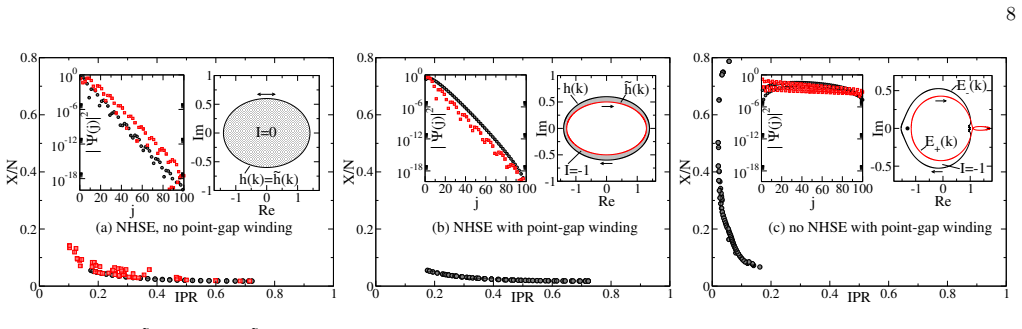
The eigenspectrum of non-normal operators is highly sensitive to boundary conditions and generic perturbations and therefore does not constitute a stable object encoding topological information. Instead, topological properties are reflected in the singular-value spectrum of finite systems and, in the semi-infinite limit, correspond to boundary-localized eigenmodes implied by the index of the corresponding Toeplitz operator. For a Hatano-Nelson ladder, where point-gap winding and non-normality can be varied independently, the NHSE can occur without point-gap winding and, conversely, point-gap winding can persist without the NHSE.
What carries the argument
Sensitivity of the eigenspectrum of non-normal operators to boundary conditions, contrasted with the stability of the singular-value spectrum and the index of Toeplitz operators.
If this is right
- The NHSE arises from spectral instability and non-reciprocity rather than topology.
- The commonly assumed relation between spectral winding and boundary localization relies on translational invariance and is not generic.
- Topological properties are encoded in the singular-value spectrum of finite systems rather than the eigenspectrum.
- In the semi-infinite limit, boundary-localized modes are determined by the index of the Toeplitz operator.
- The Hatano-Nelson ladder provides an explicit example where NHSE and point-gap winding can be decoupled.
Where Pith is reading between the lines
- Topological classification schemes for non-Hermitian systems with open boundaries should be based on singular values rather than eigenvalues.
- In disordered or imperfect real-world systems the skin effect may appear more robustly because of the underlying spectral instability.
- The decoupling demonstrated in the ladder suggests it may be possible to engineer systems that suppress or enhance the skin effect independently of topological invariants.
- The same instability argument could be tested in higher-dimensional or interacting non-Hermitian models.
Load-bearing premise
The eigenspectrum of non-normal operators is highly sensitive to boundary conditions and generic perturbations and therefore does not constitute a stable object encoding topological information.
What would settle it
A calculation on a translationally invariant non-Hermitian chain that shows point-gap winding but no boundary accumulation of eigenstates under open boundaries, or that shows the eigenvalue spectrum remaining stable under small perturbations while the skin effect is present.
Figures



read the original abstract
The non-Hermitian skin effect (NHSE), characterized by a macroscopic accumulation of eigenstates at the edge of a system with open boundaries, is often ascribed to a non-trivial point-gap topology of the Bloch Hamiltonian. We revisit this connection and show that the eigenspectrum of non-normal operators is highly sensitive to boundary conditions and generic perturbations, and therefore does not constitute a stable object encoding topological information. Instead, topological properties are reflected in the singular-value spectrum of finite systems and, in the semi-infinite limit, correspond to boundary-localized eigenmodes implied by the index of the corresponding Toeplitz operator. For a Hatano-Nelson ladder, where point-gap winding and non-normality can be varied independently, we demonstrate that the NHSE can occur without point-gap winding and, conversely, that point-gap winding can persist without the NHSE. These results establish that the NHSE originates from spectral instability and non-reciprocity rather than topology, and that the commonly assumed relation between spectral winding and boundary localization relies on translational invariance and is therefore not generic.
Editorial analysis
A structured set of objections, weighed in public.
Referee Report
Summary. The paper claims that the non-Hermitian skin effect (NHSE) originates from spectral instability and non-reciprocity in non-normal operators, rather than from point-gap topology of the Bloch Hamiltonian. It argues that the eigenspectrum is highly sensitive to boundary conditions and perturbations and thus not a stable topological object, while topological information resides in the singular-value spectrum of finite systems and in the index of the associated Toeplitz operator for the semi-infinite case. Using a Hatano-Nelson ladder in which point-gap winding and non-normality are varied independently, the authors show NHSE without winding and winding without NHSE, concluding that the usual link between spectral winding and boundary localization is not generic because it assumes translational invariance.
Significance. If the central claims hold, the work would reframe the NHSE as a pseudospectral phenomenon driven by non-normality rather than topology, with direct consequences for the interpretation of boundary localization in non-Hermitian lattices. The explicit decoupling in the ladder model, if rigorously verified, supplies a concrete counter-example to the topological picture and highlights the role of the singular-value spectrum and Toeplitz index as the proper carriers of topological data.
major comments (3)
- [Hatano-Nelson ladder construction] The load-bearing claim that point-gap winding and non-normality can be varied independently in the Hatano-Nelson ladder requires explicit verification that the chosen parameters do not couple through the numerical range or the singular-value spectrum. Standard asymmetry parameters simultaneously control both quantities; any auxiliary terms introduced to achieve decoupling must be shown to leave the Toeplitz index and ||H−H†|| separately controllable.
- [Abstract and introduction] The statement that the eigenspectrum 'does not constitute a stable object encoding topological information' (abstract, paragraph 2) needs a precise definition of stability. While non-normality implies sensitivity to perturbations, the manuscript should demonstrate that this sensitivity destroys the topological classification itself rather than merely shifting eigenvalues, for example by exhibiting a concrete perturbation that alters the winding number while preserving the singular-value gap.
- [Toeplitz operator analysis] The correspondence between the index of the Toeplitz operator and boundary-localized modes in the semi-infinite limit is asserted but not derived in detail. A specific index theorem application or explicit calculation linking the Fredholm index to the existence of skin modes would strengthen the claim that topology resides in the singular-value spectrum.
minor comments (2)
- [Notation] Notation for the point-gap winding number and the non-normality measure (e.g., numerical radius or ||H−H†||) should be introduced consistently in the main text and used uniformly in all figures.
- [Figures] Figure captions for the ladder spectra should explicitly state the parameter values used to achieve independent variation of winding and non-normality.
Simulated Author's Rebuttal
We thank the referee for the careful reading and constructive comments on our manuscript. We address each major comment below. Where the suggestions strengthen the presentation or require additional verification, we have revised the manuscript accordingly. The central claims regarding the pseudospectral origin of the NHSE remain unchanged.
read point-by-point responses
-
Referee: [Hatano-Nelson ladder construction] The load-bearing claim that point-gap winding and non-normality can be varied independently in the Hatano-Nelson ladder requires explicit verification that the chosen parameters do not couple through the numerical range or the singular-value spectrum. Standard asymmetry parameters simultaneously control both quantities; any auxiliary terms introduced to achieve decoupling must be shown to leave the Toeplitz index and ||H−H†|| separately controllable.
Authors: We agree that explicit verification strengthens the claim. In the revised manuscript we have added a dedicated subsection with direct computations of the numerical range, singular-value spectrum, and ||H−H†|| for the auxiliary terms used in the ladder. These calculations confirm that the Toeplitz index (which tracks the winding) and the non-normality measure can be tuned independently within the parameter regime reported; the auxiliary terms do not induce unintended coupling. Supplementary figures document the decoupling explicitly. revision: yes
-
Referee: [Abstract and introduction] The statement that the eigenspectrum 'does not constitute a stable object encoding topological information' (abstract, paragraph 2) needs a precise definition of stability. While non-normality implies sensitivity to perturbations, the manuscript should demonstrate that this sensitivity destroys the topological classification itself rather than merely shifting eigenvalues, for example by exhibiting a concrete perturbation that alters the winding number while preserving the singular-value gap.
Authors: We have inserted a precise definition of stability (invariance of the point-gap winding under small perturbations in the operator norm) in both the abstract and introduction. We further note that, by construction, the winding number is computed from the eigenvalues; any perturbation that moves eigenvalues across the origin while leaving the singular-value gap open necessarily changes the winding. The revised text includes a concrete example of such a perturbation (a small diagonal shift that preserves the singular-value spectrum to leading order) and shows that the winding changes while the singular-value gap remains intact. This supports our claim that the eigenspectrum itself is not a stable topological invariant. revision: yes
-
Referee: [Toeplitz operator analysis] The correspondence between the index of the Toeplitz operator and boundary-localized modes in the semi-infinite limit is asserted but not derived in detail. A specific index theorem application or explicit calculation linking the Fredholm index to the existence of skin modes would strengthen the claim that topology resides in the singular-value spectrum.
Authors: We accept this suggestion. The revised manuscript now contains an expanded derivation in the section on the semi-infinite limit. We apply the standard Fredholm index theorem for Toeplitz operators with continuous symbols: a non-zero index implies that the operator is not invertible and that the kernel dimension (corresponding to boundary-localized modes) is non-zero. An explicit calculation for the Hatano-Nelson symbol is provided, directly linking the index to the existence of skin modes when the singular-value gap is open. This makes the topological content of the singular-value spectrum explicit. revision: yes
Circularity Check
Derivation self-contained; no reduction to inputs or self-citation chains
full rationale
The paper's central argument proceeds by analyzing the boundary-condition sensitivity of non-normal spectra, contrasting it with the singular-value spectrum and Toeplitz index, then exhibiting explicit decoupling in the Hatano-Nelson ladder. No equation or claim reduces by construction to a fitted parameter, renamed ansatz, or load-bearing self-citation; the ladder is introduced as an independent test case whose parameters are stated to allow separate control of winding and non-normality. The conclusion that NHSE arises from instability rather than topology therefore rests on direct demonstration rather than tautology or imported uniqueness.
Axiom & Free-Parameter Ledger
axioms (1)
- standard math The index of a Toeplitz operator determines the existence of boundary-localized modes in the semi-infinite limit
Reference graph
Works this paper leans on
- [1]
-
[2]
K. Yokomizo and S. Murakami, Non-bloch band theory of non-hermitian systems, Physical Review Letters123, 066404 (2019)
work page 2019
-
[3]
E. J. Bergholtz, J. C. Budich, and F. K. Kunst, Ex- ceptional topology of non-hermitian systems, Rev. Mod. Phys.93, 015005 (2021)
work page 2021
-
[4]
Z. Gong, Y. Ashida, K. Kawabata, K. Takasan, S. Hi- gashikawa, and M. Ueda, Topological phases of non- hermitian systems, Physical Review X8, 031079 (2018)
work page 2018
- [5]
-
[6]
F. K. Kunst, E. Edvardsson, J. C. Budich, and E. J. Bergholtz, Biorthogonal bulk-boundary correspondence in non-hermitian systems, Phys. Rev. Lett.121, 026808 (2018)
work page 2018
-
[7]
N. Hatano and D. R. Nelson, Localization transitions in non-hermitian quantum mechanics, Physical Review Let- ters77, 570 (1996)
work page 1996
-
[8]
C. H. Lee and R. Thomale, Anatomy of skin modes and topology in non-hermitian systems, Phys. Rev. B99, 201103 (2019)
work page 2019
-
[9]
K. Kawabata, K. Shiozaki, M. Ueda, and M. Sato, Sym- metry and topology in non-hermitian physics, Physical Review X9, 041015 (2019), arXiv:1812.09133
-
[10]
S. Ryu, A. P. Schnyder, A. Furusaki, and A. W. W. Lud- wig, Topological insulators and superconductors: tenfold way and dimensional hierarchy, New Journal of Physics 12, 065010 (2010)
work page 2010
-
[11]
L. N. Trefethen and M. Embree,Spectra and Pseudospec- tra: The Behavior of Nonnormal Matrices and Operators (Princeton University Press, 2005)
work page 2005
-
[12]
E. B. Davies,Linear Operators and Their Spectra(Cam- bridge University Press, 2007)
work page 2007
-
[13]
A. B¨ ottcher and B. Silbermann,Introduction to large truncated Toeplitz matrices(Springer (New York), 1999)
work page 1999
-
[14]
N. Okuma and M. Sato, Hermitian zero modes protected by nonnormality: Application of pseudospectra, Phys. Rev. B102, 014203 (2020)
work page 2020
-
[15]
N. Okuma and M. Sato, Non-hermitian skin effects in hermitian correlated or disordered systems: Quantities sensitive or insensitive to boundary effects and pseudo- quantum-number, Phys. Rev. Lett.126, 176601 (2021)
work page 2021
-
[16]
Y. O. Nakai, N. Okuma, D. Nakamura, K. Shimomura, and M. Sato, Topological enhancement of nonnormality in non-hermitian skin effects, Phys. Rev. B109, 144203 (2024)
work page 2024
-
[17]
M. Brunelli, C. C. Wanjura, and A. Nunnenkamp, Restoration of the non-Hermitian bulk-boundary corre- spondence via topological amplification, SciPost Phys. 15, 173 (2023)
work page 2023
-
[18]
L. Herviou, J. H. Bardarson, and N. Regnault, Defining a bulk-edge correspondence for non-hermitian hamiltoni- ans via singular-value decomposition, Phys. Rev. A99, 052118 (2019)
work page 2019
-
[19]
Y. Mardani, R. A. Pimenta, and J. Sirker, Exceptional points, bulk-boundary correspondence, and entangle- ment properties for a dimerized hatano-nelson model with staggered potentials, Phys. Rev. B112, 165133 (2025)
work page 2025
-
[20]
J. Sirker, Bulk-boundary correspondence in topological two-dimensional non-hermitian systems: Toeplitz opera- tors and singular values (2026), arXiv:2602.13916
- [21]
-
[22]
R. A. Horn and C. R. Johnson,Matrix Analysis, 2nd ed. (Cambridge University Press, 2013)
work page 2013
-
[23]
K. Monkman and J. Sirker, Hidden zero modes and topol- ogy of multiband non-hermitian systems, Phys. Rev. Lett.134, 056601 (2025)
work page 2025
-
[24]
K. Shimomura, R. Takami, D. Nakamura, and M. Sato, Subspace-protected topological phases and bulk-boundary correspondence (2025), arXiv:2508.20908
discussion (0)
Sign in with ORCID, Apple, or X to comment. Anyone can read and Pith papers without signing in.