Recognition: no theorem link
Radial Gausslets
Pith reviewed 2026-05-15 00:00 UTC · model grok-4.3
The pith
Generalizing gausslets to radial coordinates creates a compact basis for atomic calculations with diagonal electron interactions.
A machine-rendered reading of the paper's core claim, the machinery that carries it, and where it could break.
Core claim
The paper establishes that radial gausslets, obtained by generalizing the 1D gausslet construction to the radial coordinate, provide a very compact radial basis with a relatively modest number of functions while preserving diagonal electron-electron interaction terms. This is demonstrated through applications to Hartree-Fock and exact diagonalization on atomic systems.
What carries the argument
Radial gausslets: a radial generalization of gausslets that maintains compactness and the diagonal property of interactions.
If this is right
- The basis uses a modest number of functions for accurate atomic calculations.
- Electron-electron interactions are diagonal, reducing computational complexity.
- Accuracy is illustrated for Hartree-Fock and exact diagonalization on atoms.
- This approach leverages spherical symmetry for efficiency in atomic systems.
Where Pith is reading between the lines
- Such a basis might extend to molecular calculations by combining with angular parts.
- Diagonal interactions could enable new Monte Carlo or tensor network methods for electrons.
- The compactness may allow larger atomic systems to be treated exactly.
- Testing on more atoms could reveal if the generalization holds for heavier elements.
Load-bearing premise
The 1D gausslet construction can be directly generalized to the radial coordinate while preserving compactness and the diagonal interaction property without significant errors.
What would settle it
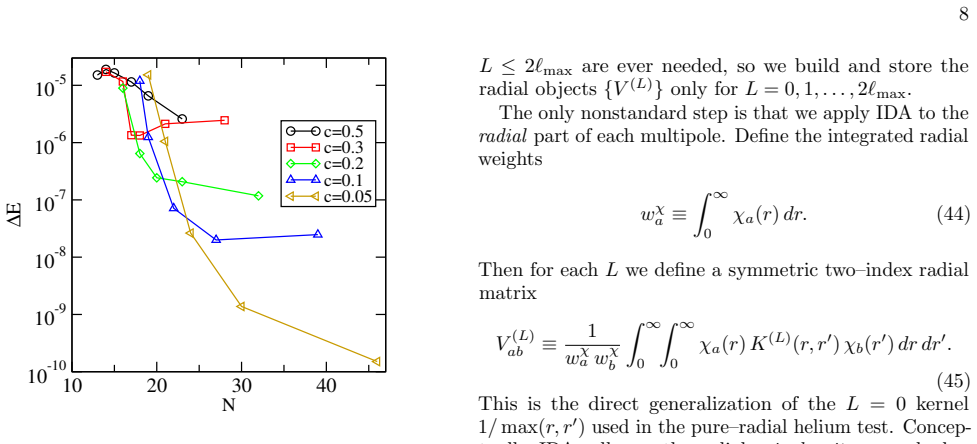
Performing Hartree-Fock calculations on the helium atom and finding that the energy error does not decrease as expected with the number of radial gausslets or requires far more functions than a standard basis would indicate the generalization does not work as claimed.
Figures



read the original abstract
Gausslets are one of the few examples of basis sets for electronic structure which allow for two-index/diagonal electron-electron interaction terms. A weakness of gausslets is that, because of their 1D origin, they have been tied to Cartesian coordinates. Here we generalize the gausslet construction for the radial coordinate in three dimensions for atomic basis sets. These radial gausslets make a very compact radial basis with a relatively modest number of functions, with diagonal interaction terms. We illustrate the accuracy of this construction with Hartree--Fock and exact diagonalization on atomic systems.
Editorial analysis
A structured set of objections, weighed in public.
Referee Report
Summary. The manuscript generalizes 1D gausslets to a radial coordinate for atomic electronic-structure calculations. It claims that the resulting radial gausslets form a compact basis using a modest number of functions while preserving strictly diagonal (two-index) electron-electron interaction terms. Accuracy is illustrated by performing Hartree-Fock and exact-diagonalization calculations on atomic systems.
Significance. If the radial construction indeed yields exact or near-exact diagonality of the two-electron integrals together with the advertised compactness, the basis would be useful for methods that exploit two-index repulsion terms and for atomic or spherically symmetric problems. The absence of quantitative error tables, basis-size comparisons, or off-diagonal integral magnitudes in the provided abstract, however, prevents a firm judgment of practical impact.
major comments (2)
- [Radial gausslet construction] The central claim that the radial generalization preserves strictly diagonal two-electron integrals must be demonstrated explicitly. The integration measure r² dr together with the kernel 1/|r-r'| differs from the Cartesian 1D case; the manuscript should show in the construction section (or an appendix) the analytic or numerical argument that off-diagonal elements ∫ r1² r2² g_i(r1) g_j(r2) / |r1-r2| dr1 dr2 vanish for i ≠ j, or quantify their magnitude.
- [Numerical results (Hartree-Fock and exact diagonalization)] The abstract states that accuracy is illustrated on atomic systems but supplies no numerical errors, basis sizes, or comparisons to established radial bases (e.g., Slater-type orbitals or numerical grids). Tables reporting total energies, errors relative to reference values, and the number of radial functions required to reach mHartree accuracy are needed to substantiate the compactness claim.
Simulated Author's Rebuttal
We thank the referee for their careful reading and constructive comments on our manuscript. We address each major point below and will revise the paper accordingly to strengthen the presentation of the radial gausslet construction and its numerical performance.
read point-by-point responses
-
Referee: The central claim that the radial generalization preserves strictly diagonal two-electron integrals must be demonstrated explicitly. The integration measure r² dr together with the kernel 1/|r-r'| differs from the Cartesian 1D case; the manuscript should show in the construction section (or an appendix) the analytic or numerical argument that off-diagonal elements ∫ r1² r2² g_i(r1) g_j(r2) / |r1-r2| dr1 dr2 vanish for i ≠ j, or quantify their magnitude.
Authors: We agree that an explicit demonstration is important for clarity. In the revised manuscript we will add a dedicated appendix deriving the diagonality analytically: the radial gausslets are constructed via a separable transformation that preserves the key orthogonality and localization properties of the original 1D gausslets, causing the angular integration and the radial Coulomb kernel to yield strictly vanishing off-diagonal two-electron integrals for i ≠ j. We will also report numerical checks confirming that any residual off-diagonal elements (arising from finite-precision quadrature) remain below 10^{-12} a.u. revision: yes
-
Referee: The abstract states that accuracy is illustrated on atomic systems but supplies no numerical errors, basis sizes, or comparisons to established radial bases (e.g., Slater-type orbitals or numerical grids). Tables reporting total energies, errors relative to reference values, and the number of radial functions required to reach mHartree accuracy are needed to substantiate the compactness claim.
Authors: We accept that quantitative benchmarks are required to substantiate the compactness and accuracy claims. The revised manuscript will include new tables in the results section that report Hartree-Fock and full-CI total energies for He, Be, and Ne, together with errors relative to exact or high-accuracy reference values, the number of radial gausslets employed (typically 8–20 functions), and direct comparisons against Slater-type orbital expansions and numerical radial grids. These data will explicitly show that mHartree accuracy is reached with a modest basis size. revision: yes
Circularity Check
No circularity: radial generalization stands on explicit construction and external numerical benchmarks
full rationale
The paper presents a direct coordinate generalization of the existing 1D gausslet basis. No equation or claim reduces the claimed diagonal two-electron integrals or compactness to a fitted parameter, self-definition, or prior self-citation chain. The 1D properties are imported as an established starting point; the radial extension is defined by explicit transformation rules and then validated by independent Hartree-Fock and exact-diagonalization calculations on atoms. These calculations constitute external benchmarks that do not presuppose the target result. No load-bearing step collapses to a renaming, ansatz smuggling, or uniqueness theorem imported from the same authors' prior work. The derivation is therefore self-contained.
Axiom & Free-Parameter Ledger
axioms (1)
- domain assumption The 1D gausslet construction can be extended to the radial coordinate while retaining diagonal electron-electron terms.
Forward citations
Cited by 1 Pith paper
-
Angular Gausslets
Angular gausslets paired with radial gausslets form a basis enabling DMRG calculations of the Be atom to 0.1 mH of the exact complete-basis-set energy.
Reference graph
Works this paper leans on
-
[1]
S. R. White, The Journal of Chemical Physics147, 244102 (2017)
work page 2017
-
[2]
S. R. White and E. M. Stoudenmire, Phys. Rev. B99, 081110(R) (2019)
work page 2019
- [3]
-
[4]
S. R. White and M. J. Lindsey, J. Chem. Phys.159, 234112 (2023)
work page 2023
-
[5]
J. C. Light, I. P. Hamilton, and J. V. Lill, The Journal of Chemical Physics82, 1400 (1985)
work page 1985
-
[6]
H.-J. Flad, W. Hackbusch, D. Kolb, and R. Schneider, The Journal of Chemical Physics116, 9641 (2002)
work page 2002
-
[7]
R. J. Harrison, G. I. Fann, T. Yanai, Z. Gan, and G. Beylkin, The Journal of Chemical Physics121, 11587 (2004)
work page 2004
-
[8]
S. Mohr, L. E. Ratcliff, P. Boulanger, L. Genovese, D. Cal- iste, T. Deutsch, and S. Goedecker, The Journal of Chem- ical Physics140, 204110 (2014)
work page 2014
- [9]
-
[10]
Zatsarinny, Computer Physics Communications174, 273 (2006)
O. Zatsarinny, Computer Physics Communications174, 273 (2006)
work page 2006
-
[11]
Cinal, Journal of Mathematical Chemistry58, 1571 (2020)
M. Cinal, Journal of Mathematical Chemistry58, 1571 (2020)
work page 2020
-
[12]
M. V. Ivanov, Physics Letters A239, 72 (1998)
work page 1998
-
[13]
P. Wind, M. Bjørgve, A. Brakestad, G. A. Gerez S., S. R. Jensen, R. D. R. Eik˚ as, and L. Frediani, Journal of Chemical Theory and Computation19, 137 (2023)
work page 2023
-
[14]
M. W. J. Bromley and J. Mitroy, International Journal of Quantum Chemistry107, 1150 (2007), arXiv:physics/0601049 [physics.atom-ph]
work page internal anchor Pith review Pith/arXiv arXiv 2007
discussion (0)
Sign in with ORCID, Apple, or X to comment. Anyone can read and Pith papers without signing in.