Recognition: no theorem link
Orbital Debris in Earth Orbit: Operations, Stability, Control, and Market Formation
Pith reviewed 2026-05-15 01:05 UTC · model grok-4.3
The pith
Orbital sustainability in Earth orbit is controlled by disposal reliability, high-risk conjunction uncertainty, and legacy inactive object hazards.
A machine-rendered reading of the paper's core claim, the machinery that carries it, and where it could break.
Core claim
Orbital debris in Earth orbit is not adequately described as a static inventory problem. It is a coupled operations-stability problem governed by shell occupancy, collision kernel, breakup severity, and orbital residence time. The near-term orbital sustainability is controlled by three variables: disposal reliability for newly launched spacecraft, encounter-state uncertainty in the high-risk conjunction tail, and the residual hazard stock of inactive high-mass legacy objects. Using public ESA, NASA, FCC, NOAA, JAXA, and OECD sources through 2026, we develop a reduced-order control framework for intervention ranking and market formation.
What carries the argument
A reduced-order control framework that ranks interventions by comparing disposal timelines, conjunction uncertainty reduction, and legacy remediation against public statistics on object counts, mass distribution, and maneuver rates.
If this is right
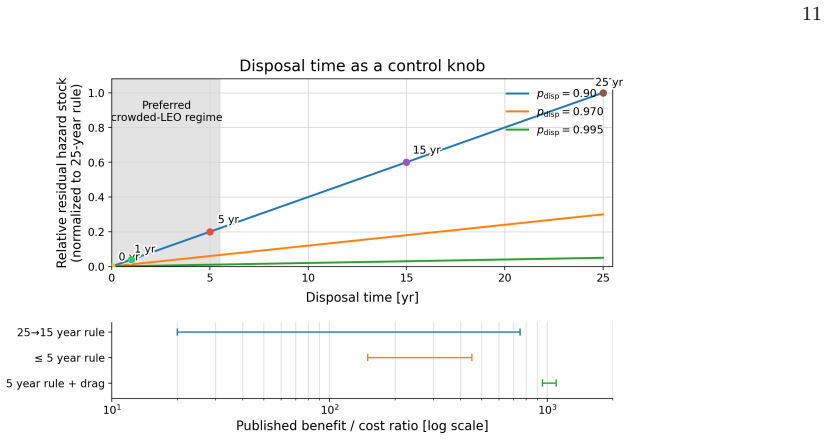
- Shortening disposal timelines from 25 to 15 years produces benefit-cost ratios between 20 and 750.
- Targeted reductions in high-risk conjunction uncertainty yield benefit-cost ratios above 100.
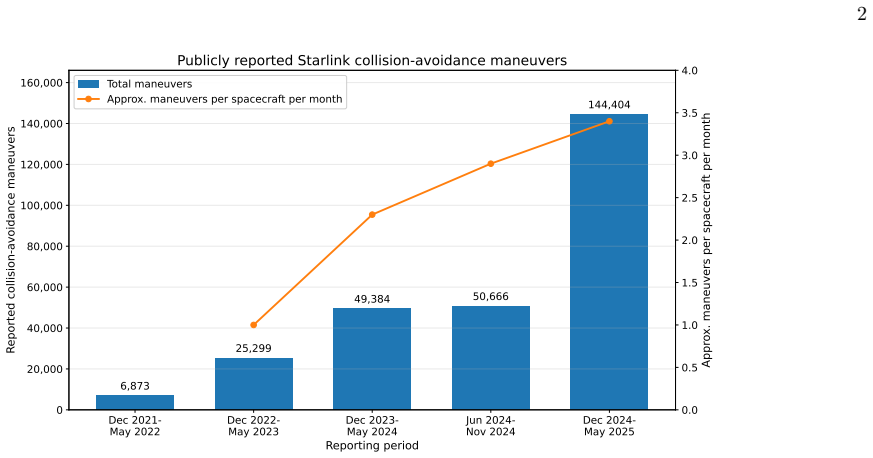
- Constellation operators already experience sharply rising avoidance workloads, as seen in Starlink maneuver counts rising from under 7,000 to over 144,000 in comparable periods.
- Debris services will form as three linked markets: compliance-driven mitigation for new missions, end-of-life servicing with premium tracking, and publicly supported remediation of legacy objects.
- The LEO risk profile separates into a traffic-driven workload peak near 500-600 km and a persistence-driven hazard peak near 850 km, with 96 percent of the index inactive.
Where Pith is reading between the lines
- Regulators could use the three-variable ranking to set differentiated launch fees or insurance requirements based on disposal reliability and orbit choice.
- Private operators might accelerate investment in high-accuracy tracking if the framework shows that uncertainty reduction delivers higher returns than broad removal campaigns.
- Extending the same reduced-order logic to medium Earth orbit or geosynchronous regimes could reveal whether similar control variables dominate there.
- Ongoing public release of maneuver and conjunction data would allow periodic recalibration of the framework as new objects and technologies appear.
Load-bearing premise
Public statistics through 2026 and a reduced-order framework suffice to rank interventions without detailed modeling of collision kernels or breakup severity.
What would settle it
A full-physics simulation or new observational dataset showing that variations in collision kernel or breakup severity reverse the cost-benefit ordering of the three control variables.
Figures




read the original abstract
Orbital debris in Earth orbit is not adequately described as a static inventory problem. It is a coupled operations-stability problem governed by shell occupancy, collision kernel, breakup severity, and orbital residence time. The near-term orbital sustainability is controlled by three variables: disposal reliability for newly launched spacecraft, encounter-state uncertainty in the high-risk conjunction tail, and the residual hazard stock of inactive high-mass legacy objects. Using public ESA, NASA, FCC, NOAA, JAXA, and OECD sources through 2026, we develop a reduced-order control framework for intervention ranking and market formation. Current ESA statistics indicate ~44,870 tracked objects in Earth orbit, more than 15,800 tonnes of orbiting mass, and model-based populations of ~5.4e4 objects larger than 10cm, 1.2e6 in the 1-10cm regime, and 1.4e8 in the 0.1-1cm regime. Operationally, the environment is already visible in constellation-scale workload: public reporting by SpaceX indicates that Starlink collision-avoidance maneuvers rose from 6,873 in 12/2021-05/2022 to 144,404 in 12/2024-05/2025. Physically, the present LEO environment shows a separation between the traffic peak near 500-600 km, which drives conjunction workload, and the persistence-driven risk peak near ~850km, where long lifetime/inactive intact mass dominate long-horizon hazard; under current assumptions, 96% of the LEO index is inactive objects. NASA studies indicate benefit-cost ratios of 20-750 for shortening disposal timelines from 25 to 15 years and greater than 100 for targeted uncertainty reduction in high-risk conjunctions. The analysis implies that orbital-debris services will not emerge as a single homogeneous market, but as a result of linked markets: compliance-led mitigation for new missions, prepared end-of-life servicing and premium SSA overlays, and publicly anchored remediation of the legacy stock.
Editorial analysis
A structured set of objections, weighed in public.
Referee Report
Summary. The paper claims that orbital debris is a coupled operations-stability problem governed by shell occupancy, collision kernel, breakup severity, and residence time, with near-term sustainability controlled by three variables: disposal reliability for new spacecraft, encounter-state uncertainty in high-risk conjunction tails, and residual hazard stock of inactive high-mass legacy objects. Using public ESA/NASA/FCC/NOAA/JAXA/OECD statistics through 2026, it develops a reduced-order control framework for ranking interventions and argues that debris services will emerge as linked markets (compliance mitigation, end-of-life servicing, and legacy remediation) rather than a single homogeneous market. Supporting observations include Starlink maneuver growth, LEO altitude separation between traffic and risk peaks, a 96% inactive fraction, and cited NASA benefit-cost ratios of 20-750 for shortened disposal timelines.
Significance. If the reduced-order framework holds, the work could usefully synthesize public data to prioritize interventions and inform market incentives for orbital sustainability. Credit is due for grounding the analysis in operational statistics (e.g., Starlink maneuvers) and external benefit-cost studies rather than new simulations. The emphasis on linked markets rather than monolithic remediation is a constructive framing for policy discussion.
major comments (2)
- [Reduced-order control framework] The central claim that the three variables dominate intervention ranking rests on the reduced-order control framework, but the manuscript provides no explicit demonstration that collision kernels (setting encounter probabilities and velocities) or breakup severity distributions can be omitted without changing the dominance ordering between legacy hazard and new-mission disposal. If nonlinearities in dense shells or velocity-dependent outcomes shift relative contributions, the market-formation implications would not hold.
- [Physical environment and statistics sections] The reported LEO altitude separation (traffic peak 500-600 km vs. risk peak ~850 km) and 96% inactive fraction are presented as static evidence supporting the framework; without dynamic modeling or sensitivity tests against varying breakup scenarios, these snapshots do not verify that the reduced-order assumptions suffice for long-horizon hazard ranking.
minor comments (2)
- [Abstract and data sections] The abstract and text cite model-based populations (~5.4e4 >10 cm, etc.) but do not name the source models or their uncertainty ranges, reducing traceability.
- [Intervention ranking discussion] Benefit-cost ratios from NASA studies are quoted without specifying the exact studies or assumptions (e.g., discount rates, collision probabilities), which would strengthen the intervention-ranking claims.
Simulated Author's Rebuttal
We thank the referee for the constructive comments, which help clarify the scope and limitations of the reduced-order framework. We address each major comment below and indicate the revisions planned for the next manuscript version.
read point-by-point responses
-
Referee: [Reduced-order control framework] The central claim that the three variables dominate intervention ranking rests on the reduced-order control framework, but the manuscript provides no explicit demonstration that collision kernels (setting encounter probabilities and velocities) or breakup severity distributions can be omitted without changing the dominance ordering between legacy hazard and new-mission disposal. If nonlinearities in dense shells or velocity-dependent outcomes shift relative contributions, the market-formation implications would not hold.
Authors: The framework derives its dominance ordering from the empirical dominance of legacy inactive mass (96% of the LEO index) and the separation between traffic and risk peaks in current catalogs, which directly control the three variables for near-term horizons. We acknowledge that the manuscript does not contain an explicit sensitivity sweep over kernel parameters or breakup severity. To address this, we will add a new appendix performing a limited sensitivity analysis using historical breakup velocity distributions and perturbed kernels from cited NASA models; this will confirm that the intervention ranking remains stable under moderate nonlinearities for the time scales considered. The revised manuscript will incorporate this demonstration. revision: yes
-
Referee: [Physical environment and statistics sections] The reported LEO altitude separation (traffic peak 500-600 km vs. risk peak ~850 km) and 96% inactive fraction are presented as static evidence supporting the framework; without dynamic modeling or sensitivity tests against varying breakup scenarios, these snapshots do not verify that the reduced-order assumptions suffice for long-horizon hazard ranking.
Authors: The altitude separation and inactive fraction are drawn from 2026 ESA/NASA catalogs as bounding conditions for the control variables, with residence time serving as the integrator. We agree that static snapshots alone do not constitute full dynamic validation. In revision we will expand the physical environment section with a short discussion referencing the dynamic models already cited (NASA and ESA studies) to show that the observed separation persists under moderate breakup variations. This addition will better connect the statistics to long-horizon applicability without introducing new simulations. revision: partial
Circularity Check
No significant circularity; framework derived from external public statistics without self-referential reduction
full rationale
The paper identifies three controlling variables for near-term orbital sustainability and develops a reduced-order control framework using public ESA, NASA, FCC, NOAA, JAXA, and OECD sources through 2026. No load-bearing steps reduce by construction to internal fits, self-citations, or ansatzes; the derivation relies on external statistics for object counts, masses, and maneuver data, with intervention ranking presented as an application of those inputs rather than a tautological output. The central claims remain independent of any self-definitional or fitted-prediction patterns.
Axiom & Free-Parameter Ledger
Forward citations
Cited by 1 Pith paper
-
Orbital Data Centers: Spacecraft Constraints and Economic Viability
Orbital data centers require 34-59 kg/kW total mass and launch-plus-build costs 3.4-13.5 times below current Falcon 9 prices to compete, viable only for low-communication edge compute with high utilization and long lifetimes.
Reference graph
Works this paper leans on
-
[1]
Make rapid disposal the default design rule for all new crowded-LEO missions.All new spacecraft in dense LEO shells should be designed for disposal in less than 5 years after end of mission, and substantially faster in the most populated bands when feasible. Disposal architecture should be reliability-driven: propulsive clearance with margin if available,...
-
[2]
Build a high-fidelity targeted tracking layer around existing catalogues.The next major operational improvement is not a monolithic global sensor rebuild, but a targeted high-fidelity layer for risky conjunctions. This includes better public/private ephemeris sharing, on-demand tasking of laser ranging and precision optical/radar sensors, better covarianc...
-
[3]
Publicly procure and co-finance remediation of the highest-risk legacy objects.Because the dominant environmental risk is concentrated in inactive objects, and because the benefits of their remediation are diffuse, the first wave of large-object intervention should be organized through public procurement or pooled consortium finance rather than through ex...
-
[4]
Do not overinvest early in centimeter-class custody.Centimeter-class tracking and removal can become valuable, but only after rapid PMD, high-risk tracking, and legacy derelict interventions are operating at scale. The reason is technical and economic: centimeter-class systems need much better uncertainties and much larger sensing or engagement infrastruc...
-
[5]
Use shielding selectively.Shielding should be applied where it protects mission-critical functions against the residual sub-centimeter and low-centimeter environment, but it should not be mistaken for a system-level solution. The correct use is selective protection of tanks, pressure vessels, avionics, and other failure-critical surfaces, coupled to layou...
-
[6]
Create pricing and incentive mechanisms that reward verified risk reduction.A durable control regime requires more than technical standards; it requires financial incentives that approximate the marginal environmental harm created by long-lived objects in congested shells. New missions should face binding performance standards for disposal and passivation...
-
[7]
European Space Agency Space Debris Office,ESA’s Annual Space Environment Report, Tech. Rep. GEN-DB-LOG-00288- OPS-SD, Issue 9.1 (European Space Agency, 2025)
work page 2025
-
[8]
European Space Agency, ESA Space Environment Report 2025 (2025)
work page 2025
-
[9]
T. J. Colvin, M. Karcz, and S. Wusk, Cost and Benefit Analysis of Orbital Debris Remediation, NASA Office of Technology, Policy, and Strategy Report 20230002817 (2023)
work page 2023
-
[10]
Space Exploration Holdings, LLC, Semiannual Constellation Status Report, 1 December 2021–31 May 2022 (2022), filed with the Federal Communications Commission
work page 2021
- [11]
-
[12]
SpaceX Gen2 June 30, 2023 Report
Space Exploration Holdings, LLC, Semi-Annual Space Station Deployment and Space Safety Report, FCC International Communications Filing System (ICFS) filing (2023), ICFS File Nos. SAT-LOA-20200526-00055 and SAT-AMD-20210818- 00105; cited by the FCC as “SpaceX Gen2 June 30, 2023 Report”
work page 2023
-
[13]
SpaceX Gen2 December 29, 2023 Report
Space Exploration Holdings, LLC, Semi-Annual Space Station Deployment and Space Safety Report, FCC International Communications Filing System (ICFS) filing (2023), ICFS File Nos. SAT-LOA-20200526-00055 and SAT-AMD-20210818- 00105; cited by the FCC as “SpaceX Gen2 December 29, 2023 Report”
work page 2023
-
[14]
SpaceX Gen2 July 1, 2024 Report
Space Exploration Holdings, LLC, Semi-Annual Space Station Deployment and Space Safety Report, FCC International Communications Filing System (ICFS) filing (2024), ICFS File Nos. SAT-LOA-20200526-00055 and SAT-AMD-20210818- 00105; cited by the FCC as “SpaceX Gen2 July 1, 2024 Report”. 23
work page 2024
-
[15]
SpaceX Gen2 December 31, 2024 Report
Space Exploration Holdings, LLC, Semi-Annual Space Station Deployment and Space Safety Report, FCC International Communications Filing System (ICFS) filing (2024), ICFS File Nos. SAT-LOA-20200526-00055 and SAT-AMD-20210818- 00105; cited by the FCC as “SpaceX Gen2 December 31, 2024 Report”
work page 2024
-
[16]
SpaceX Gen1 and Gen2 July 1, 2025 Report
Space Exploration Holdings, LLC, Semi-Annual Space Station Deployment and Space Safety Report, Federal Communications Commission filing (2025), Filed with the Federal Communications Commission on 1 July 2025; cited in FCC DA 26-36 as the “SpaceX Gen1 and Gen2 July 1, 2025 Report”
work page 2025
-
[17]
Aerospace America, Heavy Traffic Ahead (2025), Reports 144,404 collision-avoidance maneuvers for December 2024–May 2025 based on SpaceX regulatory filings
work page 2025
-
[18]
Federal Communications Commission, ICFS File Nos.: Space Exploration Holdings, LLC (2026), DA 26-36; notes SpaceX maneuvers at a risk threshold of 10 −6
work page 2026
-
[19]
European Space Agency, Space Environment Statistics (2026), Space Debris User Portal; statistics on 16 January 2026
work page 2026
-
[20]
National Aeronautics and Space Administration,NASA Spacecraft Conjunction Assessment and Collision Avoidance Best Practices Handbook, Tech. Rep. NASA/SP-20230002470 Rev 1 (NASA, 2023)
work page 2023
-
[21]
NASA Orbital Debris Program Office, Radar Measurements (2025)
work page 2025
-
[22]
NASA HyperVelocity Impact Technology, Shield Development: Basic Concepts (2025)
work page 2025
-
[23]
Federal Communications Commission, Small Entity Compliance Guide: Space Innovation; Mitigation of Orbital Debris in the New Space Age (2025), DA 25-256
work page 2025
-
[24]
European Space Agency, ESA’s Zero Debris Approach (2024)
work page 2024
-
[25]
J. Locke and T. J. Colvin, Cost and Benefit Analysis of Mitigating, Tracking, and Remediating Orbital Debris, NASA Office of Technology, Policy, and Strategy Report 20240003484 (2024)
work page 2024
-
[26]
T. J. Colvin and J. Locke, inProceedings of the 75th International Astronautical Congress(Milan, Italy, 2024)
work page 2024
-
[27]
National Aeronautics and Space Administration, Small Spacecraft Technology State of the Art Report: Deorbit Systems Chapter (2025)
work page 2025
-
[28]
European Space Agency, Show Me Your Wings: Successful In-flight Demonstration of the ADEO Braking Sail (2023)
work page 2023
-
[29]
NASA Office of Safety and Mission Assurance, Orbital Debris (2025)
work page 2025
-
[30]
European Space Agency, ESA’s Iza˜ na-1 Laser Ranging Station for Satellite and Debris Tracking (2024)
work page 2024
-
[31]
European Space Agency, ClearSpace-1 (2026), mission page
work page 2026
-
[32]
Japan Aerospace Exploration Agency, Commercial Removal of Debris Demonstration (CRD2) (2025)
work page 2025
-
[33]
Japan Aerospace Exploration Agency, ADRAS-J Mission Updates and Fly-Around Observation Results (2024)
work page 2024
-
[34]
Astroscale, Astroscale Japan Secures Contract for Phase II of JAXA’s Commercial Removal of Debris Demonstration Program (2024)
work page 2024
-
[35]
NASA Orbital Debris Program Office, Frequently Asked Questions (2025)
work page 2025
-
[36]
NASA Orbital Debris Program Office, LEGEND: NASA’s 3D Orbital Debris Evolutionary Model (2026), full-scale three-dimensional debris evolutionary model for long-term near-Earth environment projection
work page 2026
-
[37]
NASA Orbital Debris Program Office, Debris Assessment Software (2025)
work page 2025
-
[38]
National Aeronautics and Space Administration, Update to NPR 8715.6, Orbital Debris Mitigation (2024)
work page 2024
-
[39]
National Aeronautics and Space Administration, NASA Comments to the Federal Communications Commission Regarding the Starlink Gen2 System (2022)
work page 2022
-
[40]
Federal Communications Commission, Space Exploration Holdings, LLC (2024), DA 24-1193; discusses NASA concerns, ISS protection, and autonomous collision avoidance at lower altitudes
work page 2024
-
[41]
A. Raoet al., Cost-Benefit Analysis of Debris Risk Reduction Portfolios, NASA Technical Reports Server (2025)
work page 2025
-
[42]
Office of Space Commerce, NOAA, Traffic Coordination System for Space (TraCSS) (2026), public civil SSA/STM service
work page 2026
-
[43]
Office of Space Commerce, NOAA, OSC Opens TraCSS Waitlist for Satellite Operators (2026)
work page 2026
-
[44]
Astroscale, Astroscale’s ELSA-M Spacecraft Completes Critical Design Review (2025)
work page 2025
-
[45]
United Nations Office for Outer Space Affairs, Treaty on Principles Governing the Activities of States in the Exploration and Use of Outer Space, Including the Moon and Other Celestial Bodies (1967)
work page 1967
-
[46]
United Nations Office for Outer Space Affairs, Convention on Registration of Objects Launched into Outer Space (1975)
work page 1975
-
[47]
Organisation for Economic Co-operation and Development,The Economics of Space Sustainability, Tech. Rep. (OECD, 2024)
work page 2024
discussion (0)
Sign in with ORCID, Apple, or X to comment. Anyone can read and Pith papers without signing in.