Recognition: unknown
Orbital Data Centers: Spacecraft Constraints and Economic Viability
Pith reviewed 2026-05-07 09:17 UTC · model grok-4.3
The pith
Orbital data centers require combined launch and build costs several times below current benchmarks to deliver competitive compute power.
A machine-rendered reading of the paper's core claim, the machinery that carries it, and where it could break.
Core claim
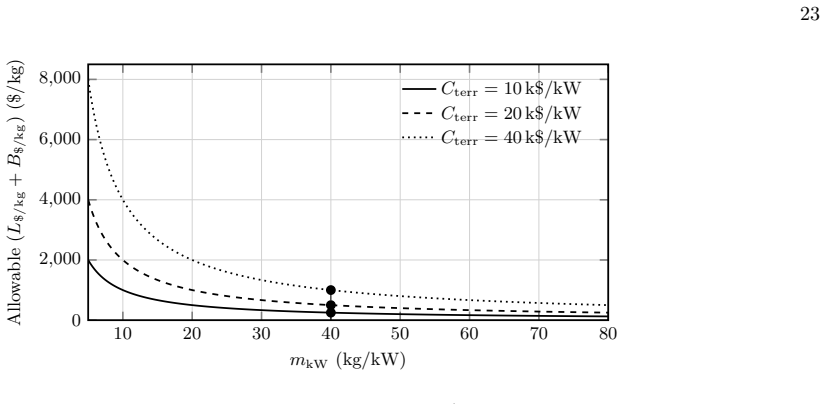
For a 1 MW IT-power anchor in high sunlight the design needs 5.64 thousand square meters of beginning-of-life photovoltaic area and 2.5 thousand square meters of radiator area. Photovoltaic, storage, and radiator mass alone reach 29.4 kg per kW; fixed spacecraft mass raises the total to 34-59 kg per kW. At roughly 40 kg per kW a terrestrial benchmark of 10-40 thousand dollars per kW allows only 250-1000 dollars per kg for the combined launch-plus-build cost before communications, operations, utilization, and lifetime terms are included. That allowance lies 3.4 to 13.5 times below the current public Falcon 9 dedicated low-Earth-orbit launch price alone.
What carries the argument
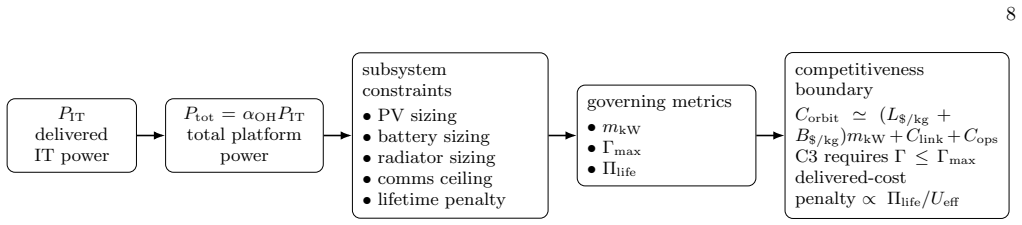
The cluster-level competitiveness conditions expressed through delivered IT power P_IT, mass per delivered kilowatt m_kW, communication intensity Gamma equals data sent to ground divided by IT energy, sustained communication ceiling Gamma_max, effective utilization U_eff, and lifetime penalty Pi_life.
If this is right
- Space-native preprocessing and communications-integrated edge compute become credible early regimes.
- Terrestrial-user general compute only closes for low Earth-coupled communication intensity, high effective utilization, long delivered lifetime, and very low combined launch-plus-build cost.
- The beginning-of-life photovoltaic area and radiator area both scale linearly with the target IT power.
- Fixed spacecraft mass raises the total mass budget above the pure power-system value of 29.4 kg per kW.
Where Pith is reading between the lines
- The same mass-budget and communication-intensity logic applies to any power-intensive orbital platform, not only data centers.
- If launch and build costs reach the required range, orbital centers could serve specific low-latency or high-bandwidth workloads that terrestrial sites handle poorly.
- Direct measurement of sustained space-to-ground data rates per unit energy would test one of the parameters that most strongly affects the economic window.
Load-bearing premise
The conclusions rest on chosen values for communication intensity, effective utilization, and lifetime penalty that are not independently measured from real orbital operations.
What would settle it
A complete orbital compute spacecraft whose total launch-plus-build cost per kilogram falls inside or below the 250-1000 dollar window, while meeting the assumed sustained communication rate and utilization, would support the viability claim; measured costs remaining above that window would falsify it under the paper's parameter ranges.
Figures


read the original abstract
Orbital data centers are being evaluated as solar-powered compute constellations and relay-integrated processing platforms. Their feasibility is not set by orbital solar flux alone, but by simultaneous closure of photovoltaic generation, eclipse recharge, radiative heat rejection, sustained space-to-ground communications, utilization, replacement cadence, and delivered compute-years over finite mission life. This paper derives necessary cluster-level competitiveness conditions using delivered information-technology (IT) electrical power $P_{\rm IT}$, deployed mass per delivered IT power $m_{\rm kW}$ in kg/kW, communication intensity $\Gamma=D_{\rm sg}/E_{\rm IT}$, sustained communication ceiling $\Gamma_{\max}$, effective utilization $U_{\rm eff}$, and lifetime penalty $\Pi_{\rm life}$. For a representative $P_{\rm IT}$=1 MW high-sunlight anchor, the base case gives beginning-of-life photovoltaic area $A^{\rm BOL}_{\rm PV}=5.64 \times 10^3 {\rm m}^2$, radiator area $A_{\rm rad}=2.50 \times 10^3 {\rm m^2}$, and 29.4 kg/kW for photovoltaic, storage, and radiator mass; fixed spacecraft mass raises the total to 34-59 kg/kW. At m_kW ~ 40 kg/kW, a terrestrial infrastructure benchmark of 10-40 k\$/kW allows only 250-1000 \$/kg for the combined launch and spacecraft-build cost before space-to-ground communications, operations, utilization, and lifetime terms are included. That allowance is 3.4-13.5 times below the current public Falcon 9 dedicated low-Earth-orbit launch-price benchmark alone, before spacecraft build is included. Space-native preprocessing and communications-integrated edge compute are credible early regimes; terrestrial-user general compute closes only for low Earth-coupled communication intensity, high effective utilization, long delivered lifetime, and very low combined launch-plus-build cost.
Editorial analysis
A structured set of objections, weighed in public.
Referee Report
Summary. The manuscript derives spacecraft-level engineering constraints for orbital data centers using standard orbital power and thermal balance equations. For a representative 1 MW IT power anchor in high-sunlight orbit it reports explicit values A_BOL_PV = 5.64 × 10^3 m², A_rad = 2.50 × 10^3 m² and 29.4 kg/kW subsystem mass (total 34–59 kg/kW once fixed spacecraft mass is added). It then introduces competitiveness conditions that fold in communication intensity Γ = D_sg/E_IT, effective utilization U_eff, lifetime penalty Π_life and a sustained-communication ceiling Γ_max to obtain an allowed combined launch-plus-build cost of only 250–1000 $/kg at ~40 kg/kW. This figure is stated to lie 3.4–13.5× below the public Falcon 9 dedicated LEO launch-price benchmark, implying that general terrestrial-user compute is not viable while space-native preprocessing or edge-compute regimes remain credible.
Significance. If the engineering stack and the framing of the cost gap hold, the work supplies concrete, equation-derived benchmarks (PV area, radiator area, mass per delivered kW) that can serve as reference points for subsequent studies. The explicit numerical outputs grounded in orbital flux, eclipse fraction and radiative rejection equations constitute a reproducible starting point, even though the final economic thresholds remain conditional on operational parameters.
major comments (1)
- [competitiveness conditions] Competitiveness conditions (abstract and associated derivation): the headline claim that the allowed combined cost is 3.4–13.5× below the Falcon 9 benchmark is obtained only after the delivered compute-years are scaled by the chosen ranges for Γ, U_eff and Π_life. These three quantities are introduced as free parameters without external bounds, literature citations, or a sensitivity table showing how the allowed $/kg changes when each is varied by a factor of two. Because the gap scales linearly with these factors, the quantitative viability conclusion is load-bearing on their selection rather than on the engineering stack alone.
minor comments (2)
- [abstract] Notation: Γ, U_eff and Π_life appear in the abstract and competitiveness conditions without immediate units or a compact definition table; adding a short nomenclature box would improve readability.
- [engineering derivations] The manuscript states explicit numerical results (A_BOL_PV, A_rad, 29.4 kg/kW) but does not display the intermediate algebraic steps or the precise efficiency and eclipse-fraction values used; a short appendix or inline derivation box would allow independent verification.
Simulated Author's Rebuttal
We thank the referee for the careful and constructive review. The major comment concerns the dependence of the competitiveness conclusions on the operational parameters. We address this point below and will revise the manuscript to improve transparency.
read point-by-point responses
-
Referee: Competitiveness conditions (abstract and associated derivation): the headline claim that the allowed combined cost is 3.4–13.5× below the Falcon 9 benchmark is obtained only after the delivered compute-years are scaled by the chosen ranges for Γ, U_eff and Π_life. These three quantities are introduced as free parameters without external bounds, literature citations, or a sensitivity table showing how the allowed $/kg changes when each is varied by a factor of two. Because the gap scales linearly with these factors, the quantitative viability conclusion is load-bearing on their selection rather than on the engineering stack alone.
Authors: We agree that the factor of 3.4–13.5× is obtained by scaling with the chosen ranges of Γ, U_eff, and Π_life, and that these are operational parameters rather than fixed engineering quantities. The manuscript frames them explicitly as variables that delineate use-case regimes (low-communication edge compute versus general terrestrial workloads), with the quoted factor corresponding to the subset of values that would render space-native preprocessing viable. The core engineering results (PV area, radiator area, and 34–59 kg/kW total mass) are independent of these parameters and derived solely from orbital flux, eclipse, and thermal-balance equations. To address the absence of a sensitivity table and external grounding, the revised manuscript will include a new table showing the allowed launch-plus-build cost for ± factor-of-two excursions in each parameter around the base values used in the abstract. We will also expand the discussion section to supply example bounds drawn from terrestrial edge-computing literature (e.g., utilization rates for content-delivery and IoT preprocessing workloads) together with appropriate citations. These additions will make the load-bearing assumptions explicit without altering the underlying engineering stack. revision: yes
Circularity Check
No circularity; cost-gap claim follows from independent physical constants and external market benchmarks
full rationale
The derivation begins with physical inputs (solar flux, eclipse duration, thermal rejection efficiency) to compute BOL photovoltaic area, radiator area, and subsystem masses for a 1 MW P_IT anchor, producing m_kW = 29.4 kg/kW (PV/storage/radiator) or 34-59 kg/kW total. The allowed combined launch-plus-build cost is obtained by dividing the independent terrestrial benchmark (10-40 k$/kW) by this m_kW, then comparing the resulting 250-1000 $/kg range to the separate Falcon 9 public price benchmark. The parameters Γ, U_eff, and Π_life enter only the broader competitiveness conditions and are explicitly excluded from the quoted allowance and shortfall factor. No equations reduce to their own inputs by construction, no parameters are fitted then renamed as predictions, and no self-citations or imported uniqueness theorems appear in the chain.
Axiom & Free-Parameter Ledger
free parameters (3)
- P_IT
- terrestrial cost benchmark 10-40 k$/kW
- Falcon 9 launch price benchmark
axioms (3)
- domain assumption Orbital solar flux and beginning-of-life photovoltaic efficiency yield A_BOL_PV = 5.64e3 m2 for 1 MW IT power
- domain assumption Radiative heat rejection model produces A_rad = 2.50e3 m2
- domain assumption Subsystem mass of 29.4 kg/kW for PV, storage, and radiator plus fixed spacecraft mass totals 34-59 kg/kW
Reference graph
Works this paper leans on
-
[1]
Shehabi, S
A. Shehabi, S. J. Smith, A. Hubbard, A. Newkirk, N. Lei, M. A. B. Siddik, B. Holecek, J. Koomey, E. Masanet, and D. Sartor,2024 United States Data Center Energy Usage Report, Tech. Rep. LBNL-2001637 (Lawrence Berkeley National Laboratory, 2024)
2024
-
[2]
North American Electric Reliability Corporation,2024 Long-Term Reliability Assessment, Tech. Rep. (NERC, 2024)
2024
-
[3]
International Energy Agency,Energy and AI, Tech. Rep. (International Energy Agency, 2025)
2025
-
[4]
Towards a future space-based, highly scalable ai infrastructure system design,
B. Ag¨ uera y Arcas, T. Beals, M. Biggs, J. V. Bloom, T. Fischbacher, K. Gromov, U. K¨ oster, R. Pravahan, and J. Manyika, Towards a Future Space-Based, Highly Scalable AI Infrastructure System Design (2025), arXiv:2511.19468 [cs.DC]
-
[5]
I. Bargatin, D. Jin, Z. Alansari, and J. R. Raney, Tether-Based Architecture for Solar-Powered Orbital AI Data Centers (2025), arXiv:2512.09044 [astro-ph.IM]
-
[6]
J. F. Gutierrezet al.,Data Centres in Space: Orbital Backbone of the Second Digital Era?, Tech. Rep. ESPI Report 98 (European Space Policy Institute, 2025)
2025
-
[7]
Technical University of Munich, Space-Based Data Centres: From Vision to Viable Infrastructure for Europe (2025), news release, November 19, 2025
2025
-
[8]
National Aeronautics and Space Administration, Communications Services Project (2026)
2026
-
[9]
SpaceX,Starlink 2025 Progress Report, Tech. Rep. (SpaceX, 2026)
2025
-
[10]
Federal Communications Commission, Space Bureau, Space Bureau Accepts for Filing SpaceX’s Application for Orbital Data Centers (2026), Public Notice, ICFS File No
U.S. Federal Communications Commission, Space Bureau, Space Bureau Accepts for Filing SpaceX’s Application for Orbital Data Centers (2026), Public Notice, ICFS File No. SAT-LOA-20260108-00016
2026
-
[11]
NVIDIA, NVIDIA Launches Space Computing, Rocketing AI Into Orbit (2026), Newsroom release, March 16, 2026
2026
-
[12]
Chabra, C
O. Chabra, C. Li, K. Hsieh, S. Segarra, B. Arzani, P. Olsen, and R. Chandra, OrbitalBrain: A Distributed Framework for Training ML Models in Space, in1st New Ideas in Networked Systems (NINeS 2026), Open Access Series in Informatics (OASIcs), Vol. 139 (Schloss Dagstuhl – Leibniz-Zentrum fuer Informatik, Dagstuhl, Germany, 2026) pp. 5:1–5:32
2026
-
[13]
A. Thummala and G. Falco, When to Compute in Space (2025), arXiv:2512.17054 [cs.DC]
-
[14]
A. A. Periola and M. O. Kolawole, Space-Based Data Centres: A Paradigm for Data Processing and Scientific Investigations, Wireless Personal Communications107, 95 (2019)
2019
-
[15]
Kopp and J
G. Kopp and J. L. Lean, A New, Lower Value of Total Solar Irradiance: Evidence and Climate Significance, Geophys. Res. Letters38, L01706 (2011)
2011
-
[16]
National Aeronautics and Space Administration,Small Spacecraft Technology State of the Art: Power Chapter, Tech. Rep. (NASA, 2024). 29
2024
-
[17]
A. J. Juhasz,Design Considerations for Lightweight Space Radiators Based on Fabrication and Test Experience with a Carbon-Carbon Composite Prototype Heat Pipe, Tech. Rep. NASA/TP-1998-207427/REV1 (NASA Lewis Research Center, 2002)
1998
-
[18]
D. G. Gilmore, ed.,Spacecraft Thermal Control Handbook. Volume I: Fundamental Technologies, 2nd ed. (American Institute of Aeronautics and Astronautics and The Aerospace Press, Reston, VA, 2002)
2002
-
[19]
C. M. Schieler, K. M. Riesing, B. C. Bilyeu, J. S. Chang, A. S. Garg, N. J. Gilbert, A. J. Horvath, R. S. Reeve, B. S. Robinson, J. P. Wang, S. Piazzolla, W. T. Roberts, J. M. Kovalik, and B. Keer, On-orbit demonstration of 200-Gbps laser communication downlink from the TBIRD CubeSat, inFree-Space Laser Communications XXXV, Vol. 12413, edited by H. Hemmat...
2023
-
[20]
Wang, TeraByte InfraRed Delivery (TBIRD): Delivering 200 Gbps from Space to Ground (2025), presentation, dated April 1, 2025
J. Wang, TeraByte InfraRed Delivery (TBIRD): Delivering 200 Gbps from Space to Ground (2025), presentation, dated April 1, 2025
2025
-
[21]
D. A. Vallado,Fundamentals of Astrodynamics and Applications, 4th ed. (Microcosm Press, Hawthorne, CA, 2013)
2013
-
[22]
Vavrin, A
A. Vavrin, A. Manis, J. Seago,et al.,NASA Orbital Debris Engineering Model (ORDEM) 3.1 – Software User Guide, Tech. Rep. NASA/TP-2019-220448 (NASA Johnson Space Center, Orbital Debris Program Office, 2019)
2019
-
[23]
National Aeronautics and Space Administration,Process for Limiting Orbital Debris, Tech. Rep. (NASA, 2019)
2019
-
[24]
Hemmati, ed.,Deep Space Optical Communications(Wiley-Interscience, 2006)
H. Hemmati, ed.,Deep Space Optical Communications(Wiley-Interscience, 2006)
2006
-
[25]
D. J. Israel, B. L. Edwards, R. L. Butler, J. D. Moores, S. Piazzolla, N. du Toit, and L. Braatz, Early results from NASA’s laser communications relay demonstration (LCRD) experiment program, inOptics Damage and Materials Processing by EUV/X-ray Radiation (XDam8), Society of Photo-Optical Instrumentation Engineers (SPIE) Conference Series, Vol. 12413, edi...
2023
-
[26]
M. A. Felix, W. S. Slater, D. C. Landauer, R. E. Pinson, and B. B. W. Rutherford, Total Ionizing Dose Radiation Testing of NVIDIA Jetson Orin NX System on Module, in2024 IEEE Space Computing Conference (SCC)(2024) pp. 116–121
2024
-
[27]
Rodriguez-Ferrandez, E
I. Rodriguez-Ferrandez, E. Rufart Blasco, L. Kosmidis, M. Tali, and D. Steenari, Radiation Effects on NVIDIA Jetson SoCs: Insights from Heavy Ion Irradiation, in2025 IEEE International Symposium on Defect and Fault Tolerance in VLSI and Nanotechnology Systems (DFT)(2025) pp. 1–4
2025
-
[28]
G. P. Ginet, T. P. O’Brien, S. L. Huston, W. R. Johnston, T. B. Guild, R. Friedel, C. D. Lindstrom, C. J. Roth, P. Whelan, R. A. Quinn, D. Madden, S. K. Morley, and Y.-J. Su, AE9, AP9, and SPM: New Models for Specifying the Trapped Energetic Particle and Space Plasma Environment, Space Science Reviews179, 579 (2013)
2013
-
[29]
T. B. Guild, S. C. Davis, A. J. Boyd,et al.,Best Practices for Generating Space Environment Specifications with Modern Tools, Tech. Rep. TOR-2022-00016 (The Aerospace Corporation, 2021)
2022
-
[30]
L. R. Rodeck, F. Reina, R. R”uddenklau,et al., Cube1G: A Full-Hemispherical, High-Speed Optical Communication Terminal for CubeSats, inProceedings of the 76th International Astronautical Congress (IAC 2025)(Sydney, Australia,
2025
-
[31]
paper IAC-25,B2,IP,29,x94524
-
[32]
S. Buchner, Radiation Hardness Assurance (RHA) for Space Systems (2008), presentation at the 4th International School on the Effects of Radiation on Embedded Systems for Space Applications (SERESSA), West Palm Beach, FL
2008
-
[33]
Turner and Townsend, Data Centre Construction Cost Index 2025–2026 (2025), Report, Nov 5, 2025
2025
-
[34]
Cushman and Wakefield, Data Center Development Cost Guide 2025 (2025), Research report
2025
-
[35]
Rahkonen, A
T. Rahkonen, A. Lawrence, and R. Ascierto,Best-in-Class Data Center Provisioning, Tech. Rep. (Uptime Institute Intelligence, 2020) UII-36 v1.0, published June 8, 2020
2020
-
[36]
International Organization for Standardization, Space Systems – Space Debris Mitigation Requirements (2019), ISO 24113:2019
2019
-
[37]
S. G. Turyshev, Orbital Debris in Earth Orbit: Operations, Stability, Control, and Market Formation (2026), arXiv:2603.23552 [astro-ph.IM]
work page internal anchor Pith review Pith/arXiv arXiv 2026
-
[38]
R. R. Romanofsky,Optical Array Versus Monolithic Telescope Ground Station Cost Assessment, Tech. Rep. NASA/TM- 2019-220216 (NASA Glenn Research Center, 2019)
2019
-
[39]
SpaceX,Capabilities and Services, Tech. Rep. (SpaceX, 2026) Falcon 9 service capabilities and standard payment plan
2026
discussion (0)
Sign in with ORCID, Apple, or X to comment. Anyone can read and Pith papers without signing in.