Dynamics of two particles with quasiperiodic long-range interactions
Pith reviewed 2026-05-15 00:26 UTC · model grok-4.3
The pith
Quasiperiodic long-range interactions induce a regime of constant inter-particle distance for two fermions.
A machine-rendered reading of the paper's core claim, the machinery that carries it, and where it could break.
Core claim
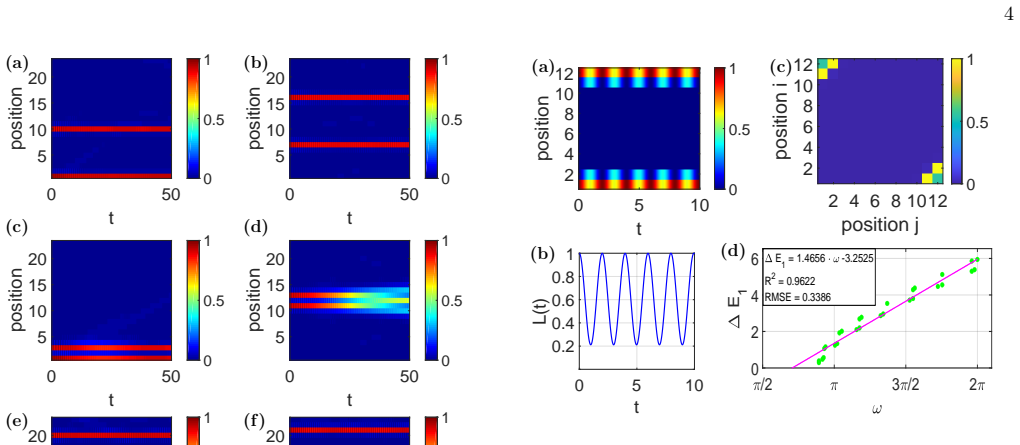
We investigate the dynamics of two identical spinless fermions on a one-dimensional lattice with open boundary conditions, subject to quasiperiodic long-range interactions. Using numerical exact diagonalization, we uncover a robust correlated dynamical regime characterized by an approximately constant inter-particle distance that emerges under sufficiently strong quasiperiodic modulation of the long-range interactions. By tuning the phase of the quasiperiodic modulation, three distinct manifestations arise: localization, nearest-neighbor separation oscillations, and next-nearest-neighbor separation transitions for specific initial separations, along with suppression of entanglement entropy.
What carries the argument
Quasiperiodic modulation applied to the long-range interaction potential in the Hamiltonian governing the continuous-time quantum walk of the two fermions.
If this is right
- The correlated regime with constant separation appears for strong enough modulation strengths.
- Different phases of the modulation lead to localization or oscillatory separation behaviors.
- Entanglement entropy growth is suppressed, sometimes showing oscillations.
- The phenomenon is sensitive to the choice of open boundary conditions and interaction nature.
- Initial particle separation determines which manifestation occurs.
Where Pith is reading between the lines
- Such modulation could be used to engineer stable pair states in quantum lattice systems.
- Similar quasiperiodic effects might stabilize correlations in systems with more particles or different statistics.
- Experimental platforms with tunable long-range interactions could test the constant-distance regime directly.
Load-bearing premise
Numerical results from exact diagonalization on small finite lattices with specific initial conditions accurately capture the general robust dynamical regime without significant finite-size effects.
What would settle it
Simulations on much larger lattices showing whether the inter-particle distance remains constant over extended evolution times under the same modulation conditions.
Figures




read the original abstract
We investigate the dynamics of two identical spinless fermions on a one-dimensional lattice with open boundary conditions (OBC), subject to quasiperiodic long-range interactions. Using numerical exact diagonalization (ED), we study this non-integrable system as a continuous-time quantum walk and uncover a robust correlated dynamical regime. This regime, characterized by an approximately constant inter-particle distance, emerges under sufficiently strong quasiperiodic modulation of the long-range interactions. Further, the study shows that the behavior is determined by the nature of the interaction and the choice of boundary condition. Notably, by tuning the phase of the quasiperiodic modulation, we observe three distinct manifestations of this phenomenon: localization, nearest-neighbor separation oscillations, and next-nearest-neighbor separation transitions -- each arising for specific initial separations. Furthermore, we identify the suppression of entanglement entropy in the system, including instances of oscillatory behavior. Our results highlight how quasiperiodic long-range interactions shape few-body quantum dynamics.
Editorial analysis
A structured set of objections, weighed in public.
Referee Report
Summary. The paper studies the continuous-time quantum walk dynamics of two identical spinless fermions on a finite 1D lattice with open boundary conditions under quasiperiodic long-range interactions. Using exact diagonalization, it reports the emergence of a robust correlated regime featuring approximately constant inter-particle distance for sufficiently strong quasiperiodic modulation; this regime exhibits three phase-dependent manifestations (localization, nearest-neighbor oscillations, next-nearest-neighbor transitions) tied to initial separation, together with suppression of entanglement entropy. The behavior is stated to depend on the form of the interaction and the choice of boundary conditions.
Significance. If the constant-distance regime survives finite-size scaling and persists in the thermodynamic limit, the results would illustrate how quasiperiodic modulation of long-range interactions can stabilize correlated few-body states, offering a concrete example of interaction-induced dynamical localization in non-integrable systems that could be tested in quantum simulators.
major comments (2)
- [Abstract and results section] The central claim of a 'robust' correlated regime with approximately constant inter-particle distance rests on ED time evolution for finite open-boundary lattices (abstract and results section). No finite-size scaling, variation of lattice length L, or thermodynamic-limit extrapolation is reported, despite the abstract explicitly noting dependence on boundary conditions; this leaves open the possibility that the observed constancy is a transient or boundary-induced artifact, directly undermining the robustness qualifier.
- [Results section] The three distinct manifestations (localization, NN oscillations, NNN transitions) are tied to specific modulation phases and initial separations, but the manuscript provides no systematic scan over the modulation strength parameter or phase values to delineate the boundaries of these regimes, making it unclear whether the reported behaviors are generic or confined to the chosen parameter points.
minor comments (2)
- [Abstract] The abstract states that entanglement entropy is suppressed, including oscillatory behavior, but does not specify the initial state or quantify the suppression relative to the unmodulated case.
- [Figure captions] Figures showing time evolution of inter-particle distance lack labels for the specific lattice size L, modulation amplitude, and time-step convergence checks used in the ED.
Simulated Author's Rebuttal
We thank the referee for the careful reading and constructive comments on our manuscript. We address the major points below and will incorporate revisions to strengthen the presentation of our results.
read point-by-point responses
-
Referee: [Abstract and results section] The central claim of a 'robust' correlated regime with approximately constant inter-particle distance rests on ED time evolution for finite open-boundary lattices (abstract and results section). No finite-size scaling, variation of lattice length L, or thermodynamic-limit extrapolation is reported, despite the abstract explicitly noting dependence on boundary conditions; this leaves open the possibility that the observed constancy is a transient or boundary-induced artifact, directly undermining the robustness qualifier.
Authors: We agree that our results are obtained via exact diagonalization on finite lattices and that the manuscript does not include explicit finite-size scaling or thermodynamic-limit extrapolation. The constant-distance regime was observed consistently for the accessible system sizes (L ranging from 12 to 24 sites). In the revised manuscript we will add a dedicated subsection on finite-size effects, including explicit comparisons of the inter-particle distance dynamics for multiple values of L, and we will qualify the term 'robust' to reflect the finite-size scope of the study while noting that the behavior persists across the sizes examined. revision: partial
-
Referee: [Results section] The three distinct manifestations (localization, NN oscillations, NNN transitions) are tied to specific modulation phases and initial separations, but the manuscript provides no systematic scan over the modulation strength parameter or phase values to delineate the boundaries of these regimes, making it unclear whether the reported behaviors are generic or confined to the chosen parameter points.
Authors: The manuscript illustrates the three manifestations at representative parameter points chosen to demonstrate the phase dependence. We agree that a systematic parameter scan would better define the regime boundaries. In the revision we will add a new figure (or supplementary material) that maps the inter-particle distance behavior over a range of modulation strengths and phases, thereby clarifying the extent of each dynamical regime. revision: yes
Circularity Check
No significant circularity: results from direct numerical time evolution
full rationale
The paper specifies a Hamiltonian with quasiperiodic long-range interactions, performs exact diagonalization on finite open-boundary chains, and reports time-evolved observables such as inter-particle distance and entanglement entropy. No parameters are fitted to data in a manner that re-predicts the same quantities, no equations reduce the central regime to a self-definition, and no load-bearing claims rest on self-citations or imported uniqueness theorems. The numerical protocol is self-contained against the stated model and initial conditions.
Axiom & Free-Parameter Ledger
free parameters (2)
- quasiperiodic modulation strength
- modulation phase
axioms (2)
- domain assumption The two-particle system on an open 1D lattice is accurately described by a time-independent Hamiltonian with quasiperiodic long-range interactions.
- domain assumption Exact diagonalization on finite lattices captures the essential dynamics without significant finite-size artifacts for the reported regimes.
Lean theorems connected to this paper
-
IndisputableMonolith/Cost/FunctionalEquation.leanwashburn_uniqueness_aczel unclear?
unclearRelation between the paper passage and the cited Recognition theorem.
We investigate the dynamics of two identical spinless fermions on a one-dimensional lattice with open boundary conditions (OBC), subject to quasiperiodic long-range interactions. Using numerical exact diagonalization (ED)... uncover a robust correlated dynamical regime, characterized by an approximately constant inter-particle distance
-
IndisputableMonolith/Foundation/DimensionForcing.leanreality_from_one_distinction unclear?
unclearRelation between the paper passage and the cited Recognition theorem.
The interaction term U = ∑ Δ cos(2πβ|i-j| + ϕ) n_i n_j ... β chosen as an irrational number to realize quasiperiodicity
What do these tags mean?
- matches
- The paper's claim is directly supported by a theorem in the formal canon.
- supports
- The theorem supports part of the paper's argument, but the paper may add assumptions or extra steps.
- extends
- The paper goes beyond the formal theorem; the theorem is a base layer rather than the whole result.
- uses
- The paper appears to rely on the theorem as machinery.
- contradicts
- The paper's claim conflicts with a theorem or certificate in the canon.
- unclear
- Pith found a possible connection, but the passage is too broad, indirect, or ambiguous to say the theorem truly supports the claim.
Reference graph
Works this paper leans on
-
[1]
Eight representative initial positions were selected: 3 (1,2),(1,34),(1,17),(5,15),(10,25),(8,26),(3,31), (15,20). They cover a range of inter-particle distances, including cases where both particles are on the same boundary, on opposite boundaries, one on a boundary and one in the interior, or both in the interior. The expected inter-particle distance, ⟨...
-
[2]
in Fig. 4(b) is defined as L(t) = ⟨Ψ(0)|e−i ˆHt |Ψ(0)⟩ 2 ,(10) 5 7.36 -10.00 7.39 17 18 19r -10 -5 0 5 10 (a) 0 5 t 5 10 15 20position 0 0.5 1 (b) 5 10 15 20 position j 5 10 15 20position i 0 0.5 1 (c) FIG. 5. Next-nearest-neighbor separation transitions. (a) Interaction energies for initial separations of 17, 18, and 19. (b) Time evolution of the probabi...
-
[3]
A. Polkovnikov, K. Sengupta, A. Silva, and M. Vengalat- tore, Reviews of Modern Physics83, 863 (2011)
work page 2011
- [4]
- [5]
-
[6]
M. Saffman, T. G. Walker, and K. Mølmer, Reviews of modern physics82, 2313 (2010)
work page 2010
- [7]
-
[8]
L. D. Carr, D. DeMille, R. V. Krems, and J. Ye, New Journal of Physics11, 055049 (2009)
work page 2009
- [9]
- [10]
-
[11]
F. Mivehvar, F. Piazza, T. Donner, and H. Ritsch, Ad- vances in Physics70, 1 (2021)
work page 2021
-
[12]
Z. Wu, J. Fan, X. Zhang, J. Qi, and H. Wu, Physical Review Letters131, 243401 (2023)
work page 2023
-
[13]
T. D. Ladd, F. Jelezko, R. Laflamme, Y. Nakamura, C. Monroe, and J. L. O’Brien, nature464, 45 (2010)
work page 2010
- [14]
-
[15]
M. Schreiber, S. S. Hodgman, P. Bordia, H. P. L¨ uschen, M. H. Fischer, R. Vosk, E. Altman, U. Schneider, and I. Bloch, Science349, 842 (2015)
work page 2015
-
[16]
Mastropietro, Physical review letters115, 180401 (2015)
V. Mastropietro, Physical review letters115, 180401 (2015)
work page 2015
-
[17]
See Supplemental Material athttps://arxiv.org/src/ 2603.25045/anc/for details
work page internal anchor Pith review Pith/arXiv arXiv
- [18]
-
[19]
T. Nicholson, S. Blatt, B. Bloom, J. Williams, J. Thom- sen, J. Ye, and P. S. Julienne, Physical Review A92, 022709 (2015)
work page 2015
-
[20]
L. W. Clark, L.-C. Ha, C.-Y. Xu, and C. Chin, Physical review letters115, 155301 (2015)
work page 2015
- [21]
- [22]
-
[23]
L. Wang, N. Liu, S. Chen, and Y. Zhang, Physical Re- view A92, 053606 (2015)
work page 2015
-
[24]
J. J. Sakurai and J. Napolitano, Modern quantum mechanics (Cambridge university press, 2020)
work page 2020
-
[25]
C. A. M¨ uller and D. Delande, arXiv preprint arXiv:1005.0915 (2010)
work page internal anchor Pith review Pith/arXiv arXiv 2010
-
[26]
P. L. Krapivsky, J.-M. Luck, and K. Mallick, Journal of Statistical Mechanics: Theory and Experiment2018, 023104 (2018)
work page 2018
-
[27]
W.-H. Zhong, H.-Q. Lin, and X.-J. Yu, Physical Review B112, 075129 (2025)
work page 2025
discussion (0)
Sign in with ORCID, Apple, or X to comment. Anyone can read and Pith papers without signing in.