Recognition: 2 theorem links
· Lean TheoremQuantum Finite Temperature Lanczos Method
Pith reviewed 2026-05-15 06:58 UTC · model grok-4.3
The pith
The Quantum Finite Temperature Lanczos Method computes thermal expectation values on quantum computers without classical exponential scaling.
A machine-rendered reading of the paper's core claim, the machinery that carries it, and where it could break.
Core claim
QFTLM extends the finite-temperature Lanczos method to quantum computers by combining real-time quantum Krylov methods with efficient preparation of typical states for trace estimation. This enables computation of thermal expectation values while avoiding exponential scaling, as shown by numerical experiments on the transverse-field Ising model that reproduce thermal observables over a wide temperature range, with analysis showing the importance of Krylov dimension, trace-estimator states, and regularization for noisy settings.
What carries the argument
The Quantum Finite Temperature Lanczos Method (QFTLM) that combines real-time quantum Krylov methods with typical state preparation to perform trace estimation for thermal averages.
If this is right
- Thermal expectation values become accessible for quantum systems too large for classical exact methods.
- Real-time evolution on quantum hardware replaces classical matrix operations in the Lanczos procedure.
- Finite Krylov dimensions and modest numbers of trace estimators suffice for accurate results when regularized properly.
- Robustness on noisy hardware requires suitable regularization to control Trotter and sampling errors.
Where Pith is reading between the lines
- QFTLM may apply to studying phase transitions at finite temperature in models beyond the Ising chain.
- Combining this with error correction could scale to even larger systems on future quantum devices.
- Similar Krylov-based approaches might adapt for other quantum statistical mechanics calculations like dynamical correlations.
Load-bearing premise
Suitable regularization together with finite Krylov dimension and modest trace-estimator states can keep Trotter and sampling errors under control on noisy quantum hardware for system sizes beyond small models.
What would settle it
Implementation on actual quantum hardware for a moderately sized system where classical simulation is feasible, checking if computed thermal observables match exact results within predicted error bounds.
Figures


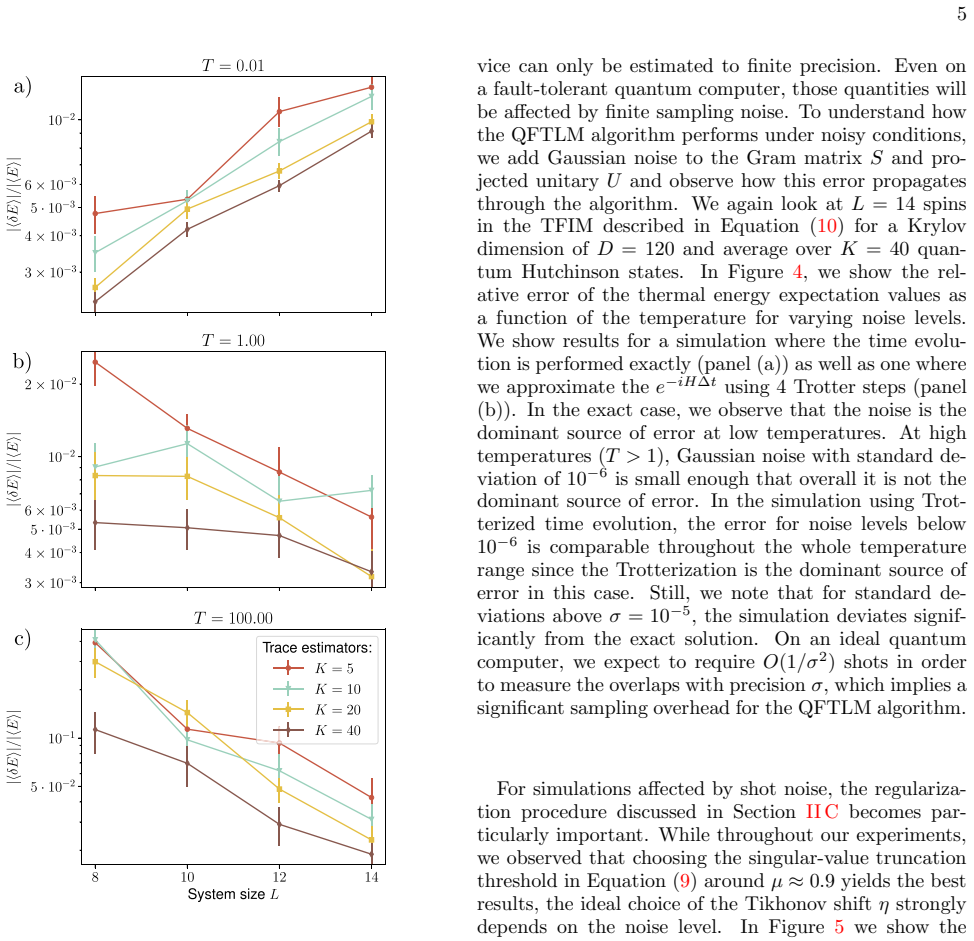
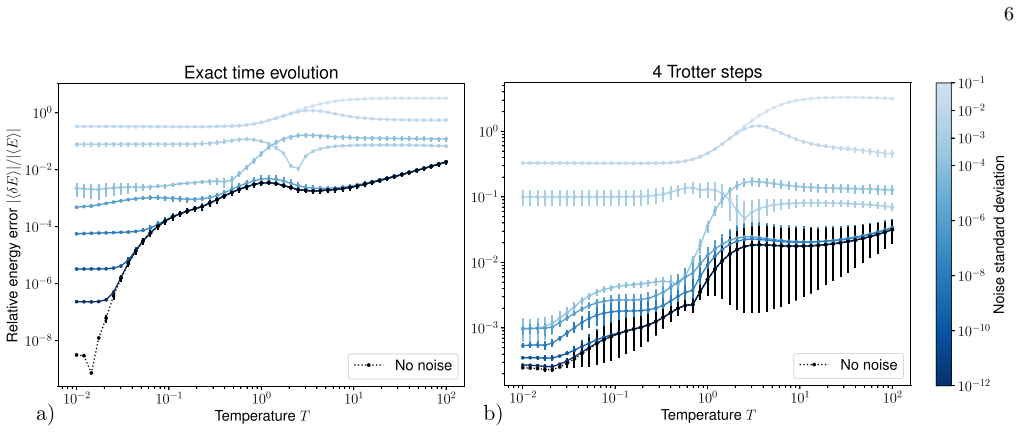
read the original abstract
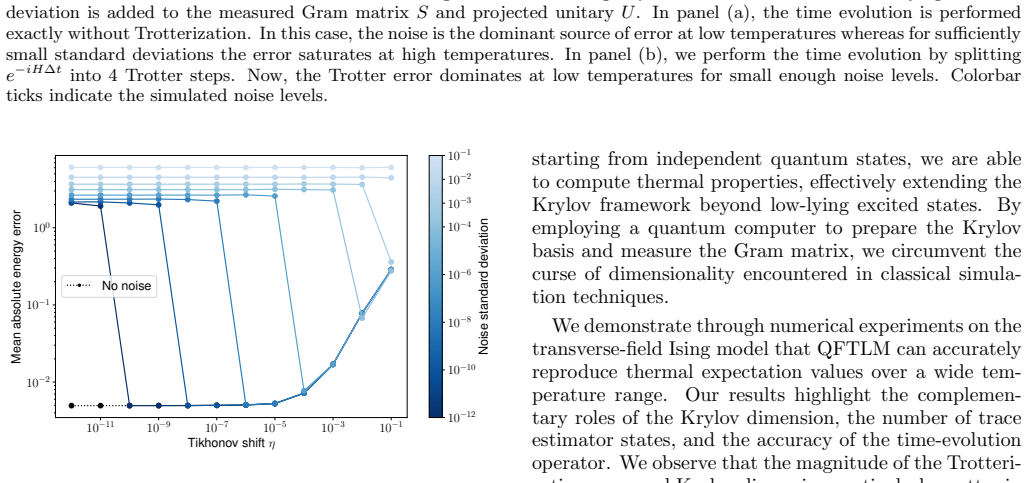
The computation of thermal properties of quantum many-body systems is a central challenge in our understanding of quantum mechanics. We introduce the Quantum Finite Temperature Lanczos Method (QFTLM), which extends the finite-temperature Lanczos method to quantum computers by combining real-time quantum Krylov methods with efficient preparation of typical states for trace estimation. This approach enables the computation of thermal expectation values while avoiding the exponential scaling inherent to classical exact simulation techniques. Numerical experiments on the transverse-field Ising model show that QFTLM can reproduce thermal observables over a wide temperature range. We further analyze the influence of Krylov dimension, number of trace-estimator states, and Trotter error, and show that suitable regularization is essential for robustness in noisy settings. These results establish QFTLM as a promising framework for finite-temperature quantum simulation.
Editorial analysis
A structured set of objections, weighed in public.
Referee Report
Summary. The paper introduces the Quantum Finite Temperature Lanczos Method (QFTLM), which extends the classical finite-temperature Lanczos approach to quantum computers by combining real-time quantum Krylov subspace methods with efficient preparation of typical states for trace estimation. This enables computation of thermal expectation values while sidestepping the exponential cost of classical exact diagonalization. Numerical experiments on the transverse-field Ising model are reported to reproduce thermal observables over a wide temperature range, with additional analysis of the effects of Krylov dimension, number of trace-estimator states, Trotter error, and regularization for noisy hardware robustness.
Significance. If the error-control assumptions hold, QFTLM would offer a scalable route to finite-temperature observables on quantum hardware for system sizes inaccessible to exact classical methods. The explicit treatment of regularization for noise robustness and the parameter choices (Krylov dimension, trace states) are strengths that could make the approach practically relevant for near-term devices.
major comments (2)
- [Numerical experiments] Numerical experiments section: the reported reproduction of thermal observables on the transverse-field Ising model is described only qualitatively, with no quantitative error bars, convergence plots versus Krylov dimension K or trace-estimator count M, or tabulated deviations from exact results; without these data the accuracy claim over a wide temperature range cannot be rigorously assessed.
- [Scaling and noise analysis] Scaling and noise analysis: the central claim that QFTLM remains accurate for system sizes N where classical exact diagonalization is intractable rests on the assumption that modest fixed K, M, and Trotter steps suffice; however, no explicit scaling data or noise-model simulations are provided for N>12, where circuit depth and accumulated errors grow, leaving the extrapolation untested.
minor comments (1)
- [Abstract] The abstract states that regularization is 'essential for robustness' but the main text does not define the regularization operator or its strength parameter explicitly in terms of the Krylov matrix.
Simulated Author's Rebuttal
We thank the referee for their careful reading and constructive comments on our manuscript. We address each major comment below and will revise the manuscript accordingly.
read point-by-point responses
-
Referee: Numerical experiments section: the reported reproduction of thermal observables on the transverse-field Ising model is described only qualitatively, with no quantitative error bars, convergence plots versus Krylov dimension K or trace-estimator count M, or tabulated deviations from exact results; without these data the accuracy claim over a wide temperature range cannot be rigorously assessed.
Authors: We agree that quantitative metrics would strengthen the presentation. The current figures show visual agreement, but the revised manuscript will include error bars on all thermal observable plots, convergence curves versus K and M, and a table of absolute deviations from exact results at representative temperatures. These additions will be incorporated in the next version. revision: yes
-
Referee: Scaling and noise analysis: the central claim that QFTLM remains accurate for system sizes N where classical exact diagonalization is intractable rests on the assumption that modest fixed K, M, and Trotter steps suffice; however, no explicit scaling data or noise-model simulations are provided for N>12, where circuit depth and accumulated errors grow, leaving the extrapolation untested.
Authors: We acknowledge that direct numerical evidence for N>12 is absent. Classical simulation limits prevent exact comparisons beyond N=12, so we will add a theoretical scaling analysis showing that cost remains polynomial in N for fixed K and M, plus noise-model simulations on the available system sizes to demonstrate robustness. This provides supporting evidence while noting the inherent verification limits. revision: partial
- Explicit numerical data or exact comparisons for N>12 cannot be provided, as classical exact diagonalization is intractable for those sizes.
Circularity Check
QFTLM defined via independent user parameters with no self-referential reduction
full rationale
The method is introduced by extending classical finite-temperature Lanczos via real-time quantum Krylov subspaces and trace estimation over typical states. All load-bearing quantities (Krylov dimension, number of trace-estimator states, Trotter steps, regularization strength) are explicitly user-chosen inputs rather than quantities fitted to the target thermal observable. Numerical experiments on the transverse-field Ising model serve as external validation; no equation equates a derived prediction back to a fitted parameter by construction, and no central claim rests on a self-citation chain that itself lacks independent support. This yields only a minor self-citation score consistent with normal scholarly practice.
Axiom & Free-Parameter Ledger
free parameters (3)
- Krylov dimension
- Number of trace-estimator states
- Regularization strength
axioms (2)
- domain assumption Standard quantum mechanics and the ability to prepare typical states for trace estimation
- domain assumption Real-time quantum Krylov methods can be implemented with controllable Trotter error
Lean theorems connected to this paper
-
IndisputableMonolith/Cost/FunctionalEquation.leanwashburn_uniqueness_aczel unclear?
unclearRelation between the paper passage and the cited Recognition theorem.
We introduce the Quantum Finite Temperature Lanczos Method (QFTLM), which extends the finite-temperature Lanczos method to quantum computers by combining real-time quantum Krylov methods with efficient preparation of typical states for trace estimation.
-
IndisputableMonolith/Foundation/RealityFromDistinction.leanreality_from_one_distinction unclear?
unclearRelation between the paper passage and the cited Recognition theorem.
Numerical experiments on the transverse-field Ising model show that QFTLM can reproduce thermal observables over a wide temperature range.
What do these tags mean?
- matches
- The paper's claim is directly supported by a theorem in the formal canon.
- supports
- The theorem supports part of the paper's argument, but the paper may add assumptions or extra steps.
- extends
- The paper goes beyond the formal theorem; the theorem is a base layer rather than the whole result.
- uses
- The paper appears to rely on the theorem as machinery.
- contradicts
- The paper's claim conflicts with a theorem or certificate in the canon.
- unclear
- Pith found a possible connection, but the passage is too broad, indirect, or ambiguous to say the theorem truly supports the claim.
Forward citations
Cited by 1 Pith paper
-
Finite-temperature quantum Krylov method from real-time overlaps
Real-time overlap sequences g_n enable extraction of specific heat, susceptibility, and entropy over a broad temperature range for quantum systems like the Heisenberg chain without target-temperature state preparation.
Reference graph
Works this paper leans on
-
[1]
N. D. Mermin, Thermal Properties of the Inhomogeneous Electron Gas, Physical Review137, A1441 (1965)
work page 1965
-
[2]
A. Georges, G. Kotliar, W. Krauth, and M. J. Rozen- berg, Dynamical mean-field theory of strongly correlated fermion systems and the limit of infinite dimensions, Re- views of Modern Physics68, 13 (1996)
work page 1996
-
[3]
A. F. White and G. Kin-Lic Chan, Finite-temperature coupled cluster: Efficient implementation and applica- tion to prototypical systems, The Journal of Chemical Physics152, 224104 (2020)
work page 2020
- [4]
-
[5]
C. Sun, U. Ray, Z.-H. Cui, M. Stoudenmire, M. Fer- rero, and G. K.-L. Chan, Finite-temperature density ma- trix embedding theory, Physical Review B101, 075131 (2020)
work page 2020
- [6]
-
[7]
J. Jakliˇ c and P. Prelovˇ sek, Lanczos method for the calcu- lation of finite-temperature quantities in correlated sys- tems, Physical Review B49, 5065 (1994)
work page 1994
-
[8]
G. H. Golub and G. Meurant,Matrices, Moments and Quadrature with Applications, Princeton Series in Ap- plied Mathematics (Princeton University Press, 2010)
work page 2010
-
[9]
H. Avron and S. Toledo, Randomized algorithms for esti- mating the trace of an implicit symmetric positive semi- definite matrix, J. ACM58, 10.1145/1944345.1944349 (2011)
-
[10]
G. H. Golub and C. F. Van Loan,Matrix Computations - 4th Edition(Johns Hopkins University Press, Philadel- phia, PA, 2013)
work page 2013
-
[11]
F. Roosta-Khorasani and U. Ascher, Improved bounds on sample size for implicit matrix trace estimators, Founda- tions of Computational Mathematics15, 1187 (2015)
work page 2015
- [12]
-
[13]
P.-G. Martinsson and J. A. Tropp, Randomized numer- ical linear algebra: Foundations and algorithms, Acta Numerica29, 403 (2020)
work page 2020
-
[14]
M. Hutchinson, A stochastic estimator of the trace of the influence matrix for Laplacian smoothing splines, Com- munication in Statistics- Simulation and Computation 18, 1059 (1989)
work page 1989
-
[15]
R. P. Feynman, Simulating physics with computers, International Journal of Theoretical Physics21, 467 (1982)
work page 1982
-
[16]
A. Kandala, A. Mezzacapo, K. Temme, M. Takita, M. Brink, J. M. Chow, and J. M. Gambetta, Hardware- efficient variational quantum eigensolver for small molecules and quantum magnets, Nature549, 242 (2017)
work page 2017
- [17]
-
[18]
Aruteet al., Hartree-fock on a superconducting qubit quantum computer, Science369, 1084 (2020)
F. Aruteet al., Hartree-fock on a superconducting qubit quantum computer, Science369, 1084 (2020)
work page 2020
-
[19]
Aruteet al., Observation of separated dynamics of charge and spin in the fermi-hubbard model (2020)
F. Aruteet al., Observation of separated dynamics of charge and spin in the fermi-hubbard model (2020)
work page 2020
-
[20]
C. Neillet al., Accurately computing the electronic prop- erties of a quantum ring, Nature594, 508 (2021)
work page 2021
-
[21]
J. R. McClean, M. E. Kimchi-Schwartz, J. Carter, and W. A. de Jong, Hybrid quantum-classical hierarchy for mitigation of decoherence and determination of excited states, Phys. Rev. A95, 042308 (2017)
work page 2017
-
[22]
J. I. Colless, V. V. Ramasesh, D. Dahlen, M. S. Blok, M. E. Kimchi-Schwartz, J. R. McClean, J. Carter, W. A. de Jong, and I. Siddiqi, Computation of molecular spec- tra on a quantum processor with an error-resilient algo- rithm, Phys. Rev. X8, 011021 (2018)
work page 2018
- [23]
- [24]
-
[25]
T. Takeshita, N. C. Rubin, Z. Jiang, E. Lee, R. Babbush, and J. R. McClean, Increasing the representation accu- racy of quantum simulations of chemistry without extra quantum resources, Phys. Rev. X10, 011004 (2020)
work page 2020
-
[26]
W. J. Huggins, J. Lee, U. Baek, B. O’Gorman, and K. B. Whaley, A non-orthogonal variational quantum eigen- solver, New Journal of Physics22, 073009 (2020)
work page 2020
-
[27]
N. H. Stair, R. Huang, and F. A. Evangelista, A multiref- erence quantum Krylov algorithm for strongly correlated 8 electrons,Journal of Chemical Theory and Computation, Journal of Chemical Theory and Computation16, 2236 (2020)
work page 2020
-
[28]
M. Urbanek, D. Camps, R. Van Beeumen, and W. A. de Jong, Chemistry on quantum computers with virtual quantum subspace expansion, Journal of Chemical The- ory and Computation16, 5425 (2020)
work page 2020
-
[29]
O. Kyriienko, Quantum inverse iteration algorithm for programmable quantum simulators, npj Quantum Infor- mation6, 7 (2020)
work page 2020
-
[30]
J. Cohn, M. Motta, and R. M. Parrish, Quantum filter di- agonalization with compressed double-factorized Hamil- tonians, PRX Quantum2, 040352 (2021)
work page 2021
-
[31]
N. Yoshioka, H. Hakoshima, Y. Matsuzaki, Y. Tokunaga, Y. Suzuki, and S. Endo, Generalized quantum subspace expansion, Phys. Rev. Lett.129, 020502 (2022)
work page 2022
-
[32]
E. N. Epperly, L. Lin, and Y. Nakatsukasa, A theory of quantum subspace diagonalization, SIAM Journal on Matrix Analysis and Applications43, 1263 (2022)
work page 2022
-
[33]
K. Seki and S. Yunoki, Quantum power method by a superposition of time-evolved states, PRX Quantum2, 010333 (2021)
work page 2021
-
[34]
T. A. Bespalova and O. Kyriienko, Hamiltonian operator approximation for energy measurement and ground-state preparation, PRX Quantum2, 030318 (2021)
work page 2021
-
[35]
T. E. Baker, Lanczos recursion on a quantum computer for the Green’s function and ground state, Phys. Rev. A 103, 032404 (2021)
work page 2021
-
[36]
T. E. Baker, Block Lanczos method for excited states on a quantum computer, Phys. Rev. A110, 012420 (2024)
work page 2024
-
[37]
C. L. Cortes and S. K. Gray, Quantum Krylov subspace algorithms for ground- and excited-state energy estima- tion, Phys. Rev. A105, 022417 (2022)
work page 2022
- [38]
- [39]
-
[40]
U. Baek, D. Hait, J. Shee, O. Leimkuhler, W. J. Hug- gins, T. F. Stetina, M. Head-Gordon, and K. B. Whaley, Say no to optimization: A nonorthogonal quantum eigen- solver, PRX Quantum4, 030307 (2023)
work page 2023
-
[41]
N. V. Tkachenko, L. Cincio, A. I. Boldyrev, S. Tretiak, P. A. Dub, and Y. Zhang, Quantum Davidson algorithm for excited states, Quantum Science and Technology9, 035012 (2024)
work page 2024
-
[42]
G. Lee, D. Lee, and J. Huh, Sampling Error Analysis in Quantum Krylov Subspace Diagonalization, Quantum8, 1477 (2024)
work page 2024
- [43]
- [44]
-
[45]
Y. Shen, K. Klymko, J. Sud, D. B. Williams-Young, W. A. d. Jong, and N. M. Tubman, Real-Time Krylov Theory for Quantum Computing Algorithms, Quantum 7, 1066 (2023)
work page 2023
-
[46]
B. Yang, N. Yoshioka, H. Harada, S. Hakkaku, Y. Toku- naga, H. Hakoshima, K. Yamamoto, and S. Endo, Resource-efficient generalized quantum subspace expan- sion, Phys. Rev. Appl.23, 054021 (2025)
work page 2025
-
[47]
R. Yang, T. Wang, B.-N. Lu, Y. Li, and X. Xu, Shadow- based quantum subspace algorithm for the nuclear shell model, Phys. Rev. A111, 012620 (2025)
work page 2025
- [48]
- [49]
-
[50]
L. W. Anderson, M. Kiffner, T. O’Leary, J. Crain, and D. Jaksch, Solving lattice gauge theories using the quan- tum Krylov algorithm and qubitization, Quantum9, 1669 (2025)
work page 2025
-
[51]
Kirby, Analysis of quantum Krylov algorithms with errors, Quantum8, 1457 (2024)
W. Kirby, Analysis of quantum Krylov algorithms with errors, Quantum8, 1457 (2024)
work page 2024
-
[52]
N. Yoshioka, M. Amico, W. Kirby, P. Jurcevic, A. Dutt, B. Fuller, S. Garion, H. Haas, I. Hamamura, A. Ivrii, R. Majumdar, Z. Minev, M. Motta, B. Pokharel, P. Rivero, K. Sharma, C. J. Wood, A. Javadi-Abhari, and A. Mezzacapo, Krylov diagonalization of large many- body Hamiltonians on a quantum processor, Nature Communications16, 5014 (2025)
work page 2025
- [53]
-
[54]
J. Yu, J. R. Moreno, J. T. Iosue, L. Bertels, D. Claudino, B. Fuller, P. Groszkowski, T. S. Humble, P. Jurce- vic, W. Kirby, T. A. Maier, M. Motta, B. Pokharel, A. Seif, A. Shehata, K. J. Sung, M. C. Tran, V. Tripathi, A. Mezzacapo, and K. Sharma, Quantum-centric algo- rithm for sample-based krylov diagonalization (2025), arXiv:2501.09702 [quant-ph]
-
[55]
S. Piccinelli, A. Baiardi, S. Barison, M. Rossmannek, A. C. Vazquez, F. Tacchino, S. Mensa, E. Altamura, A. Alavi, M. Motta, J. Robledo-Moreno, W. Kirby, K. Sharma, A. Mezzacapo, and I. Tavernelli, Quan- tum chemistry with provable convergence via randomized sample-based krylov quantum diagonalization (2026), arXiv:2508.02578 [quant-ph]
- [56]
-
[57]
C. Lanczos, An iteration method for the solution of the eigenvalue problem of linear differential and integral op- erators, Journal of Research of the National Bureau of Standards45, No. 4 (1950)
work page 1950
-
[58]
T. Iitaka and T. Ebisuzaki, Random phase vector for cal- culating the trace of a large matrix, Phys. Rev. E69, 057701 (2004)
work page 2004
-
[59]
J. Schnack, J. Richter, and R. Steinigeweg, Accuracy of the finite-temperature Lanczos method compared to sim- ple typicality-based estimates, Physical Review Research 2, 013186 (2020), arXiv:1911.08838 [cond-mat]
-
[60]
J. Schnack, J. Schulenburg, and J. Richter, Magnetism of the$N=42$kagome lattice antiferromagnet, Physical Review B98, 094423 (2018). 9
work page 2018
- [61]
-
[62]
T. Schuster, J. Haferkamp, and H.-Y. Huang, Random unitaries in extremely low depth, Science389, 92 (2025), https://www.science.org/doi/pdf/10.1126/science.adv8590
-
[63]
The Complexity of Quantum States and Transformations: From Quantum Money to Black Holes
S. Aaronson, The complexity of quantum states and transformations: From quantum money to black holes (2016), arXiv:1607.05256 [quant-ph]
work page internal anchor Pith review Pith/arXiv arXiv 2016
- [64]
-
[65]
C. Dankert, R. Cleve, J. Emerson, and E. Livine, Ex- act and approximate unitary 2-designs and their applica- tion to fidelity estimation, Physical Review A80, 012304 (2009)
work page 2009
-
[66]
D. Gross, K. Audenaert, and J. Eisert, Evenly distributed unitaries: On the structure of unitary designs, Journal of Mathematical Physics48, 10.1063/1.2716992 (2007)
-
[67]
A. W. Harrow, A. Hassidim, and S. Lloyd, Quantum Al- gorithm for Linear Systems of Equations, Physical Re- view Letters103, 150502 (2009)
work page 2009
-
[68]
G. H. Low and I. L. Chuang, Hamiltonian Simulation by Qubitization, Quantum3, 163 (2019)
work page 2019
- [69]
-
[70]
D. Aharonov, V. Jones, and Z. Landau, A polynomial quantum algorithm for approximating the jones polyno- mial, inProceedings of the Thirty-Eighth Annual ACM Symposium on Theory of Computing(Association for Computing Machinery, New York, NY, USA, 2006) pp. 427–436
work page 2006
-
[71]
L¨ owdin, On the Nonorthogonality Problem, Ad- vances in Quantum Chemistry5, 185 (1970)
P.-O. L¨ owdin, On the Nonorthogonality Problem, Ad- vances in Quantum Chemistry5, 185 (1970)
work page 1970
-
[72]
N. Hatano and M. Suzuki, Finding exponential prod- uct formulas of higher orders, inQuantum Annealing and Other Optimization Methods, edited by A. Das and B. K. Chakrabarti (Springer Berlin Heidelberg, Berlin, Heidelberg, 2005) pp. 37–68
work page 2005
-
[73]
Lloyd, Universal quantum simulators, Science273, 1073 (1996)
S. Lloyd, Universal quantum simulators, Science273, 1073 (1996)
work page 1996
-
[74]
A. M. Childs, Y. Su, M. C. Tran, N. Wiebe, and S. Zhu, Theory of Trotter Error with Commutator Scaling, Phys- ical Review X11, 011020 (2021)
work page 2021
-
[75]
G. Gentinetta and F. Metz, Code for the manuscript Quantum Finite Temperature Lanczos Method
discussion (0)
Sign in with ORCID, Apple, or X to comment. Anyone can read and Pith papers without signing in.