Recognition: 2 theorem links
· Lean TheoremFinite-temperature quantum Krylov method from real-time overlaps
Pith reviewed 2026-05-10 16:25 UTC · model grok-4.3
The pith
Real-time overlap measurements at fixed intervals allow thermodynamic quantities to be extracted across many temperatures without preparing states at each target temperature.
A machine-rendered reading of the paper's core claim, the machinery that carries it, and where it could break.
Core claim
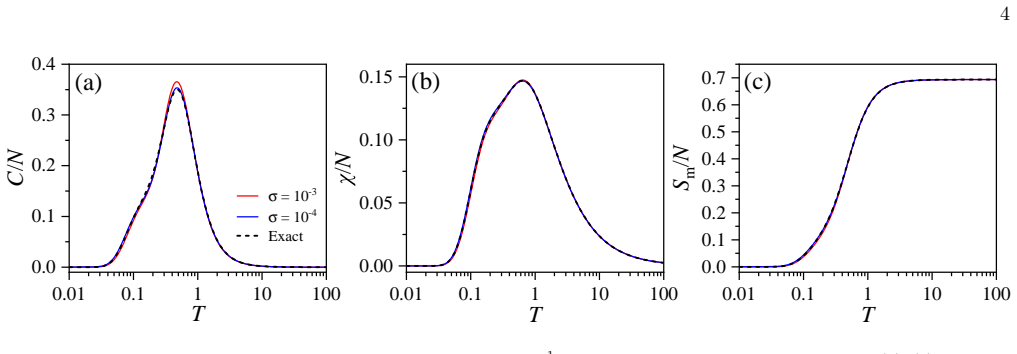
Thermodynamic quantities are obtained from the real-time overlap sequence g_n = ⟨ϕ|e^{-inτH}|ϕ⟩ over a broad temperature range without specifying a target temperature on the quantum device. For the one-dimensional spin-1/2 Heisenberg model with periodic boundaries, accurate specific heat, magnetic susceptibility, and entropy are recovered in the noiseless case; susceptibility is also evaluated without explicit symmetry-sector decomposition using pseudorandom vectors compatible with S_tot^z conservation. With suitable stabilization the method retains the main thermodynamic features under finite-shot errors up to σ ∼ 10^{-3}.
What carries the argument
The real-time overlap sequence g_n, which encodes dynamical information that classical post-processing converts into finite-temperature thermodynamics inside a quantum Krylov framework.
Load-bearing premise
The real-time overlaps can be measured accurately on quantum hardware and classical post-processing with stabilization can recover the thermodynamic quantities reliably from those overlaps.
What would settle it
If the computed specific heat or susceptibility for the Heisenberg chain from measured g_n deviates substantially from exact diagonalization results once realistic shot noise is included, the recovery procedure would be shown not to work as claimed.
Figures

read the original abstract
Accurately evaluating finite-temperature properties of quantum many-body systems remains a central challenge. Many existing quantum approaches typically require thermal-state preparation at each target temperature, making low-temperature calculations especially demanding in terms of circuit depth and accuracy. Here we introduce a distinct framework based only on the real-time overlap sequence $g_n=\langle \phi|e^{-in\tau H}|\phi\rangle$, which enables thermodynamic quantities to be obtained over a broad temperature range, without specifying a target temperature on the quantum device. For the one-dimensional spin-$\frac{1}{2}$ Heisenberg model with periodic boundary conditions, we obtain accurate specific heat, magnetic susceptibility, and entropy in the noiseless case. Magnetic susceptibility is also evaluated accurately without explicit symmetry-sector decomposition by employing pseudorandom vectors compatible with $S_{\mathrm{tot}}^{z}$ conservation. With suitable stabilization, the method further retains the main thermodynamic features under finite-shot statistical errors up to $\sigma\sim10^{-3}$. Our results establish real-time-overlap-based finite-temperature evaluation as a promising framework for finite-temperature computation on near-future quantum hardware.
Editorial analysis
A structured set of objections, weighed in public.
Referee Report
Summary. The manuscript introduces a finite-temperature quantum Krylov framework that computes thermodynamic quantities (specific heat, magnetic susceptibility, entropy) over a broad temperature range solely from the real-time overlap sequence g_n = ⟨ϕ|e^{-inτH}|ϕ⟩, without requiring target-temperature state preparation on the quantum device. For the 1D spin-1/2 Heisenberg model with periodic boundaries, noiseless results match exact diagonalization; magnetic susceptibility is obtained without explicit symmetry-sector decomposition via pseudorandom vectors compatible with S_tot^z conservation. With stabilization, main features survive finite-shot noise up to σ∼10^{-3}.
Significance. If the post-processing proves robust, the approach offers a practical advantage for near-term hardware by shifting temperature specification to classical post-processing and using accessible real-time overlaps rather than thermal-state preparation. The noiseless demonstrations on the Heisenberg model and the symmetry-handling technique via pseudorandom vectors are concrete strengths that could reduce circuit-depth demands.
major comments (2)
- [Numerical results / post-processing description] The stabilization procedure applied to the measured g_n sequence under finite-shot noise is referenced only qualitatively ('with suitable stabilization') without an explicit algorithm, convergence criteria, or error bounds. This is load-bearing for the claim that main thermodynamic features are retained at σ∼10^{-3}, especially since no tests are shown for lower-T regimes (where g_n decay is rapid) or for initial states |ϕ⟩ with incomplete spectral support.
- [Method / overlap-to-thermodynamics mapping] The classical mapping from the finite sequence of overlaps g_n to thermodynamic quantities (e.g., via some form of analytic continuation or fitting) is not accompanied by a quantitative error analysis or stability test when the number of measured g_n is limited, which directly affects the asserted broad temperature range.
minor comments (2)
- [Abstract] The abstract states that susceptibility is evaluated 'accurately' without symmetry decomposition, but does not report the system size or number of g_n terms used; adding these would clarify scalability.
- [Figures] Figure captions and legends could more explicitly indicate which curves correspond to exact diagonalization versus the stabilized quantum-Krylov results to improve immediate readability.
Simulated Author's Rebuttal
We thank the referee for their careful reading of the manuscript and for the constructive comments. We address each major point below and have revised the manuscript to incorporate additional details and tests as requested.
read point-by-point responses
-
Referee: [Numerical results / post-processing description] The stabilization procedure applied to the measured g_n sequence under finite-shot noise is referenced only qualitatively ('with suitable stabilization') without an explicit algorithm, convergence criteria, or error bounds. This is load-bearing for the claim that main thermodynamic features are retained at σ∼10^{-3}, especially since no tests are shown for lower-T regimes (where g_n decay is rapid) or for initial states |ϕ⟩ with incomplete spectral support.
Authors: We agree that the stabilization procedure requires a more explicit description. In the revised manuscript we now provide the full algorithm (a combination of SVD-based truncation followed by Tikhonov regularization on the g_n sequence), the convergence criterion based on the residual norm, and the associated error bounds obtained from the regularization parameter. We have also added numerical tests for lower-temperature regimes and for initial states |ϕ⟩ with deliberately incomplete spectral support, confirming that the principal thermodynamic features remain visible at σ∼10^{-3}. revision: yes
-
Referee: [Method / overlap-to-thermodynamics mapping] The classical mapping from the finite sequence of overlaps g_n to thermodynamic quantities (e.g., via some form of analytic continuation or fitting) is not accompanied by a quantitative error analysis or stability test when the number of measured g_n is limited, which directly affects the asserted broad temperature range.
Authors: We acknowledge the absence of a quantitative stability analysis in the original submission. The revised manuscript now contains a dedicated subsection that (i) specifies the fitting procedure used to extract the thermodynamic quantities from the finite g_n sequence and (ii) reports systematic error estimates and stability tests obtained by successively truncating the number of overlaps. These results quantify the accessible temperature window as a function of sequence length and thereby support the claim of a broad temperature range. revision: yes
Circularity Check
No circularity in the real-time overlap framework
full rationale
The paper proposes computing thermodynamic quantities from the real-time overlap sequence g_n via classical post-processing and stabilization. This chain does not reduce to a self-definition, fitted input renamed as prediction, or load-bearing self-citation; the post-processing steps are independent classical operations applied to measured overlaps, with no equations shown to be tautological by construction. The approach is self-contained against standard quantum mechanics and does not import uniqueness theorems or ansatzes from prior author work.
Axiom & Free-Parameter Ledger
free parameters (1)
- tau
axioms (1)
- standard math Unitary time evolution generated by the Hamiltonian via e^{-i t H}
Lean theorems connected to this paper
-
IndisputableMonolith/Cost/FunctionalEquation.leanwashburn_uniqueness_aczel unclear?
unclearRelation between the paper passage and the cited Recognition theorem.
real-time overlap sequence g_n=⟨ϕ|e^{-inτH}|ϕ⟩ ... Toeplitz form S_nn'=g_{n'-n} ... F_nn' = (g_{n'-n+1}+g_{n'-n-1})/2 ... generalized eigenvalue problem F u = λ S u
-
IndisputableMonolith/Foundation/AlphaCoordinateFixation.leanalpha_pin_under_high_calibration unclear?
unclearRelation between the paper passage and the cited Recognition theorem.
With suitable stabilization, the method further retains the main thermodynamic features under finite-shot statistical errors up to σ∼10^{-3}
What do these tags mean?
- matches
- The paper's claim is directly supported by a theorem in the formal canon.
- supports
- The theorem supports part of the paper's argument, but the paper may add assumptions or extra steps.
- extends
- The paper goes beyond the formal theorem; the theorem is a base layer rather than the whole result.
- uses
- The paper appears to rely on the theorem as machinery.
- contradicts
- The paper's claim conflicts with a theorem or certificate in the canon.
- unclear
- Pith found a possible connection, but the passage is too broad, indirect, or ambiguous to say the theorem truly supports the claim.
Reference graph
Works this paper leans on
-
[1]
Schollw¨ ock, The density-matrix renormalization group in the age of matrix product states, Annals of Physics 326, 96 (2011)
U. Schollw¨ ock, The density-matrix renormalization group in the age of matrix product states, Annals of Physics 326, 96 (2011)
2011
-
[2]
Troyer and U.-J
M. Troyer and U.-J. Wiese, Computational complexity and fundamental limitations to fermionic quantum monte carlo simulations, Physical Review Letters94, 170201 (2005)
2005
-
[3]
Jakliˇ c and P
J. Jakliˇ c and P. Prelovˇ sek, Lanczos method for the calcu- lation of finite-temperature quantities in correlated sys- tems, Physical Review B49, 5065 (1994)
1994
-
[4]
Jakliˇ c and P
J. Jakliˇ c and P. Prelovˇ sek, Finite-temperature properties of doped antiferromagnets, Advances in Physics49, 1 (2000)
2000
-
[5]
Schnack, J
J. Schnack, J. Schulenburg, and J. Richter, Magnetism of theN= 42 kagome lattice antiferromagnet, Physical Review B98, 094423 (2018)
2018
-
[6]
Schnack, J
J. Schnack, J. Richter, and R. Steinigeweg, Accuracy of the finite-temperature Lanczos method compared to sim- ple typicality-based estimates, Physical Review Research 2, 013186 (2020)
2020
-
[7]
Morita and T
K. Morita and T. Tohyama, Finite-temperature proper- ties of the Kitaev-Heisenberg models on kagome and tri- angular lattices studied by improved finite-temperature Lanczos methods, Physical Review Research2, 013205 (2020)
2020
-
[8]
Morita, Isothermal and adiabatic magnetization pro- cesses of the spin- 1 2 Heisenberg model on an anisotropic triangular lattice, Physical Review B105, 064428 (2022)
K. Morita, Isothermal and adiabatic magnetization pro- cesses of the spin- 1 2 Heisenberg model on an anisotropic triangular lattice, Physical Review B105, 064428 (2022)
2022
-
[9]
Morita, Stability of the 1/3 magnetization plateau of theJ 1-J2 kagome Heisenberg model, Physical Review B 108, 184405 (2023)
K. Morita, Stability of the 1/3 magnetization plateau of theJ 1-J2 kagome Heisenberg model, Physical Review B 108, 184405 (2023)
2023
-
[10]
C.-F. Chen, M. J. Kastoryano, F. G. S. L. Brand˜ ao, and A. Gily´ en, Efficient quantum thermal simulation, Nature 646, 561 (2025)
2025
-
[11]
Motta, C
M. Motta, C. Sun, A. T. K. Tan, M. J. O’Rourke, E. Ye, A. J. Minnich, F. G. S. L. Brand˜ ao, and G. K.-L. Chan, Determining eigenstates and thermal states on a quan- tum computer using quantum imaginary time evolution, Nature Physics16, 205 (2020)
2020
-
[12]
Gomes, A
N. Gomes, A. Mukherjee, F. Zhang, T. Iadecola, C.-Z. Wang, K.-M. Ho, P. P. Orth, and Y.-X. Yao, Adaptive variational quantum imaginary time evolution approach for ground state preparation, Advanced Quantum Tech- nologies4, 2100114 (2021)
2021
-
[13]
Nishi, T
H. Nishi, T. Kosugi, and Y. Matsushita, Implementa- tion of quantum imaginary-time evolution method on NISQ devices by introducing nonlocal approximation, npj Quantum Information7, 85 (2021)
2021
-
[14]
Yeter-Aydeniz, E
K. Yeter-Aydeniz, E. Moschandreou, and G. Siopsis, Quantum imaginary-time evolution algorithm for quan- tum field theories with continuous variables, Physical Re- view A105, 012412 (2022)
2022
-
[15]
Kamakari, S.-N
H. Kamakari, S.-N. Sun, M. Motta, and A. J. Minnich, Digital quantum simulation of open quantum systems us- ing quantum imaginary-time evolution, PRX Quantum 3, 010320 (2022)
2022
-
[16]
Tsuchimochi, Y
T. Tsuchimochi, Y. Ryo, S. L. Ten-no, and K. Sasasako, Improved algorithms of quantum imaginary time evolu- tion for ground and excited states of molecular systems, Journal of Chemical Theory and Computation19, 503 (2023)
2023
-
[17]
Nishi, K
H. Nishi, K. Hamada, Y. Nishiya, T. Kosugi, and Y. Mat- sushita, Optimal scheduling in probabilistic imaginary- time evolution on a quantum computer, Physical Review Research5, 043048 (2023)
2023
-
[18]
Hejazi, M
K. Hejazi, M. Motta, and G. K.-L. Chan, Adiabatic quan- tum imaginary time evolution, Physical Review Research 6, 033084 (2024)
2024
-
[19]
Cianci, L
C. Cianci, L. F. Santos, and V. S. Batista, Subspace- search quantum imaginary time evolution for excited state computations, Journal of Chemical Theory and Computation20, 8940 (2024)
2024
-
[20]
Nishi, Y
H. Nishi, Y. Takei, T. Kosugi, S. Mieda, Y. Nat- sume, T. Aoyagi, and Y. Matsushita, Encoded probabilis- tic imaginary-time evolution on a trapped-ion quantum computer for ground and excited states of spin qubits, Physical Review Applied23, 034016 (2025)
2025
-
[21]
Mizukami and A
K. Mizukami and A. Koga, Quantum algorithm for the microcanonical thermal pure quantum state method, Physical Review A108, 012404 (2023)
2023
-
[22]
Davoudi, N
Z. Davoudi, N. Mueller, and C. Powers, Towards quan- tum computing phase diagrams of gauge theories with thermal pure quantum states, Physical Review Letters 131, 081901 (2023)
2023
-
[23]
H. Wang, J. Nan, T. Zhang, X. Qiu, W. Chen, and X. Li, Kernel function based quantum algorithms for finite tem- perature quantum simulation, Physical Review B108, 085102 (2023)
2023
-
[24]
Y. Ye, J. Nan, D. Chen, T. V. Zache, Q. Zhu, Y. Zhang, Y. Li, X. Chen, C. Ying, C. Zha, S. Cao, S. Li, S. Guo, H. Qian, H. Rong, Y. Wu, K. Yan, F. Su, H. Deng, Y. Xu, J. Lin, M. Gong, F. Chen, G. Wu, Y.-H. Huo, C.-Y. Lu, C.-Z. Peng, X. Zhu, X. Li, and J.-W. Pan, Algorithmic quantum simulations of quantum thermodynamics, arXiv (2025), arXiv:2511.22898 [quant-ph]
-
[25]
N. H. Stair, R. Huang, and F. A. Evangelista, A multiref- erence quantum Krylov algorithm for strongly correlated electrons, Journal of Chemical Theory and Computation 16, 2236 (2020)
2020
-
[26]
Seki and S
K. Seki and S. Yunoki, Quantum power method by a superposition of time-evolved states, PRX Quantum2, 010333 (2021). 6
2021
-
[27]
T. E. Baker, Lanczos recursion on a quantum computer for the green’s function and ground state, Physical Re- view A103, 032404 (2021)
2021
-
[28]
J. Cohn, M. Motta, and R. M. Parrish, Quantum filter di- agonalization with compressed double-factorized hamil- tonians, PRX Quantum2, 040352 (2021)
2021
-
[29]
C. L. Cortes and S. K. Gray, Quantum Krylov subspace algorithms for ground- and excited-state energy estima- tion, Physical Review A105, 022417 (2022)
2022
-
[30]
E. N. Epperly, L. Lin, and Y. Nakatsukasa, A theory of quantum subspace diagonalization, SIAM Journal on Matrix Analysis and Applications43, 1263 (2022)
2022
-
[31]
C. L. Cortes, A. E. D. III, and S. K. Gray, Fast- forwarding quantum simulation with real-time quantum Krylov subspace algorithms, Physical Review A106, 042409 (2022)
2022
-
[32]
N. H. Stair, C. L. Cortes, R. M. Parrish, J. Cohn, and M. Motta, Stochastic quantum Krylov protocol with double-factorized hamiltonians, Physical Review A107, 032414 (2023)
2023
-
[33]
Kirby, M
W. Kirby, M. Motta, and A. Mezzacapo, Exact and effi- cient Lanczos method on a quantum computer, Quantum 7, 1018 (2023)
2023
-
[34]
Y. Shen, K. Klymko, J. Sud, D. B. Williams-Young, W. A. de Jong, and N. M. Tubman, Real-time Krylov theory for quantum computing algorithms, Quantum7, 1066 (2023)
2023
-
[35]
Filip, D
M.-A. Filip, D. M. Ramo, and N. Fitzpatrick, Variational phase estimation with variational fast forwarding, Quan- tum8, 1278 (2024)
2024
-
[36]
N. V. Tkachenko, L. Cincio, A. I. Boldyrev, S. Tretiak, P. A. Dub, and Y. Zhang, Quantum Davidson algorithm for excited states, Quantum Science and Technology9, 035012 (2024)
2024
-
[37]
T. E. Baker, Block Lanczos method for excited states on a quantum computer, Physical Review A110, 012420 (2024)
2024
-
[38]
Zhang, A
Z. Zhang, A. Wang, X. Xu, and Y. Li, Measurement- efficient quantum Krylov subspace diagonalisation, Quantum8, 1438 (2024)
2024
-
[39]
Kirby, Analysis of quantum Krylov algorithms with errors, Quantum8, 1457 (2024)
W. Kirby, Analysis of quantum Krylov algorithms with errors, Quantum8, 1457 (2024)
2024
-
[40]
G. Lee, D. Lee, and J. Huh, Sampling error analysis in quantum Krylov subspace diagonalization, Quantum8, 1477 (2024)
2024
-
[41]
D’Cunha, C
R. D’Cunha, C. L. Cortes, L. Gagliardi, and S. K. Gray, Fragment-based initialization for quantum sub- space methods, Physical Review A110, 042613 (2024)
2024
-
[42]
G. Lee, S. Choi, J. Huh, and A. F. Izmaylov, Effi- cient strategies for reducing sampling error in quantum Krylov subspace diagonalization, Digital Discovery4, 954 (2025)
2025
-
[43]
L. W. Anderson, M. Kiffner, T. O’Leary, J. Crain, and D. Jaksch, Solving lattice gauge theories using the quan- tum Krylov algorithm and qubitization, Quantum9, 1669 (2025)
2025
-
[44]
Oumarou, P
O. Oumarou, P. J. Ollitrault, C. L. Cortes, M. Scheurer, R. M. Parrish, and C. Gogolin, Molecular properties from quantum Krylov subspace diagonalization, Journal of Chemical Theory and Computation21, 4543 (2025)
2025
-
[45]
Yoshioka, M
N. Yoshioka, M. Amico, W. Kirby, P. Jurcevic, A. Dutt, B. Fuller, S. Garion, H. Haas, I. Hamamura, A. Ivrii, R. Majumdar, Z. K. Minev, M. Motta, B. Pokharel, P. Rivero, K. Sharma, C. J. Wood, A. Javadi-Abhari, and A. Mezzacapo, Krylov diagonalization of large many- body hamiltonians on a quantum processor, Nature Com- munications16, 5014 (2025)
2025
-
[46]
Y. Shen, D. Camps, A. Szasz, S. Darbha, K. Klymko, D. B. Williams-Young, N. M. Tubman, and R. V. Beeu- men, Estimating eigenenergies from quantum dynamics: A unified noise-resilient measurement-driven approach, Quantum9, 1836 (2025)
2025
-
[47]
Misciasci, R
N. Misciasci, R. Firt, J. E. Mueller, T. Friedhoff, C. Onah, A. Schulze, and S. Mostame, Evaluat- ing sample-based Krylov quantum diagonalization for Heisenberg models with applications to materials science, Entropy28, 367 (2026)
2026
-
[48]
S. R. White and A. E. Feiguin, Real-time evolution us- ing the density matrix renormalization group, Physical Review Letters93, 076401 (2004)
2004
-
[49]
E. M. Stoudenmire and S. R. White, Minimally entangled typical thermal state algorithms, New Journal of Physics 12, 055026 (2010)
2010
-
[50]
Czarnik, L
P. Czarnik, L. Cincio, and J. Dziarmaga, Projected en- tangled pair states at finite temperature: Imaginary time evolution with ancillas, Physical Review B86, 245101 (2012)
2012
-
[51]
Lubasch, J
M. Lubasch, J. I. Cirac, and M.-C. Ba˜ nuls, Algorithms for finite projected entangled pair states, Physical Review B90, 064425 (2014)
2014
-
[52]
G. Gentinetta, F. Metz, W. Kirby, and G. Carleo, Quan- tum finite temperature Lanczos method, arXiv (2026), arXiv:2603.25394 [quant-ph]
work page internal anchor Pith review arXiv 2026
discussion (0)
Sign in with ORCID, Apple, or X to comment. Anyone can read and Pith papers without signing in.