Recognition: 2 theorem links
· Lean TheoremWave-Current-Bathymetry Interaction Revisited: Modeling, Analysis and Asymptotics
Pith reviewed 2026-05-15 00:31 UTC · model grok-4.3
The pith
A single leading-order surface system with Weyl-quantized Dirichlet-to-Neumann operator unifies classical asymptotic wave models.
A machine-rendered reading of the paper's core claim, the machinery that carries it, and where it could break.
Core claim
Starting from the free surface Euler equations, a leading-order system in surface variables is derived that depends on the surface current and on the bathymetry through the depth-dependent Dirichlet-to-Neumann operator. The system is well-posed. In slowly varying media the semiclassical Weyl quantization of the symbol g_b(X,ξ)=|ξ|tanh(b(X)|ξ|) supplies an asymptotically accurate and self-adjoint-consistent approximation to that operator and thereby furnishes the natural setting in which the classical asymptotic models—the wave action equation, the mild-slope equation, the Schrödinger equation, and the action balance equation—emerge systematically from one formulation.
What carries the argument
The semiclassical Weyl quantization of the symbol g_b(X,ξ)=|ξ|tanh(b(X)|ξ|), which furnishes an explicit, asymptotically accurate approximation to the depth-dependent Dirichlet-to-Neumann operator and carries the reductions to the classical asymptotic models while preserving self-adjointness.
If this is right
- The wave action equation is recovered directly from the leading-order system under slow-variation scaling.
- The mild-slope equation appears as a special case within the same unified surface-variable formulation.
- The Schrödinger equation for narrow-banded waves follows by further asymptotic reduction of the quantized system.
- The action balance equation is obtained for energy transport in varying currents and bathymetry.
- All four models inherit well-posedness and self-adjoint structure from the single leading-order system.
Where Pith is reading between the lines
- The framework could support hybrid numerical schemes that transition smoothly between the full surface system and its asymptotic reductions in coastal domains.
- Similar quantization procedures might extend the unification to weakly nonlinear regimes while retaining mathematical consistency.
- Ocean-engineering applications could exploit the well-posedness result to assess stability of wave fields over complex bathymetry and currents.
Load-bearing premise
The semiclassical Weyl quantization of g_b(X,ξ) remains asymptotically accurate to the required order and is consistent with the self-adjoint structure of the true depth-dependent Dirichlet-to-Neumann operator.
What would settle it
Numerical computation of the operator difference between the exact depth-dependent Dirichlet-to-Neumann map and its Weyl quantization applied to a family of test functions on a bathymetry whose spatial scale is comparable to the wavelength, checking whether the discrepancy exceeds the claimed asymptotic order.
Figures


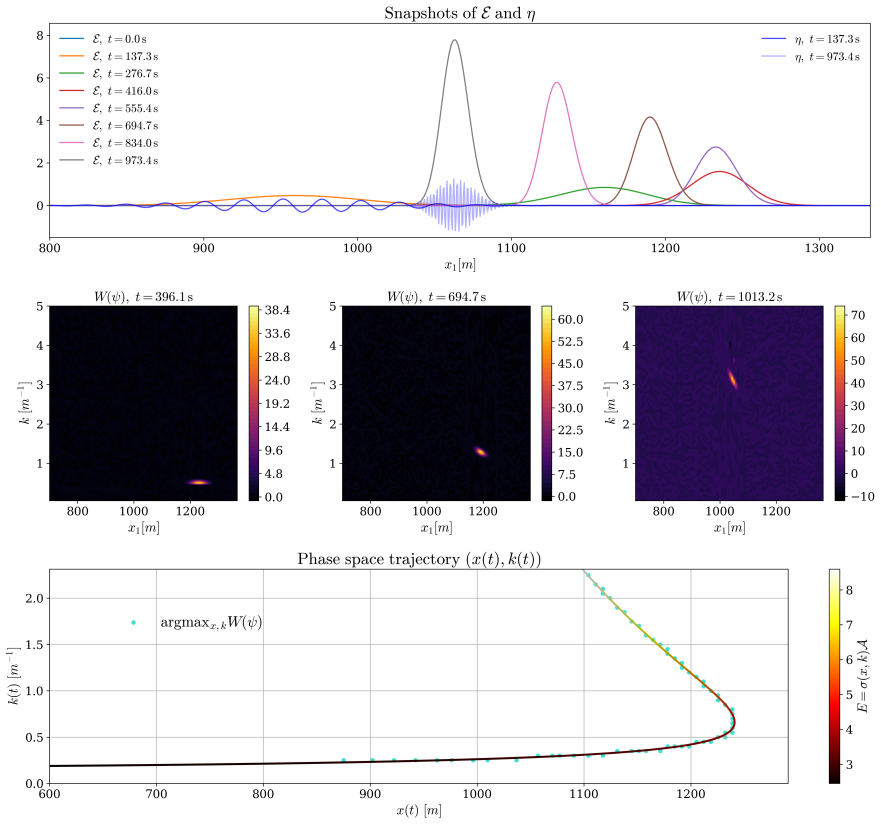
read the original abstract
Starting from the free surface Euler equations, we derive a leading-order system in terms of surface variables, depending on the surface current and on the bathymetry through the depth-dependent Dirichlet-to-Neumann (DN) operator. The resulting system is shown to be well-posed using the theory of hyperbolic systems of pseudo-differential operators. We then consider wave propagation in slowly varying environments. As an explicit approximation to the DN operator, the semiclassical Weyl quantization of the symbol $g_b(X,\xi)=|\xi|\tanh(b(X)|\xi|)$ is shown to be both asymptotically accurate and consistent with the self-adjoint structure of the true operator, and to provide the natural framework for asymptotic analysis of the wave system. A central consequence of the resulting framework is that classical asymptotic models - including the wave action equation, the mild-slope equation, the Schr\"odinger equation, and the action balance equation - emerge systematically from a single formulation. By deriving these equations, we show how the simple leading order system with the Weyl quantization of the DN operator provides a unified and mathematically consistent framework for the asymptotic linear theory of wave-current-bathymetry interaction, hence providing a transparent, rigorous and accessible route from the primitive Euler equations to the mentioned asymptotic models. Throughout, numerical experiments are included to illustrate the analysis.
Editorial analysis
A structured set of objections, weighed in public.
Referee Report
Summary. The paper derives a leading-order system for surface wave-current-bathymetry interaction directly from the free-surface Euler equations, expressed in surface variables and involving the depth-dependent Dirichlet-to-Neumann operator. Well-posedness is established via the theory of hyperbolic pseudo-differential operators. For slowly varying media the DN operator is replaced by the semiclassical Weyl quantization Op^w(g_b) of the symbol g_b(X,ξ)=|ξ|tanh(b(X)|ξ|), which is asserted to be asymptotically accurate to the requisite order and to preserve self-adjointness. From this single framework the classical models (wave-action equation, mild-slope equation, Schrödinger equation, action-balance equation) are recovered systematically, with numerical illustrations provided throughout.
Significance. If the claimed error estimates for the Weyl quantization hold, the manuscript supplies a mathematically consistent, unified derivation of several classical asymptotic models from the Euler equations. This removes ad-hoc steps that often appear when these models are obtained separately and offers a transparent route for further asymptotic analysis in variable bathymetry and currents.
major comments (2)
- [§4] §4 (quantization step): The central claim that Op^w(g_b) approximates the true depth-dependent DN operator to o(ε) in the energy space when bathymetry and current vary on the 1/ε scale is load-bearing for all subsequent derivations. The manuscript must supply the explicit remainder estimate (or a precise reference to the theorem establishing it) rather than asserting asymptotic accuracy; without this, the emergence of the classical models without uncontrolled transport or phase corrections remains unverified.
- [§5.3] §5.3 (derivation of the action-balance equation): The transport terms obtained after substituting Op^w(g_b) must be shown to coincide with the standard form up to o(ε); any hidden lower-order symbol corrections arising from the difference between the true DN operator and its Weyl quantizer would alter the balance equation at the retained order.
minor comments (2)
- [§6] Notation for the small parameter ε is introduced in §2 but occasionally omitted in the statements of the asymptotic models in §6; explicit tracking of all O(ε) remainders would improve clarity.
- [Figures] Figure captions should state the precise values of the slow scale parameter and the bathymetry profile b(X) used in each numerical test.
Simulated Author's Rebuttal
We thank the referee for the positive evaluation and the precise comments, which help clarify the presentation of the quantization step and its consequences. We address each major comment below and will revise the manuscript accordingly.
read point-by-point responses
-
Referee: [§4] §4 (quantization step): The central claim that Op^w(g_b) approximates the true depth-dependent DN operator to o(ε) in the energy space when bathymetry and current vary on the 1/ε scale is load-bearing for all subsequent derivations. The manuscript must supply the explicit remainder estimate (or a precise reference to the theorem establishing it) rather than asserting asymptotic accuracy; without this, the emergence of the classical models without uncontrolled transport or phase corrections remains unverified.
Authors: We agree that an explicit remainder estimate strengthens the argument. In the revised manuscript we will insert a new lemma in §4 that states: under the stated smoothness and scaling assumptions on b(X) and the current, ||(DN_b - Op^w(g_b))u||_{H^s} ≤ Cε ||u||_{H^{s+1}} for s sufficiently large. The proof follows from the standard semiclassical composition formula for the difference between the exact symbol of the depth-dependent DN operator and its principal Weyl symbol, together with the remainder in the semiclassical expansion (cf. Zworski, Semiclassical Analysis, Thm. 4.12 and Prop. 8.10). This estimate is o(ε) in the energy space and therefore introduces no uncontrolled transport or phase corrections at the retained order. revision: yes
-
Referee: [§5.3] §5.3 (derivation of the action-balance equation): The transport terms obtained after substituting Op^w(g_b) must be shown to coincide with the standard form up to o(ε); any hidden lower-order symbol corrections arising from the difference between the true DN operator and its Weyl quantizer would alter the balance equation at the retained order.
Authors: We will expand the derivation in the revised §5.3. After inserting the Weyl-quantized operator, we perform the explicit symbol calculus for the transport coefficients. The difference between the true DN operator and Op^w(g_b) contributes only terms of size o(ε) by the remainder lemma added in §4; these terms lie below the order retained in the action-balance equation. Consequently the leading-order transport terms coincide exactly with the classical form (ray equations for the group velocity and the refraction term arising from ∇b). The revised text will display the symbol expansion step by step so that the absence of hidden corrections is transparent. revision: yes
Circularity Check
No significant circularity; derivation self-contained from Euler equations
full rationale
The paper starts from the free surface Euler equations and derives a leading-order surface system involving the depth-dependent Dirichlet-to-Neumann operator. It then introduces the semiclassical Weyl quantization of g_b(X,ξ)=|ξ|tanh(b(X)|ξ|) as an explicit approximation, which the paper itself shows to be asymptotically accurate and self-adjoint consistent. Classical models (wave action, mild-slope, Schrödinger, action balance) are obtained as systematic consequences of this single framework rather than as inputs or fitted targets. Well-posedness rests on external hyperbolic pseudo-differential operator theory. No quantities are defined in terms of the target asymptotics, no parameters are fitted to them, and no load-bearing step reduces by construction to a self-citation or ansatz smuggled from prior work by the same authors.
Axiom & Free-Parameter Ledger
axioms (2)
- standard math The Dirichlet-to-Neumann operator encodes the depth dependence in the linearized water-wave problem
- standard math Hyperbolic systems of pseudo-differential operators are well-posed under the stated symbol conditions
Lean theorems connected to this paper
-
IndisputableMonolith/Cost/FunctionalEquation.leanwashburn_uniqueness_aczel unclear?
unclearRelation between the paper passage and the cited Recognition theorem.
semiclassical Weyl quantization of the symbol g_b(X,ξ)=|ξ|tanh(b(X)|ξ|) ... classical asymptotic models—including the wave action equation, the mild-slope equation, the Schrödinger equation, and the action balance equation—emerge systematically
-
IndisputableMonolith/Foundation/AlexanderDuality.leanalexander_duality_circle_linking unclear?
unclearRelation between the paper passage and the cited Recognition theorem.
well-posedness ... hyperbolic systems of pseudo-differential operators
What do these tags mean?
- matches
- The paper's claim is directly supported by a theorem in the formal canon.
- supports
- The theorem supports part of the paper's argument, but the paper may add assumptions or extra steps.
- extends
- The paper goes beyond the formal theorem; the theorem is a base layer rather than the whole result.
- uses
- The paper appears to rely on the theorem as machinery.
- contradicts
- The paper's claim conflicts with a theorem or certificate in the canon.
- unclear
- Pith found a possible connection, but the passage is too broad, indirect, or ambiguous to say the theorem truly supports the claim.
Reference graph
Works this paper leans on
-
[1]
Cambridge University Press, 2011
Mark J Ablowitz.Nonlinear dispersive waves: asymptotic analysis and solitons, vol- ume 47. Cambridge University Press, 2011
work page 2011
-
[2]
Gal Akrish, Pieter Smit, Marcel Zijlema, and Ad Reniers. A mild-slope formulation based on weyl rule of association with application to coastal wave modelling.Wave Motion, 122:103189, 2023
work page 2023
-
[3]
American Mathematical Soc., 2007
Serge Alinhac and Patrick G´ erard.Pseudo-differential operators and the Nash-Moser theorem, volume 82. American Mathematical Soc., 2007
work page 2007
-
[4]
D Andrade and A Nachbin. A three-dimensional dirichlet-to-neumann operator for water waves over topography.Journal of Fluid Mechanics, 845:321–345, 2018
work page 2018
- [5]
-
[6]
Capillary–gravity wave transport over spatially random drift.Wave Motion, 35(2):107–124, 2002
Guillaume Bal and Tom Chou. Capillary–gravity wave transport over spatially random drift.Wave Motion, 35(2):107–124, 2002. 39
work page 2002
-
[7]
Daniel J Bodony. Analysis of sponge zones for computational fluid mechanics.Journal of Computational Physics, 212(2):681–702, 2006
work page 2006
-
[8]
Wavetrains in inhomoge- neous moving media.Proceedings of the Royal Society of London
Francis P Bretherton and Christopher John Raymond Garrett. Wavetrains in inhomoge- neous moving media.Proceedings of the Royal Society of London. Series A. Mathematical and Physical Sciences, 302(1471):529–554, 1968
work page 1968
-
[9]
Cambridge University Press, 2014
Oliver B¨ uhler.Waves and mean flows. Cambridge University Press, 2014
work page 2014
-
[10]
Angel Castro and David Lannes. Well-posedness and shallow-water stability for a new hamiltonian formulation of the water waves equations with vorticity.Indiana University Mathematics Journal, pages 1169–1270, 2015
work page 2015
-
[11]
Luigi De Rosa, Micka¨ el Latocca, and Giorgio Stefani. Full double h¨ older regular- ity of the pressure in bounded domains.International Mathematics Research Notices, 2024(3):2511–2560, 2024
work page 2024
-
[12]
Dispersive estimates for linearized water wave-type equations in r d
Tilahun Deneke, Tamirat T Dufera, and Achenef Tesfahun. Dispersive estimates for linearized water wave-type equations in r d. InAnnales Henri Poincar´ e, volume 24, pages 3741–3761. Springer, 2023
work page 2023
-
[13]
Maarten W Dingemans.Water wave propagation over uneven bottoms (in 2 parts), volume 13. World Scientific, 1997
work page 1997
-
[14]
American Mathematical Society, 2022
Lawrence C Evans.Partial differential equations, volume 19. American Mathematical Society, 2022
work page 2022
-
[15]
A simple criterion for essential self-adjointness of weyl pseudodifferential operators: R
Robert Fulsche and Lauritz van Luijk. A simple criterion for essential self-adjointness of weyl pseudodifferential operators: R. fulsche, l. van luijk.Journal of Pseudo-Differential Operators and Applications, 16(2):38, 2025
work page 2025
-
[16]
Patrick G´ erard, Peter A Markowich, Norbert J Mauser, and Fr´ ed´ eric Poupaud. Homoge- nization limits and wigner transforms.Communications on Pure and Applied Mathemat- ics: A Journal Issued by the Courant Institute of Mathematical Sciences, 50(4):323–379, 1997
work page 1997
-
[17]
David Gilbarg, Neil S Trudinger, David Gilbarg, and NS Trudinger.Elliptic partial differential equations of second order, volume 224. Springer, 1977
work page 1977
-
[18]
Karlheinz Gr¨ ochenig.Foundations of time-frequency analysis, volume 359. Springer, 2001
work page 2001
-
[19]
Trygve Halsne, Kai H˚ akon Christensen, Gaute Hope, and Øyvind Breivik. Ocean wave tracing v. 1: a numerical solver of the wave ray equations for ocean waves on variable currents at arbitrary depths.Geoscientific Model Development, 16(22):6515–6530, 2023
work page 2023
-
[20]
Peter Hintz.An Introduction to Microlocal Analysis. Springer Cham, 2025
work page 2025
-
[21]
Cambridge university press, 2010
Leo H Holthuijsen.Waves in oceanic and coastal waters. Cambridge university press, 2010
work page 2010
-
[22]
N. Hunt J. editor.Gravity Waves in Water of Finite Depth, volume 10 ofAdvances in Fluid Mechanics. Computational Mechanics Publications, 1997
work page 1997
-
[23]
Shi Jin, Peter Markowich, and Christof Sparber. Mathematical and computational meth- ods for semiclassical schr¨ odinger equations.Acta Numerica, 20:121–209, 2011. 40
work page 2011
- [24]
-
[25]
J William Kamphuis.Introduction to coastal engineering and management, volume 48. World Scientific, 2020
work page 2020
-
[26]
James T Kirby. Higher-order approximations in the parabolic equation method for water waves.Journal of Geophysical Research: Oceans, 91(C1):933–952, 1986
work page 1986
-
[27]
James T Kirby and Robert A Dalrymple. A parabolic equation for the combined refraction–diffraction of stokes waves by mildly varying topography.Journal of Fluid Mechanics, 136:453–466, 1983
work page 1983
-
[28]
Imaging of seabed topography from the scattering of water waves
Adrian Kirkeby. Imaging of seabed topography from the scattering of water waves. Water Waves, 7(1):1–33, 2025
work page 2025
-
[29]
Cambridge univer- sity press UK, 1994
Gerbrand Johan Komen, L Cavaleri, M Donelan, K Hasselmann, S Hasselmann, PAEM Janssen, et al.Dynamics and modelling of ocean waves, volume 532. Cambridge univer- sity press UK, 1994
work page 1994
-
[30]
Rainer Kress.Linear integral equations, 3’rd Edition, volume 82. Springer, 2014
work page 2014
-
[31]
Amer- ican Mathematical Society, 2013
David Lannes.The water waves problem: mathematical analysis and asymptotics. Amer- ican Mathematical Society, 2013
work page 2013
-
[32]
Xiao Liu and Chongchun Zeng. On the spectra of the gravity water waves linearized at monotone shear flows.Communications in Mathematical Physics, 406(2):41, 2025
work page 2025
-
[33]
Michael S Longuet-Higgins and RW129244 Stewart. The changes in amplitude of short gravity waves on steady non-uniform currents.Journal of fluid mechanics, 10(4):529– 549, 1961
work page 1961
-
[34]
Andr´ e Martinez.An introduction to semiclassical and microlocal analysis, volume 994. Springer, 2002
work page 2002
-
[35]
Introduction to the uniform geometrical theory of diffraction
Derek Albert McNamara, Carl WI Pistorius, and JAG Malherbe. Introduction to the uniform geometrical theory of diffraction. 1990
work page 1990
-
[36]
Chiang C Mei.The applied dynamics of ocean surface waves, volume 1. World scientific, 1989
work page 1989
-
[37]
Benjamin Melinand. Coriolis effect on water waves.ESAIM: Mathematical Modelling and Numerical Analysis, 51(5):1957–1985, 2017
work page 1957
-
[38]
Fundamental solutions of linear partial differential operators.Theory and Practice
Norbert Ortner and Peter Wagner. Fundamental solutions of linear partial differential operators.Theory and Practice. Springer, Cham, 2015
work page 2015
-
[39]
Interaction of water waves and currents.Advances in applied mechanics, 16:9–117, 1976
D Howell Peregrine. Interaction of water waves and currents.Advances in applied mechanics, 16:9–117, 1976
work page 1976
-
[40]
O. M. Phillips.The Dynamics of the Upper Ocean. Cambridge University Press, 2nd edition, 1977
work page 1977
-
[41]
Stephen B. Pope.Turbulent Flows. Cambridge University Press, Cambridge, 2000
work page 2000
-
[42]
AC Radder. On the parabolic equation method for water-wave propagation.Journal of fluid mechanics, 95(1):159–176, 1979. 41
work page 1979
-
[43]
Alan Riquier and Emmanuel Dormy. Do irrotational water waves remain irrotational in the limit of a vanishing viscosity?Proceedings of the Royal Society A: Mathematical, Physical and Engineering Sciences, 482(2329), 2026
work page 2026
-
[44]
McGraw-Hill, New York, NY, 2 edition, 1991
Walter Rudin.Functional Analysis. McGraw-Hill, New York, NY, 2 edition, 1991
work page 1991
-
[45]
II Rypina, Michael G Brown, Francisco J Beron-Vera, Huseyin Ko¸ cak, Maria J Olasco- aga, and IA Udovydchenkov. On the lagrangian dynamics of atmospheric zonal jets and the permeability of the stratospheric polar vortex.Journal of the Atmospheric Sciences, 64(10):3595–3610, 2007
work page 2007
-
[46]
Peter J. Schmid and Dan S. Henningson.Stability and Transition in Shear Flows, volume 142 ofApplied Mathematical Sciences. Springer, New York, 2001
work page 2001
-
[47]
Roman Shvydkoy and Susan Friedlander. On recent developments in the spectral prob- lem for the linearized euler equation.Contemporary Mathematics, 371:271–296, 2005
work page 2005
-
[48]
PB Smit and TT Janssen. The evolution of inhomogeneous wave statistics through a variable medium.Journal of Physical Oceanography, 43(8):1741–1758, 2013
work page 2013
-
[49]
Cambridge University Press, 2017
Christopher D Sogge.Fourier integrals in classical analysis, volume 210. Cambridge University Press, 2017
work page 2017
-
[50]
Courier Dover Publications, 2019
James Johnston Stoker.Water waves: The mathematical theory with applications. Courier Dover Publications, 2019
work page 2019
-
[51]
M Taylor.Partial differential equations II: Qualitative studies of linear equations, volume
-
[52]
Springer Science & Business Media, 2013
work page 2013
-
[53]
American Mathematical Soc., 2014
Gerald Teschl.Mathematical methods in quantum mechanics, volume 157. American Mathematical Soc., 2014
work page 2014
- [54]
-
[55]
Gerald Beresford Whitham.Linear and nonlinear waves. John Wiley & Sons, 2011
work page 2011
-
[56]
American Mathematical Soc., 2012
Maciej Zworski.Semiclassical analysis, volume 138. American Mathematical Soc., 2012. 42
work page 2012
discussion (0)
Sign in with ORCID, Apple, or X to comment. Anyone can read and Pith papers without signing in.