Recognition: 2 theorem links
· Lean TheoremLow-scaling textit{GW} calculations of quasi-particle energies for extended systems within the numerical atomic orbital framework
Pith reviewed 2026-05-14 21:53 UTC · model grok-4.3
The pith
Space-time algorithm in numerical atomic orbitals reduces GW scaling to O(N^2) for quasi-particle energies.
A machine-rendered reading of the paper's core claim, the machinery that carries it, and where it could break.
Core claim
By computing the polarization function under the random phase approximation and the GW self-energy in real space with the localized resolution of identity technique inside the numerical atomic orbital framework, the scaling of the rate-limiting steps is formally reduced to O(N^2) with respect to system size, while the quasi-particle energies remain in close agreement with those obtained from the conventional O(N^4) k-space formalism for the crystalline solids examined.
What carries the argument
The localized resolution of identity technique applied to real-space evaluation of the polarization function and self-energy inside the numerical atomic orbital basis.
If this is right
- GW quasi-particle energies become accessible for systems with hundreds of atoms at substantially lower cost than before.
- The observed scaling reduction makes the approach faster than the canonical method already below 100 atoms.
- Periodic solids can be treated with accuracy comparable to the established high-scaling implementation.
- Larger-scale simulations of material electronic structures become practical without changing the underlying GW approximation.
Where Pith is reading between the lines
- The real-space formulation may extend naturally to supercell models containing defects or interfaces.
- Further gains could arise by combining the approach with existing low-scaling techniques for the underlying density-functional calculation.
- Time-dependent generalizations might enable efficient spectra calculations for similarly sized systems.
Load-bearing premise
The localized resolution of identity technique must preserve enough accuracy for the polarization function and self-energy when used on extended periodic systems in the numerical atomic orbital basis.
What would settle it
A benchmark on a crystalline solid with roughly 50 atoms that shows quasi-particle energies deviating substantially from the conventional O(N^4) k-space results would disprove the accuracy preservation.
Figures





read the original abstract
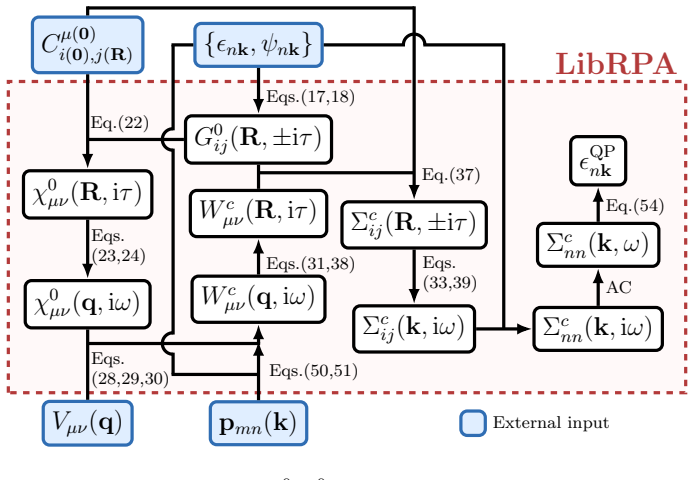
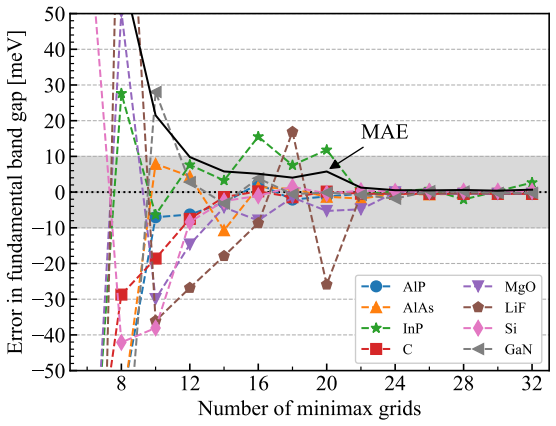
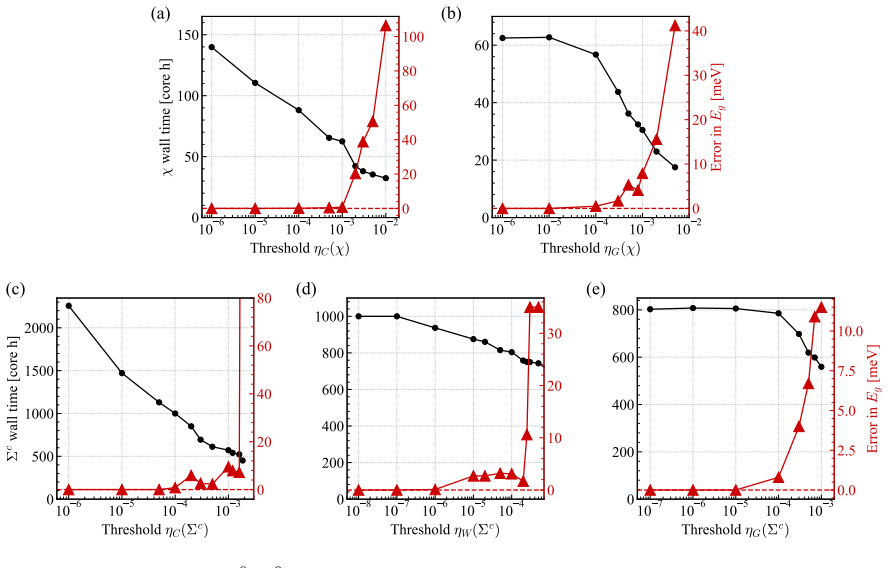
The many-body perturbation theory within the $GW$ approximation is a widely used method for describing the electronic band structures in real materials. Its application to large-scale systems is, however, impeded by its high computational cost. The rate-limiting steps in a typical $GW$ implementation are the evaluation of the polarization function under the random phase approximation (RPA) and the evaluation of the $GW$ self-energy, both of which have a canonical $O(N^4)$ scaling with $N$ being the system size. The conventional space-time algorithm within the plane-wave basis sets reduces the scaling from $O(N^4)$ to $O(N^3)$, albeit with a large prefactor and increased memory cost. Here, we present a space-time algorithm within the numerical atomic orbital (NAO) basis-set framework, for which the evaluation of the polarization function and self-energy is formally reduced to $O(N^2)$ or better with respect to system size. This is achieved by computing these quantities in real space, where low-scaling algorithms can be formulated by leveraging the localized resolution of identity (LRI) technique. The resulting NAO-based, LRI-enhanced space-time $GW$ algorithm has been implemented in the LibRPA library interfaced with the FHI-aims code package. Benchmark calculations for crystalline solids show that the low-scaling implementation yields quasi-particle energies in close agreement with the conventional $O(N^4)$ k-space formalism previously implemented in FHI-aims. For the systems studied here, the observed overall scaling is substantially reduced relative to the canonical approach, and the low-scaling implementation becomes advantageous already for systems containing fewer than 100 atoms.
Editorial analysis
A structured set of objections, weighed in public.
Referee Report
Summary. The manuscript presents a space-time GW algorithm implemented in the numerical atomic orbital (NAO) basis within the FHI-aims code, using the localized resolution of identity (LRI) to evaluate the RPA polarization function and self-energy in real space. This yields a formal reduction to O(N^2) scaling or better, in contrast to the canonical O(N^4) k-space approach. Benchmarks on crystalline solids are reported to produce quasi-particle energies in close agreement with the existing O(N^4) implementation, with the low-scaling version becoming advantageous for systems containing fewer than 100 atoms.
Significance. If the reported accuracy is robust, the work would provide a practical route to GW calculations on larger periodic systems in materials science, where conventional scaling has been prohibitive. The implementation in an established all-electron code and the explicit comparison to a prior k-space method are strengths that facilitate adoption.
major comments (2)
- [Abstract] Abstract and benchmark section: the central claim of 'close agreement' with the O(N^4) k-space formalism and the assertion that the low-scaling method becomes advantageous below 100 atoms are not supported by quantitative error metrics, mean absolute deviations, or explicit system-size scaling plots. Without these, the scaling advantage and accuracy cannot be assessed rigorously.
- [Method / Results] The accuracy for extended periodic systems rests on the LRI expansion of the Coulomb operator and the real-space cutoff applied to the polarization function P(r,r',iω). The manuscript does not specify how the cutoff radius is chosen relative to supercell size or demonstrate that truncation errors remain bounded (rather than scaling with surface area) as N increases, which is required to ensure convergence to the same thermodynamic limit as the k-space method given the slow 1/r decay of dielectric screening.
Simulated Author's Rebuttal
We thank the referee for the constructive feedback and the recommendation for major revision. We address the major comments below and plan to revise the manuscript to incorporate the suggested improvements where appropriate.
read point-by-point responses
-
Referee: [Abstract] Abstract and benchmark section: the central claim of 'close agreement' with the O(N^4) k-space formalism and the assertion that the low-scaling method becomes advantageous below 100 atoms are not supported by quantitative error metrics, mean absolute deviations, or explicit system-size scaling plots. Without these, the scaling advantage and accuracy cannot be assessed rigorously.
Authors: We agree that providing quantitative error metrics and scaling plots would make the claims more rigorous. In the revised version, we will add mean absolute deviations (MAD) between the low-scaling and conventional GW quasi-particle energies for the benchmark systems. Additionally, we will include explicit plots of computational time versus system size (number of atoms) to demonstrate the scaling behavior and the point at which the low-scaling method becomes advantageous (around 100 atoms). These additions will be placed in the benchmark section and referenced in the abstract if necessary. revision: yes
-
Referee: [Method / Results] The accuracy for extended periodic systems rests on the LRI expansion of the Coulomb operator and the real-space cutoff applied to the polarization function P(r,r',iω). The manuscript does not specify how the cutoff radius is chosen relative to supercell size or demonstrate that truncation errors remain bounded (rather than scaling with surface area) as N increases, which is required to ensure convergence to the same thermodynamic limit as the k-space method given the slow 1/r decay of dielectric screening.
Authors: We acknowledge the importance of this point for ensuring the method's reliability in the thermodynamic limit. The manuscript will be revised to specify the cutoff radius selection criterion, which is based on the localization of the NAO and LRI functions and set to ensure that the polarization function is captured within the supercell with a convergence threshold. Regarding the boundedness of truncation errors, we will include additional numerical evidence from calculations on progressively larger supercells, demonstrating that the deviation from k-space results remains small and does not increase with system size. While a rigorous mathematical proof of bounded errors for all N is challenging due to the long-range nature of screening, the practical convergence observed supports the applicability to extended systems. revision: partial
Circularity Check
No circularity: algorithmic reformulation with independent benchmarks
full rationale
The paper derives a space-time GW algorithm in the NAO basis by moving polarization and self-energy evaluations to real space and applying the LRI technique for low-scaling matrix operations. This yields a formal O(N^2) scaling claim that is implemented and then benchmarked numerically against the authors' own prior O(N^4) k-space code on crystalline solids. No equation reduces a result to a fitted parameter or to a self-citation by construction; the agreement with the conventional implementation is an external numerical test rather than a definitional identity. The LRI step is presented as a standard technique leveraged for the new implementation, not as an ansatz smuggled in or a uniqueness theorem imported from the same authors' prior work. The central claims therefore remain self-contained against external benchmarks.
Axiom & Free-Parameter Ledger
axioms (1)
- domain assumption The localized resolution of identity (LRI) approximation is sufficiently accurate for the polarization function and self-energy in NAO-based GW calculations of extended systems.
Lean theorems connected to this paper
-
IndisputableMonolith/Cost/FunctionalEquation.leanwashburn_uniqueness_aczel unclear?
unclearRelation between the paper passage and the cited Recognition theorem.
low-scaling algorithm ... leveraging the localized resolution of identity (LRI) technique ... real-space imaginary-time representation of the density response function χ₀
-
IndisputableMonolith/Foundation/RealityFromDistinction.leanreality_from_one_distinction unclear?
unclearRelation between the paper passage and the cited Recognition theorem.
empirical scaling of O(N^{2.7}) ... crossover at around 80 atoms
What do these tags mean?
- matches
- The paper's claim is directly supported by a theorem in the formal canon.
- supports
- The theorem supports part of the paper's argument, but the paper may add assumptions or extra steps.
- extends
- The paper goes beyond the formal theorem; the theorem is a base layer rather than the whole result.
- uses
- The paper appears to rely on the theorem as machinery.
- contradicts
- The paper's claim conflicts with a theorem or certificate in the canon.
- unclear
- Pith found a possible connection, but the passage is too broad, indirect, or ambiguous to say the theorem truly supports the claim.
Forward citations
Cited by 1 Pith paper
-
$G^0W^0$ implementation based on the pseudopotential and numerical-atomic-orbital basis-set framework: Algorithms and benchmarks
An efficient G0W0 framework is implemented in the NAO-PP basis via ABACUS+LibRPA with a novel LRI compression scheme, showing agreement with established codes on band structures and gaps.
Reference graph
Works this paper leans on
-
[1]
Inhomogeneous Electron Gas.Phys
(1) Hohenberg, P.; Kohn, W. Inhomogeneous Electron Gas.Phys. Rev.1964,136, B864– B871. (2) Kohn, W.; Sham, L. J. Self-Consistent Equations Including Exchange and Correlation Effects.1965,140, A1133–A1138. (3) Perdew, J. P.; Yang, W.; Burke, K.; Yang, Z.; Gross, E. K.; Scheffler, M.; Scuse- ria, G. E.; Henderson, T. M.; Zhang, I. Y.; Ruzsinszky, A.; Peng, ...
work page 1964
-
[2]
(6) Hedin, L. New Method for Calculating the One-Particle Green’s Function with Appli- cation to the Electron-Gas Problem.1965,139, A796–A823. (7) Hybertsen, M. S.; Louie, S. G. First-Principles Theory of Quasiparticles: Calculation of Band Gaps in Semiconductors and Insulators.Phys. Rev. Lett.1985,55, 1418–1421. 46 (8) Aryasetiawan, F.; Gunnarsson, O. Th...
work page 1965
-
[3]
Electronic Excitations: Density-Functional versus Many-Body Green’s-Function Approaches.Rev
(9) Onida, G.; Reining, L.; Rubio, A. Electronic Excitations: Density-Functional versus Many-Body Green’s-Function Approaches.Rev. Mod. Phys.2002,74, 601–659. (10) Golze, D.; Dvorak, M.; Rinke, P. The GW Compendium: A Practical Guide to Theo- retical Photoemission Spectroscopy.Front. Chem.2019,7,
work page 2002
-
[4]
(11) Klimeˇ s, J. r.; Kaltak, M.; Kresse, G. Predictive GW Calculations Using Plane Waves and Pseudopotentials.Phys. Rev. B2014,90, 075125. (12) Jiang, H.; Blaha, P. GW with linearized augmented plane waves extended by high- energy local orbitals.Phys. Rev. B2016,93, 115203. (13) Moerman, E.; Miranda, H.; Gallo, A.; Irmler, A.; Sch¨ afer, T.; Hummel, F.; ...
work page 2025
-
[5]
(16) Rieger, M. M.; Steinbeck, L.; White, I. D.; Rojas, H. N.; Godby, R. W. The GW Space-Time Method for the Self-Energy of Large Systems.1999,117, 211–228. (17) Kaltak, M.; Klimeˇ s, J.; Kresse, G. Low Scaling Algorithms for the Random Phase Ap- proximation: Imaginary Time and Laplace Transformations.J. Chem. Theory Comput. 2014,10, 2498–2507. 47 (18) Ka...
work page 1999
-
[6]
Cubic-Scaling All-Electron GW Calculations with a Separable Density-Fitting Space–Time Approach.J
(22) Duchemin, I.; Blase, X. Cubic-Scaling All-Electron GW Calculations with a Separable Density-Fitting Space–Time Approach.J. Chem. Theory Comput.2021,17, 2383–2393. (23) Graml, M.; Zollner, K.; Hernang´ omez-P´ erez, D.; Faria Junior, P. E.; Wilhelm, J. Low- Scaling GW Algorithm Applied to Twisted Transition-Metal Dichalcogenide Heterobi- layers.J. Che...
work page 2021
-
[7]
(39) Wirz, L. N.; Reine, S. S.; Pedersen, T. B. On Resolution-of-the-Identity Electron Re- pulsion Integral Approximations and Variational Stability.J. Chem. Theory Comput. 2017,13,
work page 2017
-
[8]
(40) Hollman, D. S.; Schaefer, H. F.; Valeev, E. F. Semi-exact concentric atomic density fitting: Reduced cost and increased accuracy compared to standard density fitting.J. Chem. Phys.2014,140, 064109. (41) Wang, X.; Lewis, C. A.; Valeev, E. F. Efficient evaluation of exact exchange for periodic systems via concentric atomic density fitting.The Journal o...
work page 2014
-
[9]
(43) Lin, P.; Ren, X.; He, L. Accuracy of Localized Resolution of the Identity in Periodic Hybrid Functional Calculations with Numerical Atomic Orbitals.J. Phys. Chem. Lett. 2020,11, 3082–3088. 50 (44) Lin, P.; Ren, X.; He, L. Efficient Hybrid Density Functional Calculations for Large Periodic Systems Using Numerical Atomic Orbitals.J. Chem. Theory Comput...
work page 2020
-
[10]
(51) Cao, Y.; Zhang, M.-Y.; Lin, P.; Chen, M.; Ren, X. Applying Space-Group Symmetry to 51 Speed Up Hybrid-Functional Calculations within the Framework of Numerical Atomic Orbitals.J. Chem. Theory Comput.2025,21, 8086–8105. (52) Baker, G. A.Essentials of Pad´ e Approximants; Academic Press,
work page 2025
-
[11]
(53) Vidberg, H. J.; Serene, J. W. Solving the Eliashberg Equations by Means of N-point Pad´ e Approximants.J. Low. Temp. Phys.1977,29, 179–192. (54) LibRI GitHub repository:https://github.com/abacusmodeling/LibRI. (55) Broqvist, P.; Alkauskas, A.; Pasquarello, A. Hybrid-Functional Calculations with Plane- Wave Basis Sets: Effect of Singularity Correction...
work page 1977
-
[12]
(58) Perdew, J. P.; Burke, K.; Ernzerhof, M. Generalized Gradient Approximation Made Simple.Phys. Rev. Lett.1996,77, 3865–3868. (59) Zhang, M.-Y.; Jiang, H. Electronic band structure of cuprous and silver halides: An all-electronGWstudy.Phys. Rev. B2019,100, 205123. (60) Azizi, M.; Delesma, F. A.; Giantomassi, M.; Zavickis, D.; Kuisma, M.; Thyghesen, K.; ...
work page 1996
discussion (0)
Sign in with ORCID, Apple, or X to comment. Anyone can read and Pith papers without signing in.