Recognition: 2 theorem links
· Lean TheoremChemical Medium-Range Order Enables Stoichiometric Rigidity
Pith reviewed 2026-05-14 21:38 UTC · model grok-4.3
The pith
Chemical medium-range order is required for rigidity at the Maxwell threshold in covalent network glasses.
A machine-rendered reading of the paper's core claim, the machinery that carries it, and where it could break.
Core claim
Rigidity near the Maxwell threshold requires chemistry-specific correlations beyond pure connectivity. Only phenomenological MRO proxies recover rigidity at experimentally accessible strengths, while enthalpic stress delays the onset, chemical defects need fractions far above observed values, and geometric linking density does not govern the threshold (which is instead set by loop-induced redundancy). Chalcogenide intermediate-phase data and amorphous SiO2 ring statistics implicate chemical MRO, while DNA spatial networks rule out pure geometric entanglement.
What carries the argument
A locally tree-like configuration model used as a zero-MRO baseline, with controlled perturbations that isolate the contribution of each candidate mechanism to the location of the rigidity threshold.
If this is right
- Enthalpic stress delays rather than enables rigidity.
- Chemical defects require fractions around 40 percent, far above experimental values such as 16 percent in GeSe2.
- Geometric linking density does not govern the threshold location, which is set by loop-induced redundancy.
- Only phenomenological MRO proxies recover rigidity at experimentally accessible strengths.
Where Pith is reading between the lines
- If chemical MRO is the decisive factor, then targeted atomic correlations could be used to tune the mechanical stiffness of amorphous materials independently of average coordination number.
- The separation of chemical correlations from pure geometric effects may extend to rigidity in other disordered systems such as biological polymers or synthetic gels.
- Explicit chemical-potential simulations could quantify the minimal MRO strength needed to shift the threshold and match specific compositions.
Load-bearing premise
The locally tree-like configuration model accurately serves as a zero-MRO baseline, and the applied perturbations isolate each candidate mechanism without introducing uncontrolled interactions or artifacts that affect the threshold location.
What would settle it
Observation of the experimental rigidity threshold in a network lacking detectable chemical medium-range order but possessing high geometric entanglement density, or ring statistics in amorphous SiO2 that match pure geometric models rather than chemical MRO predictions.
Figures

read the original abstract
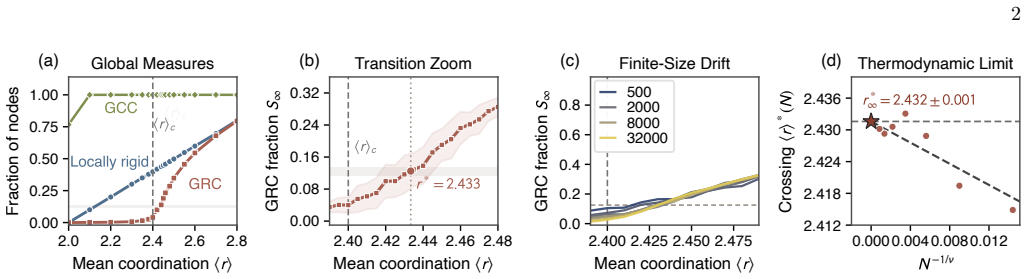
Maxwell counting predicts an isostatic threshold at $\langle r\rangle = 2.4$ for covalent network glasses, but which structural correlations actually produce rigidity near this point is still unclear. In this work, we test four candidates: enthalpic stress, chemical defects, geometric interlocking, and medium-range order (MRO). We use a locally tree-like configuration model as a zero-MRO baseline and apply perturbations to test each candidate. We find that (i) enthalpic stress delays rigidity rather than enabling it; (ii) chemical defects require fractions ($\sim$40%) far above experimental values ($\sim$16% in GeSe$_2$); (iii) geometric linking density does not govern the threshold location, which is instead set by loop-induced redundancy; and (iv) only phenomenological MRO proxies recover rigidity at experimentally accessible strengths. Consequently, chalcogenide intermediate-phase data and amorphous SiO$_2$ ring statistics positively implicate chemical MRO, while DNA spatial networks independently rule out pure geometric entanglement. We conclude that rigidity near the Maxwell threshold requires chemistry-specific correlations beyond pure connectivity.
Editorial analysis
A structured set of objections, weighed in public.
Referee Report
Summary. The manuscript examines the structural origins of rigidity in covalent network glasses near the Maxwell isostatic threshold of ⟨r⟩ = 2.4. It tests four candidate mechanisms—enthalpic stress, chemical defects, geometric interlocking, and medium-range order (MRO)—starting from a locally tree-like configuration model as a zero-MRO baseline and applying targeted perturbations to each. The analysis finds that only phenomenological MRO proxies recover rigidity at experimentally relevant strengths, while the other candidates do not; this is used to implicate chemical MRO via chalcogenide intermediate-phase data and SiO₂ ring statistics, and to rule out pure geometric entanglement using DNA spatial networks. The conclusion is that rigidity near the threshold requires chemistry-specific correlations beyond pure connectivity.
Significance. If the separation of mechanisms holds after addressing baseline concerns, the work would offer a systematic way to distinguish chemical from geometric contributions to rigidity in disordered networks, with implications for intermediate-phase behavior in chalcogenides and modeling of amorphous solids. The perturbation approach on configuration models is a clear methodological strength that could generalize to other network rigidity problems.
major comments (2)
- [Methods (configuration model baseline)] The locally tree-like configuration model is asserted as a zero-MRO baseline (see the methods description of the model and its use in §3), yet finite-graph realizations with the paper's degree sequences necessarily produce small-loop redundancies. These geometric features are the same class of redundancy later attributed to geometric interlocking, so the reported failure of the geometric perturbation to shift the threshold may reflect double-counting rather than a clean isolation of MRO effects.
- [Results (MRO proxy analysis)] The phenomenological MRO proxies are shown to recover the experimental threshold at accessible strengths (results section on MRO perturbations), but their strength parameter is listed among the free parameters and appears chosen to match the observed onset rather than derived independently from the model equations. This directly affects the central claim that only MRO succeeds where the other three candidates fail.
minor comments (2)
- [Results] Quantitative error bars or sensitivity analysis on the threshold locations under each perturbation are not reported, which would help assess robustness of the separation between mechanisms.
- [Discussion] The abstract and discussion reference 'DNA spatial networks' without specifying the network construction or how the rigidity threshold was computed for them.
Simulated Author's Rebuttal
We thank the referee for their detailed and insightful comments on our manuscript. We have carefully considered the points raised regarding the configuration model baseline and the MRO proxy parameters. Below we provide point-by-point responses and indicate the revisions made to address these concerns.
read point-by-point responses
-
Referee: [Methods (configuration model baseline)] The locally tree-like configuration model is asserted as a zero-MRO baseline (see the methods description of the model and its use in §3), yet finite-graph realizations with the paper's degree sequences necessarily produce small-loop redundancies. These geometric features are the same class of redundancy later attributed to geometric interlocking, so the reported failure of the geometric perturbation to shift the threshold may reflect double-counting rather than a clean isolation of MRO effects.
Authors: We agree that finite realizations of the configuration model contain a small density of short cycles, which are geometric in nature. However, these local redundancies are present in all models and do not constitute the medium-range order (MRO) we aim to isolate. The geometric interlocking perturbation specifically introduces longer-range spatial entanglements and linking densities beyond local loops, as described in the methods. To address this, we have added a quantitative estimate of the baseline cycle density in the revised manuscript and clarified that the geometric perturbation targets a distinct class of redundancies. This distinction preserves the separation of mechanisms, and our conclusion that geometric effects do not govern the threshold remains unchanged. revision: partial
-
Referee: [Results (MRO proxy analysis)] The phenomenological MRO proxies are shown to recover the experimental threshold at accessible strengths (results section on MRO perturbations), but their strength parameter is listed among the free parameters and appears chosen to match the observed onset rather than derived independently from the model equations. This directly affects the central claim that only MRO succeeds where the other three candidates fail.
Authors: The MRO proxies are phenomenological by design, intended to model the effect of chemistry-specific correlations without requiring a full microscopic derivation from first principles. The strength parameter is varied over a range, and we demonstrate that rigidity is recovered at values consistent with independent experimental measures of MRO, such as ring statistics in SiO2 and scattering data in chalcogenides. We have revised the text to include these independent estimates for the parameter range, showing that the required strengths are physically plausible rather than arbitrarily fitted to the threshold alone. This comparative analysis still holds, as the other candidates fail to produce the effect even at unphysically high strengths. revision: yes
Circularity Check
No significant circularity; derivation uses independent baseline and comparative perturbations.
full rationale
The paper defines a locally tree-like configuration model as the zero-MRO baseline via standard configuration-model assumptions on degree sequences, then applies four distinct perturbations (enthalpic stress, chemical defects, geometric linking, phenomenological MRO) whose effects on the rigidity threshold are measured separately. The Maxwell isostatic point at <r>=2.4 is taken from the classic constraint-counting argument and is not redefined by the simulations. The claim that only MRO recovers experimental thresholds follows from the relative outcomes of these perturbations rather than from any parameter being fitted to force that outcome or from any self-citation that supplies the central premise. No equation reduces to its own input by construction, and the baseline is not shown to embed the very loop statistics later attributed to MRO. The derivation chain therefore remains self-contained against external graph-theoretic and rigidity-theory benchmarks.
Axiom & Free-Parameter Ledger
free parameters (1)
- MRO proxy strength
axioms (2)
- standard math Maxwell counting predicts an isostatic threshold at average coordination <r> = 2.4 for covalent networks
- domain assumption Locally tree-like configuration model contains no medium-range order
Lean theorems connected to this paper
-
IndisputableMonolith/Foundation/AbsoluteFloorClosure.leanabsolute_floor_iff_bare_distinguishability unclear?
unclearRelation between the paper passage and the cited Recognition theorem.
We use a locally tree-like configuration model as a zero-MRO baseline... u=2(1-α)/(2+α)+[3α/(2+α)]u²... pebble-game result: no redundant edges
-
IndisputableMonolith/Foundation/ArithmeticFromLogic.leanembed_injective unclear?
unclearRelation between the paper passage and the cited Recognition theorem.
The Maxwell count is fM(⟨r⟩)=6−5⟨r⟩/2... GRC fraction S∞=α[1−(u*)³]
What do these tags mean?
- matches
- The paper's claim is directly supported by a theorem in the formal canon.
- supports
- The theorem supports part of the paper's argument, but the paper may add assumptions or extra steps.
- extends
- The paper goes beyond the formal theorem; the theorem is a base layer rather than the whole result.
- uses
- The paper appears to rely on the theorem as machinery.
- contradicts
- The paper's claim conflicts with a theorem or certificate in the canon.
- unclear
- Pith found a possible connection, but the passage is too broad, indirect, or ambiguous to say the theorem truly supports the claim.
Reference graph
Works this paper leans on
-
[1]
W. H. Zachariasen, The atomic arrangement in glass, Journal of the American Chemical Society54, 3841 (1932)
work page 1932
-
[2]
J. C. Phillips, Topology of covalent non-crystalline solids I: Short-range order in chalcogenide alloys, Journal of Non- Crystalline Solids34, 153 (1979)
work page 1979
-
[3]
M. F. Thorpe, Continuous deformations in random net- works, Journal of Non-Crystalline Solids57, 355 (1983)
work page 1983
-
[4]
D. J. Jacobs and M. F. Thorpe, Generic rigidity percola- tion: The pebble game, Physical Review Letters75, 4051 (1995)
work page 1995
-
[5]
M. Micoulaut, I. Pethes, P. J´ ov´ ari, L. Pusztai, M. Krbal, T. W´ agner, V. Prokop,ˇS. Michalik, K. Ikeda, and I. Ka- ban, Structural properties of chalcogenide glasses and the isocoordination rule: Disentangling effects from chemistry and network topology, Physical Review B106, 014206 (2022)
work page 2022
-
[6]
M. V. Chubynsky and M. F. Thorpe, Algorithms for three- dimensional rigidity analysis and a first-order percolation transition, Physical Review E76, 041135 (2007)
work page 2007
-
[7]
M. Micoulaut, Topological ordering during flexible to rigid transitions in disordered networks, Comptes Rendus Physique24, 133 (2023)
work page 2023
-
[8]
C. P. Broedersz and F. C. MacKintosh, Modeling semiflex- ible polymer networks, Reviews of Modern Physics86, 995 (2014)
work page 2014
-
[9]
A. Zaccone and E. Scossa-Romano, Correlated rigidity percolation and colloidal gels, Physical Review Letters 123, 058001 (2019)
work page 2019
-
[10]
J. Luo, J. Vermant, and P. Ilg, Direct link between me- chanical stability in gels and percolation of isostatic par- ticles, Science Advances5, eaav6090 (2019)
work page 2019
-
[11]
M. Nishikawa, K. Okano, R. Kodera, H. Tanabe, and M. Nakata, Rigidity-dependent formation process of dna supramolecular hydrogels, NPG Asia Materials14, 94 (2022)
work page 2022
- [12]
-
[13]
A. Neophytou, F. W. Starr, D. Chakrabarti, and F. Sciortino, Hierarchy of topological transitions in a net- work liquid, Proceedings of the National Academy of Sci- ences121, e2406890121 (2024)
work page 2024
-
[14]
M. Micoulaut and J. C. Phillips, Rings and rigidity tran- sitions in network glasses, Physical Review B67, 104204 (2003)
work page 2003
-
[15]
M. Molloy and B. Reed, A critical point for random graphs with a given degree sequence, Random Structures & Al- gorithms6, 161 (1995)
work page 1995
-
[16]
A. Sartbaeva, S. A. Wells, M. F. Thorpe, E. Bychkov, and C. J. Benmore, Local structural variability and the intermediate phase window in Ge xSe1−x glasses, Physical Review B75, 224204 (2007)
work page 2007
-
[17]
A. Zeidler, P. S. Salmon, and A. C. Hannon, Topologi- cal ordering and viscosity in the glass-forming Ge xSe1−x system: An intermediate phase interpretation, Frontiers in Materials4, 32 (2017)
work page 2017
-
[18]
S. K. Sharma, J. F. Mammone, and M. F. Nicol, Ra- man investigation of ring configurations in vitreous silica, Nature292, 140 (1981)
work page 1981
-
[19]
M. Micoulaut and M. Bauchy, Statistical mechanical model of the self-organized intermediate phase in glass- forming systems with adaptable network topologies, Fron- tiers in Materials6, 11 (2019)
work page 2019
-
[20]
E. L. Gjersing, S. Sen, and B. G. Aitken, Structure, connectivity, and configurational entropy of Ge xSe100−x glasses: Results from 77Se mas nmr spectroscopy, Journal of Physical Chemistry C114, 519 (2010)
work page 2010
-
[21]
F. Tavanti, B. Dianat, A. Catellani, and A. Calzolari, Hierarchical short- and medium-range order structures in amorphous gexse1-x for selectors applications, ACS Ap- plied Electronic Materials2, 2961 (2020)
work page 2020
-
[22]
D. Tsiulyanu, S. A. Kozyukhin, and M. Ciobanu, Middle range order and elastic properties of non-stoichiometric chalcogenide glasses in the ass3-ges4 system, Journal of Non-Crystalline Solids575, 121207 (2022)
work page 2022
-
[23]
D. L. Sidebottom and D. Olabode, Network topology uniquely determines glass fragility, Physical Review Ma- terials9, 105601 (2025)
work page 2025
-
[24]
A. Jain, S. P. Ong, G. Hautier, W. Chen, W. D. Richards, S. Dacek, S. Cholia, D. Gunter, D. Skinner, G. Ceder, and K. A. Persson, Commentary: The materials project: A materials genome approach to accelerating materials in- novation, APL Materials1, 011002 (2013)
work page 2013
-
[25]
P. Boolchand, D. G. Georgiev, and B. Goodman, Dis- covery of the intermediate phase in chalcogenide glasses, Journal of Non-Crystalline Solids293–295, 348 (2001)
work page 2001
-
[26]
P. Boolchand, G. Lucovsky, J. C. Phillips, and M. F. Thorpe, Self-organization and the physics of glassy net- works, Philosophical Magazine85, 3823 (2005)
work page 2005
-
[27]
M. F. Thorpe, D. J. Jacobs, M. V. Chubynsky, and J. C. Phillips, Self-organization in network glasses, Journal of Non-Crystalline Solids266–269, 859 (2000)
work page 2000
- [28]
-
[29]
G. Palombo, S. Weir, D. Michieletto, and Y. A. Guti´ errez Fosado, Topological linking determines elastic- ity in limited valence networks, Nature Materials24, 454 (2025)
work page 2025
-
[30]
chemical medium-range order enables stoichiometric rigidity
K. Liu, Numerical data and analysis code for “chemical medium-range order enables stoichiometric rigidity”, https://github.com/KejunLiuGitHub/riditiy-data (2026), accessed: 2026-04-25. 5 Supplemental Material S1. GENERATING-FUNCTION THEORY DERIVATIONS In the main text, we defineα=⟨r⟩ −2 for the coordination window⟨r⟩ ∈(2,3). The degree distribution for th...
work page 2026
-
[31]
M. F. Thorpe, Continuous deformations in random networks, Journal of Non-Crystalline Solids57, 355 (1983)
work page 1983
-
[32]
M. E. J. Newman, S. H. Strogatz, and D. J. Watts, Random graphs with arbitrary degree distributions and their applications, Physical Review E64, 026118 (2001)
work page 2001
-
[33]
M. Molloy and B. Reed, A critical point for random graphs with a given degree sequence, Random Structures & Algorithms 6, 161 (1995)
work page 1995
-
[34]
Y. Hiraoka, T. Nakamura, A. Hirata, E. G. Escolar, K. Matsue, and Y. Nishiura, Hierarchical structures of amorphous solids characterized by persistent homology, Proceedings of the National Academy of Sciences113, 7035 (2016)
work page 2016
-
[35]
D. J. Jacobs and M. F. Thorpe, Generic rigidity percolation: The pebble game, Physical Review Letters75, 4051 (1995)
work page 1995
-
[36]
D. J. Jacobs and M. F. Thorpe, Generic rigidity percolation in two dimensions, Physical Review E53, 3682 (1996)
work page 1996
-
[37]
G. Laman, On graphs and rigidity of plane skeletal structures, Journal of Engineering Mathematics4, 331 (1970)
work page 1970
-
[38]
M. V. Chubynsky and M. F. Thorpe, Algorithms for three-dimensional rigidity analysis and a first-order percolation tran- sition, Physical Review E76, 041135 (2007)
work page 2007
-
[39]
A. Neophytou, F. W. Starr, D. Chakrabarti, and F. Sciortino, Hierarchy of topological transitions in a network liquid, Proceedings of the National Academy of Sciences121, e2406890121 (2024)
work page 2024
discussion (0)
Sign in with ORCID, Apple, or X to comment. Anyone can read and Pith papers without signing in.