Recognition: 2 theorem links
· Lean TheoremGravitational lensing and observational features of a dynamic black hole
Pith reviewed 2026-05-14 22:01 UTC · model grok-4.3
The pith
Vaidya black holes produce a dynamical redshift ring that contracts and brightens during accretion.
A machine-rendered reading of the paper's core claim, the machinery that carries it, and where it could break.
Core claim
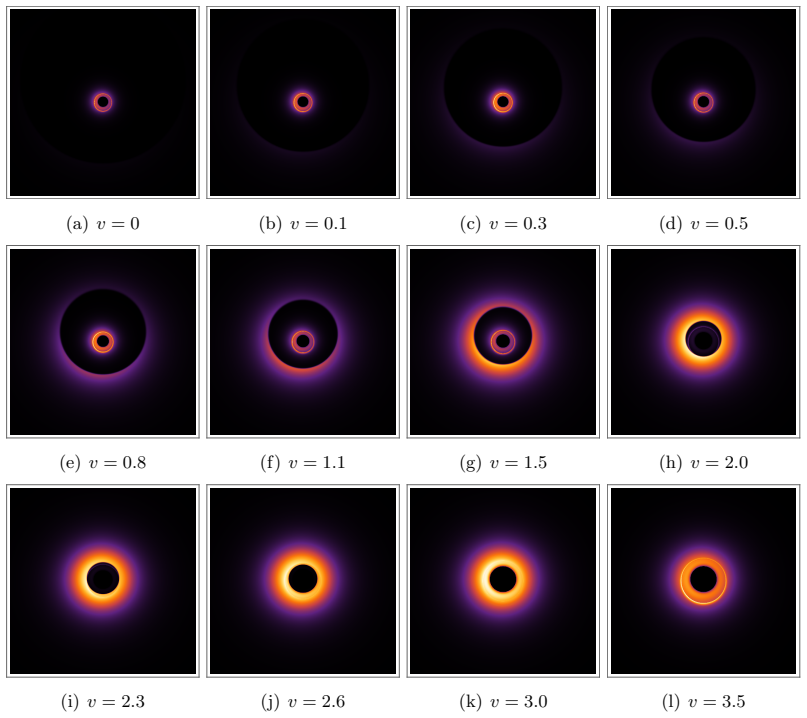
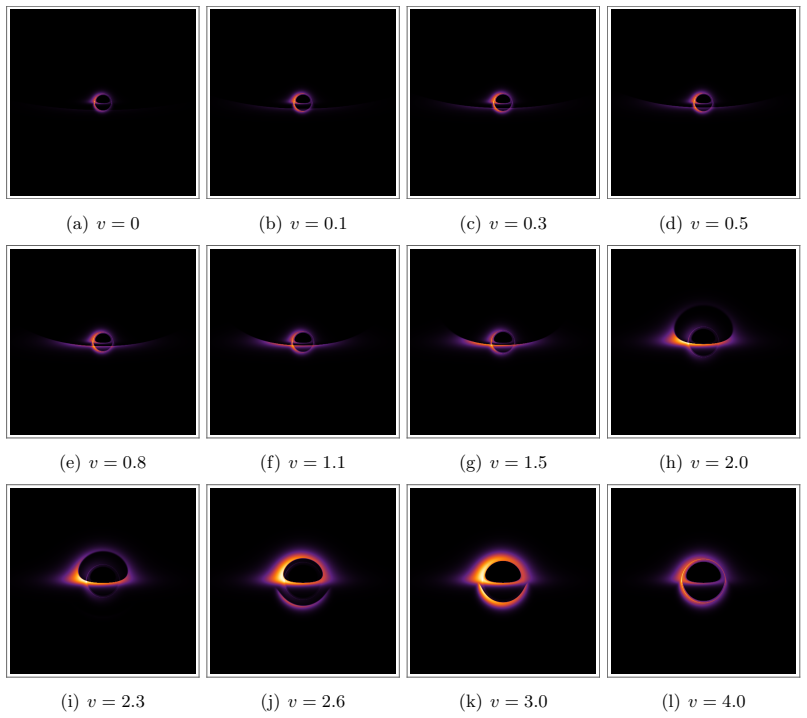
By employing backward ray-tracing techniques within the celestial sphere framework, the analysis of Vaidya black holes reveals that their shadow transitions from an initial stable configuration through continuous expansion to a final static state. During and after the active accretion phase, a distinct lensing ring emerges outside the shadow. Extending this analysis to the thin accretion disk model reveals richer observational signatures. A bright ring, formed by the superposition of the photon ring and lensing ring, appears outside the shadow but persists only during the initial and final stages of accretion, vanishing entirely when accretion becomes active. Interestingly, as the accretion
What carries the argument
Backward ray-tracing in the celestial sphere framework applied to the Vaidya metric and thin accretion disk model, which tracks photon paths and redshift in time-dependent spacetime.
If this is right
- The black hole shadow expands continuously during accretion before reaching a final static size.
- A lensing ring forms outside the shadow during and after the active accretion phase.
- The bright ring from photon and lensing ring superposition vanishes during peak accretion.
- The additional ring from dynamical redshift contracts inward while its brightness increases.
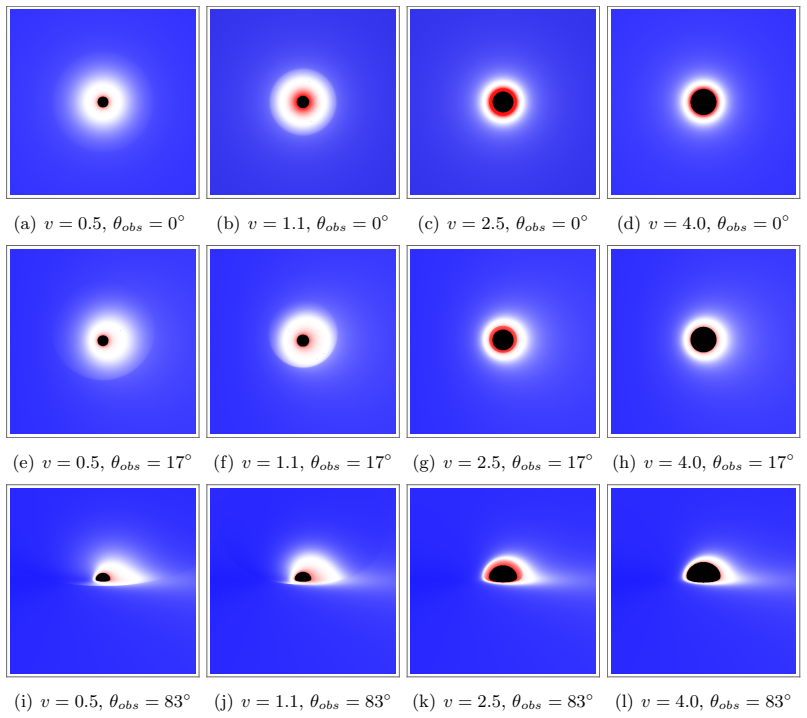
- Different observational inclinations produce strong asymmetry in shadow, bright ring, and redshift ring brightness.
Where Pith is reading between the lines
- This effect could serve as an observational test to distinguish accreting black holes from static ones in existing or upcoming telescope data.
- The dynamical redshift ring may appear in other time-dependent metrics, suggesting a general signature of spacetime evolution.
- Targeted searches for contracting bright features around sources like Sgr A* during accretion episodes could confirm the prediction.
Load-bearing premise
The Vaidya metric combined with the thin accretion disk model and backward ray-tracing fully captures the relevant light propagation and redshift effects without significant contributions from other physics.
What would settle it
High-resolution images of an actively accreting black hole that show no additional contracting and brightening ring structure would contradict the predicted dynamical redshift effect.
Figures


read the original abstract
In this work, we investigate the gravitational lensing effects and the dynamic evolution of the shadow of Vaidya black holes by employing backward ray-tracing techniques. Within the celestial sphere framework, the black hole shadow exhibits a complete evolutionary sequence, transitioning from an initial stable configuration through continuous expansion to a final static state. Notably, during and after the active accretion phase, a distinct lensing ring emerges outside the shadow. Extending this analysis to the thin accretion disk model reveals richer observational signatures. A bright ring, formed by the superposition of the photon ring and lensing ring, appears outside the shadow but persists only during the initial and final stages of accretion, vanishing entirely when accretion becomes active. Interestingly, as the accretion process progresses, an additional ring-like structure, which is caused by the dynamical redshift effect, emerges in the image. This ring-like structure not only contracts inward but also brightens continuously as accretion proceeds. Under varying observational inclinations, the Doppler effect and the dynamical redshift effect jointly modulate the brightness distribution of the image, resulting in significant asymmetry in the inner shadow, bright ring, and additional ring. Our findings uncover dynamical redshift as a novel observable phenomenon intrinsic to evolving spacetimes, offering a potential discriminant for identifying accreting black holes and providing observational access to the imprints of temporal spacetime evolution on black hole images.
Editorial analysis
A structured set of objections, weighed in public.
Referee Report
Summary. The paper investigates gravitational lensing effects and the dynamic evolution of the shadow of Vaidya black holes using backward ray-tracing in the celestial sphere framework. It reports that the shadow transitions from an initial stable state through expansion to a final static configuration, with a lensing ring emerging outside the shadow during and after accretion. For a thin accretion disk model, a bright ring (superposition of photon and lensing rings) appears only in initial and final stages and vanishes during active accretion, while an additional contracting and brightening ring-like structure is attributed to dynamical redshift; Doppler and dynamical redshift effects together produce inclination-dependent asymmetries in the image.
Significance. If the dynamical redshift ring is robustly isolated from gravitational redshift and Doppler boosting, the result would identify a potentially observable signature of spacetime evolution in accreting black holes, offering a new discriminant in strong-field imaging. The numerical backward ray-tracing approach in the Vaidya metric is a methodological strength for exploring time-dependent spacetimes.
major comments (1)
- [Results describing the additional ring and dynamical redshift] The attribution of the additional ring to dynamical redshift (abstract and results) rests on the numerical implementation correctly isolating the explicit v-dependence of M(v) in the geodesic equations and frequency shift via parallel transport of k^μ contracted with u^μ. A control run with M(v) frozen at its final value (reducing exactly to Schwarzschild while preserving identical disk emissivity, inclination, and ray-tracing pipeline) is required to confirm the ring is not an artifact of normalization, celestial-sphere coordinates, or the thin-disk velocity field.
minor comments (1)
- Clarify the precise definition of the celestial sphere framework and the numerical scheme used for parallel transport of the null wave vector along geodesics.
Simulated Author's Rebuttal
We thank the referee for their careful reading and constructive feedback on our manuscript. The request for a control simulation is a valid point that strengthens the attribution of the observed ring to dynamical redshift, and we have addressed it directly.
read point-by-point responses
-
Referee: [Results describing the additional ring and dynamical redshift] The attribution of the additional ring to dynamical redshift (abstract and results) rests on the numerical implementation correctly isolating the explicit v-dependence of M(v) in the geodesic equations and frequency shift via parallel transport of k^μ contracted with u^μ. A control run with M(v) frozen at its final value (reducing exactly to Schwarzschild while preserving identical disk emissivity, inclination, and ray-tracing pipeline) is required to confirm the ring is not an artifact of normalization, celestial-sphere coordinates, or the thin-disk velocity field.
Authors: We agree that a control run with M(v) held fixed at its final value is the cleanest way to isolate the dynamical redshift contribution. We have now performed this additional simulation using the identical ray-tracing pipeline, disk model, emissivity profile, and observer inclination. In the frozen-M case the spacetime reduces exactly to Schwarzschild and the additional contracting ring is absent from the images, while the photon ring and lensing ring remain. This confirms that the ring arises from the explicit time dependence in M(v) and the associated frequency shift computed via parallel transport. We will add a concise description of the control run together with comparative images to the revised manuscript. revision: yes
Circularity Check
No circularity in Vaidya metric ray-tracing simulations
full rationale
The paper computes black hole shadows, lensing rings, and dynamical redshift effects via direct numerical backward ray-tracing of null geodesics in the Vaidya metric, combined with parallel transport for frequency shifts and a thin-disk emissivity model. These steps apply the spacetime metric and geodesic equations without fitting parameters to observations, without renaming known results, and without load-bearing self-citations or self-definitional reductions. The reported contracting bright ring follows from the explicit v-dependence of M(v) in the metric and transport equations, remaining independent of the target claims.
Axiom & Free-Parameter Ledger
axioms (2)
- domain assumption The Vaidya metric accurately models the spacetime of a black hole with time-dependent mass due to accretion.
- domain assumption Backward ray-tracing in the celestial sphere framework captures all significant gravitational lensing and redshift effects.
Lean theorems connected to this paper
-
IndisputableMonolith/Foundation/RealityFromDistinction.leanreality_from_one_distinction unclear?
unclearRelation between the paper passage and the cited Recognition theorem.
We employ the backward ray-tracing method... gn = νobs/νn... dynamical redshift effect
-
IndisputableMonolith/Foundation/ArrowOfTime.leanarrow_from_z unclear?
unclearRelation between the paper passage and the cited Recognition theorem.
an additional ring-like structure, which is caused by the dynamical redshift effect
What do these tags mean?
- matches
- The paper's claim is directly supported by a theorem in the formal canon.
- supports
- The theorem supports part of the paper's argument, but the paper may add assumptions or extra steps.
- extends
- The paper goes beyond the formal theorem; the theorem is a base layer rather than the whole result.
- uses
- The paper appears to rely on the theorem as machinery.
- contradicts
- The paper's claim conflicts with a theorem or certificate in the canon.
- unclear
- Pith found a possible connection, but the passage is too broad, indirect, or ambiguous to say the theorem truly supports the claim.
Forward citations
Cited by 4 Pith papers
-
Optical Appearance of the Kerr-Bertotti-Robinson Black Hole with a Magnetically Driven Synchrotron Emissivity Model
Kerr-BR black hole images with magnetically coupled synchrotron emissivity show spin- and B-dependent shifts in the inner disk edge, altered lensing rings, and Doppler asymmetries, with retrograde cases displaying wid...
-
Photon Spheres and shadow of modified black-hole entropies
Modified black hole entropies alter photon sphere radii and shadow sizes, with parameters constrained by Event Horizon Telescope observations of Sgr A*.
-
Photon Spheres and shadow of modified black-hole entropies
Corrected black hole entropies produce distinct shifts in photon sphere radius and shadow size that are constrained by Event Horizon Telescope data on Sagittarius A*.
-
Photon Spheres and shadow of modified black-hole entropies
Entropy corrections to black holes produce modified metrics whose photon-sphere and shadow sizes can be constrained by Sgr A* observations.
Reference graph
Works this paper leans on
-
[1]
B. P. Abbottet al.[LIGO Scientific and Virgo], Phys. Rev. Lett.116, no.24, 241102 (2016)
work page 2016
-
[2]
Akiyamaet al.[Event Horizon Telescope], Astrophys
K. Akiyamaet al.[Event Horizon Telescope], Astrophys. J. Lett.875, L1 (2019)
work page 2019
-
[3]
Akiyamaet al.[Event Horizon Telescope], Astrophys
K. Akiyamaet al.[Event Horizon Telescope], Astrophys. J. Lett.930, no.2, L12 (2022)
work page 2022
-
[4]
K. S. Virbhadra and G. F. R. Ellis, Phys. Rev. D62, 084003 (2000)
work page 2000
-
[5]
C. M. Claudel, K. S. Virbhadra and G. F. R. Ellis, J. Math. Phys.42, 818-838 (2001)
work page 2001
-
[6]
K. S. Virbhadra and C. R. Keeton, Phys. Rev. D77, 124014 (2008)
work page 2008
- [7]
- [8]
- [9]
- [10]
-
[11]
S. F. Yanet al.Phys. Rev. Res.2, no.2, 023164 (2020)
work page 2020
-
[12]
O. Y. Tsupko, Z. Fan and G. S. Bisnovatyi-Kogan, Class. Quant. Grav.37, no.6, 065016 (2020)
work page 2020
-
[13]
Y. Chen, R. Roy, S. Vagnozzi and L. Visinelli, Phys. Rev. D106, no.4, 043021 (2022)
work page 2022
-
[14]
R. A. Konoplya, Phys. Lett. B804, 135363 (2020)
work page 2020
-
[15]
X. Hou, Z. Xu, M. Zhou and J. Wang, JCAP07, 015 (2018)
work page 2018
-
[16]
R. A. Konoplya, Phys. Lett. B795, 1-6 (2019)
work page 2019
- [17]
-
[18]
Z. Luo, J. Li, K. J. He and H. Yu, Phys. Lett. B871, 139985 (2025)
work page 2025
-
[19]
K. J. He, G. P. Li, C. Y. Yang and X. X. Zeng, JCAP10, 003 (2025)
work page 2025
-
[20]
G. P. Li, M. Q. Wu, K. J. He and Q. Q. Jiang, Phys. Rev. D113, no.4, 043009 (2026)
work page 2026
-
[21]
X. X. Zeng, C. Y. Yang, H. Yu and K. J. He, Eur. Phys. J. C86, no.2, 169 (2026)
work page 2026
-
[22]
K. J. He, Y. W. Han and G. P. Li, Phys. Dark Univ.44, 101468 (2024)
work page 2024
-
[23]
K. J. He, Z. Luo, S. Guo and G. P. Li, Chin. Phys. C48, no.6, 065105 (2024)
work page 2024
-
[24]
A. Abdujabbarov, M. Amir, B. Ahmedov and S. G. Ghosh, Phys. Rev. D93, no.10, 104004 (2016)
work page 2016
-
[25]
X. X. Zeng, G. P. Li and K. J. He, Nucl. Phys. B974, 115639 (2022)
work page 2022
-
[26]
S. W. Wei, P. Cheng, Y. Zhong and X. N. Zhou, JCAP08, 004 (2015)
work page 2015
-
[27]
V. Perlick, O. Y. Tsupko and G. S. Bisnovatyi-Kogan, Phys. Rev. D92, no.10, 104031 (2015)
work page 2015
-
[28]
F. Atamurotov, K. Jusufi, M. Jamil, A. Abdujabbarov and M. Azreg-A¨ ınou, Phys. Rev. D104, no.6, 064053 (2021)
work page 2021
-
[29]
M. Wang, S. Chen and J. Jing, Commun. Theor. Phys.74, no.9, 097401 (2022) 16
work page 2022
-
[30]
S. Chen, J. Jing, W. L. Qian and B. Wang, Sci. China Phys. Mech. Astron.66, no.6, 260401 (2023)
work page 2023
-
[31]
K. J. He, J. T. Yao, X. Zhang and X. Li, Phys. Rev. D109, no.6, 064049 (2024)
work page 2024
- [32]
-
[33]
F. Atamurotov, A. Abdujabbarov and B. Ahmedov, Phys. Rev. D88, no.6, 064004 (2013)
work page 2013
- [34]
-
[35]
Z. S. Qu, T. Wang and C. J. Feng, Annals Phys.464, 169642 (2024)
work page 2024
-
[36]
Y. Meng, X. M. Kuang, X. J. Wang and J. P. Wu, Phys. Lett. B841, 137940 (2023)
work page 2023
- [37]
-
[38]
C. Y. Yang, M. I. Aslam, X. X. Zeng and R. Saleem, J. High Energy Astrophys.46, 100345 (2025)
work page 2025
-
[39]
S. W. Hawking, Commun. Math. Phys.43, 199-220 (1975)
work page 1975
- [40]
- [41]
- [42]
-
[43]
W. B. Bonnor and P. C. Vaidya, Gen. Rel. Grav.1, 127-130 (1970)
work page 1970
-
[44]
R. L. Mallett, Phys. Rev. D31, no.2, 416-417 (1985)
work page 1985
-
[45]
P. K. Dahal and D. R. Terno, Phys. Rev. D102, 124032 (2020)
work page 2020
- [46]
- [47]
- [48]
- [49]
- [50]
-
[51]
S. Koh, M. Park and A. M. Sherif, JHEP24, 028 (2020)
work page 2020
-
[52]
A. K. Mishra, S. Chakraborty and S. Sarkar, Phys. Rev. D99, no.10, 104080 (2019)
work page 2019
- [53]
-
[54]
Y. Heydarzade and V. Vertogradov, Eur. Phys. J. C84, no.6, 582 (2024)
work page 2024
- [55]
-
[56]
J. P. Luminet, Astron. Astrophys.75, 228-235 (1979)
work page 1979
-
[57]
R. Narayan, M. D. Johnson and C. F. Gammie, Astrophys. J. Lett.885, no.2, L33 (2019)
work page 2019
-
[58]
S. E. Gralla, D. E. Holz and R. M. Wald, Phys. Rev. D100, no. 2, 024018 (2019)
work page 2019
-
[59]
X. X. Zeng, H. Q. Zhang and H. Zhang, Eur. Phys. J. C80, no.9, 872 (2020)
work page 2020
-
[60]
J. Peng, M. Guo and X. H. Feng, Chin. Phys. C45, no.8, 085103 (2021) 17
work page 2021
-
[61]
K. J. He, S. C. Tan and G. P. Li, Eur. Phys. J. C82, no.1, 81 (2022)
work page 2022
-
[62]
X. X. Zeng, K. J. He and G. P. Li, Sci. China Phys. Mech. Astron.65, no.9, 290411 (2022)
work page 2022
-
[63]
G. P. Li and K. J. He, JCAP06, 037 (2021)
work page 2021
-
[64]
X. J. Gao, T. T. Sui, X. X. Zeng, Y. S. An and Y. P. Hu, Eur. Phys. J. C83, 1052 (2023)
work page 2023
-
[65]
H. M. Wang, Z. C. Lin and S. W. Wei, Nucl. Phys. B985, 116026 (2022)
work page 2022
-
[66]
Y. Hou, Z. Zhang, H. Yan, M. Guo and B. Chen, Phys. Rev. D106, no.6, 064058 (2022)
work page 2022
-
[67]
K. J. He, G. P. Li, C. Y. Yang and X. X. Zeng, Eur. Phys. J. C85, no.6, 662 (2025)
work page 2025
-
[68]
X. X. Zeng, M. I. Aslam and R. Saleem, Eur. Phys. J. C83, no.2, 129 (2023)
work page 2023
-
[69]
A. B. Nielsen, Class. Quant. Grav.27, 245016 (2010)
work page 2010
-
[70]
A. Bohn, W. Throwe, F. H´ ebert, K. Henriksson, D. Bunandar, M. A. Scheel and N. W. Taylor, Class. Quant. Grav.32, no.6, 065002 (2015)
work page 2015
- [71]
- [72]
-
[73]
Y. P. Zhang, S. X. Sun, Y. Q. Wang, S. W. Wei, P. Laguna and Y. X. Liu, Phys. Rev. Res.6, no.3, 033187 (2024)
work page 2024
-
[74]
Porthet al.[Event Horizon Telescope], Astrophys
O. Porthet al.[Event Horizon Telescope], Astrophys. J. Suppl.243, no.2, 26 (2019)
work page 2019
-
[75]
J. C. McKinney, A. Tchekhovskoy and R. D. Blandford, Mon. Not. Roy. Astron. Soc.423, 3083 (2012)
work page 2012
-
[76]
Y. Hou, Z. Zhang, M. Guo and B. Chen, JCAP02, 030 (2024)
work page 2024
-
[77]
S. E. Gralla and A. Lupsasca, Phys. Rev. D101, no.4, 044031 (2020)
work page 2020
-
[78]
Y. Hou, P. Liu, M. Guo, H. Yan and B. Chen, Class. Quant. Grav.39, no.19, 194001 (2022)
work page 2022
-
[79]
K. Wang, C. J. Feng and T. Wang, Eur. Phys. J. C84, no.5, 457 (2024)
work page 2024
-
[80]
S. E. Gralla, A. Lupsasca and D. P. Marrone, Phys. Rev. D102, no.12, 124004 (2020) 18
work page 2020
discussion (0)
Sign in with ORCID, Apple, or X to comment. Anyone can read and Pith papers without signing in.