Recognition: 2 theorem links
· Lean TheoremOptical Appearance of the Kerr-Bertotti-Robinson Black Hole with a Magnetically Driven Synchrotron Emissivity Model
Pith reviewed 2026-05-12 04:06 UTC · model grok-4.3
The pith
The innermost stable orbit around a Kerr-Bertotti-Robinson black hole shifts with both spin and magnetic field strength, creating model-dependent emission cutoffs.
A machine-rendered reading of the paper's core claim, the machinery that carries it, and where it could break.
Core claim
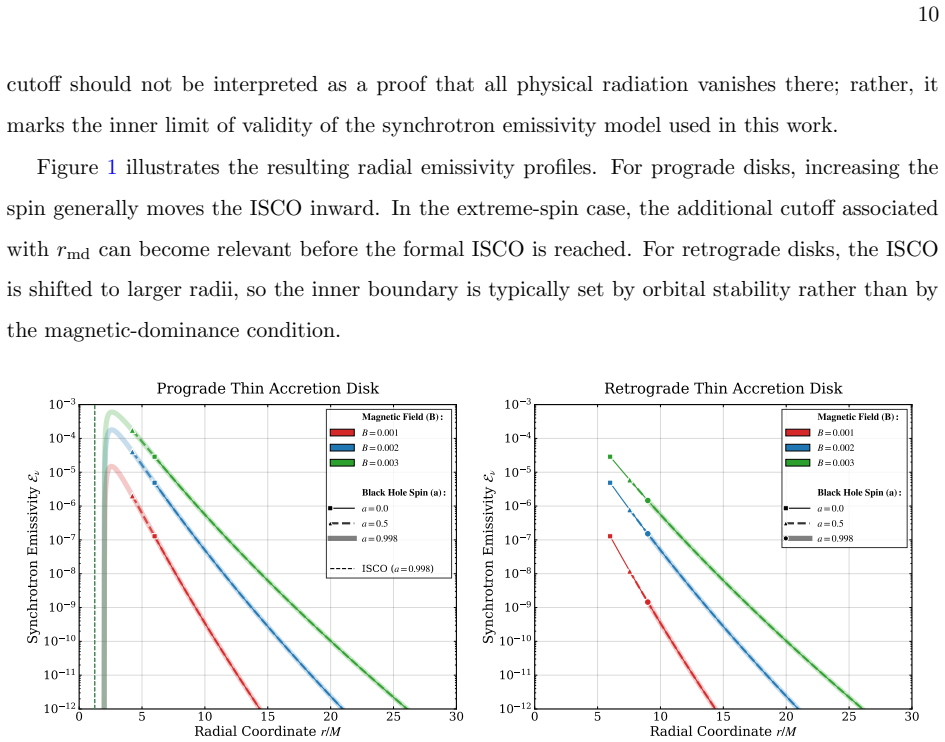
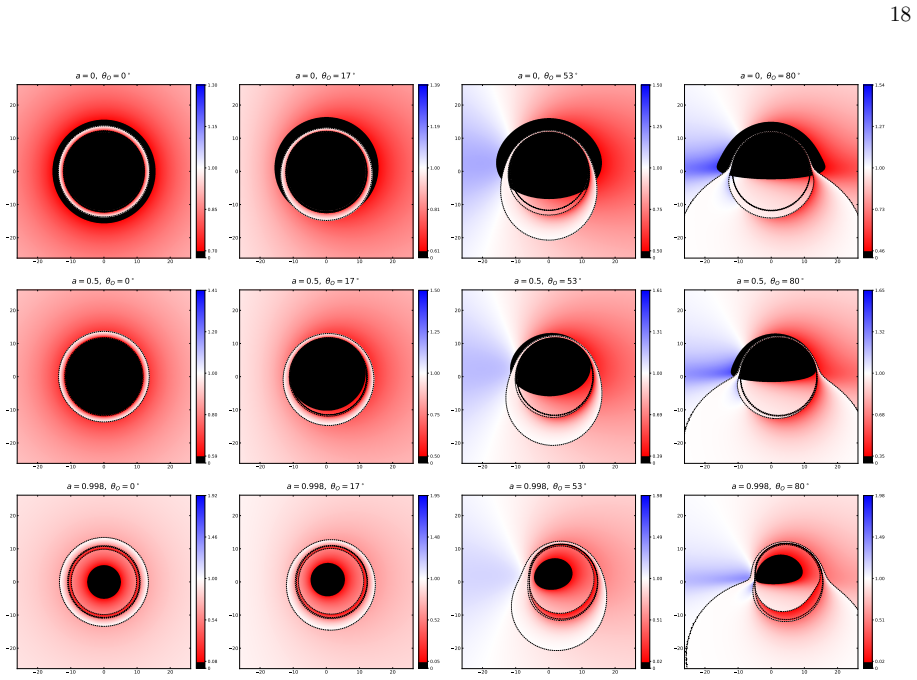
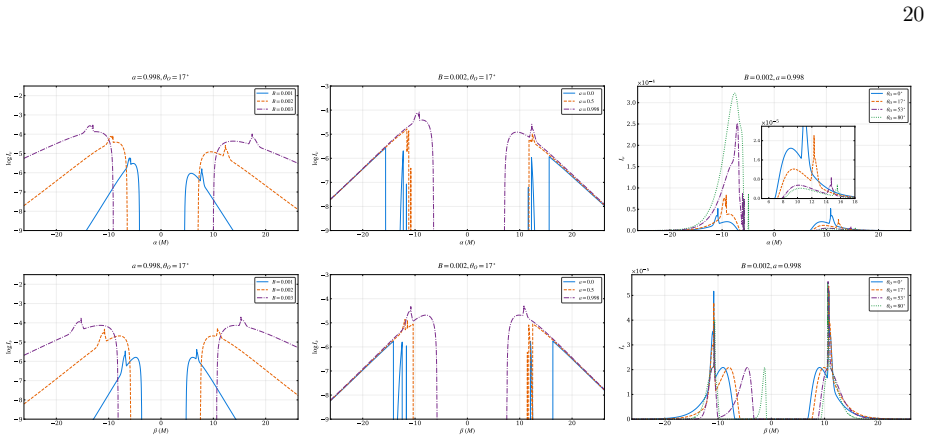
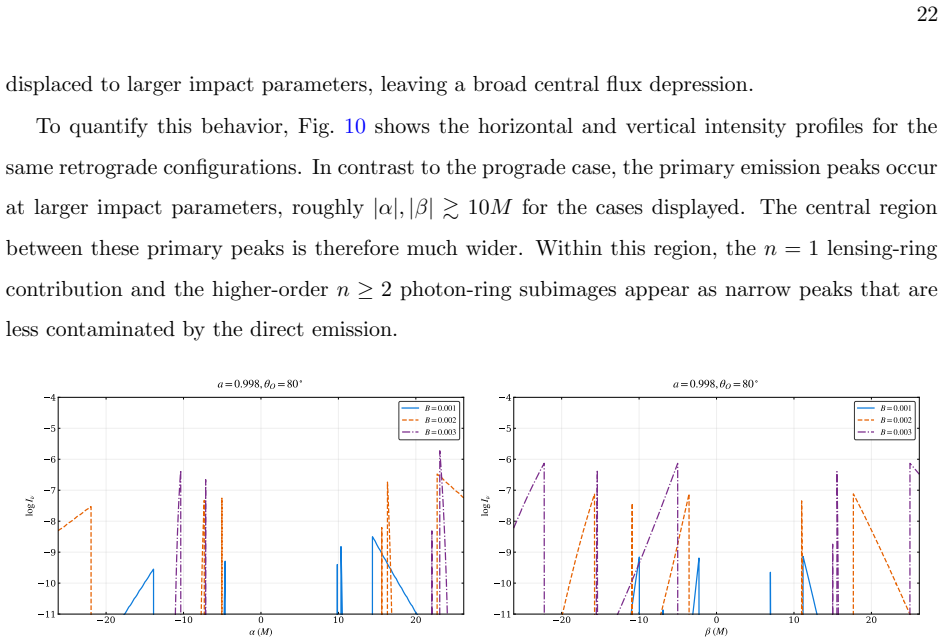
In the Kerr-Bertotti-Robinson spacetime the ISCO radius depends on both the spin a and the magnetic parameter B. Rapidly rotating prograde configurations develop an additional model-dependent inner cutoff when the magnetically dominated approximation underlying the emissivity prescription ceases to hold. Backward ray-tracing then produces ray-classification maps, redshift distributions, and specific-intensity images in which the direct disk, n=1 lensing ring, and higher-order photon rings are separated, with retrograde disks showing a wider emission-depleted central region.
What carries the argument
Magnetically driven synchrotron emissivity proxy coupled to the local electromagnetic environment, implemented inside a backward ray-tracing code for the Kerr-Bertotti-Robinson metric.
If this is right
- The direct image brightness becomes asymmetric due to quantified Doppler boosting.
- One-dimensional profiles separate the direct emission from the n=1 lensing-ring and n greater than or equal to 2 photon-ring contributions.
- Retrograde disks produce a wider central depletion zone, making higher-order lensed components easier to distinguish.
- Both the disk inner boundary and the resulting observable appearance depend on the combination of spin and magnetic strength.
Where Pith is reading between the lines
- Images that resolve the central dark region size could be used to test for the presence of a uniform magnetic field component if the emissivity model is reliable.
- The same ray-tracing setup could be applied to other metrics that include electromagnetic fields to predict distinguishing signatures.
- For sources with near-maximal prograde spin, the location where the emissivity approximation fails becomes an observable feature that must be checked against data.
Load-bearing premise
The magnetically driven synchrotron emissivity proxy remains valid and applicable all the way down to the ISCO, including at high prograde spins where the paper notes the approximation can cease to hold.
What would settle it
High-resolution intensity profiles of a rapidly spinning prograde source that show bright emission inside the predicted model-dependent cutoff radius, or no measurable change in the size of the central dark region when the inferred magnetic field strength varies.
Figures




read the original abstract
We investigate the optical appearance of a Kerr-Bertotti-Robinson (Kerr-BR) black hole illuminated by a geometrically and optically thin accretion disk. Instead of using a phenomenological power-law emissivity, we adopt a magnetically driven synchrotron emissivity proxy coupled to the local electromagnetic environment. With a backward ray-tracing framework, we examine the effects of the spin $a$, magnetic parameter $B$, and observer inclination $\theta_O$ on the ray-classification maps, redshift distributions, and specific-intensity images. We show that the ISCO position is modified by both $a$ and $B$, and that rapidly rotating prograde configurations can develop an additional model-dependent inner cutoff when the magnetically dominated approximation underlying the emissivity prescription ceases to be applicable. High-resolution one-dimensional intensity profiles further separate the direct image, the $n=1$ lensing-ring contribution, and the higher-order $n\geq 2$ photon-ring subimages, while quantifying the Doppler-induced brightness asymmetry. Retrograde disks exhibit a wider emission-depleted central region because of the outwardly shifted ISCO, making the higher-order lensed components more clearly distinguishable from the direct emission. These results show that the disk inner boundary and the magnetic-field-dependent emissivity can substantially influence the observable appearance of Kerr-BR black holes.
Editorial analysis
A structured set of objections, weighed in public.
Referee Report
Summary. The manuscript examines the optical appearance of Kerr-Bertotti-Robinson black holes illuminated by a geometrically and optically thin accretion disk using a magnetically driven synchrotron emissivity proxy tied to the local electromagnetic environment. Employing backward ray-tracing, it explores the influence of the spin parameter a, magnetic parameter B, and observer inclination θ_O on ray-classification maps, redshift distributions, and specific-intensity images, including decomposition into direct, n=1 lensing-ring, and n≥2 photon-ring components. The central results indicate that the ISCO location is modified by both a and B, with rapidly rotating prograde cases developing an additional model-dependent inner cutoff when the magnetically dominated approximation for emissivity ceases to apply, while retrograde disks show wider emission-depleted central regions.
Significance. If the emissivity model is validated, this work provides a physically motivated alternative to phenomenological emissivity profiles, highlighting how magnetic fields in the Kerr-BR spacetime affect observable features such as brightness asymmetries and the distinguishability of lensed components. The quantitative separation of image orders and Doppler effects adds value for potential observational comparisons. The paper's own identification of the approximation's limitations is noted, but addressing this would enhance the significance for high-spin regimes.
major comments (2)
- [Abstract] The assertion that rapidly rotating prograde configurations can develop an additional model-dependent inner cutoff when the magnetically dominated approximation ceases to be applicable is central to the paper's claims. However, without explicit validation of the proxy's applicability down to the ISCO or quantification of the resulting uncertainties in the intensity profiles (as flagged in the abstract), the robustness of the reported high-resolution one-dimensional intensity profiles and Doppler-induced brightness asymmetry in this regime is limited.
- [Emissivity model description] The emissivity is defined as a proxy coupled to the local electromagnetic environment. The manuscript should clarify the choice of normalization and functional form to ensure it is not adjusted post hoc to match expected image features, which could introduce circularity affecting the conclusions on ring contrasts and asymmetries.
minor comments (1)
- The abstract mentions 'high-resolution one-dimensional intensity profiles'; ensure that the corresponding figures clearly label the contributions from direct emission, n=1, and n≥2 components for reader clarity.
Simulated Author's Rebuttal
We thank the referee for the constructive and detailed comments, which have helped us improve the clarity and robustness of the manuscript. We provide point-by-point responses to the major comments below and have revised the paper to address the concerns raised.
read point-by-point responses
-
Referee: [Abstract] The assertion that rapidly rotating prograde configurations can develop an additional model-dependent inner cutoff when the magnetically dominated approximation ceases to be applicable is central to the paper's claims. However, without explicit validation of the proxy's applicability down to the ISCO or quantification of the resulting uncertainties in the intensity profiles (as flagged in the abstract), the robustness of the reported high-resolution one-dimensional intensity profiles and Doppler-induced brightness asymmetry in this regime is limited.
Authors: We agree that additional quantification would enhance the robustness discussion. The abstract already flags this model limitation. In the revised manuscript, we have added a dedicated paragraph in Section 2 (Emissivity Model) that estimates the radial range where the magnetically dominated approximation remains valid by comparing the magnetic energy density to the estimated gas pressure near the ISCO for high-spin prograde cases. We also include approximate uncertainty envelopes on the one-dimensional intensity profiles for the highest-spin models, derived from the point where the approximation begins to break down. These additions directly address the concern without changing the primary conclusions. revision: yes
-
Referee: [Emissivity model description] The emissivity is defined as a proxy coupled to the local electromagnetic environment. The manuscript should clarify the choice of normalization and functional form to ensure it is not adjusted post hoc to match expected image features, which could introduce circularity affecting the conclusions on ring contrasts and asymmetries.
Authors: The functional form follows directly from the standard synchrotron emissivity for thermal electrons in a magnetic field, scaling with the square of the local magnetic field strength (reflecting the magnetic energy density) and the electron number density. The normalization is fixed by requiring that the disk-integrated luminosity equals a reference value consistent with typical values for accreting black-hole systems; this choice is independent of any image morphology. We have expanded the emissivity-model subsection to include the explicit derivation from the synchrotron formula and to state the normalization criterion. No parameters were tuned to reproduce specific ring contrasts or Doppler asymmetries; the reported effects arise solely from the dependence on spin and magnetic parameter. revision: yes
Circularity Check
No significant circularity; derivation applies chosen emissivity model to metric-derived ISCO without tautological reduction
full rationale
The paper selects a magnetically driven synchrotron emissivity proxy tied to the Kerr-BR electromagnetic field and uses backward ray-tracing to generate images and profiles. The ISCO shift with a and B follows from the spacetime metric and effective potential, while the model-dependent inner cutoff is explicitly flagged as the point where the proxy's magnetically dominated approximation fails. No equations reduce a claimed prediction to a fitted input or self-citation by construction; the central results are direct outputs of the adopted model and geometry rather than redefinitions of the inputs. The analysis remains self-contained against external benchmarks such as standard thin-disk ray-tracing.
Axiom & Free-Parameter Ledger
free parameters (1)
- magnetic parameter B
axioms (2)
- domain assumption The accretion disk is geometrically and optically thin.
- ad hoc to paper The emissivity follows a magnetically driven synchrotron proxy that remains valid near the ISCO.
Lean theorems connected to this paper
-
IndisputableMonolith/Cost/FunctionalEquation.leanwashburn_uniqueness_aczel unclear?
unclearRelation between the paper passage and the cited Recognition theorem.
We adopt a magnetically driven synchrotron emissivity proxy ... rin = max(rISCO, rmd)
-
IndisputableMonolith/Foundation/AlexanderDuality.leanalexander_duality_circle_linking unclear?
unclearRelation between the paper passage and the cited Recognition theorem.
ISCO radius ... rISCO = (r+ + r−)/2 [3 + Z2 ∓ ...]
What do these tags mean?
- matches
- The paper's claim is directly supported by a theorem in the formal canon.
- supports
- The theorem supports part of the paper's argument, but the paper may add assumptions or extra steps.
- extends
- The paper goes beyond the formal theorem; the theorem is a base layer rather than the whole result.
- uses
- The paper appears to rely on the theorem as machinery.
- contradicts
- The paper's claim conflicts with a theorem or certificate in the canon.
- unclear
- Pith found a possible connection, but the passage is too broad, indirect, or ambiguous to say the theorem truly supports the claim.
Reference graph
Works this paper leans on
-
[1]
The observer is placed atr O = 1000M, and the field of view is fixed to 3 ◦
Effect of the Magnetic ParameterB We first study the dependence of the optical appearance on the magnetic parameterB. The observer is placed atr O = 1000M, and the field of view is fixed to 3 ◦. The emissivity parameter is set toα= 0.5. To isolate the role ofB, we fix the spin ata= 0.998 and consider three representative values, B∈ {0.001,0.002,0.003},(39...
-
[2]
Effect of the Black Hole Spina We next examine the effect of the black hole spin. The magnetic parameter is fixed atB= 0.002, and the spin is varied as a∈ {0,0.5,0.998}.(41) The corresponding ray-classification maps, redshift-factor maps, and specific-intensity maps are shown in Figs. 5, 6, and 7, respectively. Increasing the spin modifies both the photon...
-
[3]
First M87 Event Horizon Telescope Results. I. The Shadow of the Supermassive Black Hole
K. Akiyamaet al.(Event Horizon Telescope), First M87 event horizon telescope results. I. the shadow of the supermassive black hole, Astrophys. J. Lett.875, L1 (2019), arXiv:1906.11238 [astro-ph.GA]
work page internal anchor Pith review arXiv 2019
-
[4]
K. Akiyamaet al.(Event Horizon Telescope), First sagittarius A* event horizon telescope results. I. the shadow of the supermassive black hole in the center of the milky way, Astrophys. J. Lett.930, L12 (2022), arXiv:2311.08680 [astro-ph.HE]
work page internal anchor Pith review arXiv 2022
-
[5]
S. E. Gralla, D. E. Holz, and R. M. Wald, Black hole shadows, photon rings, and lensing rings, Phys. Rev. D100, 024018 (2019), arXiv:1906.00873 [astro-ph.HE]
work page Pith review arXiv 2019
-
[6]
M. D. Johnson, A. Lupsasca, A. Strominger, G. N. Wong, S. Hadar, D. Kapec, R. Narayan, A. Chael, 25 C. F. Gammie, P. Galison, D. C. M. Palumbo, S. S. Doeleman, L. Blackburn, M. Wielgus, D. W. Pesce, J. R. Farah, and J. M. Moran, Universal interferometric signatures of a black hole’s photon ring, Sci. Adv.6, eaaz1310 (2020), arXiv:1907.04329 [astro-ph.IM]
-
[7]
R. Narayan, M. D. Johnson, and C. F. Gammie, The Shadow of a Spherically Accreting Black Hole, Astrophys. J. Lett.885, L33 (2019), arXiv:1910.02957 [astro-ph.HE]
-
[8]
Luminet, Image of a spherical black hole with thin accretion disk, Astron
J.-P. Luminet, Image of a spherical black hole with thin accretion disk, Astron. Astrophys.75, 228 (1979)
work page 1979
-
[9]
Viewing the Shadow of the Black Hole at the Galactic Center
H. Falcke, F. Melia, and E. Agol, Viewing the shadow of the black hole at the galactic center, Astrophys. J. Lett.528, L13 (2000), arXiv:astro-ph/9912263 [astro-ph]
work page Pith review arXiv 2000
-
[10]
K.-i. Kanai and Y. Nambu, Viewing black holes by waves, Class. Quant. Grav.30, 175002 (2013), arXiv:1303.5520 [gr-qc]
- [11]
- [12]
- [13]
-
[14]
X.-X. Zeng, H.-Q. Zhang, and H. Zhang, Shadows and photon spheres with spherical accretions in the four-dimensional Gauss–Bonnet black hole, Eur. Phys. J. C80, 872 (2020), arXiv:2004.12074 [gr-qc]
-
[15]
X.-X. Zeng, G.-P. Li, and K.-J. He, The shadows and observational appearance of a noncommu- tative black hole surrounded by various profiles of accretions, Nucl. Phys. B974, 115639 (2022), arXiv:2106.14478 [hep-th]
- [16]
-
[17]
S. Hu, C. Deng, D. Li, X. Wu, and E.-W. Liang, Observational signatures of Schwarzschild–MOG black holes in scalar-tensor-vector gravity: Shadows and rings with different accretions, Eur. Phys. J. C82, 885 (2022)
work page 2022
-
[18]
S. Hu, C. Deng, S. Guo, X. Wu, and E.-W. Liang, Observational signatures of Schwarzschild–MOG black holes in scalar-tensor-vector gravity: Images of the accretion disk, Eur. Phys. J. C83, 264 (2023)
work page 2023
- [19]
-
[20]
X.-X. Zeng, K.-J. He, J. Pu, G.-P. Li, and Q.-Q. Jiang, Holographic Einstein rings of a Gauss–Bonnet AdS black hole, Eur. Phys. J. C83, 897 (2023), arXiv:2302.03692 [gr-qc]
- [21]
- [22]
- [23]
-
[24]
Gravitational lensing and observational features of a dynamic black hole
K.-J. He, G.-P. Li, L.-F. Li, and X.-X. Zeng, Gravitational lensing and observational features of a dynamic black hole, arXiv e-prints (2026), arXiv:2603.27606 [gr-qc]
work page internal anchor Pith review Pith/arXiv arXiv 2026
- [25]
-
[26]
M. Mo´ scibrodzka, C. F. Gammie, J. C. Dolence, H. Shiokawa, and P. K. Leung, Radiative models of Sgr A* from GRMHD simulations, Astrophys. J.706, 497 (2009), arXiv:0909.5431 [astro-ph.HE]
-
[27]
M. Mo´ scibrodzka, H. Falcke, H. Shiokawa, and C. F. Gammie, Observational appearance of inefficient accretion flows and jets in 3d GRMHD simulations: Application to sagittarius A*, Astron. Astrophys. 570, A7 (2014), arXiv:1408.4743 [astro-ph.HE]
-
[28]
The Event Horizon General Relativistic Magnetohydrodynamic Code Comparison Project,
O. Porth, K. Chatterjee, R. Narayan, C. F. Gammie, Y. Mizuno, P. Anninos, J. G. Baker, M. Bugli, C.-K. Chan, J. Davelaar, L. Del Zanna, Z. B. Etienne, P. C. Fragile, B. J. Kelly, M. Liska, S. Markoff, J. C. McKinney, B. Mishra, S. C. Noble, H. Olivares, B. Prather, L. Rezzolla, B. R. Ryan, J. M. Stone, N. Tomei, C. J. White, and Z. Younsi (Event Horizon T...
-
[29]
First M87 Event Horizon Telescope Results. V. Physical Origin of the Asymmetric Ring
K. Akiyamaet al.(Event Horizon Telescope), First M87 event horizon telescope results. V. physical origin of the asymmetric ring, Astrophys. J. Lett.875, L5 (2019), arXiv:1906.11242 [astro-ph.GA]
work page Pith review arXiv 2019
-
[30]
Polarized image of equatorial emission in the Kerr geometry,
Z. Gelles, E. Himwich, M. D. Johnson, and D. C. M. Palumbo, Polarized image of equatorial emission in the Kerr geometry, Phys. Rev. D104, 044060 (2021), arXiv:2105.09440 [gr-qc]
- [31]
- [32]
- [33]
-
[34]
C.-Y. Yang and X.-X. Zeng, Distinguishing black holes and neutron stars via optical images illuminated by thick accretion disks, arXiv e-prints (2026), arXiv:2604.00117 [gr-qc]
-
[35]
F. J. Ernst, Black holes in a magnetic universe, J. Math. Phys.17, 54 (1976)
work page 1976
-
[36]
J. Podolsk´ y and H. Ovcharenko, Kerr black hole in a uniform Bertotti–Robinson magnetic field: An 27 exact solution, Phys. Rev. Lett.135, 181401 (2025), arXiv:2507.05199 [gr-qc]
-
[37]
H. Ovcharenko and J. Podolsk´ y, A novel class of rotating black holes with non-aligned electromagnetic field, J. Phys. Conf. Ser.3177, 012006 (2026), arXiv:2511.04840 [gr-qc]
-
[38]
Various metric forms of all type D black holes and their application
J. Podolsk´ y, Various metric forms of all type D black holes and their application, J. Phys. Conf. Ser. 3177, 012012 (2026), arXiv:2511.01029 [gr-qc]
work page internal anchor Pith review Pith/arXiv arXiv 2026
-
[39]
Astorino, Black holes in the external Bertotti–Robinson–Bonnor–Melvin electromagnetic field, Phys
M. Astorino, Black holes in the external Bertotti–Robinson–Bonnor–Melvin electromagnetic field, Phys. Rev. D112, 104077 (2025), arXiv:2508.12908 [gr-qc]
-
[40]
H. Ovcharenko and J. Podolsk´ y, New class of rotating charged black holes with nonaligned electromag- netic field, Phys. Rev. D112, 064076 (2025), arXiv:2508.04850 [gr-qc]
-
[41]
Uniqueness of stationary axisymmetric type D black holes with non-aligned electromagnetic field
H. Ovcharenko and J. Podolsk´ y, Uniqueness of stationary axisymmetric type D black holes with non- aligned electromagnetic field, arXiv e-prints (2026), arXiv:2604.13202 [gr-qc]
work page internal anchor Pith review Pith/arXiv arXiv 2026
-
[42]
Black holes in rotating, electromagnetic backgrounds and topological Kerr-Newman-NUT spacetimes
M. Astorino, Black holes in rotating, electromagnetic backgrounds and topological Kerr–Newman–NUT spacetimes, arXiv e-prints (2026), arXiv:2604.05017 [gr-qc]
work page internal anchor Pith review Pith/arXiv arXiv 2026
-
[43]
J. Barrientos, A. Cisterna, A. D´ ıaz, and K. M¨ uller, From Bertotti–Robinson to vacuum: New ex- act solutions in general relativity via Harrison and inversion symmetries, arXiv e-prints (2026), arXiv:2602.17581 [gr-qc]
-
[44]
H. Ovcharenko and J. Podolsk´ y, Static black holes in an external uniform electromagnetic field: Reissner–Nordstr¨ om accelerating in Bertotti–Robinson, arXiv e-prints (2026), arXiv:2602.15462 [gr-qc]
-
[45]
J. Barrientos, F. Canfora, A. Cisterna, K. M¨ uller, and A. Neira, Melvin–Bonnor and Bertotti–Robinson spacetimes with baryonic charge, arXiv e-prints (2026), arXiv:2601.19858 [gr-qc]
- [46]
- [47]
- [48]
- [49]
- [50]
- [51]
- [52]
-
[53]
A. Al-Badawi, F. Ahmed, and E. O. Silva, Accelerating Bertotti–Robinson black holes in a uniform magnetic field, arXiv e-prints (2026), arXiv:2603.03494 [gr-qc]. 28
- [54]
-
[55]
Y.-K. Zhang and S.-W. Wei, Effects of magnetic fields on spinning test particles orbiting Kerr–Bertotti– Robinson black holes, arXiv e-prints (2025), arXiv:2510.07914 [gr-qc]
-
[56]
C.-H. Wang, X.-C. Meng, and S.-W. Wei, Magnetic field effects on spherical orbit in Kerr–Bertotti– Robinson spacetime: Constraints from jet precession of M87*, arXiv e-prints (2026), arXiv:2602.03161 [gr-qc]
-
[57]
T. Xamidov, S. Shaymatov, Q. Wu, and T. Zhu, Gravitational wave signatures from periodic orbits around a Schwarzschild–Bertotti–Robinson black hole, arXiv e-prints (2026), arXiv:2602.09453 [gr-qc]
-
[58]
G. Mustafa, O. Donmez, D. J. Gogoi, S. G. Ghosh, I. Hussain, and C. Yuan, Dynamics, ringdown, and accretion-driven multiple quasi-periodic oscillations of Kerr–Bertotti–Robinson black holes, arXiv e-prints (2026), arXiv:2602.08911 [gr-qc]
- [59]
-
[60]
M. Mirkhaydarov, T. Xamidov, P. Sheoran, S. Shaymatov, and H. Nandan, Non-monotonic enhance- ment of the magnetic Penrose process in Kerr–Bertotti–Robinson spacetime and its implication for electron acceleration, arXiv e-prints (2026), arXiv:2601.09919 [gr-qc]
-
[61]
X.-X. Zeng and K. Wang, Energy extraction from the Kerr–Bertotti–Robinson black hole via magnetic reconnection in a circular and a plunging plasma, Phys. Rev. D112, 064032 (2025), arXiv:2507.21777 [gr-qc]
- [62]
-
[63]
A. Vachher, A. Kumar, and S. G. Ghosh, The influence of uniform magnetic fields on strong field gravitational lensing by Kerr black holes, JCAP11, 021, arXiv:2508.21100 [gr-qc]
- [64]
-
[65]
X.-X. Zeng, C.-Y. Yang, and H. Yu, Optical characteristics of the Kerr–Bertotti–Robinson black hole, Eur. Phys. J. C85, 1242 (2025), arXiv:2508.03020 [gr-qc]
- [66]
-
[67]
J. Sharipov, P. Sheoran, and S. Shaymatov, Magnetic modification of black hole photospheres with image contraction, efficiency shifts and redshift boosts in Schwarzschild–Bertotti–Robinson spacetime, arXiv e-prints (2026), arXiv:2603.25210 [gr-qc]
-
[68]
T. Wang, Innermost stable circular orbit of Kerr–Bertotti–Robinson black holes and inspirals from it: Exact solutions, arXiv e-prints (2025), arXiv:2508.04684 [gr-qc]. 29
-
[69]
A. Chael, R. Narayan, and M. D. Johnson, Two-temperature, magnetically arrested disc simulations of the jet from the supermassive black hole in M87, Mon. Not. Roy. Astron. Soc.486, 2873 (2019), arXiv:1810.01983 [astro-ph.HE]
work page Pith review arXiv 2019
- [70]
discussion (0)
Sign in with ORCID, Apple, or X to comment. Anyone can read and Pith papers without signing in.