Recognition: 2 theorem links
· Lean TheoremRetinexDualV2: Physically-Grounded Dual Retinex for Generalized UHD Image Restoration
Pith reviewed 2026-05-14 22:21 UTC · model grok-4.3
The pith
A single dual Retinex network restores UHD images across rain, low-light and noise degradations by conditioning on extracted physical priors.
A machine-rendered reading of the paper's core claim, the machinery that carries it, and where it could break.
Core claim
RetinexDualV2 is a unified, physically grounded dual-branch framework for diverse Ultra-High-Definition (UHD) image restoration. Unlike generic models, our method employs a Task-Specific Physical Grounding Module (TS-PGM) to extract degradation-aware priors (e.g., rain masks and dark channels). These explicitly guide a Retinex decomposition network via a novel Physical-Conditioned Multi-head Self-Attention (PC-MSA) mechanism, enabling robust reflection and illumination correction. This physical conditioning allows a single architecture to handle various complex degradations seamlessly, without task-specific structural modifications.
What carries the argument
Task-Specific Physical Grounding Module that supplies degradation-aware priors to condition Physical-Conditioned Multi-head Self-Attention inside the dual Retinex branches for reflection and illumination separation.
If this is right
- One trained architecture can address raindrop removal and joint noise low-light enhancement without any structural changes between tasks.
- Explicit physical conditioning improves both restoration quality and computational efficiency at ultra-high resolutions.
- The same model generalizes to day and night conditions through the shared grounding and attention pathway.
- Reflection and illumination layers are corrected more reliably when guided by measurable image-formation cues rather than learned features alone.
Where Pith is reading between the lines
- Practical camera pipelines could adopt the model for on-device correction of mixed degradations without storing multiple specialized networks.
- Extending the grounding module to extract priors for blur or compression artifacts might allow further task unification.
- The explicit tie to physical image formation suggests restoration outputs could become more interpretable for downstream analysis.
Load-bearing premise
The physical priors extracted by the grounding module remain accurate and sufficiently informative to guide Retinex decomposition for any new degradation without requiring changes to the network architecture.
What would settle it
Apply the trained model to UHD images containing a previously unseen degradation such as combined haze and motion blur; if it underperforms dedicated task-specific methods or needs architectural adjustments, the claim does not hold.
Figures


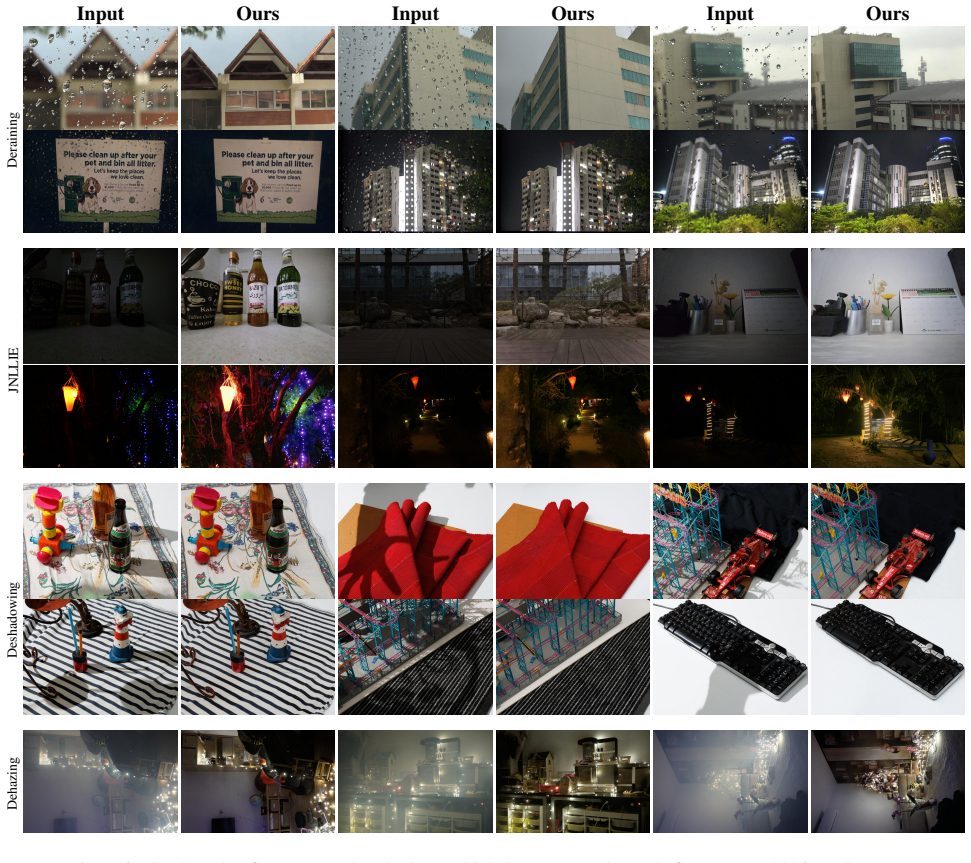
read the original abstract
We propose RetinexDualV2, a unified, physically grounded dual-branch framework for diverse Ultra-High-Definition (UHD) image restoration. Unlike generic models, our method employs a Task-Specific Physical Grounding Module (TS-PGM) to extract degradation-aware priors (e.g., rain masks and dark channels). These explicitly guide a Retinex decomposition network via a novel Physical-Conditioned Multi-head Self-Attention (PC-MSA) mechanism, enabling robust reflection and illumination correction. This physical conditioning allows a single architecture to handle various complex degradations seamlessly, without task-specific structural modifications. RetinexDualV2 demonstrates exceptional generalizability, securing 4th place in the NTIRE 2026 Day and Night Raindrop Removal Challenge and 5th place in the Joint Noise Low-light Enhancement (JNLLIE) Challenge. Extensive experiments confirm the state-of-the-art performance and efficiency of our physically motivated approach. Code is available at https://github.com/ErrorLogic1211/RetinexDual/tree/master/RetinexDualV2
Editorial analysis
A structured set of objections, weighed in public.
Referee Report
Summary. The paper proposes RetinexDualV2, a unified dual-branch Retinex framework for generalized UHD image restoration. A Task-Specific Physical Grounding Module (TS-PGM) extracts degradation-aware priors (rain masks, dark channels) that condition Retinex decomposition through a novel Physical-Conditioned Multi-head Self-Attention (PC-MSA) mechanism. This enables a single architecture to address multiple degradations without task-specific structural changes. The method reports 4th place in the NTIRE 2026 Day and Night Raindrop Removal Challenge and 5th place in the Joint Noise Low-light Enhancement (JNLLIE) Challenge, with claims of SOTA performance and efficiency; code is released.
Significance. If the physical priors reliably guide decomposition, the work could advance unified UHD restoration models that avoid per-task redesigns, offering efficiency gains for real-world applications. The challenge rankings provide evidence of competitiveness, and open-sourcing the code supports reproducibility and further validation.
major comments (2)
- [Experimental results] Experimental results section: The central claim that TS-PGM priors enable unified generalizability without architectural changes is load-bearing, yet no quantitative validation of prior accuracy (e.g., rain-mask IoU against ground truth) or ablation isolating PC-MSA conditioning from the dual-branch backbone is reported. Challenge rankings alone do not establish that performance stems from physical guidance rather than model capacity.
- [Methods] Methods section, TS-PGM and PC-MSA description: The paper states that priors are extracted from the input and injected via PC-MSA, but provides no equations or diagrams detailing the exact conditioning mechanism (e.g., how rain masks modulate attention weights). This omission prevents verification that the priors remain effective across degradations without task-specific tuning.
minor comments (2)
- [Abstract] Abstract: The summary of 'extensive experiments' and 'SOTA performance' would be strengthened by including at least one key quantitative metric (PSNR/SSIM) or reference to an ablation table.
- [Figures] Figure captions: Ensure all figures showing prior extraction (e.g., rain masks, dark channels) include scale bars or explicit comparison to input images for clarity.
Simulated Author's Rebuttal
We thank the referee for the detailed and constructive feedback. We address each major comment below and will revise the manuscript accordingly to improve clarity and strengthen the evidence for our claims.
read point-by-point responses
-
Referee: Experimental results section: The central claim that TS-PGM priors enable unified generalizability without architectural changes is load-bearing, yet no quantitative validation of prior accuracy (e.g., rain-mask IoU against ground truth) or ablation isolating PC-MSA conditioning from the dual-branch backbone is reported. Challenge rankings alone do not establish that performance stems from physical guidance rather than model capacity.
Authors: We agree that the current experimental section relies primarily on challenge rankings and overall performance metrics, which do not fully isolate the contribution of the physical priors. In the revised manuscript, we will add (1) quantitative evaluation of prior accuracy (e.g., rain-mask IoU on available synthetic data) and (2) a controlled ablation study comparing the full model against a variant without PC-MSA conditioning. These additions will provide direct evidence that performance gains stem from the physical guidance rather than model capacity alone. We note that ground-truth priors are not always available for real-world data, but synthetic benchmarks will be used where possible. revision: yes
-
Referee: Methods section, TS-PGM and PC-MSA description: The paper states that priors are extracted from the input and injected via PC-MSA, but provides no equations or diagrams detailing the exact conditioning mechanism (e.g., how rain masks modulate attention weights). This omission prevents verification that the priors remain effective across degradations without task-specific tuning.
Authors: We acknowledge the lack of explicit mathematical formulation and visual details for the conditioning process in PC-MSA. In the revision, we will include the precise equations describing how degradation-aware priors (from TS-PGM) modulate the attention weights within PC-MSA, as well as an expanded diagram of the module. This will make the mechanism verifiable and demonstrate its applicability across different degradations without architectural changes. revision: yes
Circularity Check
No significant circularity; derivation is self-contained
full rationale
The paper grounds its dual-branch Retinex framework in established Retinex theory and extracts standard physical priors (rain masks, dark channels) directly from the input image via the TS-PGM module. These priors condition the PC-MSA mechanism as an explicit design choice rather than a fitted or self-defined quantity. No equations reduce claimed performance, generalizability, or challenge rankings to parameters defined only inside the paper, and no self-citation chain is invoked as a uniqueness theorem or load-bearing premise. The architecture is presented as a physically motivated extension without tautological reduction to its own inputs.
Axiom & Free-Parameter Ledger
axioms (1)
- domain assumption Retinex theory provides a valid decomposition of degraded images into reflection and illumination components that can be corrected independently once guided by physical priors.
Lean theorems connected to this paper
-
IndisputableMonolith/Foundation/RealityFromDistinction.leanreality_from_one_distinction unclearRetinexDualV2... secured 4th place in the NTIRE 2026 Day and Night Raindrop Removal Challenge
Reference graph
Works this paper leans on
-
[1]
Ancuti, Alexandru Brateanu, Raul Balmez, Ciprian Orhei, Florin-Alexandru Vasluianu, Codruta O
Radu P. Ancuti, Alexandru Brateanu, Raul Balmez, Ciprian Orhei, Florin-Alexandru Vasluianu, Codruta O. Ancuti, Radu Timofte, Cosmin Ancuti, et al. Ntire 2026 night- time image dehazing challenge report. InProceedings of the IEEE/CVF Conference on Computer Vision and Pattern Recognition (CVPR) Workshops, 2026. 7
work page 2026
-
[2]
Retinexmamba: Retinex-based mamba for low-light image enhancement
Jiesong Bai, Yuhao Yin, Qiyuan He, Yuanxian Li, and Xiaofeng Zhang. Retinexmamba: Retinex-based mamba for low-light image enhancement. InNeural Information Processing, pages 427–442, Singapore, 2025. Springer Na- ture Singapore. 2
work page 2025
-
[3]
Retinexformer: One-stage retinex- based transformer for low-light image enhancement
Yuanhao Cai, Hao Bian, Jing Lin, Haoqian Wang, Radu Tim- ofte, and Yulun Zhang. Retinexformer: One-stage retinex- based transformer for low-light image enhancement. InPro- ceedings of the IEEE/CVF international conference on com- puter vision, pages 12504–12513, 2023. 2
work page 2023
-
[4]
Drs- former: Learning a dense-residual spatial transformer for im- age restoration
Hongming Chen, Xiang Chen, and Xianping Fu. Drs- former: Learning a dense-residual spatial transformer for im- age restoration. InProceedings of the IEEE/CVF Conference on Computer Vision and Pattern Recognition, 2023. 6
work page 2023
-
[5]
Udr- s2former: Sparse spectral-spatial transformer for ultra-high- definition deraining
Hongming Chen, Xiang Chen, and Xianping Fu. Udr- s2former: Sparse spectral-spatial transformer for ultra-high- definition deraining. InProceedings of the IEEE/CVF Con- ference on Computer Vision and Pattern Recognition, 2023. 6
work page 2023
-
[6]
Towards ultra-high-definition image deraining: A benchmark and an efficient method
Hongming Chen, Xiang Chen, Chen Wu, Zhuoran Zheng, Jinshan Pan, and Xianping Fu. Towards ultra-high-definition image deraining: A benchmark and an efficient method. arXiv preprint arXiv:2405.17074, 2024. 5, 6
-
[7]
Dehazenerf: Multi-image haze removal and 3d shape reconstruction using neural radiance fields
Wei-Ting Chen, Wang Yifan, Sy-Yen Kuo, and Gordon Wet- zstein. Dehazenerf: Multi-image haze removal and 3d shape reconstruction using neural radiance fields. In2024 Inter- national Conference on 3D Vision (3DV), pages 247–256,
-
[8]
Low Light Image Enhancement Challenge at NTIRE 2026
George Ciubotariu, Sharif S M A, Abdur Rehman, Fayaz Ali, Rizwan Ali Naqvi, Marcos Conde, Radu Timofte, et al. Low Light Image Enhancement Challenge at NTIRE 2026 . In Proceedings of the IEEE/CVF Conference on Computer Vi- sion and Pattern Recognition (CVPR) Workshops, 2026. 7
work page 2026
-
[9]
W. Dong, Y . Min, H. Zhou, and J. Chen. Towards scale- aware low-light enhancement via structure-guided trans- former design. InProc. IEEE/CVF Conf. Comput. Vis. Pattern Recognit. Workshops (CVPRW), pages 1459–1468, Nashville, TN, USA, 2025. 3
work page 2025
-
[10]
A physics-informed low-rank deep neural network for blind and universal lens aberration correction
Jin Gong, Runzhao Yang, Weihang Zhang, Jinli Suo, and Qionghai Dai. A physics-informed low-rank deep neural network for blind and universal lens aberration correction. In2024 IEEE/CVF Conference on Computer Vision and Pat- tern Recognition (CVPR), pages 24861–24870, 2024. 2
work page 2024
-
[11]
Xuejian Guo, Zhiqiang Tian, Yuehang Wang, Siqi Li, Yu Jiang, Shaoyi Du, and Yue Gao. Eretinex: Event camera meets retinex theory for low-light image enhancement.arXiv preprint arXiv:2503.02484, 2025. 2
-
[12]
Diffll: Diffusion models for low-light image enhancement
Yuchen Jiang, Cheng Li, and John Smith. Diffll: Diffusion models for low-light image enhancement. InACM Transac- tions on Graphics (TOG), 2023. 6
work page 2023
-
[13]
Mohab Kishawy, Ali A. Hussein, and Jun Chen. Retinex- dual: Retinex-based dual nature approach for generalized ultra-high-definition image restoration, 2025. 2, 3, 4
work page 2025
-
[14]
Imagenet classification with deep convolutional neural net- works
Alex Krizhevsky, Ilya Sutskever, and Geoffrey E Hinton. Imagenet classification with deep convolutional neural net- works. InAdvances in Neural Information Processing Sys- tems. Curran Associates, Inc., 2012. 5
work page 2012
-
[15]
Fast and Accurate Image Super-Resolution with Deep Laplacian Pyramid Networks
Wei-Sheng Lai, Jia-Bin Huang, Narendra Ahuja, and Ming- Hsuan Yang. Fast and accurate image super-resolution with deep laplacian pyramid networks.CoRR, abs/1710.01992,
work page internal anchor Pith review Pith/arXiv arXiv
-
[16]
Embedding fourier for ultra-high-definition low-light image enhancement
Chongyi Li, Chun-Le Guo, Man Zhou, Zhexin Liang, Shangchen Zhou, Ruicheng Feng, and Chen Change Loy. Embedding fourier for ultra-high-definition low-light image enhancement. InICLR, 2023. 2, 5, 6, 7
work page 2023
-
[17]
Xin Li, Jiachao Gong, Xijun Wang, Shiyao Xiong, Bingchen Li, Suhang Yao, Chao Zhou, Zhibo Chen, Radu Timofte, et al. NTIRE 2026 Challenge on Short-form UGC Video Restoration in the Wild with Generative Models: Datasets, Methods and Results . InProceedings of the IEEE/CVF Con- ference on Computer Vision and Pattern Recognition (CVPR) Workshops, 2026. 6, 7
work page 2026
-
[18]
Song Liu, Hongying Zhang, Xue Li, and Xi Yang. Retinex- former+: Retinex-based dual-channel transformer for low- light image enhancement.Computers, Materials and Con- tinua, 82(2):1969–1984, 2025. 2
work page 1969
-
[19]
Decoupled weight decay regularization, 2019
Ilya Loshchilov and Frank Hutter. Decoupled weight decay regularization, 2019. 6
work page 2019
-
[20]
Fourier priors-guided diffusion for zero-shot joint low-light enhance- ment and deblurring
Xiaoqian Lv, Shengping Zhang, Chenyang Wang, Yichen Zheng, Bineng Zhong, Chongyi Li, and Liqiang Nie. Fourier priors-guided diffusion for zero-shot joint low-light enhance- ment and deblurring. InProceedings of the IEEE/CVF Con- ference on Computer Vision and Pattern Recognition, pages 25378–25388, 2024. 2
work page 2024
-
[21]
Ntire 2026 single im- age shadow removal challenge report
Florin-Alexandru Vasluianu, Tim Seizinger, Zhuyun Zhou, Zongwei WU, Radu Timofte, et al. Ntire 2026 single im- age shadow removal challenge report. InProceedings of the IEEE/CVF Conference on Computer Vision and Pattern Recognition (CVPR) Workshops, 2026. 7
work page 2026
-
[22]
Cor- relation matching transformation transformers for uhd image restoration
Cong Wang, Jinshan Pan, Wei Wang, Gang Fu, Siyuan Liang, Mengzhu Wang, Xiao-Ming Wu, and Jun Liu. Cor- relation matching transformation transformers for uhd image restoration. InProceedings of the AAAI Conference on Arti- ficial Intelligence, pages 5336–5344, 2024. 2, 6
work page 2024
-
[23]
Uformer: A u- shaped transformer for image restoration
Shikun Wang, Peng Zhang, and Hao Li. Uformer: A u- shaped transformer for image restoration. InProceedings of the IEEE/CVF Conference on Computer Vision and Pattern Recognition, 2022. 6
work page 2022
-
[24]
Ultra-high-definition low-light image enhancement: A benchmark and transformer-based method
Tao Wang, Kaihao Zhang, Tianrun Shen, Wenhan Luo, Bjorn Stenger, and Tong Lu. Ultra-high-definition low-light image enhancement: A benchmark and transformer-based method. Proceedings of the AAAI Conference on Artificial Intelli- gence, 37(3):2654–2662, 2023. 2
work page 2023
-
[25]
Zero-reference low-light enhancement via physical quadru- ple priors, 2024
Wenjing Wang, Huan Yang, Jianlong Fu, and Jiaying Liu. Zero-reference low-light enhancement via physical quadru- ple priors, 2024. 2, 3
work page 2024
-
[26]
Rcdnet: Rain removal via conditional degradation modeling
Ying Wang, Jun Li, and Kai Xu. Rcdnet: Rain removal via conditional degradation modeling. InProceedings of the IEEE/CVF Conference on Computer Vision and Pattern Recognition, 2020. 6
work page 2020
-
[27]
Zhou Wang, A.C. Bovik, H.R. Sheikh, and E.P. Simoncelli. Image quality assessment: from error visibility to structural similarity.IEEE Transactions on Image Processing, 13(4): 600–612, 2004. 5, 6
work page 2004
-
[28]
Mamballie: Implicit retinex-aware low light enhancement with global-then-local state space
Jiangwei Weng, Zhiqiang Yan, Ying Tai, Jianjun Qian, Jian Yang, and Jun Li. Mamballie: Implicit retinex-aware low light enhancement with global-then-local state space. In Advances in Neural Information Processing Systems, pages 27440–27462. Curran Associates, Inc., 2024. 2
work page 2024
-
[29]
Image deraining transformer (idt) for high-resolution rain removal
Zhen Xiao, Tian Qiao, and Rui Zhang. Image deraining transformer (idt) for high-resolution rain removal. InIEEE Transactions on Pattern Analysis and Machine Intelligence,
-
[30]
Snr-aware low-light image enhancement
Ming Xu, Lei Zhang, and Wei Zhou. Snr-aware low-light image enhancement. InProceedings of the IEEE/CVF Con- ference on Computer Vision and Pattern Recognition, 2022. 6
work page 2022
-
[31]
Jorder-e: Joint rain detection and removal from a single image
Wen Yang, Xue Tan, Xi Li, and Hao Wang. Jorder-e: Joint rain detection and removal from a single image. InProceed- ings of the IEEE/CVF Conference on Computer Vision and Pattern Recognition, 2019. 6
work page 2019
-
[32]
Structure-preserving deraining with residue channel prior guidance
Qiaosi Yi, Juncheng Li, Qinyan Dai, Faming Fang, Guixu Zhang, and Tieyong Zeng. Structure-preserving deraining with residue channel prior guidance. In2021 IEEE/CVF In- ternational Conference on Computer Vision (ICCV), pages 4218–4227, 2021. 2, 6
work page 2021
-
[33]
Wei Yu, Jie Huang, Bing Li, Kaiwen Zheng, Qi Zhu, Man Zhou, and Feng Zhao. Empowering resampling operation for ultra-high-definition image enhancement with model-aware guidance. InProceedings of the IEEE/CVF Conference on Computer Vision and Pattern Recognition (CVPR), pages 25722–25731, 2024. 2
work page 2024
-
[34]
Towards efficient and scale-robust ultra- high-definition image demoir´eing
Xin Yu, Peng Dai, Wenbo Li, Lan Ma, Jiajun Shen, Jia Li, and Xiaojuan Qi. Towards efficient and scale-robust ultra- high-definition image demoir´eing. InEuropean Conference on Computer Vision, pages 646–662. Springer, 2022. 2
work page 2022
- [35]
-
[36]
Efros, Eli Shecht- man, and Oliver Wang
Richard Zhang, Phillip Isola, Alexei A. Efros, Eli Shecht- man, and Oliver Wang. The unreasonable effectiveness of deep features as a perceptual metric. In2018 IEEE/CVF Conference on Computer Vision and Pattern Recognition, pages 586–595, 2018. 5
work page 2018
-
[37]
Chen Zhao, Zhizhou Chen, Yunzhe Xu, Enxuan Gu, Jian Li, Zili Yi, Qian Wang, Jian Yang, and Ying Tai. From zero to detail: Deconstructing ultra-high-definition image restora- tion from progressive spectral perspective. InProceedings of the Computer Vision and Pattern Recognition Conference (CVPR), pages 17935–17946, 2025. 2, 6
work page 2025
-
[38]
Wave-mamba: Wavelet state space model for ultra-high- definition low-light image enhancement
Wenbin Zou, Hongxia Gao, Weipeng Yang, and Tongtong Liu. Wave-mamba: Wavelet state space model for ultra-high- definition low-light image enhancement. InACM Multime- dia 2024, 2024. 2, 6
work page 2024
discussion (0)
Sign in with ORCID, Apple, or X to comment. Anyone can read and Pith papers without signing in.