Recognition: 2 theorem links
· Lean TheoremProducts of consecutive integers with unusual anatomy
Pith reviewed 2026-05-14 01:11 UTC · model grok-4.3
The pith
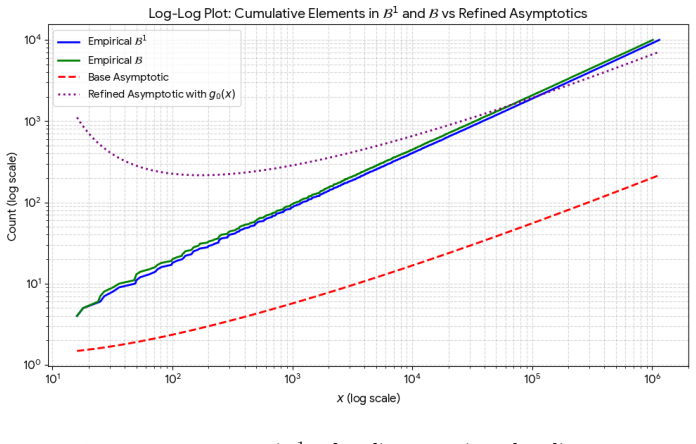
The number of integers lying in bad or very bad intervals of consecutive numbers admits a precise asymptotic count.
A machine-rendered reading of the paper's core claim, the machinery that carries it, and where it could break.
Core claim
An interval of H consecutive integers is bad if its product is divisible by the square of the largest prime factor, very bad if the product is powerful, and of type F3 if it shares the same squarefree kernel as a factorial. Asymptotics are obtained for the number of integers contained in bad or very bad intervals, together with near-asymptotics for the number of right endpoints of type F3 intervals and hence for the number of solutions to a1! a2! a3! = m squared.
What carries the argument
The bad, very bad, and type F3 classifications of short intervals of consecutive integers, determined by whether the square of the largest prime factor divides the product and whether the squarefree kernel matches a factorial.
If this is right
- The count of integers inside bad intervals up to X follows a specific main-term asymptotic derived from short-interval prime estimates.
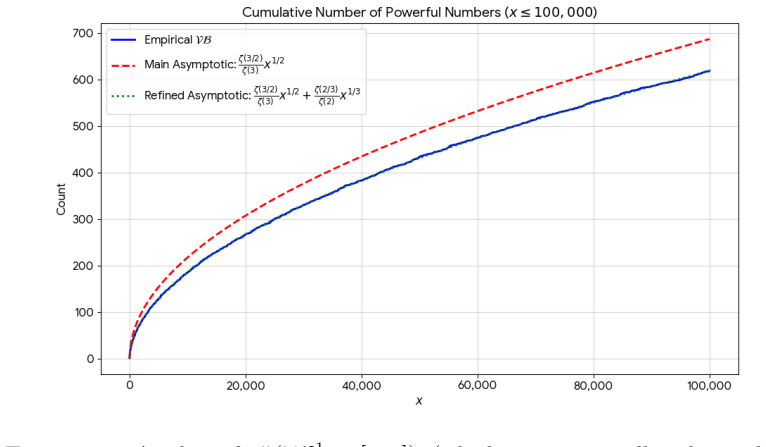
- Very bad intervals, whose consecutive products are powerful, admit their own but related asymptotic count.
- The number of type F3 right endpoints up to X is given by a near-asymptotic expression whose error is smaller than the main term.
- The solutions to a1! a2! a3! = m squared are controlled by the same near-asymptotic count for type F3 intervals.
Where Pith is reading between the lines
- The same interval classifications could be applied to equations involving four or more factorials equal to a square or higher power.
- If the near-asymptotics for type F3 endpoints are sufficiently strong, only finitely many solutions to the three-factorial square equation exist beyond a computable bound.
- The underlying short-interval estimates would also govern the frequency of other square-divisibility conditions on consecutive products, such as divisibility by the cube of the largest prime factor.
Load-bearing premise
Standard analytic and sieve estimates for the prime factors appearing in short intervals remain accurate enough to give the correct main terms without any post-hoc corrections.
What would settle it
An exact enumeration of all bad intervals whose right endpoint is at most 10 to the 12, compared against the predicted main-term asymptotic, would confirm or refute the leading asymptotic formula.
Figures



read the original abstract
Call an interval $\{N+1,\dots,N+H\}$ of consecutive natural numbers \emph{bad} if the product $(N+1) \dots (N+H)$ is divisible by the square of its largest prime factor; \emph{very bad} if this product is powerful, and \emph{type $F_3$} if it has the same squarefree component as a factorial. Such concepts arose in the analysis of the factorial equation $a_1! a_2! a_3! = m^2$ with $a_1<a_2<a_3$. Answering several questions of Erd\H{o}s and Graham, we obtain asymptotics for the number of integers contained in bad or very bad intervals, and to get near-asymptotics for the number of right endpoints of a type $F_3$ interval, or on the number of solutions to $a_1! a_2! a_3! = m^2$.
Editorial analysis
A structured set of objections, weighed in public.
Referee Report
Summary. The paper defines bad intervals of H consecutive integers where their product is divisible by the square of its largest prime factor, very bad intervals where the product is powerful, and type F3 intervals sharing the squarefree kernel of a factorial. It derives asymptotics for the count of integers lying in bad or very bad intervals and near-asymptotics for the number of right endpoints of type F3 intervals as well as the number of solutions to a1! a2! a3! = m², thereby answering several questions of Erdős and Graham.
Significance. If the derivations hold, the work supplies precise counts for intervals with prescribed divisibility and kernel properties in products of consecutive integers, resolving open questions on the distribution of powerful numbers and factorial squarefree components via standard sieve and analytic estimates on prime factors in short intervals. The absence of free parameters or post-hoc adjustments in the main terms is a strength.
minor comments (2)
- The abstract states the main results but the introduction should include a brief outline of the sieve method used for the asymptotic counts to improve readability for readers unfamiliar with the specific estimates on prime factors in short intervals.
- Notation for the length H and the right endpoint N should be fixed consistently across sections; currently the transition from the definition of bad intervals to the count of contained integers is slightly abrupt.
Simulated Author's Rebuttal
We thank the referee for the positive assessment of our work on bad, very bad, and type F3 intervals, and for recommending minor revision. We note that no specific major comments were listed in the report.
Circularity Check
No significant circularity; derivation grounded in external analytic estimates
full rationale
The paper obtains asymptotics for counts of bad/very bad intervals and near-asymptotics for type F3 endpoints and factorial equation solutions by applying standard sieve and analytic number theory estimates on prime factors in short intervals. These techniques are external benchmarks with no post-hoc adjustments altering main terms. No derivation step reduces by construction to a self-definition, a fitted parameter renamed as prediction, or a load-bearing self-citation chain. The central claims remain independent of the paper's own inputs.
Axiom & Free-Parameter Ledger
axioms (1)
- standard math Standard analytic number theory estimates apply to the distribution of largest prime factors in short intervals of consecutive integers
Lean theorems connected to this paper
-
IndisputableMonolith/Cost/FunctionalEquation.leanwashburn_uniqueness_aczel unclear?
unclearRelation between the paper passage and the cited Recognition theorem.
asymptotics #(B1 ∩[1,x]) = x / z^{2+o(1)} with z=exp((1/√2+o(1))log^{1/2}x log^{1/2}_2 x) and u0=√2 log^{1/2}x / log^{1/2}_2 x; use of Ψ(x,y) and Mertens
-
IndisputableMonolith/Foundation/AlexanderDuality.leanalexander_duality_circle_linking unclear?
unclearRelation between the paper passage and the cited Recognition theorem.
very-bad intervals create linear relation an+h=bm with n,m powerful; bound via squares in quadratic fields and Pell orbits
What do these tags mean?
- matches
- The paper's claim is directly supported by a theorem in the formal canon.
- supports
- The theorem supports part of the paper's argument, but the paper may add assumptions or extra steps.
- extends
- The paper goes beyond the formal theorem; the theorem is a base layer rather than the whole result.
- uses
- The paper appears to rely on the theorem as machinery.
- contradicts
- The paper's claim conflicts with a theorem or certificate in the canon.
- unclear
- Pith found a possible connection, but the passage is too broad, indirect, or ambiguous to say the theorem truly supports the claim.
Reference graph
Works this paper leans on
-
[1]
K. Akta¸ s, M. R. Murty,Fundamental units and consecutive squarefull numbers, Int. J. Number Theory 13(2017), 243–252
work page 2017
-
[2]
R. C. Baker, G. Harman, J. Pintz,The difference between consecutive primes. II, Proc. London Math. Soc.83(2001), 532–562
work page 2001
-
[3]
P. Bateman, E. Grosswald,On a theorem of Erd˝ os and Szekeres, Illinois J. Math.2(1958), 88–98
work page 1958
-
[4]
D. Bazzanella, A. Perelli,The exceptional set for the number of primes in short intervals, J. Number Theory80(2000), 109–124
work page 2000
-
[5]
A. B´ erczes, A. Dujella, H. Lajos, N. Saradha, R. Tijdeman,Products of factorials which are powers, Acta Arithmetica190(2019), 339–350
work page 2019
-
[6]
Blomer,Binary quadratic forms with large discriminants and sums of two squareful integers, J
V. Blomer,Binary quadratic forms with large discriminants and sums of two squareful integers, J. Reine Angew. Math.569(2004), 213–234
work page 2004
-
[7]
T. F. Bloom,https://www.erdosproblems.com
-
[8]
Bombieri,A note on the large sieve, Acta Arith.18(1971), 401–404
E. Bombieri,A note on the large sieve, Acta Arith.18(1971), 401–404
work page 1971
-
[9]
T. D. Browning, K. Van Valckenborgh,Sums of three squareful numbers, Experimental Math.21(2012), 204–211
work page 2012
-
[10]
D. A. Burgess,On character sums and primitive roots, Proc. London Math. Soc. (3),12(1962), 179–192
work page 1962
-
[11]
D. A. Burgess,On character sums and L-series. II, Proc. London Math. Soc. (3),13(1963), 524–536
work page 1963
-
[12]
D. A. Burgess,The character sum estimate withr= 3, J. London Math. Soc. (2),33(1986), 219–226
work page 1986
-
[13]
T. H. Chan,Twin squareful numbers, J. Aust. Math. Soc.93(2012), 43–51
work page 2012
-
[14]
J. Cilleruelo, M. Garaev,Concentration of points on two and three dimensional modular hyperbolas and applications, Geom. Funct. Anal.21(2011), no. 4, 892–904
work page 2011
-
[15]
A. Dujella, F. Najman, N. Saradha, T. N. Shorey,Products of three factorials, Publ. Math. Debrecen85 (2014), 123–130
work page 2014
-
[16]
Erd˝ os,A theorem of Sylvester and Schur, J
P. Erd˝ os,A theorem of Sylvester and Schur, J. London Math. Soc.9(1934), 282–288
work page 1934
-
[17]
P. Erd˝ os,Problems and results on number theoretic properties of consecutive integers and related ques- tions, Proceedings of the Fifth Manitoba Conference on Numerical Mathematics (Univ. Manitoba, Win- nipeg, Man., 1975) (1976), 25–44
work page 1975
-
[18]
Erd˝ os,Problems and results on consecutive integers, Publ
P. Erd˝ os,Problems and results on consecutive integers, Publ. Math. Debrecen23(1976), 272–282
work page 1976
-
[19]
P. Erd˝ os, R. L. Graham,On products of factorials, Bull. Inst. Math. Acad. Sinica4(1976), pp. 337–355
work page 1976
-
[20]
P. Erd˝ os, R. L. Graham,Old and new problems and results in combinatorial number theory. Monographies de L’Enseignement Mathematique (1980)
work page 1980
-
[21]
P. Erd˝ os, J. L. Selfridge,The product of consecutive integers is never a power, Ill. J. Math.19(1975), 292–301
work page 1975
-
[22]
M. Faulkner,On a Theorem of Sylvester and Schur, Journal of the London Mathematical Society, s1-41 (1966), 107–110
work page 1966
- [23]
-
[24]
S. W. Golomb,Powerful numbers, American Mathematical Monthly.77(1970), 848–852
work page 1970
-
[25]
A. Granville, O. Ramar´ e,Explicit bounds on exponential sums and the scarcity of squarefree binomial coefficients, Mathematika43(1996), 73–107. 39
work page 1996
-
[26]
Granville,Smooth numbers: computational number theory and beyond, in: Buhler JP, Stevenhagen P, eds
A. Granville,Smooth numbers: computational number theory and beyond, in: Buhler JP, Stevenhagen P, eds. Algorithmic Number Theory: Lattices, Number Fields, Curves and Cryptography. Mathematical Sciences Research Institute Publications. Cambridge University Press; 2008:267–324
work page 2008
-
[27]
L. Guth, J. Maynard,New large value estimates for Dirichlet polynomials, arXiv:2405.20552
work page internal anchor Pith review Pith/arXiv arXiv
-
[28]
Hanson,On a theorem of Sylvester and Schur, Can
D. Hanson,On a theorem of Sylvester and Schur, Can. Math. Bull.16(1973), 195–199
work page 1973
-
[29]
G. Harcos,The Bombieri–Hal´ asz–Montgomery inequality, preprint.https://users.renyi.hu/ ~gharcos/bombieri-halasz-montgomery.pdf
-
[30]
Harman,Primes in short intervals, Math
G. Harman,Primes in short intervals, Math. Z.180(1982), no. 3, 335–348
work page 1982
-
[31]
D. R. Heath-Brown,Gaps between primes, and the pair correlation of zeros of the zeta function, Acta Arith. 41 (1982), no. 1, 85–99
work page 1982
-
[32]
D. R. Heath-Brown,The density of rational points on Cayley’s cubic surface, Proceedings of the Session in Analytic Number Theory and Diophantine Equations, 33 pp., Bonner Math. Schriften, 360, Univ. Bonn, Bonn, 2003
work page 2003
- [33]
-
[34]
A. Hildebrand and G. Tenenbaum,Integers without large prime factors, J. Th´ eorie Nombres Bordeaux 5(1993), 411–484
work page 1993
-
[35]
M. N. Huxley,On the difference between consecutive primes, Invent. Math.15(1972), 164–170
work page 1972
-
[36]
Iv´ ıc,On a problem of Erd˝ os involving the largest prime factor ofn, Monatsh
A. Iv´ ıc,On a problem of Erd˝ os involving the largest prime factor ofn, Monatsh. Math.145, No. 1, 35–46 (2005)
work page 2005
-
[37]
Colloquia Math. Soc. J. Bolyai 34. Topics in Analytic Number Theory
A. Iv´ ıc, C. Pomerance,Estimates for certain sums involving the largest prime factor of an integer, in “Colloquia Math. Soc. J. Bolyai 34. Topics in Analytic Number Theory”, Budapest 1981, North-Holland, 769–789
work page 1981
-
[38]
H. Iwaniec, E. Kowalski,Analytic Number Theory, American Mathematical Society, Providence, 2004
work page 2004
-
[39]
F. Luca, N. Saradha, T. N. Shorey,Squares and factorials in products of factorials, Monatsh. Math.175 (2014), 385–400
work page 2014
-
[40]
K. Matom¨ aki, M. Radziwi l l, X. Shao, T. Tao, J. Ter¨ av¨ ainen,Singmaster’s conjecture in the interior of Pascal’s triangle, Q. J. Math.73, No. 3, 1137–1177 (2022)
work page 2022
-
[41]
H. L. Montgomery, R. C. Vaughan,The large sieve, Mathematika20(1973), 119–134
work page 1973
-
[42]
L. Moser,Notes on number theory. V: Insolvability of 2n n = 2a a 2b b , Can. Math. Bull.6, 167–169 (1963)
work page 1963
-
[43]
M. R. Murty, J. Esmonde,Problems in Algebraic Number Theory, 2nd edn. Springer, 2005
work page 2005
- [44]
-
[45]
K. Ramachandra,A Note on Numbers with a Large Prime Factor, Journal of the London Mathematical Society, s2-1 (1969), 303–306
work page 1969
-
[46]
Ribenboim,My Numbers, My Friends: Popular Lectures in Number Theory, Springer, 2006
P. Ribenboim,My Numbers, My Friends: Popular Lectures in Number Theory, Springer, 2006
work page 2006
-
[47]
C. Størmer,Quelques th´ eor` emes sur l’´ equation de Pellx2 −Dy 2 =±1et leurs applications, Skrifter Videnskabs-selskabet (Christiania), Mat.-Naturv. Kl. I (2) (1897)
-
[48]
I. Schur,Einige Satze uber Primzahlen mit wendung auf Irreduzibilitatsfragen, Sitzungberichte der preussichen Akedemie der Wissenschaften, Phys. Math. Klasse,23(1929), 1–24
work page 1929
-
[49]
A. Selberg,Collected papers. Vol. II, With a foreword by K. Chandrasekharan, Springer-Verlag, Berlin, 1991
work page 1991
-
[50]
J. J. Sylvester,On arithmetical series, Messenger Math.21(1892), 1–19, 87–120
-
[51]
C. Elsholtz, T. Tao,Counting the number of solutions to the Erd˝ os-Straus equation on unit fractions, J. Aust. Math. Soc. 94 (2013), no. 1, 50–105
work page 2013
-
[52]
G. Tenenbaum, Introduction to Analytic and Probabilstic Number Theory, Cambridge Studies in Ad- vanced Mathematics 46, Cambridge University Press, Cambridge, 1995
work page 1995
-
[53]
Ter¨ av¨ ainen,On binary correlations of multiplicative functions, Forum Math
J. Ter¨ av¨ ainen,On binary correlations of multiplicative functions, Forum Math. Sigma6(2018), Paper No. e10, 41 pp
work page 2018
-
[54]
R. C. Vaughan,Some applications of Montgomery’s sieve, J. Number Theory5(1973), 64–79
work page 1973
-
[55]
R. C. Vaughan, T. D. Wooley,Further improvements in Waring’s problem, Acta Math.174(1995), 147–240
work page 1995
-
[56]
D. T. Walker,Consecutive integer pairs of powerful numbers and related Diophantine equations, Fi- bonacci Quart. (1976), 111–116. 40 Department of Mathematics, UCLA, 405 Hilgard A ve, Los Angeles CA 90024 Email address:tao@math.ucla.edu 41
work page 1976
discussion (0)
Sign in with ORCID, Apple, or X to comment. Anyone can read and Pith papers without signing in.