Recognition: 2 theorem links
· Lean TheoremIntegrated sensing and communications in the 3GPP New Radio: sensing limits
Pith reviewed 2026-05-14 01:50 UTC · model grok-4.3
The pith
5G NR signals meet 3GPP UAV sensing targets only by combining data across multiple slots.
A machine-rendered reading of the paper's core claim, the machinery that carries it, and where it could break.
Core claim
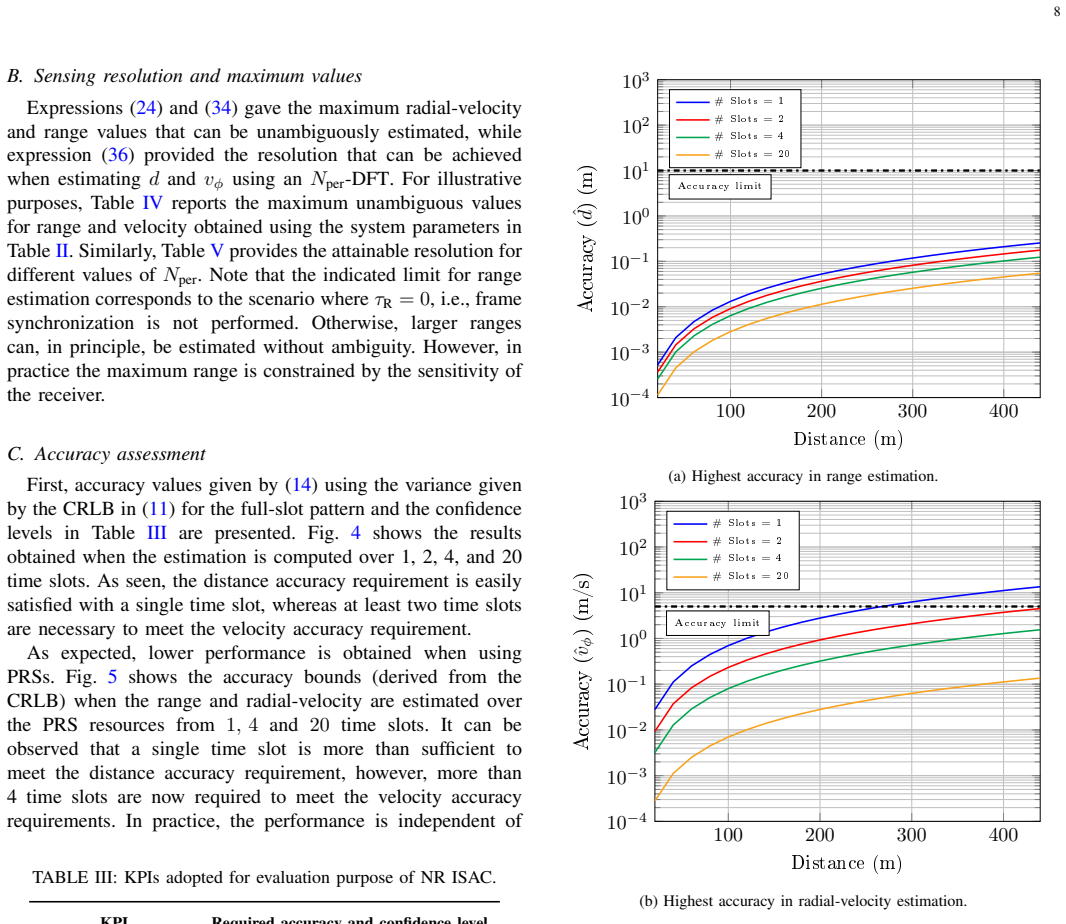
The compact CRLB expressions for range and radial-velocity estimation using standardized 5G NR signals in a monostatic UAV scenario show that multiple slots must be combined to meet 3GPP accuracy requirements. The 5G NR PRS, suboptimal for single-slot velocity estimation, becomes effective with multislot processing. A proposed two-step iterative estimator attains the CRLB over significantly wider distances than conventional ML estimators.
What carries the argument
Cramér-Rao lower bound (CRLB) for range and radial velocity estimation using 5G NR reference signals, together with a two-step iterative estimator
If this is right
- Multislot estimation is required to achieve 3GPP-defined sensing performance targets with NR signals.
- The positioning reference signal supports velocity estimation when resources span multiple slots.
- The two-step estimator maintains CRLB performance at larger distances where ML methods degrade due to threshold effects.
- Reference signals designed for sensing can provide additional performance improvements over standardized signals.
Where Pith is reading between the lines
- Adopting multislot processing in 3GPP standards could enable practical ISAC for UAVs without requiring new waveforms.
- The identified trade-offs suggest ways to jointly optimize communication and sensing parameters in NR deployments.
- Hardware validation of the estimator would confirm whether real-world channel effects preserve the theoretical advantages.
Load-bearing premise
The monostatic UAV sensing scenario with 5G NR signal structures allows derivation of compact CRLB under the noise and channel models from 3GPP specifications.
What would settle it
An experiment or simulation where the two-step estimator does not attain the CRLB at distances claimed to work, or where multislot NR signals fail to reach 3GPP targets.
Figures




read the original abstract
Integrated Sensing and Communications (ISAC) is regarded as a key element of the beyond-fifth-generation (5G) and sixth-generation (6G) systems, raising the question of whether current 5G New Radio (NR) signal structures can meet the sensing accuracy requirements specified by the Third Generation Partnership Project (3GPP). This paper addresses this issue by analyzing the fundamental limits of range and velocity estimation through the Cram\'er-Rao lower bound (CRLB) for a monostatic unmanned aerial vehicle (UAV) sensing use case currently under consideration in the 3GPP standardization process. The study focuses on standardized signals and also evaluates the potential performance gains achievable with reference signals specifically designed for sensing purposes. The compact CRLB expressions derived in this work highlight the fundamental trade-offs between estimation accuracy and system parameters. The results further indicate that information from multiple slots must be exploited in the estimation process to attain the performance targets defined by the 3GPP. As a result, the 5G NR positioning reference signal (PRS), whose patterns may be suboptimal for velocity estimation when using single-slot resources, becomes suitable when multislot estimation is employed. Finally, we propose a two-step iterative range and radial-velocity estimator that attains the CRLB over a significantly wider range of distances than conventional maximum-likelihood (ML) estimators, for which the well-known threshold effect severely limits the distance range over which the accuracy requirements imposed by the 3GPP are satisfied.
Editorial analysis
A structured set of objections, weighed in public.
Referee Report
Summary. The paper derives compact Cramér-Rao lower bound (CRLB) expressions for range and radial-velocity estimation in a monostatic UAV integrated sensing and communications scenario using standardized 5G NR signals. It identifies fundamental trade-offs with system parameters, shows that multi-slot processing is required to meet 3GPP positioning targets, and proposes a two-step iterative estimator that attains the CRLB over a wider distance range than conventional maximum-likelihood estimators.
Significance. If the derivations and simulations hold, the work is significant for ongoing 3GPP ISAC standardization by providing analytical limits on whether current NR signal structures can satisfy sensing accuracy requirements in UAV use cases. Strengths include the rigorous application of the CRLB to standardized signal models and simulation evidence that the proposed estimator avoids the ML threshold effect over a broader operating range.
major comments (1)
- Abstract: the central claims rest on compact CRLB expressions and estimator performance, yet the manuscript provides no derivation details, error analysis, or explicit validation against simulated data; this is load-bearing because the expressions and the claim that the two-step estimator attains the CRLB cannot be assessed without them.
minor comments (2)
- The abstract and results sections should include the explicit compact CRLB formulas (with all parameters defined) to enable reproducibility and direct comparison with 3GPP targets.
- Clarify the exact 3GPP NR signal parameters (e.g., PRS patterns, slot configurations) used in the multi-slot analysis so that the necessity of multi-slot processing can be verified independently.
Simulated Author's Rebuttal
We thank the referee for the positive assessment and the recommendation for minor revision. The single major comment is addressed below with a commitment to strengthen the presentation of derivations and validation.
read point-by-point responses
-
Referee: [—] Abstract: the central claims rest on compact CRLB expressions and estimator performance, yet the manuscript provides no derivation details, error analysis, or explicit validation against simulated data; this is load-bearing because the expressions and the claim that the two-step estimator attains the CRLB cannot be assessed without them.
Authors: We thank the referee for this observation. The compact CRLB expressions are derived in Section III, starting from the general Fisher information matrix for the monostatic OFDM signal model and arriving at the closed-form expressions (12) and (13) after algebraic simplification under the far-field and narrowband assumptions. The two-step estimator is defined in Section IV-A, and its attainment of the CRLB is shown via Monte-Carlo simulations in Section IV-B (Figs. 3–5), where the empirical MSE coincides with the analytical CRLB above the threshold SNR. To make the validation fully explicit and to include a concise error analysis, we will add a new subsection IV-C that (i) tabulates the exact simulation parameters used for CRLB comparison, (ii) reports the observed bias and variance of the estimator, and (iii) discusses the operating regimes where the threshold effect is avoided. These additions will be placed before the numerical results so that readers can directly assess the claims. revision: yes
Circularity Check
No significant circularity; CRLB derivation is self-contained from standard signal model
full rationale
The paper derives compact CRLB expressions directly from the monostatic UAV channel and noise model implicit in 3GPP NR signal structures (PRS and other reference signals). These follow standard information-theoretic bounding applied to the given waveform without any reduction to fitted parameters, self-definitional loops, or load-bearing self-citations. The multi-slot requirement and two-step estimator performance claims are supported by the derived bounds and simulations rather than by renaming or smuggling prior results. The central claims remain independent of the paper's own inputs.
Axiom & Free-Parameter Ledger
axioms (1)
- domain assumption 5G NR reference signal structures follow 3GPP specifications and permit compact CRLB derivation under standard radar-like sensing models.
Lean theorems connected to this paper
-
Cost.FunctionalEquationwashburn_uniqueness_aczel unclearThe compact CRLB expressions derived in this work highlight the fundamental trade-offs between estimation accuracy and system parameters... V AR(ˆd)≥Γ·1/Δf²·1/(1/NA∑q q²−(1/NA∑q q)²)
-
Foundation.RealityFromDistinctionreality_from_one_distinction unclearThe CRLB for the estimation of d and vϕ can then be expressed as... det(I(τd,vϕ,ψ))
Reference graph
Works this paper leans on
-
[1]
Integrated sensing and communications over the years: An evolution perspective,
D. Zhang, Y . Cui, X. Cao, N. Su, Y . Gong, F. Liu, W. Yuan, X. Jing, J. An- drew Zhang, J. Xu, C. Masouros, D. Niyato, and M. Di Renzo, “Integrated sensing and communications over the years: An evolution perspective,” IEEE Communications Surveys & Tutorials, vol. 28, pp. 5014–5048, 2026
work page 2026
-
[2]
Joint communication and sensing in 6G networks
H. Andersson, “Joint communication and sensing in 6G networks.” Ericsson Blog, [On-line, 24/03/2026] https://www.ericsson.com/en/blog/2021/10/joint-sensing-and- communication-6g, 2021
work page 2026
-
[3]
ISAC-Enabled V2I Networks Based on 5G NR: How Much Can the Overhead Be Reduced?,
Y . Li, F. Liu, Z. Du, W. Yuan, and C. Masouros, “ISAC-Enabled V2I Networks Based on 5G NR: How Much Can the Overhead Be Reduced?,” inIEEE International Conference on Communications Workshops (ICC Workshops), pp. 691–696, 2023
work page 2023
-
[4]
Integrated sensing and commu- nication: Towards multifunctional perceptive network,
Y . Cui, J. Nie, and F. e. a. Liu, “Integrated sensing and commu- nication: Towards multifunctional perceptive network,”arXiv preprint arXiv:2510.14358, 16/10/2025, 2025
-
[5]
Enabling joint communication and radar sensing in mobile networks—a survey,
J. A. Zhang, M. L. Rahman, K. Wu, X. Huang, Y . J. Guo, S. Chen, and J. Yuan, “Enabling joint communication and radar sensing in mobile networks—a survey,”IEEE Communications Surveys & Tutorials, vol. 24, no. 1, pp. 306–345, 2022
work page 2022
-
[6]
Summary #5 on Evaluations for NR ISAC RAN WG1 #122bis, Agenda Item 10.5.1, Moderator: Xiaomi,
3GPP TSG RAN WG1, “Summary #5 on Evaluations for NR ISAC RAN WG1 #122bis, Agenda Item 10.5.1, Moderator: Xiaomi,” RAN WG1 Meeting Contribution R1-2507427, Third Generation Partnership Project (3GPP), Prague, Czech, Nov. 2025. https://www.3gpp.org/ftp/tsg_ ran/WG1_RL1/TSGR1_122b/Docs
work page 2025
-
[7]
Target detection and localization using MIMO radars and sonars,
I. Bekkerman and J. Tabrikian, “Target detection and localization using MIMO radars and sonars,”IEEE Transactions on Signal Processing, vol. 54, no. 10, pp. 3873–3883, 2006
work page 2006
-
[8]
Performance Analysis of Joint Radar and Communication using OFDM and OTFS,
L. Gaudio, M. Kobayashi, B. Bissinger, and G. Caire, “Performance Analysis of Joint Radar and Communication using OFDM and OTFS,” inIEEE International Conference on Communications Workshops (ICC Workshops), pp. 1–6, 2019
work page 2019
-
[9]
Cramér-rao bound optimization for joint radar-communication beamforming,
F. Liu, Y .-F. Liu, A. Li, C. Masouros, and Y . C. Eldar, “Cramér-rao bound optimization for joint radar-communication beamforming,”IEEE Transactions on Signal Processing, vol. 70, pp. 240–253, 2022
work page 2022
-
[10]
Z. Wei, Y . Wang, L. Ma, S. Yang, Z. Feng, C. Pan, Q. Zhang, Y . Wang, H. Wu, and P. Zhang, “5G PRS-Based Sensing: A Sensing Reference Signal Approach for Joint Sensing and Communication System,”IEEE Transactions on V ehicular Technology, vol. 72, no. 3, pp. 3250–3263, 2023
work page 2023
-
[11]
On stochastic fundamental limits in a downlink integrated sensing and communication network,
M. Soltani, M. Mirmohseni, and R. Tafazolli, “On stochastic fundamental limits in a downlink integrated sensing and communication network,” IEEE Transactions on Communications, vol. 73, no. 11, pp. 10436–10450, 2025
work page 2025
-
[12]
Summary #6 on Evaluations for NR ISAC RAN WG1 #123, Agenda Item 10.5.1, Moderator: Xiaomi,
3GPP TSG RAN WG1, “Summary #6 on Evaluations for NR ISAC RAN WG1 #123, Agenda Item 10.5.1, Moderator: Xiaomi,” RAN WG1 Meeting Contribution R1-2509243, Third Generation Partnership Project (3GPP), Dallas, US, Nov. 2025. https://www.3gpp.org/ftp/tsg_ran/WG1_ RL1/TSGR1_123/Docs
work page 2025
-
[13]
J. G. Proakis and M. Salehi,Digital Communications. New York, NY , USA: McGraw-Hill, 5th ed., 2008
work page 2008
-
[14]
C. Sturm and W. Wiesbeck, “Waveform design and signal processing aspects for fusion of wireless communications and radar sensing,”Pro- ceedings of the IEEE, vol. 99, no. 7, pp. 1236–1259, 2011
work page 2011
-
[15]
On the Fundamental Trade-Offs of Time-FrequencyResource Distribution in OFDMA ISAC,
X.-Y . Wang, S. Yang, K. Meng, H.-Y . Zhai, and C. Masouros, “On the Fundamental Trade-Offs of Time-FrequencyResource Distribution in OFDMA ISAC,”arXiv:2407.12628, 2024
-
[16]
“Third Generation Partnership Project; Technical Specification Group Radio Access Network; NR; Base Station (BS) radio transmission and reception (Release 19),” 3GPP Technical Specification TS 38.104, Third Generation Partnership Project (3GPP), June 2025. Available at https: //www.3gpp.org/ftp/Specs/archive/38_series/38.104/
work page 2025
-
[17]
5G; NR; Physical channels and modulation,
“5G; NR; Physical channels and modulation,” Technical Specification TS 38.211, E.T.S.I., July 2025. Available at https://portal.etsi.org/webapp/ workprogram/Report_WorkItem.asp?WKI_ID=75300
work page 2025
-
[18]
E. Dahlman, S. Parkvall, and J. Sköld,5G NR: The Next Generation Wireless Access Technology. Elsevier, 2018
work page 2018
-
[19]
S. M. Kay,Fundamentals of Statistical Signal Processing: Estimation Theory. USA: Prentice Hall, Inc., 1993
work page 1993
-
[20]
Thresholds in frequency estimation,
A. Steinhardt and C. Bretherton, “Thresholds in frequency estimation,” inIEEE International Conference on Acoustics, Speech, and Signal Processing, vol. 10, pp. 1273–1276, 1985
work page 1985
-
[21]
Single tone parameter estimation from discrete- time observations,
D. Rife and R. Boorstyn, “Single tone parameter estimation from discrete- time observations,”IEEE Transactions on Information Theory, vol. 20, no. 5, pp. 591–598, 1974
work page 1974
-
[22]
Study on channel model for frequencies from 0.5 to 100 GHz,
Third Generation Partnership Project (3GPP), “Study on channel model for frequencies from 0.5 to 100 GHz,” Technical Report TR 38.901 V19.1.0, 3GPP Technical Specification Group Radio Access Network, Sept. 2025. (Release 19)
work page 2025
-
[23]
Summary #4 on Evaluations for NR ISAC RAN WG1 #122, Agenda Item 10.5.1, Moderator: Xiaomi,
3GPP TSG RAN WG1, “Summary #4 on Evaluations for NR ISAC RAN WG1 #122, Agenda Item 10.5.1, Moderator: Xiaomi,” RAN WG1 Meeting Contribution R1-2506479, Third Generation Partnership Project (3GPP), Bengaluru, India, 2025. https://www.3gpp.org/ftp/tsg_ran/WG1_ RL1/TSGR1_122/Docs
work page 2025
discussion (0)
Sign in with ORCID, Apple, or X to comment. Anyone can read and Pith papers without signing in.