Recognition: 2 theorem links
· Lean TheoremHow Many Qubits Can Be Teleported? Scalability of Fidelity-Constrained Quantum Applications
Pith reviewed 2026-05-14 00:42 UTC · model grok-4.3
The pith
Memory coherence time is the primary limit on how many qubits can be teleported while meeting a joint fidelity threshold.
A machine-rendered reading of the paper's core claim, the machinery that carries it, and where it could break.
Core claim
In a two-node quantum network the number of qubits that can be teleported under a joint fidelity threshold is set by the coherence time of the quantum memories; stochastic Bell-pair generation and repeater distribution produce variable storage intervals that drive fidelity below the threshold unless entanglement is generated in parallel.
What carries the argument
The QApp-level reliability metric, defined as the probability that all teleported qubits simultaneously meet the target fidelity after the multi-qubit teleportation stage completes, incorporating decoherence during storage.
If this is right
- Memory coherence becomes the main scalability bottleneck once fidelity targets are made stringent.
- Parallel entanglement generation is required to keep storage intervals short enough for multi-qubit teleportation.
- NV-center and trapped-ion memories impose different practical limits according to their measured coherence times.
- Fiber and free-space optical links affect distribution rates yet remain secondary to memory effects.
Where Pith is reading between the lines
- Longer coherence times would directly raise the number of qubits that can be teleported together in fidelity-constrained applications.
- Network architectures may need to emphasize rapid parallel entanglement sources rather than solely extending repeater reach.
- Protocol designers could trade storage duration against fidelity margins when scheduling multi-qubit teleportation.
Load-bearing premise
The Monte Carlo simulator's models of stochastic Bell-pair generation, repeater distribution, and fidelity degradation match real NV-center and trapped-ion hardware behavior.
What would settle it
An experiment that teleports multiple qubits over a real quantum link, records the fraction meeting the fidelity threshold, and compares the result to the simulator output for identical coherence times and link parameters.
Figures


read the original abstract
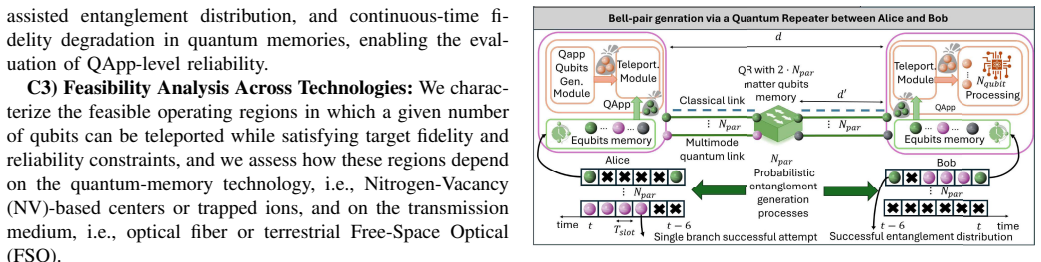
Quantum networks (QNs) enable qubit transfer between distant nodes through quantum teleportation, which reconstructs a quantum state at a remote node by consuming a shared Bell pair. In multi-qubit quantum applications (QApps), the teleported qubits may need to remain stored in quantum memories until execution can start, while decoherence progressively reduces their fidelity with respect to the ideal target state. Such QApps can operate only if all teleported qubits simultaneously satisfy a minimum fidelity threshold. In this paper, we study how many qubits can be teleported under this fidelity-constrained operation in a two-node QN. To this end, we define a QApp-level reliability metric as the probability that all end-to-end Bell pairs satisfy the target fidelity when the multi-qubit teleportation stage is completed. We then develop a Monte Carlo simulator that captures stochastic Bell-pair generation, Quantum Repeater (QR)-assisted entanglement distribution, and fidelity degradation. The analysis considers fiber-based and terrestrial free-space optical (FSO) quantum links, as well as representative NV-center- and trapped-ion-based quantum memories. Results show that memory coherence is the main scalability bottleneck under stringent fidelity targets, while parallel entanglement generation is essential for multi-qubit teleportation.
Editorial analysis
A structured set of objections, weighed in public.
Referee Report
Summary. The paper studies scalability limits for multi-qubit teleportation in a two-node quantum network under a fidelity threshold constraint. It defines a QApp reliability metric as the probability that all teleported qubits simultaneously meet the target fidelity after storage, then uses a Monte Carlo simulator incorporating stochastic Bell-pair generation, repeater-assisted distribution, and decoherence to analyze NV-center and trapped-ion memories over fiber and free-space optical links. The central claim is that memory coherence time is the dominant bottleneck for scaling the number of qubits, while parallel entanglement generation is required to achieve viable reliability.
Significance. If the simulator assumptions hold, the work supplies concrete, quantitative guidance on resource trade-offs (memory lifetime versus entanglement rate) for fidelity-constrained quantum applications, which is useful for quantum-network architecture studies. The probabilistic reliability metric and explicit comparison of fiber versus FSO channels add practical value beyond abstract capacity bounds.
major comments (2)
- [methods / simulator description] Simulator description (methods section): the fidelity-degradation model for multi-qubit storage intervals in NV-center and trapped-ion memories is parameterized solely from literature coherence times without reported calibration or validation against experimental data for storage durations comparable to the multi-qubit teleportation completion time. Because the headline result—that memory coherence is the dominant scalability bottleneck—rests directly on the probability that all qubits remain above threshold, this modeling choice is load-bearing and requires either additional experimental grounding or a sensitivity analysis to plausible variations in T2 distributions.
- [results] Results section (figures showing reliability vs. number of qubits): the reported probabilities for simultaneous fidelity satisfaction are obtained from Monte Carlo runs whose convergence and statistical error bars are not stated. Without these, it is impossible to assess whether the claimed crossover between memory-coherence and entanglement-rate limits is statistically robust or an artifact of sampling variance.
minor comments (2)
- [abstract] Abstract: the phrase 'parallel entanglement generation is essential' is stated without quantifying the required parallelism factor; a brief numerical example would clarify the claim.
- [introduction / methods] Notation: the definition of the QApp-level reliability metric should be given an explicit equation number and cross-referenced in the results when probabilities are plotted.
Simulated Author's Rebuttal
We thank the referee for the constructive comments, which have helped us improve the clarity and rigor of the manuscript. We address each major comment below and indicate the corresponding revisions.
read point-by-point responses
-
Referee: [methods / simulator description] Simulator description (methods section): the fidelity-degradation model for multi-qubit storage intervals in NV-center and trapped-ion memories is parameterized solely from literature coherence times without reported calibration or validation against experimental data for storage durations comparable to the multi-qubit teleportation completion time. Because the headline result—that memory coherence is the dominant scalability bottleneck—rests directly on the probability that all qubits remain above threshold, this modeling choice is load-bearing and requires either additional experimental grounding or a sensitivity analysis to plausible variations in T2 distributions.
Authors: We acknowledge that the fidelity-degradation model is parameterized from established literature values for T2 coherence times of NV-center and trapped-ion memories. Direct experimental validation for the precise multi-qubit storage intervals considered here would require new measurements outside the scope of this simulation-based study. To strengthen the analysis, we have added a sensitivity study in the revised Methods section that varies T2 within the range of experimentally reported values (±30 %). The results confirm that memory coherence remains the dominant bottleneck across this range, with only minor shifts in the absolute reliability values. revision: partial
-
Referee: [results] Results section (figures showing reliability vs. number of qubits): the reported probabilities for simultaneous fidelity satisfaction are obtained from Monte Carlo runs whose convergence and statistical error bars are not stated. Without these, it is impossible to assess whether the claimed crossover between memory-coherence and entanglement-rate limits is statistically robust or an artifact of sampling variance.
Authors: We thank the referee for highlighting this omission. The revised manuscript now states that each reliability value is computed from 100 000 independent Monte Carlo trials. We have added 95 % confidence intervals (Wilson score method) as error bars to all figures in the Results section. These intervals demonstrate that the reported crossover points between memory-coherence and entanglement-rate regimes remain statistically significant and are not attributable to sampling variance. revision: yes
Circularity Check
No circularity: simulation results derive from external hardware parameters
full rationale
The paper defines a reliability metric as the probability that all teleported qubits meet a fidelity threshold, then implements a Monte Carlo simulator using stochastic Bell-pair generation, repeater-assisted distribution, and decoherence models parameterized from external literature values for NV-center and trapped-ion coherence times and link losses. The conclusion that memory coherence is the dominant bottleneck follows directly from comparing simulation outcomes across fidelity targets and hardware configurations; no equation reduces the output to a fitted parameter defined inside the paper, and no load-bearing step relies on self-citation or ansatz smuggling. The derivation chain is therefore self-contained against independent physical inputs.
Axiom & Free-Parameter Ledger
free parameters (2)
- memory coherence time
- Bell-pair generation rate
axioms (2)
- domain assumption Fidelity decays exponentially with storage time according to the memory's coherence time.
- domain assumption All teleported qubits must simultaneously exceed the fidelity threshold for the QApp to succeed.
Lean theorems connected to this paper
-
IndisputableMonolith/Cost/FunctionalEquation.leanwashburn_uniqueness_aczel unclear?
unclearRelation between the paper passage and the cited Recognition theorem.
We develop a Monte Carlo simulator that captures stochastic Bell-pair generation, Quantum Repeater (QR)-assisted entanglement distribution, and fidelity degradation... F(t, t1, t2) = 3/4 (4F0-1/3) e^{-(t-t1)/τ1} e^{-(t-t2)/τ2} + 1/4
-
IndisputableMonolith/Foundation/RealityFromDistinction.leanreality_from_one_distinction unclear?
unclearRelation between the paper passage and the cited Recognition theorem.
Results show that memory coherence is the main scalability bottleneck under stringent fidelity targets
What do these tags mean?
- matches
- The paper's claim is directly supported by a theorem in the formal canon.
- supports
- The theorem supports part of the paper's argument, but the paper may add assumptions or extra steps.
- extends
- The paper goes beyond the formal theorem; the theorem is a base layer rather than the whole result.
- uses
- The paper appears to rely on the theorem as machinery.
- contradicts
- The paper's claim conflicts with a theorem or certificate in the canon.
- unclear
- Pith found a possible connection, but the passage is too broad, indirect, or ambiguous to say the theorem truly supports the claim.
Reference graph
Works this paper leans on
-
[1]
Quantum internet: A vision for the road ahead,
S. Wehner, D. Elkouss, and R. Hanson, “Quantum internet: A vision for the road ahead,”Science, vol. 362, no. 6412, p. eaam9288, 2018
work page 2018
-
[2]
Fundamental limits of repeaterless quantum communications,
S. Pirandola, R. Laurenza, C. Ottaviani, and L. Banchi, “Fundamental limits of repeaterless quantum communications,”Nat. Commun., vol. 8, no. 1, p. 15043, 2017
work page 2017
-
[3]
Experimental quantum teleportation,
D. Bouwmeester, J. W. Pan, K. Mattle, M. Eibl, H. Weinfurter, and A. Zeilinger, “Experimental quantum teleportation,”Nature, vol. 390, pp. 575–579, 1997
work page 1997
-
[4]
Tools for the Analysis of Quantum Protocols Requiring State Generation Within a Time Window,
B. Davies, T. Beauchamp, G. Vardoyan, and S. Wehner, “Tools for the Analysis of Quantum Protocols Requiring State Generation Within a Time Window,”IEEE Trans. on Quantum Eng., vol. 5, pp. 1–20, 2024
work page 2024
-
[5]
Distributed quantum computing across an optical network link,
D. Mainet al., “Distributed quantum computing across an optical network link,”Nature, vol. 638, pp. 383–388, 2025
work page 2025
-
[6]
Review of Distributed Quantum Computing: From single QPU to High Performance Quantum Computing,
D. Barralet al., “Review of Distributed Quantum Computing: From single QPU to High Performance Quantum Computing,”Comput. Sci. Rev., vol. 57, p. 100747, 2025
work page 2025
-
[7]
Entanglement-based quantum clock synchronization,
E. O. Ilo-Okeke, L. Tessler, J. P. Dowling, and T. Byrnes, “Entanglement-based quantum clock synchronization,” inAIP Conf. Proc., vol. 2241, p. 020011, 2020
work page 2020
-
[8]
M. Barhoumi, “Quantum-assisted network time synchronisation: A literature review, considering examples and challenges,”SSRN Electron. J., 2024
work page 2024
-
[9]
Mul- tipartite Entanglement Verification Resistant against Dishonest Parties,
A. Pappa, A. Chailloux, S. Wehner, E. Diamanti, and I. Kerenidis, “Mul- tipartite Entanglement Verification Resistant against Dishonest Parties,” Phys. Rev. Lett., vol. 108, no. 26, p. 260502, 2012
work page 2012
-
[10]
Experimental Verification of Multipartite En- tanglement in Quantum Networks,
W. McCutcheonet al., “Experimental Verification of Multipartite En- tanglement in Quantum Networks,”Nat. Commun., vol. 7, p. 13251, 2016
work page 2016
-
[11]
Telecom-Wavelength Quantum Repeater Node Based on a Trapped-Ion Processor,
V . Krutyanskiyet al., “Telecom-Wavelength Quantum Repeater Node Based on a Trapped-Ion Processor,”Phys. Rev. Lett., vol. 130, p. 213601, May 2023
work page 2023
-
[12]
W. Dai, T. Peng, and M. Z. Win, “Quantum Queuing Delay,”IEEE J. Sel. Areas Commun., vol. 38, no. 3, pp. 605–618, 2020
work page 2020
-
[13]
On the Exact Analysis of an Idealized Quantum Switch,
G. Vardoyan, S. Guha, P. Nain, and D. Towsley, “On the Exact Analysis of an Idealized Quantum Switch,”Perform. Eval., vol. 144, p. 102141, 2020
work page 2020
-
[14]
On the Stochastic Analysis of a Quantum Entanglement Distribution Switch,
G. Vardoyan, S. Guha, P. Nain, and D. Towsley, “On the Stochastic Analysis of a Quantum Entanglement Distribution Switch,”IEEE Trans. on Quantum Eng., vol. 2, pp. 1–16, 2021
work page 2021
-
[15]
On the Capacity Region of Bipartite and Tripartite Entanglement Switching,
G. Vardoyan, P. Nain, S. Guha, and D. Towsley, “On the Capacity Region of Bipartite and Tripartite Entanglement Switching,”ACM Trans. Model. Perform. Eval. Comput. Syst., vol. 8, Mar. 2023
work page 2023
-
[16]
On the Analysis of a Multipartite Entanglement Distribution Switch,
P. Nain, G. Vardoyan, S. Guha, and D. Towsley, “On the Analysis of a Multipartite Entanglement Distribution Switch,”Proc. ACM Meas. Anal. Comput. Syst., vol. 4, June 2020
work page 2020
-
[17]
On the Capacity Region of a Quantum Switch with Entanglement Purification,
N. K. Panigrahy, T. Vasantam, D. Towsley, and L. Tassiulas, “On the Capacity Region of a Quantum Switch with Entanglement Purification,” inIEEE INFOCOM, pp. 1–10, 2023
work page 2023
-
[18]
Calculat- ing the Capacity Region of a Quantum Switch,
I. Tillman, T. Vasantam, D. Towsley, and K. P. Seshadreesan, “Calculat- ing the Capacity Region of a Quantum Switch,” inIEEE QCE, vol. 01, pp. 1868–1878, 2024
work page 2024
-
[19]
Simulators for quantum network modeling: A comprehensive review,
O. Bel and M. Kiran, “Simulators for quantum network modeling: A comprehensive review,”Comput. Netw., vol. 263, p. 111204, 2025
work page 2025
-
[20]
Spatial- mode diversity and multiplexing for continuous variables quantum communications,
S. Koudia, L. Oleynik, J. ur Rehman, and S. Chatzinotas, “Spatial- mode diversity and multiplexing for continuous variables quantum communications,”Commun. Phys., vol. 8, no. 351, 2025
work page 2025
-
[21]
Capacity limits of spatially multiplexed free-space communication channels,
N. Zhao, X. Li, G. Li, and J. M. Kahn, “Capacity limits of spatially multiplexed free-space communication channels,”Nat. Photon., vol. 9, no. 12, pp. 822–826, 2015
work page 2015
-
[22]
Limits and security of free-space quantum communica- tions,
S. Pirandola, “Limits and security of free-space quantum communica- tions,”Phys. Rev. Res., vol. 3, no. 1, p. 013279, 2021
work page 2021
-
[23]
Entanglement Distribution Delay Optimization in Quantum Networks With Distillation,
M. Chehimi, K. Goodenough, W. Saad, D. Towsley, and T. X. Zhou, “Entanglement Distribution Delay Optimization in Quantum Networks With Distillation,”IEEE J. Sel. Areas Commun., vol. 43, no. 5, pp. 1871– 1886, 2025
work page 2025
-
[24]
D. Bruß, “Characterizing entanglement,”J. Math. Phys., vol. 43, pp. 4237–4251, 09 2002
work page 2002
-
[25]
Trapped- ion quantum computing: Progress and challenges,
C. D. Bruzewicz, J. Chiaverini, R. McConnell, and J. M. Sage, “Trapped- ion quantum computing: Progress and challenges,”Applied Physics Reviews, vol. 6, p. 021314, 05 2019
work page 2019
-
[26]
A Ten-Qubit Solid-State Spin Register with Quantum Memory up to One Minute,
C. E. Bradleyet al., “A Ten-Qubit Solid-State Spin Register with Quantum Memory up to One Minute,”Phys. Rev. X, vol. 9, p. 031045, Sep 2019
work page 2019
-
[27]
A. S. El-Wakeel, N. A. Mohammed, and M. H. Aly, “Free space optical communications system performance under atmospheric scattering and turbulence for 850 and 1550  nm operation,”Appl. Opt., vol. 55, pp. 7276–7286, Sep 2016
work page 2016
-
[28]
A. Moranaet al., “Extreme Radiation Sensitivity of Ultra-Low Loss Pure-Silica-Core Optical Fibers at Low Dose Levels and Infrared Wave- lengths,”Sensors, vol. 20, no. 24, p. 7254, 2020
work page 2020
-
[29]
Simulation of atmospheric optical channel with ISI,
Z. Kolka, D. Biolek, and V . Biolkova, “Simulation of atmospheric optical channel with ISI,” inCSECS, vol. 9, pp. 198–201, 2009
work page 2009
-
[30]
H. Singh, N. Mittal, and K. A. Ogudo, “Optimizing the receiver aperture parameters of free space optical (FSO) link for performance enhancement,”AIP Conf. Proc., vol. 2495, p. 020030, 10 2023
work page 2023
-
[31]
Optical Communication in Space: Challenges and Mitigation Techniques,
H. Kaushal and G. Kaddoum, “Optical Communication in Space: Challenges and Mitigation Techniques,”IEEE Commun. Surv. Tutor., vol. 19, no. 1, pp. 57–96, 2017
work page 2017
-
[32]
Toward Defeating Diffraction and Randomness for Laser Beam Propagation in Turbulent Atmosphere,
P. M. Lushnikov and N. Vladimirova, “Toward Defeating Diffraction and Randomness for Laser Beam Propagation in Turbulent Atmosphere,” JETP Lett., vol. 108, no. 9, pp. 571–576, 2018
work page 2018
-
[33]
Ultralong Spin Coherence Time in Isotopi- cally Engineered Diamond,
G. Balasubramanianet al., “Ultralong Spin Coherence Time in Isotopi- cally Engineered Diamond,”Nature Mater., vol. 8, pp. 383–387, 2009
work page 2009
-
[34]
Coherence of nitrogen-vacancy electronic spin ensembles in diamond,
P. L. Stanwixet al., “Coherence of nitrogen-vacancy electronic spin ensembles in diamond,”Phys. Rev. B, vol. 82, p. 201201, Nov 2010
work page 2010
-
[35]
S. Sangtawesinet al., “Origins of Diamond Surface Noise Probed by Correlating Single-Spin Measurements with Surface Spectroscopy,” Phys. Rev. X, vol. 9, p. 031052, Sep 2019
work page 2019
-
[36]
Creation of nitrogen-vacancy centers in chemical vapor deposition diamond for sensing applications,
T. Luoet al., “Creation of nitrogen-vacancy centers in chemical vapor deposition diamond for sensing applications,”New Journal of Physics, vol. 24, p. 033030, mar 2022
work page 2022
-
[37]
Trapped-ion quantum computers,
C. Hempel, “Trapped-ion quantum computers,” inQuantum Technolo- gies. Trends and Implications for Cyber Defense(J. Jang-Jaccard, P. Caroff, E. Blezinger, V . Mulder, A. Mulder, and V . Lenders, eds.), pp. 15–24, Cham: Springer Nature, 2026
work page 2026
-
[38]
High-fidelity preparation, gates, memory, and readout of a trapped-ion quantum bit,
T. P. Hartyet al., “High-fidelity preparation, gates, memory, and readout of a trapped-ion quantum bit,”Phys. Rev. Lett., vol. 113, p. 220501, Nov 2014
work page 2014
-
[39]
Single-qubit quantum memory exceeding ten-minute coherence time,
Y . Wanget al., “Single-qubit quantum memory exceeding ten-minute coherence time,”Nat. Photon., vol. 11, no. 10, pp. 646–650, 2017
work page 2017
-
[40]
Single ion qubit with estimated coherence time exceed- ing one hour,
P. Wanget al., “Single ion qubit with estimated coherence time exceed- ing one hour,”Nat. Commun., vol. 12, p. 233, 2021
work page 2021
discussion (0)
Sign in with ORCID, Apple, or X to comment. Anyone can read and Pith papers without signing in.