Recognition: 2 theorem links
· Lean TheoremProbing soft signals of gravitational-wave memory with space-based interferometers
Pith reviewed 2026-05-14 01:54 UTC · model grok-4.3
The pith
A single LISA-like detector can independently measure soft gravitational-wave displacement memory signals at signal-to-noise ratios of 10 or higher.
A machine-rendered reading of the paper's core claim, the machinery that carries it, and where it could break.
Core claim
The low-frequency spectrum of gravitational waves from moderately relativistic compact binary scattering and nearly equal-mass quasi-circular non-precessing black hole mergers can be described by a corrected soft waveform of displacement memory. This description enables independent measurement of the soft displacement-memory signal with a single LISA-like detector at signal-to-noise ratios ≳ 10, with joint LISA-Taiji observations improving precision. A single BBO detector can separately measure null memory from stellar-mass compact binary mergers, and an idealized stochastic background of soft displacement-memory signals remains detectable.
What carries the argument
The corrected soft waveform of displacement memory, which supplies a universal low-frequency template for matched filtering and parameter estimation of gravitational-wave signals.
If this is right
- Independent measurement of a soft displacement-memory signal is achievable with a single LISA-like detector at signal-to-noise ratios ≳ 10.
- Joint observations with a LISA-Taiji network significantly improve the precision of the memory measurement.
- A single BBO detector can separately measure the null memory component from stellar-mass compact binary mergers.
- An idealized stochastic background of soft displacement-memory signals can be evaluated for detectability with space-based interferometers.
Where Pith is reading between the lines
- Detection of these soft signals would give access to the infrared limit of gravitational radiation that oscillatory components alone do not reveal at low frequencies.
- The template approach could be extended to velocity-memory and integrated-displacement-memory waveforms to search for additional low-frequency features in the same data sets.
- Networked observations would help separate memory contributions from instrumental noise and astrophysical foregrounds in realistic observing runs.
Load-bearing premise
The low-frequency spectrum of the examined compact binary scattering and black hole merger events can be described by a corrected soft waveform of displacement memory.
What would settle it
A direct comparison showing that the actual low-frequency spectrum from a moderately relativistic compact binary scattering event deviates substantially from the shape predicted by the corrected soft displacement-memory waveform.
Figures








read the original abstract
Gravitational-wave displacement memory is a remarkable and ubiquitous phenomenon predicted by general relativity, which has not yet been detected. Unlike the oscillatory components of gravitational waveforms, displacement memory is associated with soft gravitons, making it the only observable signal of its parent event at sufficiently low frequencies. Similarly, soft waveforms may arise from velocity and integrated-displacement memory. The simple and universal spectral shapes of soft waveforms also provide effective templates for matched filtering and parameter estimation. In this paper, we investigate the detection prospects for such soft memory signals with future space-based laser interferometers. As realistic examples, we examine the infrared spectral features of gravitational waves from moderately relativistic compact binary scattering and nearly equal-mass quasi-circular, non-precessing black hole mergers. In both cases, the low frequency spectrum can be described by a corrected soft waveform of displacement memory. The results of simulated Bayesian parameter estimation demonstrate that independent measurement of a soft displacement-memory signal with a single LISA-like detector is achievable at signal-to-noise ratios $\gtrsim 10$. The measurement precision can be significantly improved by joint observations with a LISA-Taiji network. A single BBO detector could be capable of separately measuring the null memory from stellar-mass compact binary mergers. We also evaluate the detectability of an idealized stochastic background of soft displacement-memory signals. Our results indicate that gravitational-wave bursts with memory can be promising targets for space-based interferometers.
Editorial analysis
A structured set of objections, weighed in public.
Referee Report
Summary. The paper claims that soft displacement-memory signals from gravitational waves can be independently measured with a single LISA-like space-based interferometer at signal-to-noise ratios ≳10, based on the low-frequency spectra of moderately relativistic compact binary scattering and nearly equal-mass quasi-circular non-precessing black hole mergers being accurately captured by a corrected soft waveform of displacement memory. Simulated Bayesian parameter estimation supports this threshold, with improved precision from LISA-Taiji networks, and the work also assesses detectability of an idealized stochastic background of such signals.
Significance. If the waveform modeling and recovery results hold, this would be a significant contribution by providing concrete detection prospects for the soft sector of gravitational waves and memory effects with future space-based detectors, using universal spectral templates that simplify matched filtering and parameter estimation. The focus on infrared features and network synergies offers a practical path toward observing GR predictions that remain undetected.
major comments (1)
- [Abstract and sections on infrared spectral features of the examined events] The central claim that independent measurement at SNR ≳10 is achievable rests on the assertion (in the abstract and the sections examining the two source classes) that the low-frequency spectrum is accurately described by a corrected soft waveform of displacement memory. However, no quantitative bounds are given on the size of the correction, the frequency range of validity, or the residual mismatch with the true waveform (including finite-velocity effects, nonlinear memory, or higher multipoles). Without explicit validation or mismatch metrics for these source classes, the Bayesian recovery results and detection thresholds cannot be reliably assessed.
Simulated Author's Rebuttal
We thank the referee for their careful reading of the manuscript and for the constructive major comment. We appreciate the positive assessment of the work's potential significance. We address the concern below and will incorporate the requested validation into the revised manuscript.
read point-by-point responses
-
Referee: The central claim that independent measurement at SNR ≳10 is achievable rests on the assertion (in the abstract and the sections examining the two source classes) that the low-frequency spectrum is accurately described by a corrected soft waveform of displacement memory. However, no quantitative bounds are given on the size of the correction, the frequency range of validity, or the residual mismatch with the true waveform (including finite-velocity effects, nonlinear memory, or higher multipoles). Without explicit validation or mismatch metrics for these source classes, the Bayesian recovery results and detection thresholds cannot be reliably assessed.
Authors: We agree that explicit quantitative validation is required to support the central claims. The manuscript asserts that the infrared spectra of the two source classes are captured by the corrected soft displacement-memory waveform on the basis of the soft-graviton theorem and the specific kinematics (moderately relativistic scattering and quasi-circular non-precessing mergers), but we did not supply mismatch metrics or bounds on residual corrections. In the revised manuscript we will add a dedicated subsection (and associated figures) that computes the overlap and residual mismatch between the full waveforms and the soft template in the LISA band (∼10^{-4}–10^{-2} Hz). We will quantify the size of finite-velocity corrections, nonlinear-memory contributions, and higher-multipole effects, and we will state the frequency range over which the approximation holds to within a few percent. These additions will directly substantiate the reported SNR ≳10 threshold and the Bayesian recovery results. revision: yes
Circularity Check
No circularity: soft-waveform template adopted from external GR literature
full rationale
The paper applies a corrected soft displacement-memory waveform template taken from prior general-relativity literature to generate detector-response templates for Bayesian parameter estimation on two source classes. No equation reduces by construction to a fitted parameter, no self-citation chain supplies the central premise, and the low-frequency spectral description is presented as an input assumption rather than a derived output. The derivation chain therefore remains self-contained against external benchmarks.
Axiom & Free-Parameter Ledger
axioms (1)
- domain assumption General relativity predicts a permanent displacement memory effect in gravitational waves
Lean theorems connected to this paper
-
IndisputableMonolith/Cost/FunctionalEquation.leanwashburn_uniqueness_aczel unclear?
unclearRelation between the paper passage and the cited Recognition theorem.
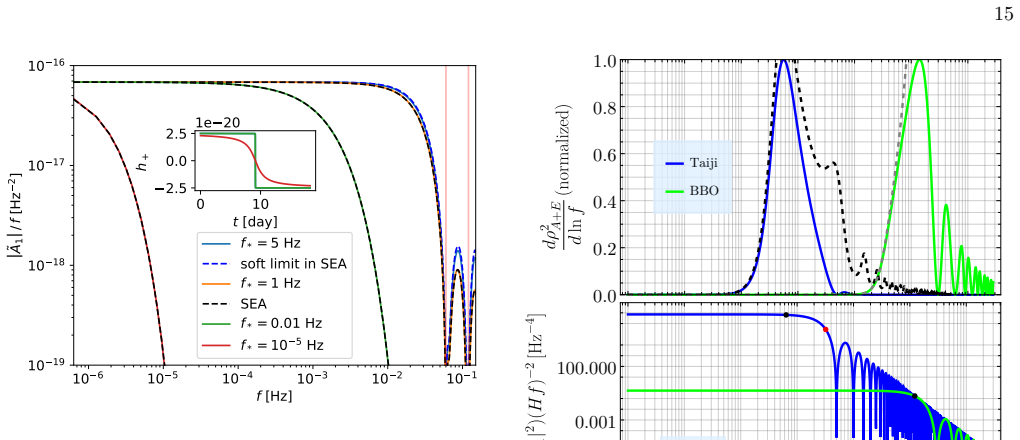
the low frequency spectrum can be described by a corrected soft waveform of displacement memory... ˜h∞(f)→iΔh/(2πf)e2πift∗
-
IndisputableMonolith/Foundation/RealityFromDistinction.leanreality_from_one_distinction unclear?
unclearRelation between the paper passage and the cited Recognition theorem.
TDI response... X1(t)=(y13+D13y31+...)−(3↔2); optimal SNR ρ²=⟨a|a⟩
What do these tags mean?
- matches
- The paper's claim is directly supported by a theorem in the formal canon.
- supports
- The theorem supports part of the paper's argument, but the paper may add assumptions or extra steps.
- extends
- The paper goes beyond the formal theorem; the theorem is a base layer rather than the whole result.
- uses
- The paper appears to rely on the theorem as machinery.
- contradicts
- The paper's claim conflicts with a theorem or certificate in the canon.
- unclear
- Pith found a possible connection, but the passage is too broad, indirect, or ambiguous to say the theorem truly supports the claim.
Reference graph
Works this paper leans on
-
[1]
V. B. Braginsky and K. S. Thorne, Nature 327, 123 (1987)
work page 1987
- [2]
-
[3]
K. S. Thorne, Phys. Rev. D 45, 520 (1992)
work page 1992
-
[4]
Favata, Classical and Quantum Gravity 27, 084036 (2010)
M. Favata, Classical and Quantum Gravity 27, 084036 (2010)
work page 2010
-
[5]
L. Bieri and D. Garfinkle, Physical Review D 89, 10.1103/physrevd.89.084039 (2014)
-
[6]
Winicour, Classical and Quantum Gravity 31, 205003 (2014)
J. Winicour, Classical and Quantum Gravity 31, 205003 (2014)
work page 2014
- [7]
-
[8]
A. Strominger and A. Zhiboedov, Gravitational mem- ory, bms supertranslations and soft theorems (2014), arXiv:1411.5745 [hep-th]
-
[9]
Mitman et al., Physical Review D 102, 10.1103/physrevd.102.104007 (2020)
K. Mitman et al., Physical Review D 102, 10.1103/physrevd.102.104007 (2020)
-
[11]
Favata, Astrophysical Journal 696, L159 (2009)
M. Favata, Astrophysical Journal 696, L159 (2009)
work page 2009
- [13]
-
[14]
H. Yang and D. Martynov, Physical Review Letters 121, 10.1103/physrevlett.121.071102 (2018)
-
[15]
M. Ebersold, Y. Boetzel, G. Faye, C. K. Mishra, B. R. Iyer, and P. Jetzer, Physical Review D 100, 10.1103/physrevd.100.084043 (2019)
-
[16]
S. Tiwari, M. Ebersold, and E. Z. Hamilton, Physical Review D 104, 10.1103/physrevd.104.123024 (2021)
-
[17]
X. Liu, X. He, and Z. Cao, Physical Review D 103, 10.1103/physrevd.103.043005 (2021)
-
[18]
Z.-C. Zhao, X. Liu, Z. Cao, and X. He, Physical Review D 104, 10.1103/physrevd.104.064056 (2021)
-
[19]
T. Islam, S. E. Field, G. Khanna, and N. Warburton, Physical Review D 108, 10.1103/physrevd.108.024046 (2023)
- [20]
-
[22]
Dandapat et al., Physical Review D 108, 10.1103/physrevd.108.024013 (2023)
S. Dandapat et al., Physical Review D 108, 10.1103/physrevd.108.024013 (2023)
-
[23]
A. Hait, S. Mohanty, and S. Prakash, Physical Review D 109, 10.1103/physrevd.109.084037 (2024)
-
[24]
D. Lopez, S. Tiwari, and M. Ebersold, Physical Review D 109, 10.1103/physrevd.109.043039 (2024)
-
[25]
S. Gasparotto, G. Franciolini, and V. Domcke, Phys. Rev. D 112, 103021 (2025)
work page 2025
- [26]
-
[27]
A. Elhashash and D. A. Nichols, Physical Review D 111, 10.1103/physrevd.111.044052 (2025)
-
[28]
Cunningham et al., Classical and Quantum Gravity 42, 135009 (2025)
K. Cunningham et al., Classical and Quantum Gravity 42, 135009 (2025)
work page 2025
- [29]
-
[30]
N. Sago, K. Ioka, T. Nakamura, and R. Yamazaki, Phys- ical Review D 70, 10.1103/physrevd.70.104012 (2004)
-
[31]
Sakai et al., Physical Review D 112, 10.1103/58pt- ms85 (2025)
Y. Sakai et al., Physical Review D 112, 10.1103/58pt- ms85 (2025)
-
[32]
M. Mukhopadhyay, C. Cardona, and C. Lunardini, Journal of Cosmology and Astroparticle Physics 2021 (07), 055
work page 2021
-
[33]
C. J. Richardson et al., Physical Review D 105, 10.1103/physrevd.105.103008 (2022)
- [35]
-
[36]
M. Ebersold and S. Tiwari, Physical Review D 101, 10.1103/physrevd.101.104041 (2020)
-
[37]
M. Hübner, C. Talbot, P. D. Lasky, and E. Thrane, Physical Review D 101, 10.1103/physrevd.101.023011 (2020)
-
[38]
M. Hübner, P. Lasky, and E. Thrane, Physical Review D 104, 10.1103/physrevd.104.023004 (2021)
-
[39]
A. M. Grant and D. A. Nichols, Physical Review D 107, 10.1103/physrevd.107.064056 (2023)
-
[40]
S. Y. Cheung, P. D. Lasky, and E. Thrane, Classical and Quantum Gravity 41, 115010 (2024)
work page 2024
-
[41]
B. Goncharov, L. Donnay, and J. Harms, Physical Review Letters 132, 10.1103/physrevlett.132.241401 (2024)
- [42]
-
[45]
H. Inchauspé, S. Gasparotto, D. Blas, L. Heisenberg, J. Zosso, and S. Tiwari, Phys. Rev. D 111, 044044 (2025), arXiv:2406.09228 [gr-qc]
- [46]
-
[47]
A. Cogez et al., Detectability of gravitational-wave memory with lisa: A bayesian approach (2026), arXiv:2601.23230 [gr-qc]
-
[48]
Toward claiming a detection of gravitational memory
J. Zosso, L. M. Zertuche, S. Gasparotto, A. Cogez, H. Inchauspé, and M. Jacobs, Towards claiming a detec- tion of gravitational memory (2026), arXiv:2601.23019 [gr-qc]
work page internal anchor Pith review Pith/arXiv arXiv 2026
-
[49]
R. van Haasteren and Y. Levin, Monthly Notices of the Royal Astronomical Society 401, 2372–2378 (2010)
work page 2010
-
[50]
J. B. Wang et al., Monthly Notices of the Royal Astro- nomical Society 446, 1657–1671 (2014)
work page 2014
-
[51]
Aggarwal et al., The Astrophysical Journal 889, 38 (2020)
K. Aggarwal et al., The Astrophysical Journal 889, 38 (2020)
work page 2020
-
[52]
J. Sun, P. T. Baker, A. D. Johnson, D. R. Madison, and X. Siemens, The Astrophysical Journal 951, 121 (2023)
work page 2023
-
[53]
Dandapat et al., Physical Review D 109, 10.1103/physrevd.109.103018 (2024)
S. Dandapat et al., Physical Review D 109, 10.1103/physrevd.109.103018 (2024). 30
-
[54]
J. P. Sun, X. Siemens, and D. R. Madison, Phys. Rev. D 111, 102002 (2025)
work page 2025
-
[55]
G. Agazie et al., The nanograv 15-year data set: Search for gravitational wave memory (2025), arXiv:2502.18599 [gr-qc]
- [56]
-
[57]
J. Fontbuté, T. Andrade, R. Luna, J. C. Bustillo, G. Morrás, S. Jaraba, J. García-Bellido, and G. L. Izquierdo, Phys. Rev. D 111, 044024 (2025)
work page 2025
- [58]
- [59]
-
[60]
Q. Alnasheet, V. Cardoso, F. Duque, and R. P. Macedo, Phys. Rev. D 112, 044066 (2025)
work page 2025
-
[61]
L. P. Grishchuk and A. G. Polnarev, Soviet Journal of Experimental and Theoretical Physics 69, 653 (1989)
work page 1989
-
[62]
L. Bieri and A. Polnarev, Classical and Quantum Grav- ity 41, 135012 (2024)
work page 2024
-
[63]
Laser Interferometer Space Antenna
P. Amaro-Seoane et al., Laser interferometer space an- tenna (2017), arXiv:1702.00786 [astro-ph.IM]
work page internal anchor Pith review Pith/arXiv arXiv 2017
- [64]
-
[65]
W.-R. Hu and Y.-L. Wu, National Science Review 4, 685 (2017) , https://academic.oup.com/nsr/article- pdf/4/5/685/31566708/nwx116.pdf
work page 2017
-
[66]
V. Corbin and N. J. Cornish, Classical and Quantum Gravity 23, 2435–2446 (2006)
work page 2006
-
[67]
W.-H. Ruan, C. Liu, Z.-K. Guo, Y.-L. Wu, and R.-G. Cai, Nature Astronomy 4, 108–109 (2020)
work page 2020
-
[68]
J. B. Achour and J.-P. Uzan, Journal of Cosmology and Astroparticle Physics 2024 (08), 004
work page 2024
-
[69]
A. G. Wiseman and C. M. Will, Phys. Rev. D 44, R2945 (1991)
work page 1991
-
[70]
R. Takahashi and T. Nakamura, The Astrophysical Journal 595, 1039–1051 (2003)
work page 2003
-
[71]
E. Bruyère and C. Pitrou, Gravitational lensing beyond the eikonal approximation (2026), arXiv:2601.10239 [gr- qc]
- [72]
- [73]
-
[74]
J. García-Bellido and S. Nesseris, Physics of the Dark Universe 21, 61–69 (2018)
work page 2018
-
[75]
L. E. Kidder, Phys. Rev. D 52, 821 (1995)
work page 1995
-
[76]
P. Brax and D. A. Steer, Phys. Rev. D 111, 104046 (2025), arXiv:2412.17938 [gr-qc]
-
[77]
T. Damour and N. Deruelle, Annales de L’Institut Henri Poincare Section (A) Physique Theorique 43, 107 (1985)
work page 1985
-
[78]
N. Siemonsen, T. May, and W. E. East, Phys. Rev. D 107, 104003 (2023) , arXiv:2211.03845 [gr-qc]
- [79]
-
[80]
D. A. Nichols, Phys. Rev. D 95, 084048 (2017)
work page 2017
-
[81]
M. Goryachev, W. M. Campbell, I. S. Heng, S. Galliou, E. N. Ivanov, and M. E. Tobar, Phys. Rev. Lett. 127, 071102 (2021)
work page 2021
-
[82]
M. M. Riva, F. Vernizzi, and L. K. Wong, Phys. Rev. D 108, 104052 (2023)
work page 2023
-
[83]
M. Tinto and S. V. Dhurandhar, Living Rev. Rel. 8, 4 (2005), arXiv:gr-qc/0409034
-
[84]
Y.-M. Hu, Gravitational wave astrophysics with tianqin: A brief progress review (2024), arXiv:2409.19664 [gr-qc]
- [86]
-
[87]
M. L. Katz, J.-B. Bayle, A. J. Chua, and M. Vallisneri, Physical Review D 106, 10.1103/physrevd.106.103001 (2022)
discussion (0)
Sign in with ORCID, Apple, or X to comment. Anyone can read and Pith papers without signing in.