Recognition: no theorem link
From Detection to Host Galaxy Identification: Precision Continuous Gravitational Wave Localization with a Few Anchor Pulsars
Pith reviewed 2026-05-14 01:28 UTC · model grok-4.3
The pith
Sub-wavelength precision on just six anchor pulsars suffices to phase-lock a pulsar timing array and shrink continuous gravitational wave sky localizations to 0.1-9.2 square degrees.
A machine-rendered reading of the paper's core claim, the machinery that carries it, and where it could break.
Core claim
Achieving sub-wavelength precision for a few anchor pulsars is sufficient to phase-lock the array and drastically shrink the sky-localization error for continuous gravitational wave sources. In a 25-pulsar array with six high-precision anchors, the 90% credible localization areas range from approximately 0.1 to 9.2 deg² at a signal-to-noise ratio of 20, with diminishing returns from further distance improvements once the threshold is crossed.
What carries the argument
Anchor pulsars with sub-wavelength distance uncertainties that enable phase-locking of the pulsar timing array for coherent use of the pulsar term in gravitational wave signal modeling.
If this is right
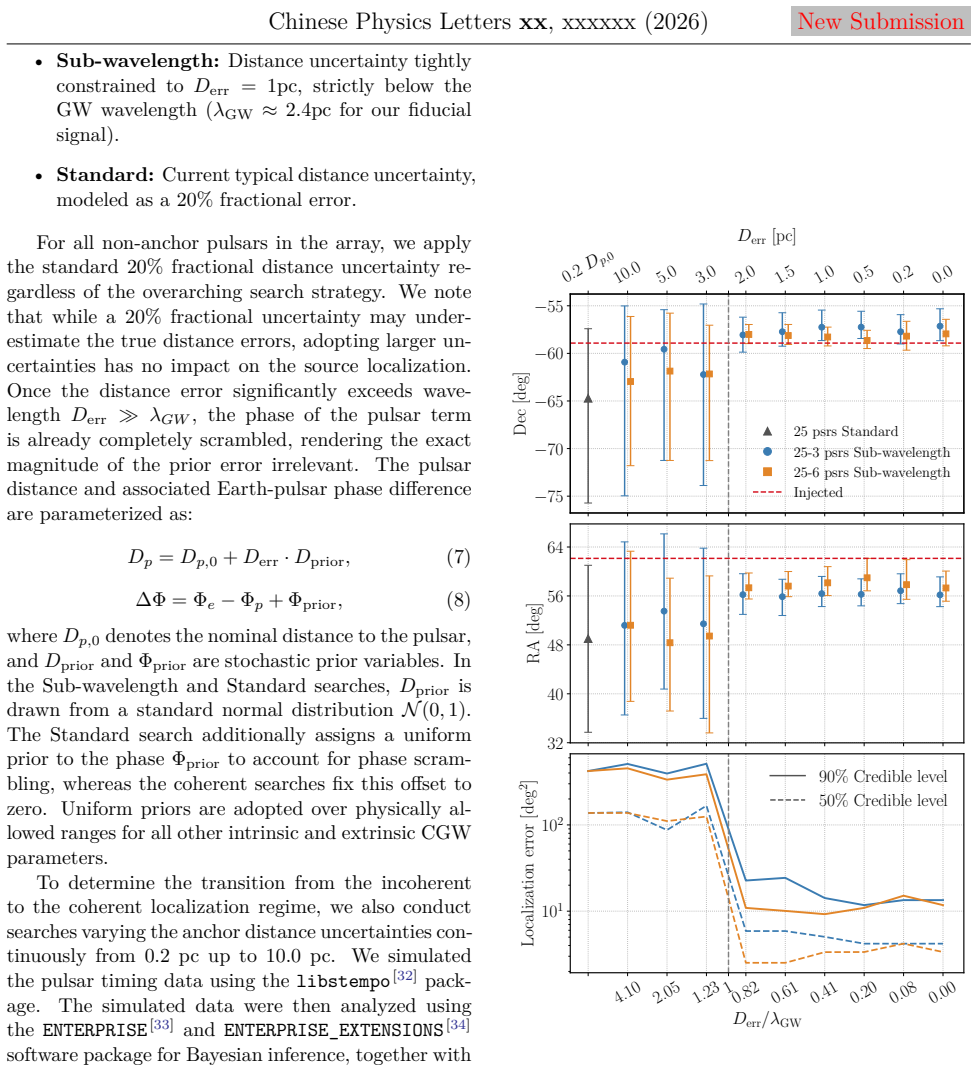
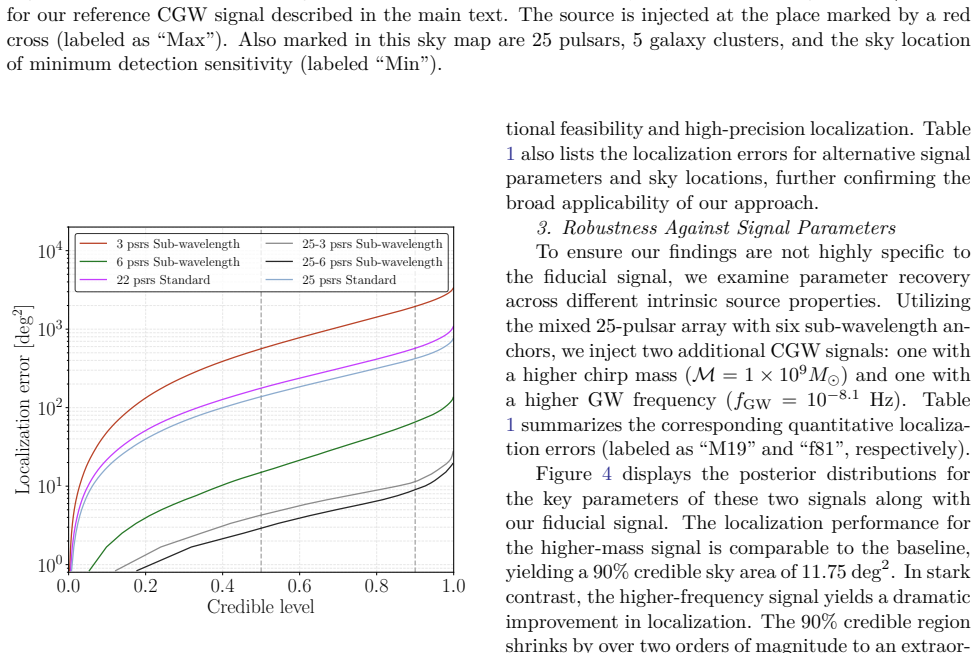
- Introducing three sub-wavelength anchors reduces the 90% credible sky area by a factor of 30 in certain directions.
- Expanding to six anchor pulsars ensures high-precision localizations across diverse source directions including galaxy clusters.
- Once anchors cross the sub-wavelength threshold, additional reductions in distance uncertainty provide only diminishing returns.
- The strategy allows prioritizing intensive parallax campaigns on a small core of stable millisecond pulsars for cost-effective precision astronomy.
Where Pith is reading between the lines
- This could enable quicker follow-up observations to identify host galaxies within the localized regions.
- Array design might shift focus toward maintaining high-precision distance measurements for a core subset rather than all pulsars.
- Similar anchor concepts could apply to other interferometric or timing-based detection systems where full calibration is resource-intensive.
Load-bearing premise
The simulations assume that distance uncertainties for the chosen anchor pulsars can be reduced below the gravitational wavelength while the remaining pulsars retain only standard timing precision.
What would settle it
An actual detection of a continuous gravitational wave source at signal-to-noise ratio 20 showing a 90% credible sky area larger than 9.2 deg² when using only six sub-wavelength anchor pulsars.
Figures


read the original abstract
Pulsar Timing Arrays (PTAs) are rapidly advancing toward the detection of continuous gravitational waves from individual supermassive binary black holes. While it is well established that coherently utilizing the ``pulsar term" requires astrometric distance uncertainties to be smaller than the gravitational wavelength, achieving this precision across an entire array is observationally prohibitive. Here, we demonstrate that achieving sub-wavelength precision for a few ``anchor" pulsars is sufficient to phase-lock the array and drastically shrink the sky-localization error. Using 20 years of realistically simulated data, we systematically evaluate the localization performance of a 25-pulsar array containing three to six high-precision anchors. We show that while introducing three sub-wavelength anchors can reduce the 90\% credible sky area by a factor of 30 in certain directions, expanding this high-precision subset to six anchor pulsars ensures high-precision localizations across diverse source directions. Evaluating a representative set of sky directions, including local galaxy clusters and the locations of maximum and minimum array sensitivity, this six-anchor configuration yields 90\% credible localization areas ranging from $\sim 0.1$ to $9.2 \text{ deg}^2$ at a signal-to-noise ratio of 20. Furthermore, once this minimal subset crosses the sub-wavelength threshold, further reductions in distance uncertainty yield diminishing returns. This establishes a highly efficient near-term observational strategy: prioritizing intensive parallax campaigns for a small core of stable millisecond pulsars provides a cost-effective pathway to precision multi-messenger astronomy.
Editorial analysis
A structured set of objections, weighed in public.
Referee Report
Summary. The manuscript claims that in pulsar timing arrays for continuous gravitational waves, sub-wavelength distance precision for only 3-6 'anchor' pulsars suffices to phase-lock the array and reduce sky localization errors by a factor of ~30. Using 20 years of simulated data on a 25-pulsar array, the six-anchor case yields 90% credible areas from ~0.1 to 9.2 deg² at SNR=20 across tested directions (including galaxy clusters and sensitivity extrema), with diminishing returns beyond the threshold; this is positioned as a cost-effective near-term strategy via targeted parallax campaigns.
Significance. If the simulation assumptions hold, the work identifies a practical observational shortcut that avoids the prohibitive cost of high-precision distances for the full array, thereby accelerating multi-messenger follow-up of individual SMBBH sources. Systematic testing over diverse sky directions and explicit demonstration of diminishing returns constitute clear strengths.
major comments (2)
- [Simulation methods] Simulation methods (anchor distance modeling): The factor-of-30 improvement and reported deg² areas are obtained only under the assumption that distance uncertainties for the chosen 3-6 anchors fall below the gravitational wavelength while the remaining pulsars retain standard timing precision. The manuscript treats this threshold as an input without demonstrating or citing evidence that it is reachable for the specific selected pulsars via VLBI or timing parallax, which is load-bearing for the 'near-term strategy' conclusion.
- [Results] Results (six-anchor configuration): The localization areas (0.1–9.2 deg²) and robustness across directions rest on forward simulations whose exact noise models, data-exclusion criteria, and anchor-selection procedure are not fully specified; without these, the quantitative claims cannot be independently verified and the cross-direction generalization is difficult to assess.
minor comments (2)
- [Abstract] Abstract: The phrase 'sub-wavelength precision' should be accompanied by the explicit numerical threshold (in terms of GW wavelength) used in the simulations.
- [Figures] Figure captions: Ensure every panel explicitly states the number of anchors, the exact sky direction, and the SNR value for immediate readability.
Simulated Author's Rebuttal
We thank the referee for the constructive review and positive assessment of the work's significance. We address the two major comments point by point below. Where the comments identify gaps in documentation or supporting evidence, we have revised the manuscript accordingly.
read point-by-point responses
-
Referee: [Simulation methods] Simulation methods (anchor distance modeling): The factor-of-30 improvement and reported deg² areas are obtained only under the assumption that distance uncertainties for the chosen 3-6 anchors fall below the gravitational wavelength while the remaining pulsars retain standard timing precision. The manuscript treats this threshold as an input without demonstrating or citing evidence that it is reachable for the specific selected pulsars via VLBI or timing parallax, which is load-bearing for the 'near-term strategy' conclusion.
Authors: We agree that explicit support for the reachability of sub-wavelength precision is necessary to underpin the near-term strategy claim. The original manuscript introduced the threshold as a controlled simulation input to isolate the localization benefit of phase-locking. In revision we have added a dedicated paragraph in the Discussion section that cites published VLBI and timing-parallax results for several millisecond pulsars already in or near the 25-pulsar array (e.g., PSR J0437−4715, PSR J1713+0747), showing current or near-term distance uncertainties below the gravitational wavelength at typical PTA frequencies. We further outline a practical observing strategy—targeted VLBI campaigns on the six most stable anchors—whose required precision (tens of parsecs) is within the demonstrated capabilities of current facilities. These additions directly address the load-bearing assumption without altering the simulation results themselves. revision: partial
-
Referee: [Results] Results (six-anchor configuration): The localization areas (0.1–9.2 deg²) and robustness across directions rest on forward simulations whose exact noise models, data-exclusion criteria, and anchor-selection procedure are not fully specified; without these, the quantitative claims cannot be independently verified and the cross-direction generalization is difficult to assess.
Authors: We accept that the simulation details must be specified at a level permitting independent reproduction. The revised Methods section now provides the complete noise model (white-noise RMS, red-noise amplitude and spectral index, DM-variation parameters) used for the 20-year data sets, the precise 3-σ outlier rejection criterion applied to timing residuals, and the anchor-selection algorithm (ranking by timing stability, sky-position diversity, and existing parallax quality). A new supplementary table lists the six chosen pulsars together with their adopted distance uncertainties and noise parameters. These additions allow full verification of the reported 90 % credible areas and their variation across the tested sky directions. revision: yes
Circularity Check
No significant circularity; localization results obtained from forward simulations under explicit assumptions
full rationale
The paper evaluates sky-localization performance through numerical simulations of 20-year PTA data for a 25-pulsar array, introducing 3-6 anchors with sub-wavelength distance precision as an observational strategy. The reported 90% credible areas (∼0.1-9.2 deg² at SNR=20) are computed outputs of those simulations rather than quantities forced by definition, fitted parameters renamed as predictions, or self-citation chains. No load-bearing step equates the claimed result to its inputs by construction; the sub-wavelength threshold is treated as an input assumption whose feasibility is left for future observational work, not derived tautologically within the manuscript.
Axiom & Free-Parameter Ledger
axioms (2)
- standard math Gravitational waves propagate at the speed of light and produce the standard Earth-term plus pulsar-term timing residuals in the PTA response.
- domain assumption The simulated timing noise and pulsar properties are representative of real millisecond pulsars in current and near-future PTAs.
Reference graph
Works this paper leans on
-
[1]
Agazie G, Anumarlapudi A, Archibald A M, Arzoumanian Z, Baker P T, Bécsy B, Blecha L, Brazier A, Brook P R, Burke-Spolaor S, Burnette R, Case R, Charisi M, Chatter- jee S, Chatziioannou K, Cheeseboro B D, Chen S, Cohen T, Cordes J M, Cornish N J, Crawford F, Cromartie H T, Crowter K, Cutler C J, DeCesar M E, DeGan D, Demor- est P B, Deng H, Dolch T, Drach...
work page 2023
-
[2]
EPTA Collaboration, InPTA Collaboration, Antoniadis J, Arumugam P, Arumugam S, Babak S, Bagchi M, Bak Nielsen A S, Bassa C G, Bathula A, Berthereau A, Bonetti M, Bortolas E, Brook P R, Burgay M, Caballero R N, Chalumeau A, Champion D J, Chanlaridis S, Chen S, xxxxxx-9 Chinese Physics Letters xx, xxxxxx (2026) New Submission Cognard I, Dandapat S, Deb D, D...
work page 2026
-
[3]
Reardon D J, Zic A, Shannon R M, Hobbs G B, Bailes M, Di Marco V, Kapur A, Rogers A F, Thrane E, Askew J, Bhat N D R, Cameron A, Curylo M, Coles W A, Dai S, Goncharov B, Kerr M, Kulkarni A, Levin Y, Lower M E, Manchester R N, Mandow R, Miles M T, Nathan R S, Oslowski S, Russell C J, Spiewak R, Zhang S, Zhu X J 2023 ApJ Lett. 951 L6
work page 2023
-
[4]
Xu H, Chen S Y, Guo Y J, Jiang J C, Wang B J, Xu J W, Xue Z H, Caballero R N, Yuan J P, Xu Y H, Wang J B, Hao L F, Luo J T, Lee K J, Han J L, Jiang P, Shen Z Q, Wang M, Wang N, Xu R X, Wu X P, Manchester R, Qian L, Guan X, Huang M L, Sun C, Zhu Y 2023 RAA 23 075024
work page 2023
-
[5]
Miles M T, Shannon R M, Reardon D J, Bailes M, Cham- pion D J, Geyer M, Gitika P, Grunthal K, Keith M J, Kramer M, Kulkarni A D, Nathan R S, Parthasarathy A, Singha J, Theureau G, Thrane E, Abbate F, Buchner S, Cameron A D, Camilo F, Moreschi B E, Shaifullah G, Shamohammadi M, Possenti A, Krishnan V V 2025 MN- RAS 536 1489
work page 2025
-
[6]
Rosado P A, Sesana A and Gair J 2015 MNRAS 451 2417
work page 2015
- [7]
-
[8]
Falxa M, Babak S, Baker P T, Bécsy B, Chalumeau A, Chen S, Chen Z, Cornish N J, Guillemot L, Hazboun J S, Mingarelli C M F, Parthasarathy A, Petiteau A, Pol N S, Sesana A, Spolaor S B, Taylor S R, Theureau G, Val- lisneri M, Vigeland S J, Witt C A, Zhu X, Antoniadis J, Arzoumanian Z, Bailes M, Bhat N D R, Blecha L, Brazier A, Brook P R, Caballero N, Camer...
work page 2023
-
[9]
Agazie G, Anumarlapudi A, Archibald A M, Arzoumanian Z, Baker P T, Bécsy B, Blecha L, Brazier A, Brook P R, Burke-Spolaor S, Case R, Casey-Clyde J A, Charisi M, Chatterjee S, Cohen T, Cordes J M, Cornish N J, Craw- ford F, Cromartie H T, Crowter K, DeCesar M E, Demor- est P B, Digman M C, Dolch T, Drachler B, Ferrara E C, Fiore W, Fonseca E, Freedman G E,...
work page 2023
-
[10]
EPTA Collaboration, InPTA Collaboration, Antoniadis J, Arumugam P, Arumugam S, Babak S, Bagchi M, Bak Nielsen A S, Bassa C G, Bathula A, Berthereau A, Bonetti M, Bortolas E, Brook P R, Burgay M, Caballero R N, Chalumeau A, Champion D J, Chanlaridis S, Chen S, Cognard I, Dandapat S, Deb D, Desai S, Desvignes G, Dhanda-Batra N, Dwivedi C, Falxa M, Ferranti ...
work page 2024
-
[11]
Zhao S Y, Chen Z C, Cardinal Tremblay J, Goncharov B, Zhu X J, Bhat N D R, Curylo M, Dai S, Di Marco V, Ding H, Hobbs G, Kapur A, Ling W H, Liu T, Mandow R, Mishra S, Reardon D J, Russell C J, Shannon R M, Wang S Q, Zhang L, Zic A 2025 ApJ 992 181
work page 2025
-
[12]
Yu Q J 2002 MNRAS 331 935
work page 2002
-
[13]
Milosavljević M and Merritt D 2003 AIP Conf. Proc. 686 201
work page 2003
-
[14]
Khan F M, Holley-Bockelmann K, Berczik P and Just A 2013 ApJ 773 100
work page 2013
-
[15]
Kormendy J and Ho L C 2013 Annu. Rev. Astron. Astro- phys. 51 511 xxxxxx-10 Chinese Physics Letters xx, xxxxxx (2026) New Submission
work page 2013
-
[16]
De Rosa A, Vignali C, Bogdanovic T, Capelo P R, Charisi M, Dotti M, Husemann B, Lusso E, Mayer L, Paragi Z, Runnoe J, Sesana A, Steinborn L, Bianchi S, Colpi M, del Valle L, Frey S, Gabanyi K E, Giustini M, Guainazzi M, Haiman Z, Herrera Ruiz N, Herrero-Illana R, Iwasawa K, Komossa S, Lena D, Loiseau N, Perez-Torres M, Piconcelli E and Volonteri M 2019 Ne...
work page 2019
- [17]
-
[18]
Zhu X J, Wen L, Xiong J, Xu Y, Wang Y, Mohanty S D, Hobbs G and Manchester R N 2016 MNRAS 461 1317
work page 2016
-
[19]
Wang Y and Mohanty S D 2017 Phys. Rev. Lett. 118 151104
work page 2017
-
[20]
Chen J W and Wang Y 2022 ApJ 929 168
work page 2022
-
[21]
Shamohammadi M, Bailes M, Flynn C, Reardon D J, Shannon R M, Buchner S, Cameron A D, Camilo F, Coro- ngiu A, Geyer M, Kramer M, Miles M and Spiewak R 2024 MNRAS 530 287
work page 2024
-
[22]
Ding H 2025 A&A 704 A308
work page 2025
-
[23]
Boyle L and Pen U L 2012 Phys. Rev. D 86 124028
work page 2012
-
[24]
Tsai A C, Jow D L and Pen U L 2025 arXiv:2512.10795
work page internal anchor Pith review Pith/arXiv arXiv 2025
-
[25]
Kato R and Takahashi K 2023 Phys. Rev. D 108 123535
work page 2023
-
[26]
Kato R and Takahashi K 2026 Phys. Rev. D 113 022001
work page 2026
-
[27]
Zic A, Reardon D J, Kapur A, Hobbs G, Mandow R, Curylo M, Shannon R M, Askew J, Bailes M, Bhat N D R, Cameron A, Chen Z C, Dai S, Di Marco V, Feng Y, Kerr M, Kulkarni A, Lower M E, Luo R, Manchester R N, Miles M T, Nathan R S, Oslowski S, Rogers A F, Russell C J, Sarkissian J M, Shamohammadi M, Spiewak R, Thyagarajan N, Toomey L, Wang S Q, Zhang L, Zhang ...
work page 2023
-
[28]
EPTA Collaboration, Antoniadis J, Babak S, Bak Nielsen A S, Bassa C G, Berthereau A, Bonetti M, Bortolas E, Brook P R, Burgay M, Caballero R N, Chalumeau A, Champion D J, Chanlaridis S, Chen S, Cognard I, Desvi- gnes G, Falxa M, Ferdman R D, Franchini A, Gair J R, Goncharov B, Graikou E, Griessmeier J M, Guillemot L, Guo Y J, Hu H, Iraci F, Izquierdo-Vill...
work page 2023
-
[29]
Agazie G, Alam M F, Anumarlapudi A, Archibald A M, Arzoumanian Z, Baker P T, Blecha L, Bonidie V, Brazier A, Brook P R, Burke-Spolaor S, Bécsy B, Chapman C, Charisi M, Chatterjee S, Cohen T, Cordes J M, Cornish N J, Crawford F, Cromartie H T, Crowter K, DeCesar M E, Demorest P B, Dolch T, Drachler B, Ferrara E C, Fiore W, Fonseca E, Freedman G E, Garver-D...
work page 2023
-
[30]
Miles M T, Shannon R M, Reardon D J, Bailes M, Cham- pion D J, Geyer M, Gitika P, Grunthal K, Keith M J, Kramer M, Kulkarni A D, Nathan R S, Parthasarathy A, Porayko N K, Singha J, Theureau G, Abbate F, Buchner S, Cameron A D, Camilo F, Moreschi B E, Shaifullah G, Shamohammadi M and Krishnan V V 2025 MNRAS 536 1467
work page 2025
-
[31]
Arzoumanian Z, Baker P T, Blecha L, Blumer H, Brazier A, Brook P R, Burke-Spolaor S, Bécsy B, Casey-Clyde J A, Charisi M, Chatterjee S, Chen S Y, Cordes J M, Cornish N J, Crawford F, Cromartie H T, DeCesar M E, Demorest P B, Dolch T, Drachler B, Ellis J A, Ferrara E C, Fiore W, Fonseca E, Freedman G E, Garver-Daniels N, Gentile P A, Glaser J, Good D C, Gü...
work page 2023
-
[32]
Vallisneri M 2020 libstempo
work page 2020
-
[33]
Ellis J A, Vallisneri M, Taylor S R and Baker P T 2020 ENTERPRISE
work page 2020
-
[34]
Taylor S R, Baker P T, Hazboun J S, Simon J and Vige- land S J 2021 enterprise_extensions v2.4.3
work page 2021
-
[35]
Ellis J and van Haasteren R 2017 PTMCMCSampler
work page 2017
-
[36]
Vousden W D, Farr W M and Mandel I 2016 MNRAS 455 1919
work page 2016
- [37]
- [38]
-
[39]
Ding H, Deller A T, Stappers B W, Lazio T J W, Kaplan D, Chatterjee S, Brisken W, Cordes J, Freire P C C, Fon- seca E, Stairs I, Guillemot L, Lyne A, Cognard I, Reardon D J and Theureau G 2023 MNRAS 519 4982
work page 2023
-
[40]
Reardon D J, Bailes M, Shannon R M, Flynn C, Askew J, Bhat N D R, Chen Z C, Curylo M, Feng Y, Hobbs G B, Kapur A, Kerr M, Liu X, Manchester R N, Mandow R, Mishra S, Russell C J, Shamohammadi M, Zhang L and Zic A 2024 ApJ Lett. 971 L18
work page 2024
-
[41]
Liu K, Guillemot L, Istrate A G, Shao L, Tauris T M, Wex N, Antoniadis J, Chalumeau A, Cognard I, Desvignes G, Freire P C C, Kehl M S and Theureau G 2020 MNRAS 499 2276
work page 2020
-
[42]
Ding H, Deller A T, Freire P C C and Petrov L 2024 Astron. Astrophys. 691 A47 xxxxxx-11 Chinese Physics Letters xx, xxxxxx (2026) New Submission Appendix A: Pulsar distances and noise parameters Table 3 summarizes the pulsar distances, the corresponding red- and white-noise parameters used in this work, and the signal-to-noise ratio of each pulsar for dif...
work page 2024
discussion (0)
Sign in with ORCID, Apple, or X to comment. Anyone can read and Pith papers without signing in.