Recognition: 2 theorem links
· Lean TheoremPervasive Cavity-Ring Structure for Star Formation in Dwarf Irregular Galaxies
Pith reviewed 2026-05-14 01:12 UTC · model grok-4.3
The pith
Star formation in dwarf irregular galaxies occurs sequentially on the rims of expanding giant cavities driven by prior supernovae.
A machine-rendered reading of the paper's core claim, the machinery that carries it, and where it could break.
Core claim
Unsharp-mask images of HI emission illustrate star formation in dispersed clouds and on the rims of large cavities that extend for a radial scalelength and typically retain circular or slightly sheared forms. Cavity ages range between 10^7 and 10^8 years, which accounts for the common absence of bright OB associations in their centers and their low expansion speeds. Most cavities remain circular because shear times exceed 100 Myr. These observations suggest that star formation in dIrrs proceeds slowly in a sequential fashion in dispersed clouds and on the periphery of giant cavities that move and expand during the ~50 Myr supernova era of the previous generation, in contrast to the shorter 5
What carries the argument
Cavity-ring structures in HI emission, where new stars form on the expanding rims of supernova-blown cavities from the prior generation.
If this is right
- Gas consumption proceeds over ~3.2 Gyr at ~1% efficiency per free-fall time.
- Cavities expand and move without significant shear distortion over 100 Myr.
- Sequential star formation leaves older cavities without central bright associations.
- The process spans the ~50 Myr supernova feedback window of the prior stellar generation.
Where Pith is reading between the lines
- This feedback-regulated sequence could explain the sustained but low overall star formation rates typical of dwarf galaxies.
- Analogous rim structures may appear in simulations of low-metallicity systems or in observations of higher-redshift dwarfs.
- The similarity in efficiency to spiral clouds implies that CO presence mainly tracks metallicity rather than controlling the star formation rate itself.
- The mechanism predicts that shear-dominated environments should suppress cavity rings in favor of filamentary compression.
Load-bearing premise
The cavities are created and expanded primarily by supernova feedback from the previous generation of stars, with ages inferred from U-B colors and low expansion speeds that have not been distorted by shear.
What would settle it
High-resolution maps showing star formation distributed uniformly inside cavities rather than concentrated on rims, or cavity expansion speeds and shapes that contradict 10-100 Myr supernova-driven ages.
Figures






read the original abstract
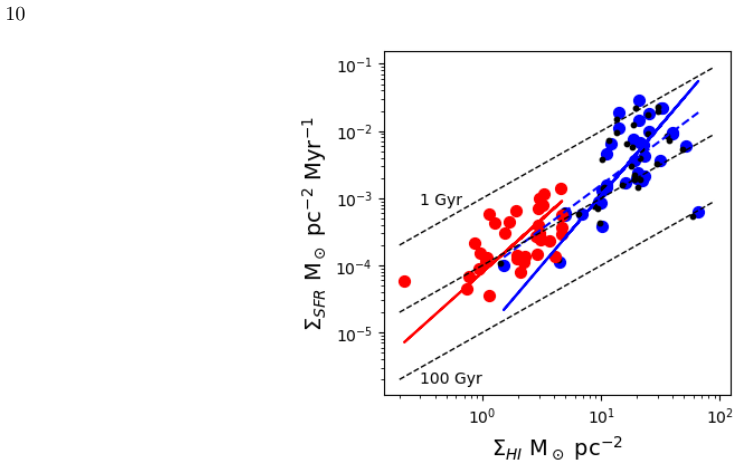
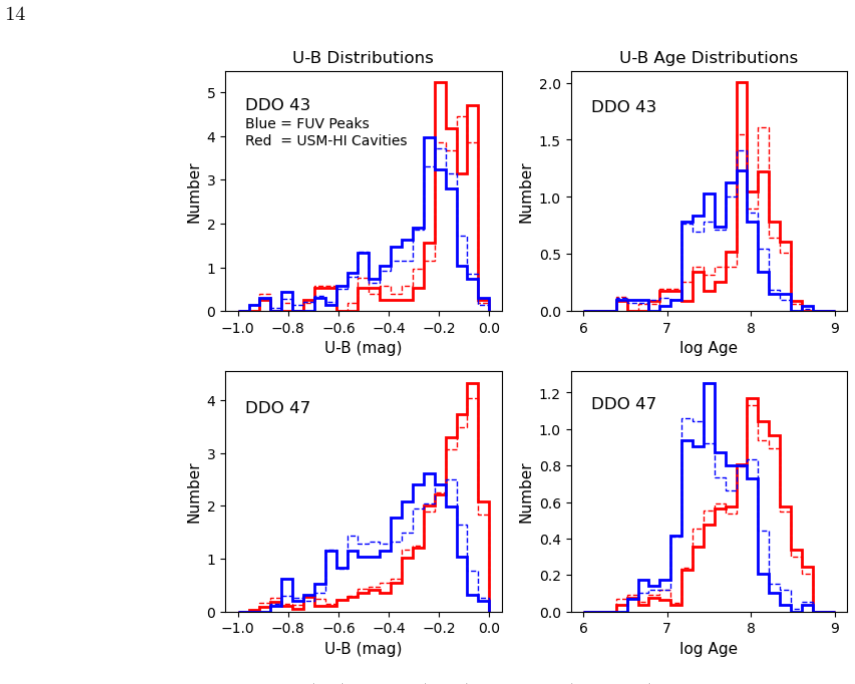
Unsharp-mask images of HI emission from 36 dwarf irregular (dIrr) galaxies illustrate star formation in dispersed clouds and on the rims of large cavities. The cavities can extend for a radial scalelength and typically have circular or slightly sheared forms. The average surface density of cloud peaks is ~20 Msun/pc2, and, combined with their average FUV star formation rate, suggests a gas consumption time of ~3.2 Gyr. Vertical hydrostatic equilibrium calculations for 24 of these dIrrs give a typical scale height of ~400 pc, which combines with the gas and star formation surface densities to suggest an efficiency per free fall time of ~1%. These values are comparable to those in the molecular clouds of spiral galaxies, suggesting the primary difference between clouds is the presence of CO at higher metallicity in the spirals. U-B color images of the dIrrs suggest that cavity ages range between 10^7 and 10^8 years, with the longer times explaining the common lack of bright OB associations in their centers and their low expansion speeds. Most are circular because the shear time exceeds 100 Myr, although some of the HI has spiral structure. These observations suggest that star formation in dIrrs proceeds slowly in a sequential fashion in dispersed clouds and on the periphery of giant cavities that move and expand during the ~50 Myr supernova era of the previous generation. In contrast, spiral galaxies have shear times 10 times shorter and more important stellar dynamics that compresses the gas into filaments.
Editorial analysis
A structured set of objections, weighed in public.
Referee Report
Summary. The manuscript analyzes unsharp-masked HI emission maps from 36 dwarf irregular galaxies, revealing star formation occurring in dispersed clouds and on the rims of large cavities that extend over a radial scalelength. It reports average cloud-peak surface densities of ~20 M⊙ pc⁻², which combined with FUV star-formation rates imply a gas consumption time of ~3.2 Gyr. Vertical hydrostatic equilibrium calculations for 24 galaxies yield typical scale heights of ~400 pc; together with the observed surface densities these give an efficiency per free-fall time of ~1 %. Cavity ages inferred from U-B colors span 10⁷–10⁸ yr, supporting a picture of sequential, supernova-driven star formation on cavity peripheries in systems whose shear times exceed 100 Myr, in contrast to the shear-dominated regime of spiral galaxies.
Significance. If the interpretation holds, the result shows that the key star-formation parameters (gas consumption time and ε_ff) are essentially the same in dIrrs as in the molecular clouds of spirals, despite the absence of CO. The work therefore isolates the structural role of supernova feedback and long shear times in low-metallicity, low-mass galaxies and supplies a concrete observational basis for sequential star-formation models in dwarf systems.
major comments (2)
- [Results on cavity ages (abstract and § on color imaging)] The link between observed U-B colors and cavity ages (10⁷–10⁸ yr) is central to the claim that cavities are still expanding during the ~50 Myr supernova era of the previous generation. The manuscript should state explicitly which color-age calibration is adopted for the low-metallicity regime and whether any correction for internal extinction or recent star-formation contamination has been applied.
- [Hydrostatic equilibrium section] The hydrostatic scale-height calculation (~400 pc) for the 24 galaxies assumes vertical equilibrium with the given gas and stellar surface densities. A brief sensitivity test to the adopted stellar velocity dispersion or dark-matter contribution would confirm that the derived ε_ff ~1 % is robust rather than an artifact of the equilibrium assumption.
minor comments (2)
- [Figure captions] Figure captions for the unsharp-mask images should include explicit labels or arrows marking the cavity rims and the locations of the surface-density peaks used in the averages.
- [Throughout] The text occasionally switches between “surface density” and “Σ” without a consistent symbol definition; a short notation table or inline definition at first use would improve readability.
Simulated Author's Rebuttal
We thank the referee for the positive assessment and the constructive comments, which have helped us clarify key aspects of the analysis. We address each major comment below and have revised the manuscript accordingly.
read point-by-point responses
-
Referee: [Results on cavity ages (abstract and § on color imaging)] The link between observed U-B colors and cavity ages (10⁷–10⁸ yr) is central to the claim that cavities are still expanding during the ~50 Myr supernova era of the previous generation. The manuscript should state explicitly which color-age calibration is adopted for the low-metallicity regime and whether any correction for internal extinction or recent star-formation contamination has been applied.
Authors: We agree that the color-age calibration should be stated explicitly. In the revised manuscript we have added a dedicated paragraph in the color-imaging section specifying that we adopt the U-B color evolution tracks from the Starburst99 models (Leitherer et al. 1999) computed at Z = 0.004, which matches the typical metallicities of our dIrr sample. No internal-extinction correction has been applied, as the low dust-to-gas ratios in these galaxies render extinction negligible at U and B wavelengths. We have verified that recent star-formation contamination is minimal by cross-checking the cavity interiors against available Hα maps, which show no bright emission or OB associations in the centers, consistent with the inferred ages of 10^7–10^8 yr. revision: yes
-
Referee: [Hydrostatic equilibrium section] The hydrostatic scale-height calculation (~400 pc) for the 24 galaxies assumes vertical equilibrium with the given gas and stellar surface densities. A brief sensitivity test to the adopted stellar velocity dispersion or dark-matter contribution would confirm that the derived ε_ff ~1 % is robust rather than an artifact of the equilibrium assumption.
Authors: We thank the referee for this suggestion. We have inserted a short sensitivity subsection in the hydrostatic-equilibrium analysis. With the adopted stellar velocity dispersion of 10 km s^{-1}, varying this value by ±25 % alters the derived scale height by only ±15 %, keeping ε_ff between 0.8 % and 1.2 %. Adding a 20 % dark-matter contribution to the total surface density reduces the scale height by ~10 % while leaving ε_ff at ~1 %. These tests demonstrate that the reported efficiency remains robust under reasonable variations in the input assumptions. revision: yes
Circularity Check
No significant circularity; derivations are direct from observations
full rationale
The paper calculates gas consumption time (~3.2 Gyr) and efficiency per free-fall time (~1%) directly from measured HI surface densities (~20 Msun/pc2), FUV SFRs, and hydrostatic scale heights (~400 pc) using standard equations. Cavity ages are inferred from U-B colors and expansion speeds without fitting parameters to the target quantities and predicting them back. No self-citations form load-bearing premises, no ansatzes are smuggled, and no uniqueness theorems reduce the central claims to inputs by construction. The sequential star-formation interpretation follows from morphological and color data without definitional loops.
Axiom & Free-Parameter Ledger
axioms (2)
- domain assumption Vertical hydrostatic equilibrium holds for deriving scale heights from gas and stellar surface densities
- domain assumption Cavity ages lie between 10^7 and 10^8 years based on U-B colors and low expansion speeds
Lean theorems connected to this paper
-
IndisputableMonolith/Cost/FunctionalEquation.leanwashburn_uniqueness_aczel unclear?
unclearRelation between the paper passage and the cited Recognition theorem.
Unsharp-mask images of HI emission... star formation in dispersed clouds and on the rims of large cavities... gas consumption time of ~3.2 Gyr... efficiency per free fall time of ~1%.
-
IndisputableMonolith/Foundation/AlexanderDuality.leanalexander_duality_circle_linking unclear?
unclearRelation between the paper passage and the cited Recognition theorem.
Vertical hydrostatic equilibrium calculations... scale height of ~400 pc... shear time exceeds 100 Myr
What do these tags mean?
- matches
- The paper's claim is directly supported by a theorem in the formal canon.
- supports
- The theorem supports part of the paper's argument, but the paper may add assumptions or extra steps.
- extends
- The paper goes beyond the formal theorem; the theorem is a base layer rather than the whole result.
- uses
- The paper appears to rely on the theorem as machinery.
- contradicts
- The paper's claim conflicts with a theorem or certificate in the canon.
- unclear
- Pith found a possible connection, but the passage is too broad, indirect, or ambiguous to say the theorem truly supports the claim.
Reference graph
Works this paper leans on
-
[1]
2023, MNRAS, 522, 2543, doi: 10.1093/mnras/stad1143
Aditya, K. 2023, MNRAS, 522, 2543, doi: 10.1093/mnras/stad1143
-
[2]
2022, Nature Astronomy, 6, 48, doi: 10.1038/s41550-021-01575-x
Annibali, F., & Tosi, M. 2022, Nature Astronomy, 6, 48, doi: 10.1038/s41550-021-01575-x
-
[3]
2020, A&A, 644, A125, doi: 10.1051/0004-6361/202038962
Bacchini, C., Fraternali, F., Pezzulli, G., & Marasco, A. 2020, A&A, 644, A125, doi: 10.1051/0004-6361/202038962
-
[4]
2010, AJ, 140, 1194, doi: 10.1088/0004-6256/140/5/1194
Bigiel, F., Leroy, A., Walter, F., et al. 2010, AJ, 140, 1194, doi: 10.1088/0004-6256/140/5/1194
-
[5]
2010, AJ, 140, 1194, doi: 10.1088/0004-6256/136/6/2846
Bigiel, F., Leroy, A., Walter, F., et al. 2008, AJ, 136, 2846, doi: 10.1088/0004-6256/136/6/2846
-
[6]
Bolatto, A. D. 2019, in IAU Symposium, Vol. 344, Dwarf Galaxies: From the Deep Universe to the Present, ed. K. B. W. McQuinn & S. Stierwalt, 233–239, doi: 10.1017/S1743921318006853
-
[7]
and Wolfire, Mark and Leroy, Adam K
Bolatto, A. D., Wolfire, M., & Leroy, A. K. 2013, ARA&A, 51, 207, doi: 10.1146/annurev-astro-082812-140944
work page internal anchor Pith review doi:10.1146/annurev-astro-082812-140944 2013
-
[8]
Bolatto, A. D., Leroy, A. K., Jameson, K., et al. 2011, ApJ, 741, 12, doi: 10.1088/0004-637X/741/1/12
-
[9]
2017, MNRAS, 468, L63, doi: 10.1093/mnrasl/slx027
Bovy, J. 2017, MNRAS, 468, L63, doi: 10.1093/mnrasl/slx027
-
[10]
Bruzual, G., & Charlot, S. 2003, MNRAS, 344, 1000, doi: 10.1046/j.1365-8711.2003.06897.x
-
[11]
1995, ApJL, 447, L25, doi: 10.1086/309560
Burkert, A. 1995, ApJL, 447, L25, doi: 10.1086/309560
-
[12]
1984, ApJS, 54, 33, doi: 10.1086/190918 Cair´ os, L
Burstein, D., & Heiles, C. 1984, ApJS, 54, 33, doi: 10.1086/190918 Cair´ os, L. M., & Gonz´ alez-P´ erez, J. N. 2017a, A&A, 600, A125, doi: 10.1051/0004-6361/201629681 Cair´ os, L. M., & Gonz´ alez-P´ erez, J. N. 2017b, A&A, 608, A119, doi: 10.1051/0004-6361/201731293
-
[13]
Chandar, R., Barnes, A. T., Thilker, D. A., et al. 2025, AJ, 169, 150, doi: 10.3847/1538-3881/adaa80
-
[14]
2016, AJ, 151, 14, doi: 10.3847/0004-6256/151/1/14
Cigan, P., Young, L., Cormier, D., et al. 2016, AJ, 151, 14, doi: 10.3847/0004-6256/151/1/14
-
[15]
Cigan, P., Young, L. M., Gomez, H. L., et al. 2021, AJ, 162, 83, doi: 10.3847/1538-3881/abfd2e
-
[16]
Cook, D. O., Lee, J. C., Adamo, A., et al. 2019, MNRAS, 484, 4897, doi: 10.1093/mnras/stz331
-
[17]
2025, A&A, 700, A57, doi: 10.1051/0004-6361/202555408
Corbelli, E., Elmegreen, B., Ellison, S., & Bianchi, S. 2025, A&A, 700, A57, doi: 10.1051/0004-6361/202555408
-
[18]
Cormier, D., Abel, N. P., Hony, S., et al. 2019, A&A, 626, A23, doi: 10.1051/0004-6361/201834457 de Blok, W. J. G., & Walter, F. 2000, ApJL, 537, L95, doi: 10.1086/312777
-
[19]
2013, MNRAS, 435, 999, doi: 10.1093/mnras/stt1338 Di Cintio, A., Brook, C
Dekel, A., Zolotov, A., Tweed, D., et al. 2013, MNRAS, 435, 999, doi: 10.1093/mnras/stt1338 Di Cintio, A., Brook, C. B., Dutton, A. A., et al. 2014, MNRAS, 441, 2986, doi: 10.1093/mnras/stu729
-
[20]
2005, ApJ, 630, 238, doi: 10.1086/431785
Dib, S., & Burkert, A. 2005, ApJ, 630, 238, doi: 10.1086/431785
-
[21]
A., Ramsay, G., Andronov, I., et al
Efremov, Y. I., & Elmegreen, B. G. 1998, MNRAS, 299, 643, doi: 10.1046/j.1365-8711.1998.01745.x 30
-
[22]
Shchekinov, Y. A. 2017, MNRAS, 464, 1833, doi: 10.1093/mnras/stw2367
-
[23]
Smirnov-Pinchukov, G. V. 2014, MNRAS, 444, 376, doi: 10.1093/mnras/stu1369
-
[24]
Smirnov-Pinchukov, G. V. 2018, MNRAS, 478, 3386, doi: 10.1093/mnras/sty1158
-
[25]
Elmegreen, B. G., & Efremov, Y. N. 1996, ApJ, 466, 802, doi: 10.1086/177554
-
[26]
Elmegreen, B. G., & Elmegreen, D. M. 2019, ApJS, 245, 14, doi: 10.3847/1538-4365/ab4903
-
[27]
Elmegreen, B. G., & Hunter, D. A. 2015, ApJ, 805, 145, doi: 10.1088/0004-637X/805/2/145
-
[28]
Elmegreen, B. G., & Hunter, D. A. 2017, in Astrophysics and Space Science Library, Vol. 434, Outskirts of Galaxies, ed. J. H. Knapen, J. C. Lee, & A. Gil de Paz, 115, doi: 10.1007/978-3-319-56570-5 4
-
[29]
Elmegreen, B. G., Hunter, D. A., & Corbelli, E. 2025, arXiv e-prints, arXiv:2512.10776, doi: 10.48550/arXiv.2512.10776
-
[30]
Elmegreen, D. M., & Elmegreen, B. G. 1984, ApJS, 54, 127, doi: 10.1086/190922
-
[31]
Elmegreen, D. M., Elmegreen, B. G., Marcus, M. T., et al. 2009, ApJ, 701, 306, doi: 10.1088/0004-637X/701/1/306
-
[32]
Henkel, C., Hunt, L. K., & Izotov, Y. I. 2022, Galaxies, 10, 11, doi: 10.3390/galaxies10010011
-
[33]
Herrmann, K. A., Hunter, D. A., & Elmegreen, B. G. 2016, AJ, 151, 145, doi: 10.3847/0004-6256/151/6/145
-
[34]
Hunter, D. A., & Elmegreen, B. G. 2006, ApJS, 162, 49, doi: 10.1086/498096
-
[35]
Hunter, D. A., Elmegreen, B. G., & Ludka, B. C. 2010, AJ, 139, 447, doi: 10.1088/0004-6256/139/2/447
-
[36]
Hunter, D. A., Elmegreen, B. G., & Madden, S. C. 2024, ARA&A, 62, 113, doi: 10.1146/annurev-astro-052722-104109
-
[37]
Hunter, D. A., & Hoffman, L. 1999, AJ, 117, 2789, doi: 10.1086/300885
-
[38]
A., Zhang, H.-X., Elmegreen, B
Hunter, D. A., Zhang, H.-X., Elmegreen, B. G., et al. 2025, AJ, 170, 76, doi: 10.3847/1538-3881/ade154
-
[39]
A., Ficut-Vicas, D., Ashley, T., et al
Hunter, D. A., Ficut-Vicas, D., Ashley, T., et al. 2012, AJ, 144, 134, doi: 10.1088/0004-6256/144/5/134
-
[40]
Hunter, D. A., Adamo, A., Elmegreen, B. G., et al. 2018, AJ, 156, 21, doi: 10.3847/1538-3881/aac50e
-
[41]
Hunter, D. A., Elmegreen, B. G., Goldberger, E., et al. 2021, AJ, 161, 71, doi: 10.3847/1538-3881/abd089
-
[42]
Israel, F. P. 1978, A&A, 70, 769
work page 1978
-
[43]
Kawata, D., Gibson, B. K., Barnes, D. J., Grand, R. J. J., & Rahimi, A. 2014, MNRAS, 438, 1208, doi: 10.1093/mnras/stt2267
-
[44]
Kennicutt, R. C., & Evans, N. J. 2012, ARA&A, 50, 531, doi: 10.1146/annurev-astro-081811-125610
work page internal anchor Pith review doi:10.1146/annurev-astro-081811-125610 2012
-
[45]
Kennicutt, Jr., R. C. 1998, ARA&A, 36, 189, doi: 10.1146/annurev.astro.36.1.189
work page internal anchor Pith review doi:10.1146/annurev.astro.36.1.189 1998
-
[46]
Krumholz, M. R. 2012, ApJ, 759, 9, doi: 10.1088/0004-637X/759/1/9
-
[47]
Krumholz, M. R., McKee, C. F., & Bland-Hawthorn, J. 2019, ARA&A, 57, 227, doi: 10.1146/annurev-astro-091918-104430 Lah´ en, N., Naab, T., Johansson, P. H., et al. 2019, ApJL, 879, L18, doi: 10.3847/2041-8213/ab2a13
-
[48]
K., Walter, F., Brinks, E., et al
Leroy, A. K., Walter, F., Brinks, E., et al. 2008, AJ, 136, 2782, doi: 10.1088/0004-6256/136/6/2782
-
[49]
C., Cormier, D., Hony, S., et al
Madden, S. C., Cormier, D., Hony, S., et al. 2020, A&A, 643, A141, doi: 10.1051/0004-6361/202038860
-
[50]
McKee, C. F., & Ostriker, E. C. 2007, ARA&A, 45, 565, doi: 10.1146/annurev.astro.45.051806.110602
-
[51]
1980, MNRAS, 192, 365, doi: 10.1093/mnras/192.3.365
Meaburn, J. 1980, MNRAS, 192, 365, doi: 10.1093/mnras/192.3.365
-
[52]
The Astrophysical Journal Supplement Series , author =
Morrissey, P., Conrow, T., Barlow, T. A., et al. 2007, ApJS, 173, 682, doi: 10.1086/520512
-
[53]
2001, AJ, 122, 3070, doi: 10.1086/324101
Ott, J., Walter, F., Brinks, E., et al. 2001, AJ, 122, 3070, doi: 10.1086/324101
-
[54]
2023, ApJ, 955, 145, doi: 10.3847/1538-4357/ace164
Park, G., Lee, M.-Y., Bialy, S., et al. 2023, ApJ, 955, 145, doi: 10.3847/1538-4357/ace164
-
[55]
Pokhrel, N. R., Simpson, C. E., & Bagetakos, I. 2020, AJ, 160, 66, doi: 10.3847/1538-3881/ab9bfa
-
[56]
1992, AJ, 103, 1841, doi: 10.1086/116199
Puche, D., Westpfahl, D., Brinks, E., & Roy, J.-R. 1992, AJ, 103, 1841, doi: 10.1086/116199
-
[57]
Ramambason, L., Lebouteiller, V., Madden, S. C., et al. 2024, A&A, 681, A14, doi: 10.1051/0004-6361/202347280
-
[58]
Reynolds, R. J. 1992, ApJL, 392, L35, doi: 10.1086/186419
-
[59]
Karachentsev, I. D. 2009, MNRAS, 397, 1435, doi: 10.1111/j.1365-2966.2009.14931.x
-
[60]
2018, ApJS, 235, 23, doi: 10.3847/1538-4365/aaa8e5
Sabbi, E., Calzetti, D., Ubeda, L., et al. 2018, ApJS, 235, 23, doi: 10.3847/1538-4365/aaa8e5
-
[61]
Schinnerer, E., & Leroy, A. K. 2024, ARA&A, 62, 369, doi: 10.1146/annurev-astro-071221-052651
-
[62]
Schlafly, E. F., & Finkbeiner, D. P. 2011, ApJ, 737, 103, doi: 10.1088/0004-637X/737/2/103
work page internal anchor Pith review doi:10.1088/0004-637x/737/2/103 2011
-
[63]
2025, A&A, 699, A354, doi: 10.1051/0004-6361/202555308
Schneider, N., Ossenkopf-Okada, V., R¨ ollig, M., et al. 2025, A&A, 699, A354, doi: 10.1051/0004-6361/202555308
-
[64]
Shapley, H., & Lindsay, E. M. 1963, Irish Astronomical Journal, 6, 74
work page 1963
-
[65]
Shetty, R., Vogel, S. N., Ostriker, E. C., & Teuben, P. J. 2007, ApJ, 665, 1138, doi: 10.1086/520037 31
-
[66]
2006, A&A, 448, 123, doi: 10.1051/0004-6361:20053326
Silich, S., Lozinskaya, T., Moiseev, A., et al. 2006, A&A, 448, 123, doi: 10.1051/0004-6361:20053326
-
[67]
Simpson, C. E., Hunter, D. A., & Knezek, P. M. 2005, AJ, 129, 160, doi: 10.1086/426364
-
[68]
Sternberg, A., Hoffmann, T. L., & Pauldrach, A. W. A. 2003, ApJ, 599, 1333, doi: 10.1086/379506
-
[69]
Stewart, S. G., & Walter, F. 2000, AJ, 120, 1794, doi: 10.1086/301584
- [70]
-
[71]
Vorobyov, E. I., & Basu, S. 2005, A&A, 431, 451, doi: 10.1051/0004-6361:20041324
-
[72]
1999, AJ, 118, 273, doi: 10.1086/300906
Walter, F., & Brinks, E. 1999, AJ, 118, 273, doi: 10.1086/300906
-
[73]
2001, AJ, 121, 3026, doi: 10.1086/321065
Walter, F., & Brinks, E. 2001, AJ, 121, 3026, doi: 10.1086/321065
-
[74]
1998, ApJL, 502, L143, doi: 10.1086/311500
Walter, F., Kerp, J., Duric, N., Brinks, E., & Klein, U. 1998, ApJL, 502, L143, doi: 10.1086/311500
-
[75]
Warren, S. R., Weisz, D. R., Skillman, E. D., et al. 2011, ApJ, 738, 10, doi: 10.1088/0004-637X/738/1/10
-
[76]
Westerlund, B. E., & Mathewson, D. S. 1966, MNRAS, 131, 371, doi: 10.1093/mnras/131.3.371
-
[77]
Wilcots, E. M., & Miller, B. W. 1998, AJ, 116, 2363, doi: 10.1086/300595
-
[78]
2024, ApJ, 974, 240, doi: 10.3847/1538-4357/ad67e2
Wadsley, J. 2024, ApJ, 974, 240, doi: 10.3847/1538-4357/ad67e2
discussion (0)
Sign in with ORCID, Apple, or X to comment. Anyone can read and Pith papers without signing in.