Recognition: 2 theorem links
· Lean TheoremDistribution function-based modelling of discrete kinematic datasets, in application to the Milky Way nuclear star cluster
Pith reviewed 2026-05-13 23:53 UTC · model grok-4.3
The pith
A distribution-function method applied to discrete star velocities measures the Milky Way central black hole at 4 million solar masses and the enclosed mass within 10 parsecs at 2.0 to 2.3 times 10 to the 7 solar masses.
A machine-rendered reading of the paper's core claim, the machinery that carries it, and where it could break.
Core claim
The authors demonstrate that distribution functions constrained by discrete kinematic data recover the gravitational potential of the nuclear star cluster plus central black hole, giving a black hole mass of 4 times 10 to the 6 solar masses with 10 percent uncertainty that agrees with GRAVITY results while the total mass within 10 parsecs remains between 2.0 and 2.3 times 10 to the 7 solar masses across all model variants.
What carries the argument
The central mechanism is the construction of distribution functions that directly encode the phase-space distribution of stars and are fitted to the observed positions and velocities, thereby inferring the gravitational potential without an assumed density profile or selection function.
If this is right
- The total mass within 10 parsecs remains tightly constrained regardless of which subset of kinematic data is used.
- The method supplies mass constraints in regimes where only sparse velocity measurements exist.
- The public models released in the Agama framework allow direct reuse for further dynamical studies of the same cluster.
Where Pith is reading between the lines
- The same fitting procedure could be applied to discrete kinematic catalogs of other galactic nuclei to estimate their central masses.
- Running the method on mock datasets drawn from known potentials would quantify how sensitive the recovered masses are to incomplete knowledge of the selection function.
Load-bearing premise
The nuclear stellar disc and Galactic bar contributions can be subtracted or modeled separately so that the remaining discrete data reflect only the nuclear star cluster and central black hole.
What would settle it
An independent black-hole mass measurement from stellar-orbit fitting that lies outside the reported 10 percent uncertainty range around 4 times 10 to the 6 solar masses would show the model recovery is inaccurate for this system.
Figures


read the original abstract
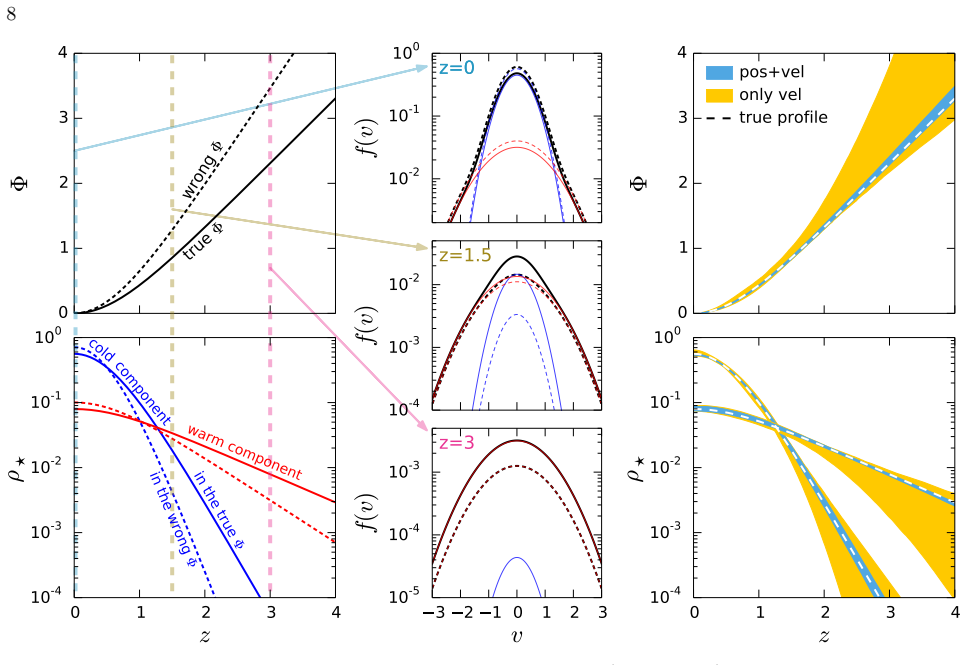
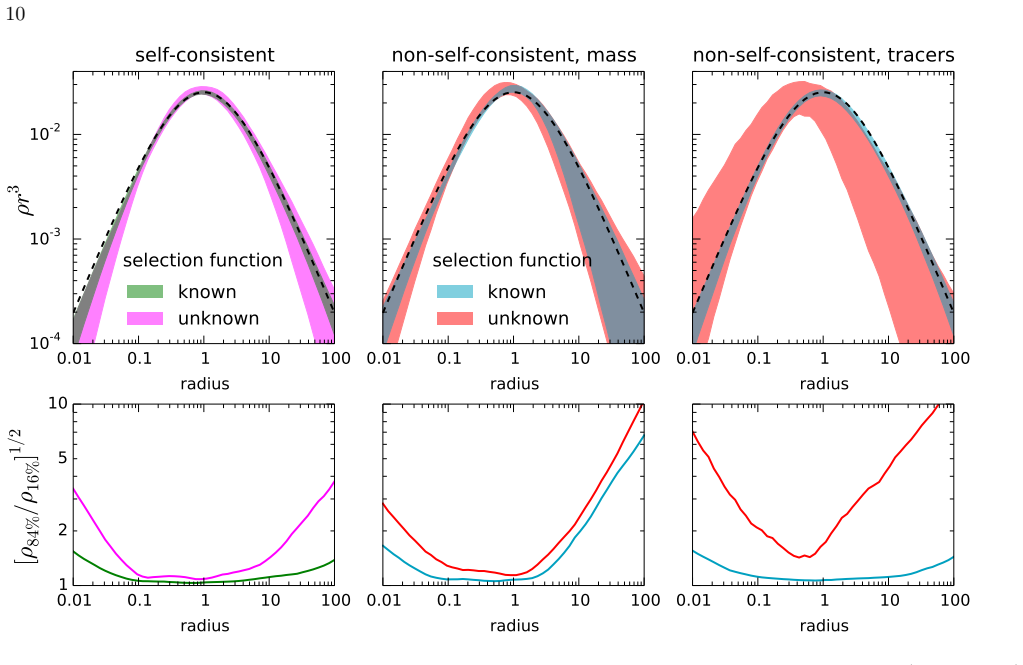
We present a method for constructing dynamical models of stellar systems described by distribution functions and constrained by discrete-kinematic data. We implement various improvements compared to earlier applications of this approach, demonstrating with several examples that it can deliver meaningful constraints on the mass distribution even in situations when the density profile of tracers and the selection function of the kinematic catalogue are unknown. We then apply this method to the Milky Way nuclear star cluster, using kinematic data (line-of-sight velocities and proper motions) for a few thousand stars within 10 pc from the central black hole, accounting for the contributions of the nuclear stellar disc and the Galactic bar. We measure the mass of the black hole to be 4x10^6 Msun with a 10% uncertainty, which agrees with the more precise value obtained by the GRAVITY instrument. The inferred stellar mass profile depends on the choice of kinematic data, but the total mass within 10 pc is well constrained in all models to be (2.0-2.3)x10^7 Msun. We make our models publicly available as part of the Agama software framework for galactic dynamics.
Editorial analysis
A structured set of objections, weighed in public.
Referee Report
Summary. The paper introduces an improved distribution-function (DF) based method for dynamical modeling of stellar systems from discrete kinematic datasets (line-of-sight velocities and proper motions). The approach is shown to recover meaningful mass constraints even when the tracer density profile and selection function are unknown. After testing on several examples, the method is applied to the Milky Way nuclear star cluster using a few thousand stars within 10 pc, after subtracting contributions from the nuclear stellar disc and Galactic bar. The central black hole mass is measured as 4×10^6 M⊙ (10% uncertainty), consistent with GRAVITY, while the total mass within 10 pc is robustly constrained to (2.0–2.3)×10^7 M⊙ across different kinematic subsets. The models are released publicly within the Agama framework.
Significance. If the results hold, the work supplies a practical, publicly available DF-modeling pipeline that can deliver stable enclosed-mass estimates from discrete kinematics in galactic nuclei even under incomplete knowledge of the tracer distribution. The agreement with the independent GRAVITY black-hole mass and the cross-subset stability of the total mass within 10 pc constitute concrete, falsifiable outputs that strengthen the method’s credibility for future applications to other nuclear clusters or dwarf galaxies.
minor comments (3)
- [Abstract] Abstract: the phrase “a few thousand stars” is imprecise; if the exact sample size after quality cuts is stated in §3 or Table 1, repeating the number in the abstract would improve clarity.
- [§4 (application section)] The description of how the nuclear stellar disc and Galactic bar contributions are subtracted (or jointly modeled) is stated but lacks a quantitative sensitivity test; a brief paragraph or supplementary figure showing the effect on the recovered total mass when the subtraction parameters are varied by ±1σ would strengthen the robustness claim.
- [Throughout] Notation: the paper uses both “M_BH” and “M_•” for the black-hole mass; consistent use of a single symbol throughout the text and figures would reduce minor confusion.
Simulated Author's Rebuttal
We thank the referee for their positive review, accurate summary of the method and results, and recommendation to accept the manuscript. We appreciate the recognition of the practical value of the publicly available DF-modeling pipeline and the robustness of the mass constraints.
Circularity Check
No significant circularity in the derivation chain
full rationale
The paper develops a DF-based fitting method for discrete kinematic data and applies it to the Milky Way nuclear star cluster after subtracting nuclear disc and bar contributions. The reported black-hole mass and total enclosed mass within 10 pc are obtained by direct parameter fitting to observed velocities and proper motions; these quantities remain stable across kinematic subsets and agree with independent GRAVITY measurements. No load-bearing step reduces by construction to the inputs via self-definition, renaming of fitted quantities as predictions, or unverified self-citation chains. The derivation is self-contained, with results externally falsifiable against other instruments.
Axiom & Free-Parameter Ledger
free parameters (2)
- black-hole mass
- stellar mass profile parameters
axioms (2)
- domain assumption The stellar system is in dynamical equilibrium and can be described by a steady-state distribution function.
- domain assumption Contributions from the nuclear stellar disc and Galactic bar can be subtracted or modeled independently without biasing the nuclear cluster mass estimate.
Lean theorems connected to this paper
-
IndisputableMonolith/Foundation/AlphaCoordinateFixation.leanalpha_pin_under_high_calibration unclear12-dimensional parameter space... MCMC... 30 walkers
Reference graph
Works this paper leans on
-
[1]
Amorim, A., Lima, J., Alves, J., et al. 2006, in SPIE Conf. series, Vol. 6269, 626957, doi: 10.1117/12.671746
-
[2]
An, J. H., & Evans, N. W. 2006, ApJ, 642, 752, doi: 10.1086/501040
-
[3]
M., Pascale, R., Battaglia, G., et al
Arroyo-Polonio, J. M., Pascale, R., Battaglia, G., et al. 2025, A&A, 699, A347, doi: 10.1051/0004-6361/202554826 Ba˜ nares-Hern´ andez, A., Calore, F., Martin Camalich, J., &
-
[4]
Read, J. I. 2025, A&A, 693, A104, doi: 10.1051/0004-6361/202451763 Ba˜ nares-Hern´ andez, A., Read, J. I., & J´ ulio, M. P. 2026, A&A, 705, A212, doi: 10.1051/0004-6361/202557195
-
[5]
Baes, M., Dejonghe, H., & De Rijcke, S. 2000, MNRAS, 318, 798, doi: 10.1046/j.1365-8711.2000.03834.x
-
[6]
Monthly Notices of the Royal Astronomical Society , author =
Binney, J. 2010, MNRAS, 401, 2318, doi: 10.1111/j.1365-2966.2009.15845.x
-
[7]
Binney, J. 2012, MNRAS, 426, 1324, doi: 10.1111/j.1365-2966.2012.21757.x
-
[8]
2014, MNRAS, 440, 787, doi: 10.1093/mnras/stu297
Binney, J. 2014, MNRAS, 440, 787, doi: 10.1093/mnras/stu297
-
[9]
2026, arXiv:2602.23127, doi: 10.48550/arXiv.2602.23127
Binney, J. 2026, arXiv:2602.23127, doi: 10.48550/arXiv.2602.23127
-
[10]
Monthly Notices of the Royal Astronomical Society , author =
Binney, J., & McMillan, P. 2011, MNRAS, 413, 1889, doi: 10.1111/j.1365-2966.2011.18268.x
-
[11]
2015, MNRAS, 454, 3653, doi: 10.1093/mnras/stv2225
Binney, J., & Piffl, T. 2015, MNRAS, 454, 3653, doi: 10.1093/mnras/stv2225
-
[12]
2008, Galactic Dynamics: Second Edition (Princeton University press)
Binney, J., & Tremaine, S. 2008, Galactic Dynamics: Second Edition (Princeton University press)
work page 2008
-
[13]
2023, MNRAS, 520, 1832, doi: 10.1093/mnras/stad094
Binney, J., & Vasiliev, E. 2023, MNRAS, 520, 1832, doi: 10.1093/mnras/stad094
-
[14]
2024, MNRAS, 527, 1915, doi: 10.1093/mnras/stad3312
Binney, J., & Vasiliev, E. 2024, MNRAS, 527, 1915, doi: 10.1093/mnras/stad3312
-
[15]
Bonnet, H., Abuter, R., Baker, A., et al. 2004, The Messenger, 117, 17
work page 2004
-
[16]
2013, ApJ, 779, 115, doi: 10.1088/0004-637X/779/2/115 Chanam´ e, J., Kleyna, J., & van der Marel, R
Bovy, J., & Rix, H.-W. 2013, ApJ, 779, 115, doi: 10.1088/0004-637X/779/2/115 Chanam´ e, J., Kleyna, J., & van der Marel, R. 2008, ApJ, 682, 841, doi: 10.1086/589429
-
[17]
Chatzopoulos, S., Fritz, T. K., Gerhard, O., et al. 2015a, MNRAS, 447, 948, doi: 10.1093/mnras/stu2452
-
[18]
Chatzopoulos, S., Gerhard, O., Fritz, T. K., et al. 2015b, MNRAS, 453, 939, doi: 10.1093/mnras/stv1681
-
[19]
Cole, D. R., & Binney, J. 2017, MNRAS, 465, 798, doi: 10.1093/mnras/stw2775
-
[20]
2016, MNRAS, 460, 1725, doi: 10.1093/mnras/stw744
Das, P., & Binney, J. 2016, MNRAS, 460, 1725, doi: 10.1093/mnras/stw744
-
[21]
I., Agudo Berbel, A., Wiezorrek, E., et al
Davies, R. I., Agudo Berbel, A., Wiezorrek, E., et al. 2013, A&A, 558, A56, doi: 10.1051/0004-6361/201322282 Della Croce, A., Pascale, R., Giunchi, E., et al. 2024, A&A, 682, A22, doi: 10.1051/0004-6361/202347569 den Brok, M., van de Ven, G., van den Bosch, R., &
-
[22]
2014, MNRAS, 438, 487, doi: 10.1093/mnras/stt2221
Watkins, L. 2014, MNRAS, 438, 487, doi: 10.1093/mnras/stt2221
-
[23]
Do, T., Lu, J. R., Ghez, A. M., et al. 2013a, ApJ, 764, 154, doi: 10.1088/0004-637X/764/2/154
-
[24]
Do, T., Martinez, G. D., Yelda, S., et al. 2013b, ApJL, 779, L6, doi: 10.1088/2041-8205/779/1/L6
-
[25]
Eisenhauer, F., Abuter, R., Bickert, K., et al. 2003, in SPIE Conf. series, Vol. 4841, 1548, doi: 10.1117/12.459468 22 Eugene, & Neige, 2026, arXiv:2603.29503, doi: 10.48550/arXiv.2603.29503
-
[26]
2014, A&A, 570, A2, doi: 10.1051/0004-6361/201423777
Feldmeier, A., Neumayer, N., Seth, A., et al. 2014, A&A, 570, A2, doi: 10.1051/0004-6361/201423777
-
[27]
2017a, MNRAS, 464, 194, doi: 10.1093/mnras/stw2339
Feldmeier-Krause, A., Kerzendorf, W., Neumayer, N., et al. 2017a, MNRAS, 464, 194, doi: 10.1093/mnras/stw2339
-
[28]
2017b, MNRAS, 466, 4040, doi: 10.1093/mnras/stw3377
Feldmeier-Krause, A., Zhu, L., Neumayer, N., et al. 2017b, MNRAS, 466, 4040, doi: 10.1093/mnras/stw3377
-
[29]
2020, MNRAS, 494, 396, doi: 10.1093/mnras/staa703
Feldmeier-Krause, A., Kerzendorf, W., Do, T., et al. 2020, MNRAS, 494, 396, doi: 10.1093/mnras/staa703
-
[30]
2025, A&A, 699, A239, doi: 10.1051/0004-6361/202554630
Gallego-Cano, E., & Neumayer, N. 2025, A&A, 699, A239, doi: 10.1051/0004-6361/202554630
-
[31]
Publications of the Astronomical Society of the Pacific , author =
Foreman-Mackey, D., Hogg, D. W., Lang, D., & Goodman, J. 2013, PASP, 125, 306, doi: 10.1086/670067
-
[32]
K., Chatzopoulos, S., Gerhard, O., et al
Fritz, T. K., Chatzopoulos, S., Gerhard, O., et al. 2016, ApJ, 821, 44, doi: 10.3847/0004-637X/821/1/44 Gal´ an-de Anta, P. M., Vasiliev, E., Sarzi, M., et al. 2023, MNRAS, 520, 4490, doi: 10.1093/mnras/stad419
-
[33]
2018, A&A, 609, A26, doi: 10.1051/0004-6361/201730451
Gallego-Cano, E., Sch¨ odel, R., Dong, H., et al. 2018, A&A, 609, A26, doi: 10.1051/0004-6361/201730451
-
[34]
2020, A&A, 634, A71, doi: 10.1051/0004-6361/201935303
Gallego-Cano, E., Sch¨ odel, R., Nogueras-Lara, F., et al. 2020, A&A, 634, A71, doi: 10.1051/0004-6361/201935303
-
[35]
Genzel, R., Eisenhauer, F., & Gillessen, S. 2010, Rev. Mod. Phys., 82, 3121, doi: 10.1103/RevModPhys.82.3121
-
[36]
2026, MNRAS, 546, stag254, doi: 10.1093/mnras/stag254
Gherghinescu, P., Vasiliev, E., Das, P., & Read, J. 2026, MNRAS, 546, stag254, doi: 10.1093/mnras/stag254
-
[37]
Ghez, A. M., Salim, S., Weinberg, N. N., et al. 2008, ApJ, 689, 1044, doi: 10.1086/592738
-
[38]
Graves, J. E., Northcott, M. J., Roddier, F. J., Roddier, C. A., & Close, L. M. 1998, in SPIE Conf. series, Vol. 3353, 34, doi: 10.1117/12.321698 GRAVITY Collaboration. 2018, A&A, 615, L15, doi: 10.1051/0004-6361/201833718 GRAVITY Collaboration. 2019, A&A, 625, L10, doi: 10.1051/0004-6361/201935656 GRAVITY Collaboration. 2020, A&A, 636, L5, doi: 10.1051/0...
-
[39]
2021, MNRAS, 508, 5468, doi: 10.1093/mnras/stab2898
Hattori, K., Valluri, M., & Vasiliev, E. 2021, MNRAS, 508, 5468, doi: 10.1093/mnras/stab2898
-
[40]
Hodapp, K.-W., Hora, J. L., Hall, D. N. B., et al. 1996, NewA, 1, 177, doi: 10.1016/S1384-1076(96)00013-9
-
[41]
Imig, J., Holtzman, J. A., Zasowski, G., et al. 2025, ApJ, 990, 203, doi: 10.3847/1538-4357/adf723
-
[42]
Johnson, S. G. 2005, Multi-dimensional adaptive integration in C: The Cubature package, https://github.com/stevengj/cubature
work page 2005
-
[43]
1989, MNRAS, 239, 571, doi: 10.1093/mnras/239.2.571
Kuijken, K., & Gilmore, G. 1989, MNRAS, 239, 571, doi: 10.1093/mnras/239.2.571
-
[44]
Lenzen, R., Hartung, M., Brandner, W., et al. 2003, in SPIE Conf. series, Vol. 4841, 944, doi: 10.1117/12.460044
-
[45]
1995, MNRAS, 277, 1185, doi: 10.1093/mnras/277.4.1185
Magorrian, J. 1995, MNRAS, 277, 1185, doi: 10.1093/mnras/277.4.1185
-
[46]
2019, MNRAS, 484, 1166, doi: 10.1093/mnras/stz037
Magorrian, J. 2019, MNRAS, 484, 1166, doi: 10.1093/mnras/stz037
-
[47]
Marchetti, E., Brast, R., Delabre, B., et al. 2004, in SPIE Conf. series, Vol. 5490, 236, doi: 10.1117/12.551185
-
[48]
Monthly Notices of the Royal Astronomical Society , author =
McMillan, P. J., & Binney, J. 2012, MNRAS, 419, 2251, doi: 10.1111/j.1365-2966.2011.19879.x
-
[49]
McMillan, P. J., & Binney, J. J. 2013, MNRAS, 433, 1411, doi: 10.1093/mnras/stt814
-
[50]
Merrifield, M. R., & Kent, S. M. 1990, AJ, 99, 1548, doi: 10.1086/115438
-
[51]
1995, Nature, 373, 127, doi: 10.1038/373127a0
Miyoshi, M., Moran, J., Herrnstein, J., et al. 1995, Nature, 373, 127, doi: 10.1038/373127a0
-
[52]
2020, A&A Rv, 28, 4, doi: 10.1007/s00159-020-00125-0
Neumayer, N., Seth, A., & B¨ oker, T. 2020, A&A Rv, 28, 4, doi: 10.1007/s00159-020-00125-0
-
[53]
2021, A&A, 653, A133, doi: 10.1051/0004-6361/202140996
Nogueras-Lara, F., Sch¨ odel, R., & Neumayer, N. 2021, A&A, 653, A133, doi: 10.1051/0004-6361/202140996
-
[54]
2018, MNRAS, 480, 927, doi: 10.1093/mnras/sty1860
Pascale, R., Posti, L., Nipoti, C., & Binney, J. 2018, MNRAS, 480, 927, doi: 10.1093/mnras/sty1860
-
[55]
2019, MNRAS, 488, 2423, doi: 10.1093/mnras/stz1617
Pascale, R., Binney, J., Nipoti, C., & Posti, L. 2019, MNRAS, 488, 2423, doi: 10.1093/mnras/stz1617
-
[56]
2024, A&A, 684, L19, doi: 10.1051/0004-6361/202449620
Pascale, R., Nipoti, C., Calura, F., & Della Croce, A. 2024, A&A, 684, L19, doi: 10.1051/0004-6361/202449620
-
[57]
2025, A&A, 700, A77, doi: 10.1051/0004-6361/202555004
Pascale, R., Nipoti, C., Calura, F., & Della Croce, A. 2025, A&A, 700, A77, doi: 10.1051/0004-6361/202555004
-
[58]
Piffl, T., Binney, J., McMillan, P. J., et al. 2014, MNRAS, 445, 3133, doi: 10.1093/mnras/stu1948
-
[59]
2015, MNRAS, 451, 639, doi: 10.1093/mnras/stv938
Piffl, T., Penoyre, Z., & Binney, J. 2015, MNRAS, 451, 639, doi: 10.1093/mnras/stv938
-
[60]
2017, MNRAS, 465, 1621, doi: 10.1093/mnras/stw2819
Portail, M., Gerhard, O., Wegg, C., & Ness, M. 2017, MNRAS, 465, 1621, doi: 10.1093/mnras/stw2819
-
[61]
2015, MNRAS, 447, 3060, doi: 10.1093/mnras/stu2608
Posti, L., Binney, J., Nipoti, C., & Ciotti, L. 2015, MNRAS, 447, 3060, doi: 10.1093/mnras/stu2608
-
[62]
Read, J. I., & Steger, P. 2017, MNRAS, 471, 4541, doi: 10.1093/mnras/stx1798
-
[63]
Read, J. I., Mamon, G. A., Vasiliev, E., et al. 2021, MNRAS, 501, 978, doi: 10.1093/mnras/staa3663
-
[64]
Reid, M. J., & Brunthaler, A. 2020, ApJ, 892, 39, doi: 10.3847/1538-4357/ab76cd
-
[65]
2013, MNRAS, 432, 3361, doi: 10.1093/mnras/stt686 23
Richardson, T., & Fairbairn, M. 2013, MNRAS, 432, 3361, doi: 10.1093/mnras/stt686 23
-
[66]
Rousset, G., Lacombe, F., Puget, P., et al. 2003, in SPIE Conf. series, Vol. 4839, 140, doi: 10.1117/12.459332
-
[67]
Sanders, J. L., & Binney, J. 2015, MNRAS, 449, 3479, doi: 10.1093/mnras/stv578
-
[68]
Sanders, J. L., & Evans, N. W. 2015, MNRAS, 454, 299, doi: 10.1093/mnras/stv1898 Sch¨ odel, R., Merritt, D., & Eckart, A. 2009, A&A, 502, 91, doi: 10.1051/0004-6361/200810922 Sch¨ odel, R., Feldmeier, A., Kunneriath, D., et al. 2014, A&A, 566, A47, doi: 10.1051/0004-6361/201423481 Sch¨ odel, R., Gallego-Cano, E., Dong, H., et al. 2018, A&A, 609, A27, doi:...
-
[69]
Schultheis, M., Chen, B. Q., Jiang, B. W., et al. 2014, A&A, 566, A120, doi: 10.1051/0004-6361/201322788
-
[70]
Schultheis, M., Sormani, M. C., & Gadotti, D. A. 2025, A&A Rv, 33, 7, doi: 10.1007/s00159-025-00163-6
-
[71]
1979, ApJ, 232, 236, doi: 10.1086/157282
Schwarzschild, M. 1979, ApJ, 232, 236, doi: 10.1086/157282
-
[72]
Sharples, R., Bender, R., Agudo Berbel, A., et al. 2013, The Messenger, 151, 21
work page 2013
-
[73]
Smith, L. C., Lucas, P. W., Koposov, S. E., et al. 2025, MNRAS, 536, 3707, doi: 10.1093/mnras/stae2797
-
[74]
C., Magorrian, J., Nogueras-Lara, F., et al
Sormani, M. C., Magorrian, J., Nogueras-Lara, F., et al. 2020, MNRAS, 499, 7, doi: 10.1093/mnras/staa2785
-
[75]
Sormani, M. C., Sanders, J. L., Fritz, T. K., et al. 2022a, MNRAS, 512, 1857, doi: 10.1093/mnras/stac639
-
[76]
2022b, MNRAS, 514, L1, doi: 10.1093/mnrasl/slac046
Clarke, J. 2022b, MNRAS, 514, L1, doi: 10.1093/mnrasl/slac046
-
[77]
2013, MNRAS, 434, 652, doi: 10.1093/mnras/stt1053
Ting, Y.-S., Rix, H.-W., Bovy, J., & van de Ven, G. 2013, MNRAS, 434, 652, doi: 10.1093/mnras/stt1053
-
[78]
Trick, W. H., Bovy, J., & Rix, H.-W. 2016, ApJ, 830, 97, doi: 10.3847/0004-637X/830/2/97
-
[79]
2019a, MNRAS, 482, 1525, doi: 10.1093/mnras/sty2672
Vasiliev, E. 2019a, MNRAS, 482, 1525, doi: 10.1093/mnras/sty2672
-
[80]
2019b, MNRAS, 484, 2832, doi: 10.1093/mnras/stz171
Vasiliev, E. 2019b, MNRAS, 484, 2832, doi: 10.1093/mnras/stz171
discussion (0)
Sign in with ORCID, Apple, or X to comment. Anyone can read and Pith papers without signing in.