Recognition: 2 theorem links
· Lean TheoremAccessibility Percolation with Rough Mount Fuji labels
Pith reviewed 2026-05-15 06:29 UTC · model grok-4.3
The pith
On Bienaymé-Galton-Watson trees, accessibility percolation occurs with positive probability precisely when the drift parameter θ exceeds an exactly characterizable critical value θ_c.
A machine-rendered reading of the paper's core claim, the machinery that carries it, and where it could break.
Core claim
When the graph is a Bienaymé-Galton-Watson tree, there is a critical value θ_c such that accessibility percolation occurs with positive probability if and only if θ > θ_c; the value θ_c admits an exact characterization, and explicit bounds are derived that hold more generally for other trees. On Z^n, n ≥ 2, a non-trivial phase transition exists and the critical value satisfies explicit inequalities obtained from a coupling with oriented percolation.
What carries the argument
The label X_v = U_v + θ d(ρ, v) with U_v i.i.d. Uniform(0,1), together with the event that there exists an infinite path from the root along which the labels are strictly increasing.
If this is right
- If θ exceeds the characterized θ_c on a Bienaymé-Galton-Watson tree, then an infinite increasing path from the root exists with positive probability.
- If θ lies below θ_c, then every path from the root eventually decreases and no infinite increasing path exists almost surely.
- The lower bound on θ_c derived for Bienaymé-Galton-Watson trees continues to hold for a wider family of infinite trees.
- On Z^n for n ≥ 2 the model undergoes a phase transition at some finite positive critical value whose bounds follow from the oriented-percolation coupling.
Where Pith is reading between the lines
- The exact characterization for branching-process trees suggests that similar closed-form thresholds may be derivable for other Galton-Watson-type models with varying offspring distributions.
- The oriented-percolation coupling introduced for lattices could be adapted to prove phase transitions on other periodic graphs with drift.
- Numerical evaluation of the exact θ_c expression for specific branching laws would allow direct comparison with Monte-Carlo estimates of percolation probability.
Load-bearing premise
The labels added to the distance term are i.i.d. uniform random variables independent of the graph structure, and the graph is an infinite rooted tree or lattice.
What would settle it
For a concrete offspring distribution such as Poisson with mean 1, compute the explicit θ_c and verify whether the probability of an infinite increasing path jumps from zero to positive exactly at that value.
Figures
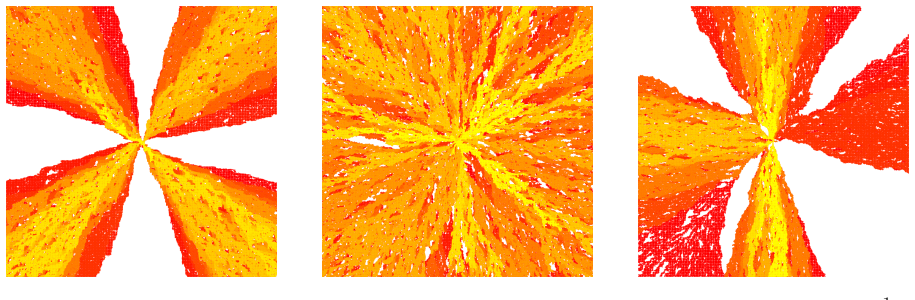

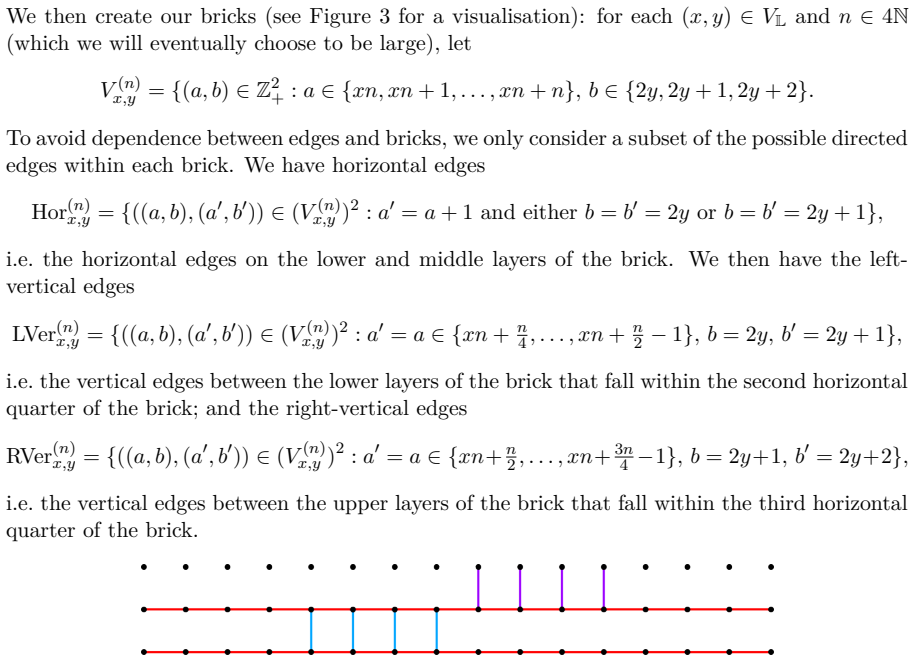
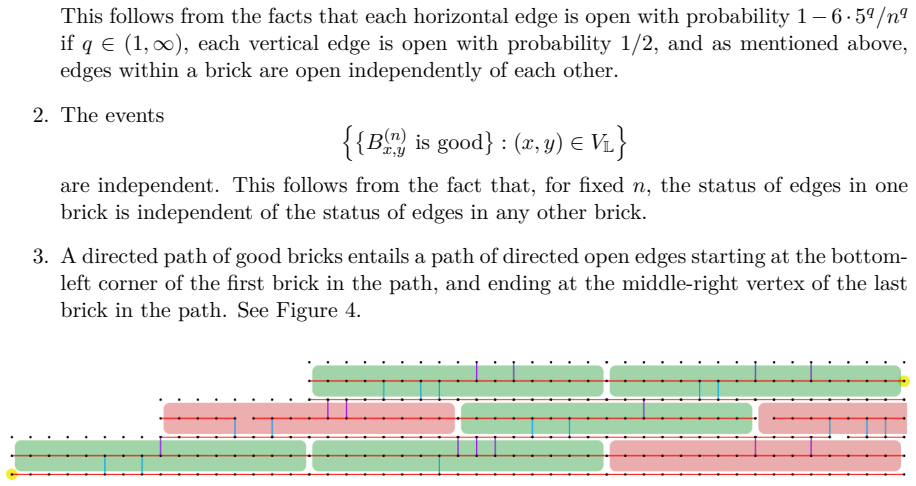
read the original abstract
Consider an infinite, rooted, connected graph where each vertex is labelled with an independent and identically distributed Uniform(0,1) random variable, plus a parameter $\theta$ times its distance from the root $\rho$. That is, we label vertex $v$ with $X_v = U_v + \theta d(\rho,v)$. We say that accessibility percolation occurs if there is an infinite path started from $\rho$ along which the vertex labels are increasing. When the graph is a Bienaym\'e-Galton-Watson tree, we give an exact characterisation of the critical value $\theta_c$ such that there is accessibility percolation with positive probability if and only if $\theta>\theta_c$. We also give more explicit bounds on the value of $\theta_c$. The lower bound holds for a much more general class of trees. When the graph is the lattice $\mathbb{Z}^n$ for $n\ge 2$, we show that there is a non-trivial phase transition and give some first bounds on $\theta_c$. To do this we introduce a novel coupling with oriented percolation.
Editorial analysis
A structured set of objections, weighed in public.
Referee Report
Summary. The manuscript studies accessibility percolation on infinite rooted connected graphs with vertex labels given by i.i.d. Uniform(0,1) random variables plus a linear height term θ times graph distance from the root. For Bienaymé-Galton-Watson trees it supplies an exact characterization of the critical threshold θ_c such that an infinite increasing path from the root exists with positive probability if and only if θ > θ_c; the characterization is obtained by reducing the problem to survival of an auxiliary branching process whose offspring law is determined by the probability that a child label exceeds the parent's effective value. Explicit bounds on θ_c are derived, with the lower bound holding for a broader class of trees. For the lattice Z^n (n ≥ 2) the paper establishes a non-trivial phase transition and supplies initial bounds on θ_c by means of a coupling to oriented percolation.
Significance. If the central claims hold, the work advances percolation theory on random graphs and lattices by furnishing an exact, computable threshold on branching-process trees via a fixed-point analysis of an effective offspring distribution. The reduction to an auxiliary branching process and the novel oriented-percolation coupling for the lattice case are technically clean contributions that should be of interest to researchers in probability theory. The lower bound that applies to general trees further broadens the reach of the results.
minor comments (3)
- [Section 3] In the statement of the exact characterization for BGWT (presumably Theorem 3.1 or equivalent), the fixed-point equation for the survival probability is presented without an explicit remark on uniqueness of the solution; adding a short sentence confirming that the mean-offspring function is continuous and strictly increasing would clarify the argument.
- [Section 4] The coupling construction for the Z^n case (Section 4) is sketched at a high level; a brief diagram or one-sentence description of how the oriented edges are defined from the label comparisons would improve readability for readers unfamiliar with oriented percolation.
- [Section 2] Notation for the effective label threshold U_v + θ d(ρ,v) is introduced early but reused with slight variations in the branching-process offspring formula; a single consolidated definition in a preliminary subsection would reduce minor notational friction.
Simulated Author's Rebuttal
We thank the referee for their positive summary of the manuscript and for recommending minor revision. The assessment accurately captures the main results on the exact characterization of θ_c for BGWT trees, the bounds for general trees, and the oriented-percolation coupling for Z^n. No major comments were raised in the report.
Circularity Check
No significant circularity in the derivation
full rationale
The paper characterizes θ_c for Bienaymé-Galton-Watson trees by mapping accessibility percolation to the survival probability of an auxiliary branching process, where the offspring distribution is derived from the probability that a child's label exceeds the parent's effective value (U_v + θ d(ρ,v)). This is a standard fixed-point analysis on the mean offspring exceeding 1, consistent with the i.i.d. Uniform(0,1) labels and additive distance term. No reduction to fitted parameters, self-definitional loops, or load-bearing self-citations is present. The lower bound on general trees follows from comparison arguments. The lattice case introduces a coupling with oriented percolation, which is an independent construction. The derivation is self-contained against the given probabilistic inputs.
Axiom & Free-Parameter Ledger
axioms (2)
- domain assumption Vertex labels are i.i.d. Uniform(0,1) independent of the graph.
- standard math The graph is infinite, rooted, and connected (BGWT or Z^n).
Lean theorems connected to this paper
-
IndisputableMonolith/Cost/FunctionalEquation.leanwashburn_uniqueness_aczel unclear?
unclearRelation between the paper passage and the cited Recognition theorem.
Theorem 1.2: Q_θ(m) = sum_{j=0}^{⌊1/θ⌋+1} (-m)^j / j! * (1-(j-1)θ)^j =0 defines m_c(θ); percolation iff m > m_c(θ) on BGWT
-
IndisputableMonolith/Foundation/BranchSelection.leanbranch_selection unclear?
unclearRelation between the paper passage and the cited Recognition theorem.
Proposition 1.8 and Theorem 1.6: first-moment + branching-number lower bound θ_c ≥ 1/(e br_T)
What do these tags mean?
- matches
- The paper's claim is directly supported by a theorem in the formal canon.
- supports
- The theorem supports part of the paper's argument, but the paper may add assumptions or extra steps.
- extends
- The paper goes beyond the formal theorem; the theorem is a base layer rather than the whole result.
- uses
- The paper appears to rely on the theorem as machinery.
- contradicts
- The paper's claim conflicts with a theorem or certificate in the canon.
- unclear
- Pith found a possible connection, but the passage is too broad, indirect, or ambiguous to say the theorem truly supports the claim.
Reference graph
Works this paper leans on
-
[1]
Analysis of a local fitness landscape with a model of the rough mt
Takuyo Aita, Hidefumi Uchiyama, Tetsuya Inaoka, Motowo Nakajima, Toshio Kokubo, and Yuzuru Husimi. Analysis of a local fitness landscape with a model of the rough mt. fuji-type landscape: application to prolyl endopeptidase and thermolysin.Biopolymers: Original Research on Biomolecules, 54(1):64–79, 2000. 30
work page 2000
-
[2]
Omer Angel, Asaf Ferber, Benny Sudakov, and Vincent Tassion. Long monotone trails in random edge-labellings of random graphs.Combinatorics, Probability and Computing, 29(1):22–30, 2020
work page 2020
-
[3]
K.B. Athreya and P.E. Ney.Branching Processes. Springer-Verlag, New York, 1972
work page 1972
-
[4]
Paul Balister, Bela Bollobas, and Alan Stacey. Upper bounds for the critical probability of oriented percolation in two dimensions.Proceedings of the Royal Society of London. Series A: Mathematical and Physical Sciences, 440(1908):201–220, 1993
work page 1908
-
[5]
The number of accessible paths in the hypercube.Bernoulli, 22(2):653–680, 2016
Julien Berestycki, Eric Brunet, and Zhan Shi. The number of accessible paths in the hypercube.Bernoulli, 22(2):653–680, 2016
work page 2016
-
[6]
Accessibility percolation with backsteps
Julien Berestycki, Eric Brunet, and Zhan Shi. Accessibility percolation with backsteps. Latin American Journal of Probability and Mathematical Statistics, 14:45–62, 2017
work page 2017
-
[7]
John D. Biggins and Andreas E. Kyprianou. Measure change in multitype branching. Advances in Applied Probability, 36(2):544–581, 2004
work page 2004
-
[8]
Increasing paths in random temporal graphs.The Annals of Applied Probability, 34(6):5498–5521, 2024
Nicolas Broutin, Nina Kamčev, and Gábor Lugosi. Increasing paths in random temporal graphs.The Annals of Applied Probability, 34(6):5498–5521, 2024
work page 2024
-
[9]
Sharp thresholds in random simple temporal graphs.SIAM Journal on Computing, 53(2):346–388, 2024
Arnaud Casteigts, Michael Raskin, Malte Renken, and Viktor Zamaraev. Sharp thresholds in random simple temporal graphs.SIAM Journal on Computing, 53(2):346–388, 2024
work page 2024
-
[10]
Increasing paths on N-ary trees
Xinxin Chen. Increasing paths on n-ary trees.arXiv preprint arXiv:1403.0843, 2014
work page internal anchor Pith review Pith/arXiv arXiv 2014
- [11]
-
[12]
Robert Hardy and Simon C. Harris. A spine approach to branching diffusions with applica- tions toLp-convergence of martingales. InSéminaire de probabilités XLII, pages 281–330. Springer, 2009
work page 2009
-
[13]
Peter Hegarty and Anders Martinsson. On the existence of accessible paths in various models of fitness landscapes.Annals of Applied Probability, 24(4):1375–1395, 2014
work page 2014
-
[14]
John F. Kingman. A simple model for the balance between selection and mutation.Journal of Applied Probability, 15(1):1–12, 1978
work page 1978
- [15]
-
[16]
Russell Lyons, Robin Pemantle, and Yuval Peres. Conceptual proofs oflloglcriteria for mean behavior of branching processes.The Annals of Probability, pages 1125–1138, 1995
work page 1995
-
[17]
Cambridge University Press, New York, 2016
Russell Lyons and Yuval Peres.Probability on Trees and Networks, volume 42 ofCambridge Series in Statistical and Probabilistic Mathematics. Cambridge University Press, New York, 2016
work page 2016
-
[18]
Accessibility percolation onn-trees.Europhysics Letters, 101(6):66004, 2013
Stefan Nowak and Joachim Krug. Accessibility percolation onn-trees.Europhysics Letters, 101(6):66004, 2013
work page 2013
-
[19]
A remark on Stirling’s formula.The American Mathematical Monthly, 62(1):26–29, 1955
Herbert Robbins. A remark on Stirling’s formula.The American Mathematical Monthly, 62(1):26–29, 1955. 31
work page 1955
-
[20]
Matthew I. Roberts and Lee Zhuo Zhao. Increasing paths in regular trees.Electronic Communications in Probability, 18:1–10, 2013. 32
work page 2013
discussion (0)
Sign in with ORCID, Apple, or X to comment. Anyone can read and Pith papers without signing in.