Recognition: no theorem link
Security and Privacy in Virtual and Robotic Assistive Systems: A Comparative Framework
Pith reviewed 2026-05-13 23:28 UTC · model grok-4.3
The pith
A unified comparative threat-modeling framework structures analysis of attack surfaces, risk profiles, and safety implications for virtual and robotic assistive systems.
A machine-rendered reading of the paper's core claim, the machinery that carries it, and where it could break.
Core claim
We present a comparative analysis of security and privacy challenges across virtual and robotic assistive systems. We develop a unified comparative threat-modeling framework that enables structured analysis of attack surfaces, risk profiles, and safety implications across both systems. Moreover, we provide design recommendations for developing secure, privacy-preserving, and trustworthy assistive technologies.
What carries the argument
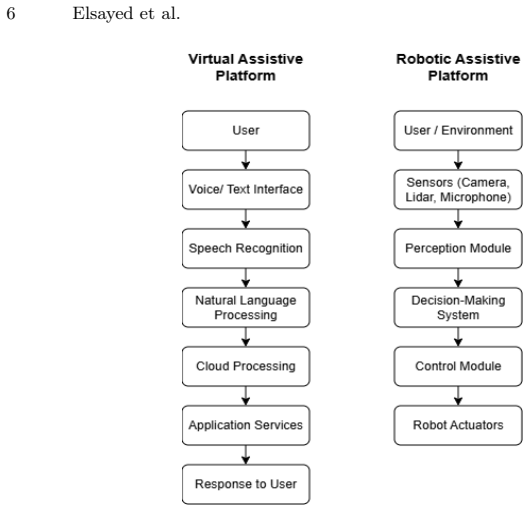
The unified comparative threat-modeling framework, which organizes attack surfaces, risk profiles, and safety implications into a shared structure for virtual and robotic assistive systems.
Load-bearing premise
The listed risks for virtual systems and robotic systems represent the primary and sufficiently distinct threats without major unaddressed overlaps or additional vectors.
What would settle it
Identification of a major attack vector that affects both system types yet cannot be placed into any category of the proposed unified framework would show the model is incomplete.
Figures

read the original abstract
Assistive technologies increasingly support independence, accessibility, and safety for older adults, people with disabilities, and individuals requiring continuous care. Two major categories are virtual assistive systems and robotic assistive systems operating in physical environments. Although both offer significant benefits, they introduce important security and privacy risks due to their reliance on artificial intelligence, network connectivity, and sensor-based perception. Virtual systems are primarily exposed to threats involving data privacy, unauthorized access, and adversarial voice manipulation. In contrast, robotic systems introduce additional cyber-physical risks such as sensor spoofing, perception manipulation, command injection, and physical safety hazards. In this paper, we present a comparative analysis of security and privacy challenges across these systems. We develop a unified comparative threat-modeling framework that enables structured analysis of attack surfaces, risk profiles, and safety implications across both systems. Moreover, we provide design recommendations for developing secure, privacy-preserving, and trustworthy assistive technologies.
Editorial analysis
A structured set of objections, weighed in public.
Referee Report
Summary. The manuscript presents a comparative analysis of security and privacy risks in virtual assistive systems (data privacy, unauthorized access, adversarial voice manipulation) and robotic assistive systems (sensor spoofing, perception manipulation, command injection, physical safety hazards). It claims to develop a unified comparative threat-modeling framework enabling structured analysis of attack surfaces, risk profiles, and safety implications across both, along with design recommendations for secure and privacy-preserving assistive technologies.
Significance. If a repeatable unifying model with shared taxonomy, notation, and cross-system mappings were supplied, the work could aid systematic threat analysis in assistive technologies and highlight hybrid cyber-physical risks. As presented, the contribution is limited to separate high-level risk enumerations without an operational framework, reducing significance to a survey-style overview rather than a methodological advance.
major comments (2)
- [Abstract] Abstract: The claim of developing a 'unified comparative threat-modeling framework' is not supported; the text supplies no common taxonomy, shared attack-surface notation, quantitative risk metric, or repeatable analysis method that would enable systematic comparison beyond the listed items.
- [Framework section] Framework section: The analysis reduces to independent enumerations of virtual risks and robotic risks with only passing mention of overlaps (e.g., voice-command injection); no cross-system mapping or integration into a single model is defined, undermining the central claim of structured comparative analysis.
minor comments (1)
- [Abstract] The abstract would be strengthened by briefly outlining the framework's key components (e.g., taxonomy or mapping procedure) to preview how the comparison is performed.
Simulated Author's Rebuttal
We thank the referee for the constructive comments, which help clarify the presentation of our comparative analysis. We address each major point below and commit to revisions that strengthen the manuscript's contribution without altering its core claims.
read point-by-point responses
-
Referee: [Abstract] Abstract: The claim of developing a 'unified comparative threat-modeling framework' is not supported; the text supplies no common taxonomy, shared attack-surface notation, quantitative risk metric, or repeatable analysis method that would enable systematic comparison beyond the listed items.
Authors: We acknowledge that the abstract's phrasing may imply a more formalized model than is explicitly detailed. The paper structures the analysis around consistent categories (privacy, access control, manipulation, and safety) applied to both system types, but we agree a clearer taxonomy and notation would better substantiate the framework claim. We will revise the abstract to describe a 'comparative threat-modeling approach' and add an explicit taxonomy subsection with shared notation for attack surfaces. revision: yes
-
Referee: [Framework section] Framework section: The analysis reduces to independent enumerations of virtual risks and robotic risks with only passing mention of overlaps (e.g., voice-command injection); no cross-system mapping or integration into a single model is defined, undermining the central claim of structured comparative analysis.
Authors: The manuscript aligns risks under shared dimensions (e.g., data exposure, command integrity, physical/cyber safety) to enable comparison, with overlaps such as voice interfaces noted as bridging elements. However, we accept that dedicated cross-system mappings are insufficiently explicit. In revision, we will add a unified mapping table and integration diagram that consolidates attack surfaces and risk profiles into a single comparative structure. revision: yes
Circularity Check
No circularity; framework is a descriptive enumeration of risks without self-referential derivation
full rationale
The paper claims to develop a unified comparative threat-modeling framework enabling structured analysis of attack surfaces and risk profiles. The content consists of separate enumerations of virtual-system risks (data privacy, unauthorized access, adversarial voice manipulation) and robotic-system risks (sensor spoofing, perception manipulation, command injection, physical hazards) plus high-level design recommendations. No equations, fitted parameters, predictions, self-citations as load-bearing premises, ansatz smuggling, or uniqueness theorems are present. The central claim does not reduce to its inputs by construction; the analysis is self-contained as a side-by-side categorization of described threats.
Axiom & Free-Parameter Ledger
axioms (1)
- domain assumption Standard assumptions in threat modeling such as the existence of adversaries with defined capabilities and access to network or sensor interfaces.
Reference graph
Works this paper leans on
-
[1]
Applied Computing and Informatics 20(1-2), 119–141 (2024)
Abba Ari, A.A., Ngangmo, O.K., Titouna, C., Thiare, O., Kolyang, Mohamadou, A., Gueroui, A.M.: Enabling privacy and security in cloud of things: Architecture, applications, security & privacy challenges. Applied Computing and Informatics 20(1-2), 119–141 (2024)
work page 2024
-
[2]
In: Cyber Security for Next-Generation Computing Technologies, pp
Abou El Houda, Z.: Cyber threat actors review: examining the tactics and motiva- tions of adversaries in the cyber landscape. In: Cyber Security for Next-Generation Computing Technologies, pp. 84–101. CRC Press (2024)
work page 2024
-
[3]
Journal of Field Robotics43(1), 5–33 (2025)
Adesiji, A.D., Ibitoye, S.E., Mahamood, R.M., Olayemi, O.A., Omoniyi, P.O., Jen, T., Akinlabi, E.T.: Safety considerations in deployment of robotic sys- tems – a systematic review. Journal of Field Robotics43(1), 5–33 (2025). https://doi.org/10.1002/rob.70022, http://dx.doi.org/10.1002/rob.70022
-
[4]
IEEE Internet of Things Journal (2026)
Adil, M., Ali, A., Abulkasim, H., Farouk, A., Song, H., Jin, Z.: Internet of audio things, future vision, open challenges, and research opportunities. IEEE Internet of Things Journal (2026)
work page 2026
-
[5]
International Journal of Speech Technology28(3), 615–638 (2025)
Al-Karawi, K.A., Abdelwahab, M.M., Alenizi, A.S.: Comprehensive review of auto- matic speaker verification with spoofing detection techniques attacks. International Journal of Speech Technology28(3), 615–638 (2025)
work page 2025
-
[6]
Journal of Systems and Software p
Amiri, Z., Taghavirashidizadeh, A., Khorrami, P.: Ai-driven decision-making in healthcare information systems: a comprehensive review. Journal of Systems and Software p. 112470 (2025)
work page 2025
-
[7]
https://doi.org/10.4018/979-8-3693-9694-0.ch014, http://dx.doi.org/10.4018/979- 8-3693-9694-0.ch014
Anand, S., Miglani, S., Anand, R.: Ai-driven assistive technologies: Cloud infrastructure for enhanced accessibility and inclusion (2025). https://doi.org/10.4018/979-8-3693-9694-0.ch014, http://dx.doi.org/10.4018/979- 8-3693-9694-0.ch014
-
[8]
In: 2021 IEEE 11th Annual Com- puting and Communication Workshop and Conference (CCWC)
Anniappa, D., Kim, Y.: Security and privacy issues with vir- tual private voice assistants. In: 2021 IEEE 11th Annual Com- puting and Communication Workshop and Conference (CCWC). p. 0702–0708. IEEE (2021). https://doi.org/10.1109/ccwc51732.2021.9375964, http://dx.doi.org/10.1109/CCWC51732.2021.9375964
-
[9]
Avenoğlu, B., Koeman, V.J., Hindriks, K.V.: A cloud-based middleware for multi- modal interaction services and applications. Journal of Ambient Intelligence and Title Suppressed Due to Excessive Length 15 Smart Environments14(6), 455–481 (2022). https://doi.org/10.3233/ais-220161, http://dx.doi.org/10.3233/AIS-220161
-
[10]
In: 2007 International Conference on Control, Automation and Sys- tems
Baeg, S.H., Park, J.H., Koh, J., Park, K.W., Baeg, M.H.: Building a smart home environment for service robots based on rfid and sensor net- works. In: 2007 International Conference on Control, Automation and Sys- tems. p. 1078–1082. IEEE (2007). https://doi.org/10.1109/iccas.2007.4407059, http://dx.doi.org/10.1109/ICCAS.2007.4407059
-
[11]
The Service Industries Journal41(13–14), 860–876 (2020)
Belk, R.: Ethical issues in service robotics and artifi- cial intelligence. The Service Industries Journal41(13–14), 860–876 (2020). https://doi.org/10.1080/02642069.2020.1727892, http://dx.doi.org/10.1080/02642069.2020.1727892
-
[12]
EURASIP Journal on Information Security2025(1), 1 (2025)
Bhardwaj, A., Bharany, S., Rehman, A.U., Tejani, G.G., Hussen, S.: Securing cyber-physical robotic systems for enhanced data security and real-time threat mitigation. EURASIP Journal on Information Security2025(1), 1 (2025)
work page 2025
-
[13]
Bilika, D., Michopoulou, N., Alepis, E., Patsakis, C.: Hello me, meet the real me: Audio deepfake attacks on voice assistants (2023). https://doi.org/10.48550/ARXIV.2302.10328, https://arxiv.org/abs/2302.10328
-
[14]
Bolton, T., Dargahi, T., Belguith, S., Al-Rakhami, M.S., Sodhro, A.H.: On the security and privacy challenges of virtual assistants. Sensors21(7), 2312 (2021). https://doi.org/10.3390/s21072312, http://dx.doi.org/10.3390/s21072312
-
[15]
https://doi.org/10.1080/09687599.2011.543862
Borg, J., Larsson, S., Östergren, P.: The right to assistive technology: for whom, for what, and by whom? Disability & Society26(2), 151–167 (2011). https://doi.org/10.1080/09687599.2011.543862
-
[16]
arXiv preprint arXiv:1712.04248 (2017)
Brendel, W., Rauber, J., Bethge, M.: Decision-based adversarial attacks: Re- liable attacks against black-box machine learning models. arXiv preprint arXiv:1712.04248 (2017)
-
[17]
Brunete, A., Gambao, E., Hernando, M., Cedazo, R.: Smart assistive architecture for the integration of iot devices, robotic systems, and multimodal interfaces in healthcare environments. Sensors21(6), 2212 (2021)
work page 2021
-
[18]
In: 2019 International Conference on Electronics, Communications and Computers (CONIELECOMP)
Castro-Antonio, M.K., Carmona-Arroyo, G., Herrera-Luna, I., Marin- Hernandez, A., Rios-Figueroa, H.V., Rechy-Ramirez, E.J.: An approach based on a robotics operation system for the implementation of inte- grated intelligent house services system. In: 2019 International Conference on Electronics, Communications and Computers (CONIELECOMP). p. 182–186. IEEE...
-
[19]
IEEE Access6, 36662–36682 (2018)
Chen, W., Yaguchi, Y., Naruse, K., Watanobe, Y., Nakamura, K., Ogawa, J.: A study of robotic cooperation in cloud robotics: Architecture and challenges. IEEE Access6, 36662–36682 (2018). https://doi.org/10.1109/access.2018.2852295, http://dx.doi.org/10.1109/ACCESS.2018.2852295
-
[20]
Proceedings of the IEEE110(4), 476–507 (2022)
Cheng, P., Roedig, U.: Personal voice assistant security and privacy—a survey. Proceedings of the IEEE110(4), 476–507 (2022). https://doi.org/10.1109/jproc.2022.3153167, http://dx.doi.org/10.1109/JPROC.2022.3153167
-
[21]
Chimuco, F.T., Sequeiros, J.B., Lopes, C.G., Simões, T.M., Freire, M.M., Inacio, P.R.:Securecloud-basedmobileapps:attacktaxonomy,requirements,mechanisms, testsandautomation.InternationalJournalofInformationSecurity22(4),833–867 (2023)
work page 2023
-
[22]
In: 2017 IEEE conference on cognitive and computational aspects of situation management (CogSIMA)
Clark, G.W., Doran, M.V., Andel, T.R.: Cybersecurity issues in robotics. In: 2017 IEEE conference on cognitive and computational aspects of situation management (CogSIMA). pp. 1–5. IEEE (2017) 16 Elsayed et al
work page 2017
-
[23]
Ethical theory and moral practice13(2), 181–190 (2010)
Coeckelbergh, M.: Health care, capabilities, and ai assistive technologies. Ethical theory and moral practice13(2), 181–190 (2010)
work page 2010
-
[24]
Journal of Neu- roEngineering and Rehabilitation9(1), 20 (2012)
Cowan, R.E., Fregly, B.J., Boninger, M.L., Chan, L., Rodgers, M.M., Reinkens- meyer, D.J.: Recent trends in assistive technology for mobility. Journal of Neu- roEngineering and Rehabilitation9(1), 20 (2012). https://doi.org/10.1186/1743- 0003-9-20, http://jneuroengrehab.biomedcentral.com/articles/10.1186/1743-0003- 9-20
-
[25]
De Freitas, M.P., Piai, V.A., Farias, R.H., Fernandes, A.M., de Moraes Rossetto, A.G., Leithardt, V.R.Q.: Artificial intelligence of things applied to assistive tech- nology: a systematic literature review. Sensors22(21), 8531 (2022)
work page 2022
-
[26]
In: 2022 IEEE 8th World Forum on Internet of Things (WF- IoT)
Elsayed, N., ElSayed, Z., Asadizanjani, N., Ozer, M., Abdelgawad, A., Bayoumi, M.: Speech emotion recognition using supervised deep recurrent system for mental health monitoring. In: 2022 IEEE 8th World Forum on Internet of Things (WF- IoT). pp. 1–6. IEEE (2022)
work page 2022
-
[27]
Georgoulas, C., Raza, A., Güttler, J., Linner, T., Bock, T.: Home environment interaction via service robots and the leap motion controller. In: Proceedings of the 31st International Symposium on Automation and Robotics in Construction (ISARC) (2014)
work page 2014
-
[28]
Journal of Computer Science Research5(2), 28–36 (2023)
Giachos, I., Papakitsos, E.C., Savvidis, P., Laskaris, N.: Inquiring natural language processing capabilities on robotic systems through virtual assistants: A systemic approach. Journal of Computer Science Research5(2), 28–36 (2023)
work page 2023
-
[29]
Security and Commu- nication Networks4(11), 1295–1307 (2011)
Giannetsos, T., Dimitriou, T., Prasad, N.R.: People-centric sensing in as- sistive healthcare: Privacy challenges and directions. Security and Commu- nication Networks4(11), 1295–1307 (2011). https://doi.org/10.1002/sec.313, http://dx.doi.org/10.1002/sec.313
-
[30]
Giansanti, D., Pirrera, A.: Integrating ai and assistive technologies in healthcare: Insights from a narrative review of reviews. In: Healthcare. vol. 13, p. 556. MDPI (2025)
work page 2025
-
[31]
Robotics and Autonomous Systems 60(6), 889–900 (2012)
González Alonso, I., Álvarez Fres, O., Alonso Fernández, A., del Torno, P.G., Maestre, J., Almudena García Fuente, M.: Towards a new open communication standard between homes and service robots, the dhcompliant case. Robotics and Autonomous Systems 60(6), 889–900 (2012). https://doi.org/10.1016/j.robot.2012.01.006, http://dx.doi.org/10.1016/j.robot.2012.01.006
-
[32]
Grabler, R., Koeszegi, S.T.: Privacy beyond data: Assessment and mitigation of privacy risks in robotic technology for elderly care. ACM Transactions on Human-Robot Interaction14, 1 – 23 (2024), https://api.semanticscholar.org/CorpusID:272044712
work page 2024
-
[33]
Robotics and Autonomous Sys- tems99, 75–83 (2018)
Guerrero-Higueras, A.M., DeCastro-Garcia, N., Matellan, V.: De- tection of cyber-attacks to indoor real time localization sys- tems for autonomous robots. Robotics and Autonomous Sys- tems99, 75–83 (2018). https://doi.org/10.1016/j.robot.2017.10.006, http://dx.doi.org/10.1016/j.robot.2017.10.006
-
[34]
Robotics and Autonomous Systems 94, 43–52 (2017)
Guiochet, J., Machin, M., Waeselynck, H.: Safety-critical ad- vanced robots: A survey. Robotics and Autonomous Systems 94, 43–52 (2017). https://doi.org/10.1016/j.robot.2017.04.004, http://dx.doi.org/10.1016/j.robot.2017.04.004
-
[35]
In: Proceedings of the 20th International ACM SIGAC- CESS Conference on Computers and Accessibility
Hamidi, F., Poneres, K., Massey, A., Hurst, A.: Who should have access to my pointing data?: Privacy tradeoffs of adaptive assistive Title Suppressed Due to Excessive Length 17 technologies. In: Proceedings of the 20th International ACM SIGAC- CESS Conference on Computers and Accessibility. p. 203–216. AS- SETS ’18, ACM (2018). https://doi.org/10.1145/323...
-
[36]
ACM Computing Surveys57(9), 1–48 (2025)
Haskard, A., Herath, D.: Secure robotics: Navigating challenges at the nexus of safety, trust, and cybersecurity in cyber-physical systems. ACM Computing Surveys57(9), 1–48 (2025). https://doi.org/10.1145/3723050, http://dx.doi.org/10.1145/3723050
-
[37]
IEEE Network26(3), 21–28 (2012)
Hu,G.,Tay,W.,Wen,Y.:Cloudrobotics:architecture,challengesandapplications. IEEE Network26(3), 21–28 (2012). https://doi.org/10.1109/mnet.2012.6201212, http://dx.doi.org/10.1109/MNET.2012.6201212
-
[38]
https://doi.org/10.48550/ARXIV.2508.16843, https://arxiv.org/abs/2508.16843
Kamel, K., Sood, K., Dutta, H.S., Aryal, S.: A survey of threats against voice authentication and anti-spoofing systems (2025). https://doi.org/10.48550/ARXIV.2508.16843, https://arxiv.org/abs/2508.16843
-
[39]
Kchaou, M., Munusamy, Y., Alharthi, K.A., Al-mahmodi, A.F.: In- dustry 5.0 adaptation for disability-inclusive healthcare: A review of emergent and ai technologies for assistive digital health. DIGI- TAL HEALTH11(2025). https://doi.org/10.1177/20552076251395558, http://dx.doi.org/10.1177/20552076251395558
-
[40]
Computers in Industry97, 132–145 (2018)
Khalid, A., Kirisci, P., Khan, Z.H., Ghrairi, Z., Thoben, K.D., Pannek, J.: Security framework for industrial collaborative robotic cyber-physical systems. Computers in Industry97, 132–145 (2018)
work page 2018
-
[41]
Krausz, N.E., Hargrove, L.J.: A survey of teleceptive sensing for wearable assistive robotic devices. Sensors19(23), 5238 (2019)
work page 2019
-
[42]
IEEE Internet of Things Journal7(6), 5103– 5115 (2020)
Li, J., Liu, Y., Chen, T., Xiao, Z., Li, Z., Wang, J.: Adversarial attacks and defenses on cyber–physical systems: A survey. IEEE Internet of Things Journal7(6), 5103– 5115 (2020)
work page 2020
-
[43]
Comput- ers &; Security134, 103448 (2023)
Li, J., Chen, C., Rahimi Azghadi, M., Ghodosi, H., Pan, L., Zhang, J.: Secu- rity and privacy problems in voice assistant applications: A survey. Comput- ers &; Security134, 103448 (2023). https://doi.org/10.1016/j.cose.2023.103448, http://dx.doi.org/10.1016/j.cose.2023.103448
-
[44]
Mao, J., Zhu, S., Dai, X., Lin, Q., Liu, J.: Watchdog: Detecting ultrasonic- based inaudible voice attacks to smart home systems. IEEE Internet of ThingsJournal7(9),8025–8035(2020).https://doi.org/10.1109/jiot.2020.2997779, http://dx.doi.org/10.1109/JIOT.2020.2997779
-
[45]
Maqsood, M., Yasmin, S., Gillani, S., Aadil, F., Mehmood, I., Rho, S., Yeo, S.S.: An autonomous decision-making framework for gait recognition systems against adversarialattackusingreinforcementlearning.ISAtransactions132,80–93(2023)
work page 2023
-
[46]
Applied Sciences12(4), 2174 (2022)
Marchang,J.,DiNuovo,A.:Assistivemultimodalroboticsystem(amrsys):security and privacy issues, challenges, and possible solutions. Applied Sciences12(4), 2174 (2022)
work page 2022
-
[47]
In: ACM Transactions on Accessible Computing
Marsh, A., Milne, S.: I don’t want to sound rude, but it’s none of their business: Ex- ploringsecurityandprivacyconcernsaroundassistivetechnologyuseineducational settings. In: ACM Transactions on Accessible Computing. Association for Comput- ing Machinery, New York, NY, USA (2024). https://doi.org/10.1145/3670690
-
[48]
Micheletto, M., Setzu, A., Tronci, M., Trudu, M., Marcialis, G.L.: Deep- fake voice command attacks on automatic speaker recognition systems, https://api.semanticscholar.org/CorpusID:283562207
-
[49]
Miller, D.P.: Assistive robotics: an overview. Assistive Technology and Artificial Intelligence: Applications in Robotics, User Interfaces and Natural Language Pro- cessing pp. 126–136 (2006) 18 Elsayed et al
work page 2006
-
[50]
Disability and Rehabilitation: Assistive Tech- nology17(6), 605–623 (2020)
Modi, N., Singh, J.: A survey of research trends in assistive technologies using information modelling techniques. Disability and Rehabilitation: Assistive Tech- nology17(6), 605–623 (2020). https://doi.org/10.1080/17483107.2020.1817992, http://dx.doi.org/10.1080/17483107.2020.1817992
-
[51]
Computer Vision and Image Understanding149, 78–97 (2016)
Mollaret, C., Mekonnen, A.A., Lerasle, F., Ferrané, I., Pinquier, J., Boudet, B., Rumeau, P.: A multi-modal perception based assistive robotic system for the el- derly. Computer Vision and Image Understanding149, 78–97 (2016)
work page 2016
-
[52]
In: International Symposium on End User Development
Monge Roffarello, A., De Russis, L.: Defining trigger-action rules via voice: a novel approach for end-user development in the iot. In: International Symposium on End User Development. pp. 65–83. Springer (2023)
work page 2023
-
[53]
Mulfari, D., Celesti, A., Fazio, M., Villari, M., Puliafito, A., et al.: Achieving as- sistive technology systems based on iot devices in cloud computing. EAI Endorsed Trans. Cloud Syst.1(1), e4 (2015)
work page 2015
-
[54]
IEEE Access 12, 22072–22097 (2024)
Neupane, S., Mitra, S., Fernandez, I.A., Saha, S., Mittal, S., Chen, J., Pillai, N., Rahimi, S.: Security considerations in ai-robotics: A sur- vey of current methods, challenges, and opportunities. IEEE Access 12, 22072–22097 (2024). https://doi.org/10.1109/access.2024.3363657, http://dx.doi.org/10.1109/ACCESS.2024.3363657
-
[55]
The International Journal of Advanced Manufacturing Technol- ogy138(9–10), 3925–3942 (2025)
Omiyale, B.O., Odeyemi, J., Ogbeyemi, A., Olorunsogbon, F., Zhang, W.C.: Im- pact of cyber physical systems on enhancing robotic system autonomy: a brief critical review. The International Journal of Advanced Manufacturing Technol- ogy138(9–10), 3925–3942 (2025). https://doi.org/10.1007/s00170-025-15828-w, http://dx.doi.org/10.1007/s00170-025-15828-w
-
[56]
Oruma, S.O., Sánchez-Gordón, M., Colomo-Palacios, R., Gkioulos, V., Hansen, J.K.: A systematic review on social robots in public spaces: Threat landscape and attack surface. Computers11(12), 181 (2022)
work page 2022
-
[57]
In: 2020 International Confer- ence on Computational Science and Computational Intelligence (CSCI)
Ozer, M., Varlioglu, S., Gonen, B., Adewopo, V., Elsayed, N., Zengin, S.: Cloud incident response: Challenges and opportunities. In: 2020 International Confer- ence on Computational Science and Computational Intelligence (CSCI). pp. 49–54. IEEE (2020)
work page 2020
-
[58]
Elsevier, United States, 6 edn
Polgar, J., Encarnação, P., Smith, E., Cook, A.: Assistive technologies: principles and practice. Elsevier, United States, 6 edn. (Jan 2025)
work page 2025
-
[59]
Journal of Intelligent & Robotic Systems107(1), 12 (2023)
Ringwald, M., Theben, P., Gerlinger, K., Hedrich, A., Klein, B.: How should your assistive robot look like? a scoping review on embodiment for assistive robots. Journal of Intelligent & Robotic Systems107(1), 12 (2023)
work page 2023
-
[60]
Roy, N., Hassanieh, H., Roy Choudhury, R.: Backdoor: Making micro- phones hear inaudible sounds. In: Proceedings of the 15th Annual In- ternational Conference on Mobile Systems, Applications, and Services. p. 2–14. MobiSys’17, ACM (Jun 2017). https://doi.org/10.1145/3081333.3081366, http://dx.doi.org/10.1145/3081333.3081366
-
[61]
ACM Computing Surveys (CSUR)48(3), 1–38 (2016)
Sgandurra, D., Lupu, E.: Evolution of attacks, threat models, and solutions for virtualized systems. ACM Computing Surveys (CSUR)48(3), 1–38 (2016)
work page 2016
-
[62]
IET Cyber-Physical Systems: Theory &; Applications10(1) (2025)
Shaik, A.K., Mohammadi, A., Malik, H.: A systematic review of sen- sor vulnerabilities and cyber-physical threats in industrial robotic sys- tems. IET Cyber-Physical Systems: Theory &; Applications10(1) (2025). https://doi.org/10.1049/cps2.70023, http://dx.doi.org/10.1049/cps2.70023
-
[63]
IEEE Ac- cess5, 4621–4635 (2017)
Sharma, S.K., Wang, X.: Live data analytics with collaborative edge and cloud processing in wireless iot networks. IEEE Ac- cess5, 4621–4635 (2017). https://doi.org/10.1109/access.2017.2682640, http://dx.doi.org/10.1109/ACCESS.2017.2682640 Title Suppressed Due to Excessive Length 19
-
[64]
Singhal, K., Sabharwal, P., Sharma, D.K., Kuntala, C., Sristi, Ghosh, U.: Sensing and communication mechanisms for advanced robotics and complex cyber-physical systems (Nov 2023)
work page 2023
-
[65]
International Journal of Global Innova- tions and Solutions (IJGIS) (2024)
Tabbassum, A., Bhattacharya, S.: A comprehensive review of privacy risks in voice-activated virtual assistants. International Journal of Global Innova- tions and Solutions (IJGIS) (2024). https://doi.org/10.21428/e90189c8.2b69e04c, http://dx.doi.org/10.21428/e90189c8.2b69e04c
-
[66]
The journal of supercomputing76(12), 9493–9532 (2020)
Tabrizchi, H., Kuchaki Rafsanjani, M.: A survey on security challenges in cloud computing: issues, threats, and solutions. The journal of supercomputing76(12), 9493–9532 (2020)
work page 2020
-
[67]
Journal of Computing and Information Science in Engineering25(12), 120809 (2025)
Thakur, A., Kaipa, K., Banerjee, A.G., Cappelleri, D.J., Krovi, V.N., Gupta, S.: Physical artificial intelligence for powering the next revolution in robotics. Journal of Computing and Information Science in Engineering25(12), 120809 (2025)
work page 2025
-
[68]
In: 2013 IEEE International Conference on Robotics and Automation
Vasic, M., Billard, A.: Safety issues in human-robot interactions. In: 2013 IEEE International Conference on Robotics and Automation. p. 197–204. IEEE (2013). https://doi.org/10.1109/icra.2013.6630576, http://dx.doi.org/10.1109/ICRA.2013.6630576
-
[69]
In: 2013 ieee international conference on robotics and automation
Vasic, M., Billard, A.: Safety issues in human-robot interactions. In: 2013 ieee international conference on robotics and automation. pp. 197–204. IEEE (2013)
work page 2013
-
[70]
Applied Sciences12(8), 3929 (2022)
Villalón-Huerta, A., Ripoll-Ripoll, I., Marco-Gisbert, H.: A taxonomy for threat actors’ delivery techniques. Applied Sciences12(8), 3929 (2022)
work page 2022
-
[71]
https://doi.org/10.48550/ARXIV.2312.06010, https://arxiv.org/abs/2312.06010
Wang, Y., Yan, Q., Ivanov, N., Chen, X.: A practical survey on emerg- ing threats from ai-driven voice attacks: How vulnerable are commer- cial voice control systems? (2023). https://doi.org/10.48550/ARXIV.2312.06010, https://arxiv.org/abs/2312.06010
-
[72]
Journal of Advanced Nursing81(6), 2885–2912 (2025)
Wang, Y., Sun, H., Xu, S., Xia, Q., Ge, S., Li, M., Tang, X.: Smart home technolo- gies for enhancing independence of living and reducing care dependence in older adults: a systematic review. Journal of Advanced Nursing81(6), 2885–2912 (2025)
work page 2025
-
[73]
International Journal of Information Security21(1), 115–158 (2021)
Yaacoub, J.P.A., Noura, H.N., Salman, O., Chehab, A.: Robotics cy- ber security: vulnerabilities, attacks, countermeasures, and recommenda- tions. International Journal of Information Security21(1), 115–158 (2021). https://doi.org/10.1007/s10207-021-00545-8, http://dx.doi.org/10.1007/s10207- 021-00545-8
-
[74]
ACM Computing Surveys55(4), 1–36 (2022)
Yan, C., Ji, X., Wang, K., Jiang, Q., Jin, Z., Xu, W.: A survey on voice assistant se- curity: Attacks and countermeasures. ACM Computing Surveys55(4), 1–36 (2022)
work page 2022
-
[75]
In: 2019 IEEE Symposium on Security and Privacy (SP)
Zhang, N., Mi, X., Feng, X., Wang, X., Tian, Y., Qian, F.: Dangerous skills: Un- derstanding and mitigating security risks of voice-controlled third-party functions on virtual personal assistant systems. In: 2019 IEEE Symposium on Security and Privacy (SP). p. 1381–1396. IEEE (2019). https://doi.org/10.1109/sp.2019.00016, http://dx.doi.org/10.1109/SP.2019.00016
discussion (0)
Sign in with ORCID, Apple, or X to comment. Anyone can read and Pith papers without signing in.