Recognition: 2 theorem links
· Lean TheoremBig Bang revisited
Pith reviewed 2026-05-13 22:55 UTC · model grok-4.3
The pith
A degenerate spacetime metric eliminates the Big Bang curvature singularity in the Friedmann solution.
A machine-rendered reading of the paper's core claim, the machinery that carries it, and where it could break.
Core claim
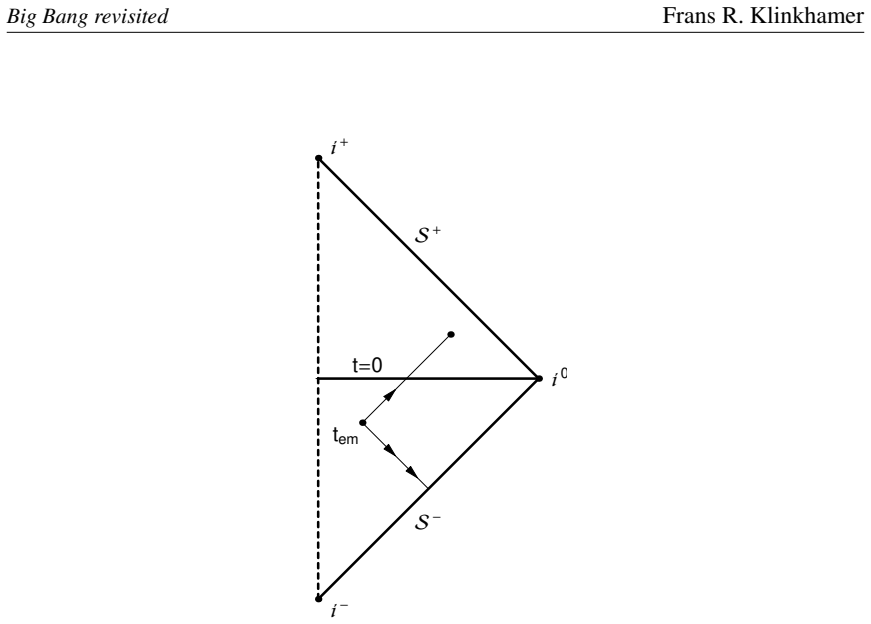
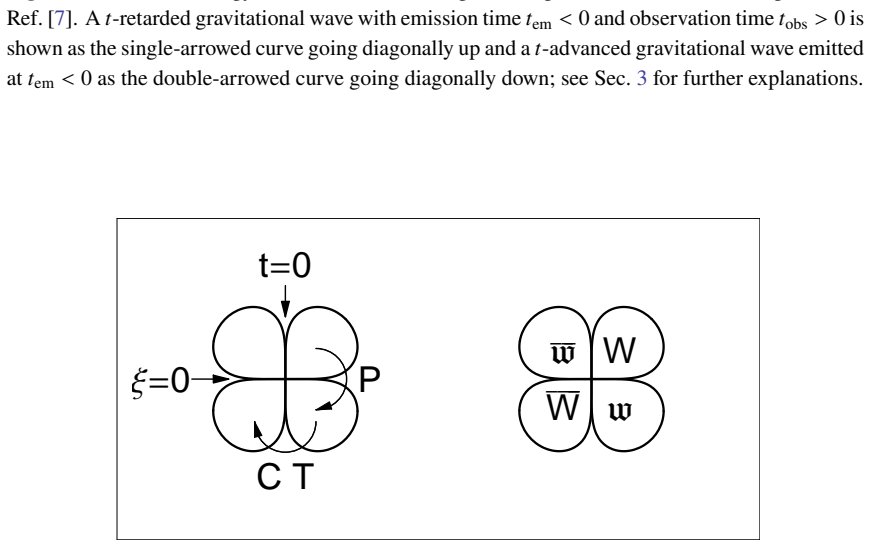
The Friedmann solution of Einstein's field equation has a curvature singularity at the Big Bang. This singularity is eliminated when a degenerate spacetime metric is used instead. The same framework allows discussion of CPT-conjugated worlds and points toward an extended version of the Einstein field equation.
What carries the argument
The degenerate spacetime metric applied to the Friedmann solution, which removes the curvature singularity at the initial time while satisfying the field equations.
Load-bearing premise
A degenerate spacetime metric remains physically acceptable and consistent with the Einstein field equations and cosmological observations when applied to the Friedmann solution.
What would settle it
A direct calculation showing that the degenerate metric produces inconsistent light propagation or expansion history compared with observed cosmological data would disprove the proposal.
Figures


read the original abstract
The Friedmann cosmological solution of the standard Einstein gravitational field equation has a curvature singularity at a moment in time known as the Big Bang. It has been suggested that this Big Bang curvature singularity can be eliminated by use of a degenerate spacetime metric. This proposal was the main topic of our talk at the Workshop, but, here, we also discuss the possible appearance of CPT-conjugated worlds and the conjectured relevance of an extended version of Einstein's field equation.
Editorial analysis
A structured set of objections, weighed in public.
Referee Report
Summary. The paper proposes that the curvature singularity at t=0 in the standard Friedmann-Lemaître-Robertson-Walker solution of Einstein's equations can be removed by adopting a degenerate spacetime metric. It further discusses the possible emergence of CPT-conjugated worlds and the conjectured applicability of an extended form of the Einstein field equations to accommodate this degeneracy.
Significance. A rigorously verified demonstration that a degenerate metric yields finite curvature invariants at t=0 while recovering the standard Friedmann equations for t>0 would constitute a classical resolution of the Big Bang singularity without quantum gravity or inflation. The absence of such verification in the current manuscript leaves the significance conditional on future explicit calculations.
major comments (2)
- [Degenerate metric construction] The central claim that a degenerate FLRW metric eliminates the t=0 curvature singularity requires explicit computation of the inverse metric, Christoffel symbols, Riemann tensor, and Ricci scalar when det(g)→0. No such component-wise derivation is supplied, so it remains unclear whether the curvature invariants stay finite or whether the Einstein tensor remains well-defined.
- [Extended field equation and CPT worlds] The extended Einstein field equation invoked for CPT-conjugated worlds is stated without an explicit tensorial form or reduction to the standard Friedmann equations for t>0. This step is load-bearing for the claim that the proposal is consistent with general relativity outside the degeneracy point.
minor comments (2)
- The abstract frames the work as a suggestion rather than a completed derivation; this framing should be made consistent throughout the introduction and conclusions.
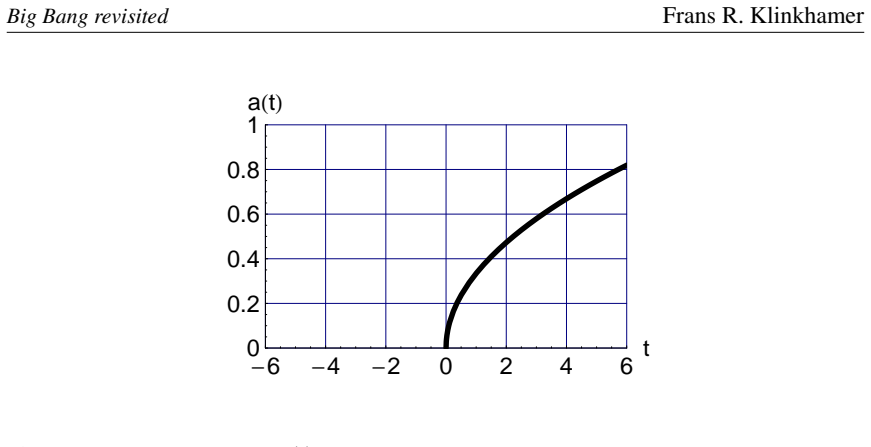
- Notation for the degenerate metric (e.g., how the scale factor a(t) behaves at t=0) should be defined explicitly before discussing curvature.
Simulated Author's Rebuttal
We thank the referee for the careful reading and constructive comments. We address the two major comments below and will incorporate the requested explicit derivations into the revised manuscript.
read point-by-point responses
-
Referee: [Degenerate metric construction] The central claim that a degenerate FLRW metric eliminates the t=0 curvature singularity requires explicit computation of the inverse metric, Christoffel symbols, Riemann tensor, and Ricci scalar when det(g)→0. No such component-wise derivation is supplied, so it remains unclear whether the curvature invariants stay finite or whether the Einstein tensor remains well-defined.
Authors: The referee correctly identifies that the manuscript presents the degenerate-metric proposal at a conceptual level without the full component-wise calculation. We will add these derivations in the revised version: we will explicitly construct the inverse (via a limiting procedure as det(g)→0), compute the Christoffel symbols, Riemann tensor, and Ricci scalar, and verify that the curvature invariants remain finite at t=0 while the Einstein tensor stays well-defined. The same calculation will confirm recovery of the standard Friedmann equations for t>0. revision: yes
-
Referee: [Extended field equation and CPT worlds] The extended Einstein field equation invoked for CPT-conjugated worlds is stated without an explicit tensorial form or reduction to the standard Friedmann equations for t>0. This step is load-bearing for the claim that the proposal is consistent with general relativity outside the degeneracy point.
Authors: We agree that an explicit tensorial expression and reduction are required. In the revision we will write the extended Einstein field equation in fully tensorial form, incorporating the degeneracy, and then demonstrate its reduction to the standard Einstein equations (and hence the Friedmann equations) for all t>0 by showing that the extra terms vanish identically once the metric is non-degenerate. revision: yes
Circularity Check
No circularity: degenerate-metric extension presented as independent proposal
full rationale
The paper begins with the standard Friedmann solution and its known curvature singularity at t=0, then introduces a degenerate metric as an external modification whose purpose is to remove that singularity while recovering ordinary cosmology for t>0. The discussion of CPT-conjugated worlds and an extended Einstein equation is framed as a conjecture and possible relevance rather than a derivation that reduces to a fitted parameter or self-referential definition. No equation in the supplied text equates the target result to its own inputs by construction, and the central claim remains an open suggestion rather than a closed loop.
Axiom & Free-Parameter Ledger
axioms (2)
- domain assumption The Friedmann solution satisfies Einstein's field equations away from the initial singularity
- ad hoc to paper Degenerate metrics are permissible in the gravitational theory
invented entities (1)
-
CPT-conjugated worlds
no independent evidence
Lean theorems connected to this paper
-
IndisputableMonolith/Foundation/RealityFromDistinction.leanreality_from_one_distinction unclear?
unclearRelation between the paper passage and the cited Recognition theorem.
A new spatially-flat metric Ansatz has been proposed: ds²|RWK = -t²/(b²+t²) dt² + a(t)² dx² with det g = 0 at t=0, corresponding to a three-dimensional spacetime defect.
-
IndisputableMonolith/Foundation/AlexanderDuality.leanalexander_duality_circle_linking unclear?
unclearRelation between the paper passage and the cited Recognition theorem.
The Friedmann curvature singularity can be evaded if we consider a degenerate metric.
What do these tags mean?
- matches
- The paper's claim is directly supported by a theorem in the formal canon.
- supports
- The theorem supports part of the paper's argument, but the paper may add assumptions or extra steps.
- extends
- The paper goes beyond the formal theorem; the theorem is a base layer rather than the whole result.
- uses
- The paper appears to rely on the theorem as machinery.
- contradicts
- The paper's claim conflicts with a theorem or certificate in the canon.
- unclear
- Pith found a possible connection, but the passage is too broad, indirect, or ambiguous to say the theorem truly supports the claim.
Reference graph
Works this paper leans on
-
[1]
Friedmann, Über die Krümmung des Raumes (On the curvature of space), Z
A.A. Friedmann, Über die Krümmung des Raumes (On the curvature of space), Z. Phys. 10 (1922) 377; Über die Möglichkeit einer Welt mit konstanter negativer Krüm- mung des Raumes (On the possibility of a world with constant negative curvature), Z. Phys. 21 (1924) 326. 16 Big Bang revisited Frans R. Klinkhamer
work page 1922
-
[2]
Hubble, A relation between distance and radial velocity among extra-galactic neb- ulae, Proc
E. Hubble, A relation between distance and radial velocity among extra-galactic neb- ulae, Proc. Nat. Acad. Sci. 15 (1929) 168
work page 1929
-
[3]
Klinkhamer, Regularized big bang singularity, Phys
F.R. Klinkhamer, Regularized big bang singularity, Phys. Rev. D 100 (2019) 023536 [arXiv:1903.10450]
-
[4]
Klinkhamer,Big Bang as spacetime defect, Mod
F.R. Klinkhamer,Big Bang as spacetime defect, Mod. Phys. Lett. A40 (2025) 2530010 [arXiv:2412.03538]
-
[5]
A. Einstein, N. Rosen, The particle problem in the general theory of relativity , Phys. Rev. 48 (1935) 73
work page 1935
-
[6]
S. Weinberg,Gravitation and Cosmology: Principles and Applications of the General Theory of Relativity , John Wiley and Sons, New Y ork, 1972
work page 1972
-
[7]
S.W. Hawking and G.F.R. Ellis,The Large Scale Structure of Space-Time, Cambridge University Press, Cambridge, England, 1973
work page 1973
-
[8]
S.W. Hawking and R. Penrose, The singularities of gravitational collapse and cos- mology, Proc. Roy. Soc. Lond. A 314 (1970) 529
work page 1970
-
[9]
F.R. Klinkhamer and F. Sorba, Comparison of spacetime defects which are homeomorphic but not diffeomorphic , J. Math. Phys. (N.Y.) 55 (2014) 112503 [arXiv:1404.2901]
-
[10]
Klinkhamer, A new type of nonsingular black-hole solution in general relativity , Mod
F.R. Klinkhamer, A new type of nonsingular black-hole solution in general relativity , Mod. Phys. Lett. A 29 (2014) 1430018 [arXiv:1309.7011]
-
[11]
Klinkhamer, On a soliton-type spacetime defect, J
F.R. Klinkhamer, On a soliton-type spacetime defect, J. Phys. Conf. Ser. 1275 (2019) 012012 [arXiv:1811.01078]
-
[12]
Horowitz, Topology change in classical and quantum gravity , Class
G.T. Horowitz, Topology change in classical and quantum gravity , Class. Quant. Grav. 8 (1991) 587
work page 1991
-
[13]
M. Guenther, Skyrmion spacetime defect, degenerate metric, and negative gravitational mass , Master Thesis, KIT, September 2017; available from https://www.itp.kit.edu/en/publications/diploma
work page 2017
-
[14]
E. Battista, Nonsingular bouncing cosmology in general relativity: Physical analysis of the spacetime defect, Class. Quant. Grav. 38 (2021) 195007 [arXiv:2011.09818]
-
[15]
Wang, Regularized big bang singularity: Geodesic congruences , Phys
Z.L. Wang, Regularized big bang singularity: Geodesic congruences , Phys. Rev. D 104 (2021) 084093 [arXiv:2109.04229]
-
[16]
F.R. Klinkhamer and Z.L. Wang, Nonsingular bouncing cosmology from general rel- ativity, Phys. Rev. D 100 (2019) 083534 [arXiv:1904.09961]. 17 Big Bang revisited Frans R. Klinkhamer
-
[17]
F.R. Klinkhamer and Z.L. Wang, Nonsingular bouncing cosmology from gen- eral relativity: Scalar metric perturbations , Phys. Rev. D 101 (2020) 064061 [arXiv:1911.06173]
-
[18]
Sakharov, Violation of CP invariance, C asymmetry, and baryon asymmetry of the universe, JETP Lett
A.D. Sakharov, Violation of CP invariance, C asymmetry, and baryon asymmetry of the universe, JETP Lett. 5 (1967) 24
work page 1967
-
[19]
L. Boyle, K. Finn, and N. Turok,CPT-symmetric Universe, Phys. Rev. Lett.121 (2018) 251301 [arXiv:1803.08928]
work page Pith review arXiv 2018
-
[20]
Klinkhamer, Defect wormhole: A traversable wormhole without exotic matter , Acta Phys
F.R. Klinkhamer, Defect wormhole: A traversable wormhole without exotic matter , Acta Phys. Polon. B 54 (2023) 5-A3 [arXiv:2301.00724]
-
[21]
Klinkhamer, Vacuum-defect wormholes and a mirror world, Acta Phys
F.R. Klinkhamer, Vacuum-defect wormholes and a mirror world, Acta Phys. Polon. B 54 (2023) 7-A3 [arXiv:2305.13278]
-
[22]
Klinkhamer, CPT-conjugated worlds from a degenerate cosmological met- ric, Mod
F.R. Klinkhamer, CPT-conjugated worlds from a degenerate cosmological met- ric, Mod. Phys. Lett. A to appear; preprint KA–TP–32–2025 [PDF available from: https://www.itp.kit.edu/publications/preprints/2025]
work page 2025
-
[23]
Feynman,The theory of positrons , Phys
R.P . Feynman,The theory of positrons , Phys. Rev. 76 (1949) 749
work page 1949
-
[24]
J. Dimaschko, Non-degenerate and degenerate wormholes: a unified approach, unpublished preprint December 2025 [PDF available from: https://www.researchgate.net/publication/398448029]
-
[25]
M.B. Green, J.H. Schwarz, and E. Witten, Superstring Theory , Volumes 1 and 2, Cambridge University Press, Cambridge, UK, 1987
work page 1987
-
[26]
Polchinski, String theory , Volumes 1 and 2, Cambridge University Press, Cam- bridge, UK, 1998
J. Polchinski, String theory , Volumes 1 and 2, Cambridge University Press, Cam- bridge, UK, 1998
work page 1998
-
[27]
A. Pais and G.E. Uhlenbeck, On field theories with nonlocalized action , Phys. Rev. 79 (1950) 145
work page 1950
-
[28]
G.W. Gibbons, C.N. Pope, and S. Solodukhin, Higher derivative scalar quantum field theory in curved spacetime , Phys. Rev. D 100 (2019) 105008 [arXiv:1907.03791]
-
[29]
Wang, private communication, March 23, 2026
Z.L. Wang, private communication, March 23, 2026. 18
work page 2026
discussion (0)
Sign in with ORCID, Apple, or X to comment. Anyone can read and Pith papers without signing in.