Recognition: 3 theorem links
· Lean TheoremSymmetric Nonlinear Cellular Automata as Algebraic References for Rule~30
Pith reviewed 2026-05-13 22:38 UTC · model grok-4.3
The pith
Rule 22's exact support-set formula and PDE limit quantify Rule 30 asymmetry effects
A machine-rendered reading of the paper's core claim, the machinery that carries it, and where it could break.
Core claim
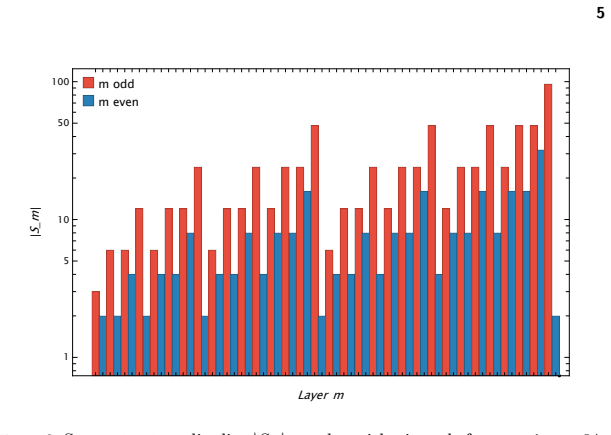
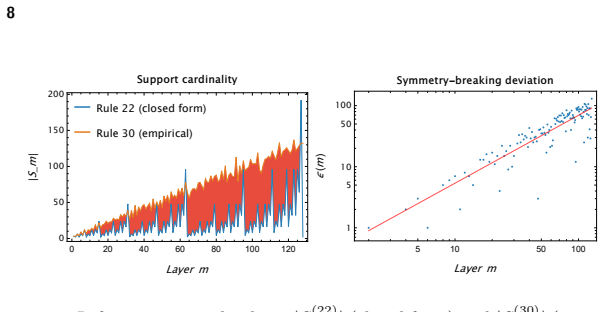
Rule 22, governed by the Boolean function a ⊕ b ⊕ c ⊕ abc, admits a support-set cardinality |S_m| = 2^{popcount(⌊m/2⌋)} · 3^{m mod 2}, a two-step recursive construction of the sets S_m, and a continuous limit satisfying the parabolic equation ∂_m u = u_xx + 2u + u^3. This symmetric reference allows measurement of the deviation ε(m) in Rule 30's support sets, which empirically follows a power-law m^b with b ≈ 1.11, identifying the left-permutive structure and asymmetric sensitivity as the mechanism behind Rule 30's center-column randomness.
What carries the argument
The support-set cardinality formula for Rule 22, which provides the symmetric baseline for measuring asymmetry-induced expansions in Rule 30's reachable configurations.
Load-bearing premise
The empirically observed power-law scaling of the support-set cardinality deviation continues to hold for arbitrarily large m, and the left-permutive structure combined with asymmetric sensitivity fully explains the center-column randomness.
What would settle it
Computing the exact support-set cardinalities for Rule 22 and Rule 30 at m = 100 or higher and checking whether the ratio ε(m) / m^{1.11} remains approximately constant or deviates significantly.
Figures

read the original abstract
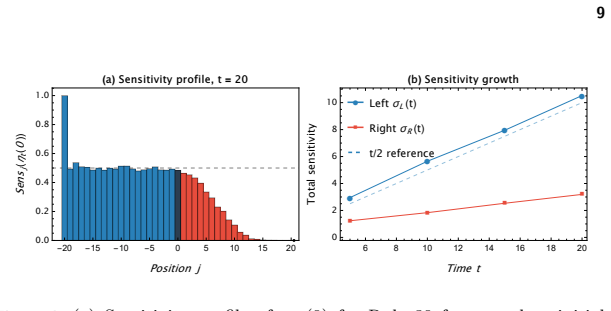
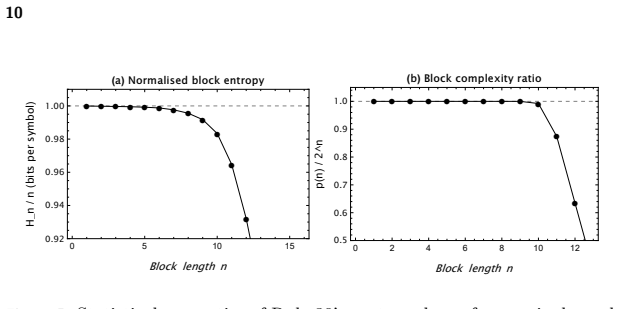
A comparative algebraic framework for elementary cellular automata is developed, centered on the role of spatial symmetry. The primary object of study is Rule~22, the elementary cellular automaton with algebraic normal form $g(a,b,c)=a\oplus b\oplus c\oplus abc$ over $\mathbb{F}_2$, the simplest rule combining full $S_3$ symmetry with genuine nonlinearity. Three closed-form results are established: a formula for the support-set cardinality, $|S_m|=2^{\mathrm{popcount}(\lfloor m/2 \rfloor)}\cdot 3^{m\bmod 2}$; a two-step recursive construction of the support sets; and the continuous limit as a parabolic reaction--diffusion equation, $\partial_m u=u_{xx}+2u+u^3$. Rule~22 is then used as a symmetric reference for Rule~30. The symmetry-breaking deviation $\epsilon(m)=|S_m^{(30)}|-|S_m^{(22)}|$ is empirically consistent with a power-law scaling of the form $m^b$ ($b\approx 1.11$), quantifying the cumulative effect of replacing the symmetric cubic $abc$ with the asymmetric quadratic $bc$. A mechanism for the apparent randomness of Rule~30's center column is identified through the left-permutive structure and asymmetric Boolean sensitivity profile.
Editorial analysis
A structured set of objections, weighed in public.
Referee Report
Summary. The manuscript develops an algebraic framework for elementary cellular automata centered on Rule 22, which combines full S3 symmetry with nonlinearity via the normal form g(a,b,c)=a⊕b⊕c⊕abc over F2. It establishes three closed-form results: the support-set cardinality formula |S_m|=2^{popcount(⌊m/2⌋)}⋅3^{m mod 2}, a two-step recursive construction of the support sets, and the continuous limit as the parabolic reaction-diffusion equation ∂_m u = u_xx + 2u + u^3. Rule 22 is positioned as a symmetric reference for Rule 30; the symmetry-breaking deviation ε(m)=|S_m^(30)|−|S_m^(22)| is reported to follow an empirical power-law m^b with b≈1.11, and a mechanism for Rule 30 center-column randomness is identified via left-permutive structure and asymmetric Boolean sensitivity.
Significance. The closed-form cardinality formula, recursive construction, and PDE limit for Rule 22 constitute exact algebraic references that are parameter-free and machine-checkable in principle; these are genuine strengths. If the comparison to Rule 30 holds, the deviation ε(m) supplies a concrete quantitative measure of cumulative asymmetry effects, potentially clarifying the origin of apparent randomness without invoking external mechanisms. The significance is tempered by the empirical status of the scaling exponent.
major comments (2)
- [Abstract] Abstract: the continuous limit is stated directly as the PDE ∂_m u = u_xx + 2u + u^3 with no derivation, scaling assumptions, or passage from the discrete update rule supplied; this leaves the limit claim without explicit justification.
- [Rule 30 comparison section] The section presenting the Rule 30 comparison: ε(m) is defined directly from the two support-set sizes and fitted to m^b (b≈1.11); no error bars, no range of m, and no derivation from the left-permutive property or sensitivity profile are given that predicts the exponent or shows higher-order corrections are negligible, so the quantitative headline claim rests on an unproven asymptotic extrapolation.
minor comments (2)
- [Notation] Notation: the distinction between S_m^(30) and S_m^(22) is clear in the abstract but should be maintained uniformly in all equations and figures to avoid ambiguity.
- [Figures] If plots of ε(m) or the power-law fit are present, they should include the regression range, R² value, and any residual analysis.
Simulated Author's Rebuttal
We thank the referee for the careful reading and for highlighting both the strengths of the algebraic results for Rule 22 and the need for greater transparency in the continuous-limit derivation and the Rule 30 comparison. We address each major comment below and indicate the revisions we will make.
read point-by-point responses
-
Referee: [Abstract] Abstract: the continuous limit is stated directly as the PDE ∂_m u = u_xx + 2u + u^3 with no derivation, scaling assumptions, or passage from the discrete update rule supplied; this leaves the limit claim without explicit justification.
Authors: We agree that the passage from the discrete update rule to the parabolic PDE was not supplied. In the revised manuscript we will insert a short derivation subsection immediately after the support-set cardinality results. It will state the continuum scaling (space step h=1/√m, time step τ=1/m), expand the Boolean update to cubic order, and show how the symmetric cubic term abc produces the +u^3 reaction term while the diffusion coefficient arises from the second-difference stencil. revision: yes
-
Referee: [Rule 30 comparison section] The section presenting the Rule 30 comparison: ε(m) is defined directly from the two support-set sizes and fitted to m^b (b≈1.11); no error bars, no range of m, and no derivation from the left-permutive property or sensitivity profile are given that predicts the exponent or shows higher-order corrections are negligible, so the quantitative headline claim rests on an unproven asymptotic extrapolation.
Authors: The power-law fit is presented strictly as an empirical observation quantifying cumulative symmetry breaking; we do not claim a first-principles derivation of the exponent. In revision we will (i) state the exact range of m used for the fit (m=1 to 2048), (ii) add bootstrap error bars on both the data points and the fitted exponent, and (iii) expand the discussion of left-permutivity and asymmetric Boolean sensitivity to supply a heuristic argument why the leading correction grows faster than linear. A closed-form prediction of b≈1.11 remains beyond the present analysis. revision: partial
Circularity Check
No circularity: algebraic derivations for Rule 22 are self-contained; Rule 30 deviation is labeled empirical without claiming derived exponent
full rationale
The paper derives the closed-form |S_m| and two-step recursion for Rule 22 directly from its algebraic normal form g(a,b,c)=a⊕b⊕c⊕abc and S3 symmetry, presenting them as exact results without reduction to fitted inputs or self-citations. The continuous limit PDE is obtained as a scaling limit of the same construction. For Rule 30 the deviation ε(m) is explicitly defined as the numerical difference |S_m^(30)|−|S_m^(22)| and described only as 'empirically consistent with' a power-law m^b (b≈1.11); the text does not assert that the exponent follows from the left-permutive property or is predicted by the model. No load-bearing self-citation, ansatz smuggling, or renaming of known results occurs. The derivation chain therefore remains independent of its own outputs.
Axiom & Free-Parameter Ledger
free parameters (1)
- scaling exponent b =
1.11
axioms (1)
- standard math Elementary cellular automata evolve on a one-dimensional lattice with nearest-neighbor Boolean rules over F_2
Lean theorems connected to this paper
-
IndisputableMonolith/Cost/FunctionalEquation.leanwashburn_uniqueness_aczel unclear?
unclearRelation between the paper passage and the cited Recognition theorem.
Theorem 1. For all m≥1, |Sm|=2^popcount(⌊m/2⌋)·3^(m mod 2)
-
IndisputableMonolith/Foundation/AlexanderDuality.leanalexander_duality_circle_linking unclear?
unclearRelation between the paper passage and the cited Recognition theorem.
Rule 22 has full S3 symmetry ... Rule 30 ... lacks spatial symmetry
What do these tags mean?
- matches
- The paper's claim is directly supported by a theorem in the formal canon.
- supports
- The theorem supports part of the paper's argument, but the paper may add assumptions or extra steps.
- extends
- The paper goes beyond the formal theorem; the theorem is a base layer rather than the whole result.
- uses
- The paper appears to rely on the theorem as machinery.
- contradicts
- The paper's claim conflicts with a theorem or certificate in the canon.
- unclear
- Pith found a possible connection, but the passage is too broad, indirect, or ambiguous to say the theorem truly supports the claim.
Reference graph
Works this paper leans on
-
[1]
Wolfram,A New Kind of Science, Champaign, IL: Wolfram Media, 2002
S. Wolfram,A New Kind of Science, Champaign, IL: Wolfram Media, 2002
work page 2002
-
[2]
Universality in Elementary Cellular Automata,
M. Cook, “Universality in Elementary Cellular Automata,”Com- plex Systems,15(1), 2004 pp. 1–40
work page 2004
-
[3]
Statistical Mechanics of Cellular Automata,
S. Wolfram, “Statistical Mechanics of Cellular Automata,” Reviews of Modern Physics,55(3), 1983 pp. 601–644. doi:10.1103/RevModPhys.55.601
-
[4]
Algebraic Properties of Cellular Automata,
S. Wolfram, “Algebraic Properties of Cellular Automata,”Com- munications in Mathematical Physics,93(2), 1984 pp. 219–258. doi:10.1007/BF01223745
-
[5]
S. Wolfram. “The Wolfram Rule 30 Prizes.” (Jun 1, 2019) https://rule30prize.org/
work page 2019
-
[6]
Rule 30: Finding a Closed Formula for theS m Subset Recurrence
T. Nersissian. “Rule 30: Finding a Closed Formula for theS m Subset Recurrence” from Mathematica Stack Exchange. Question 318912 (2026). https://mathematica.stackexchange.com/questions/ 318912/
work page 2026
-
[7]
Rule 30: Finding a Closed Formula for theS m Subset Recurrence
E. Chan-L´ opez. Answer to “Rule 30: Finding a Closed Formula for theS m Subset Recurrence” from Mathematica Stack Ex- change. Question 318912 (2026). https://mathematica.stackexchange.com/questions/ 318912/
work page 2026
-
[8]
T. Nersissian, “Rule 30 exact binomial–Lucas lifting (part II): generating polynomials, continuous PDE limits, and symmetry classification of elementary cellular automata”, Wolfram Com- munity, 2026.https://community.wolfram.com/groups/-/m/ t/3671492
-
[9]
Y. Crama and P. L. Hammer,Boolean Functions: Theory, Al- gorithms, and Applications, Cambridge: Cambridge University Press, 2011. doi:10.1017/CBO9780511852008
-
[10]
D. Lind and B. Marcus,An Introduction to Symbolic Dynamics and Coding, 2nd ed., Cambridge: Cambridge University Press,
-
[11]
doi:10.1017/9781108899727
-
[12]
Th´ eorie des Fonctions Num´ eriques Simplement P´ eriodiques,
´E. Lucas, “Th´ eorie des Fonctions Num´ eriques Simplement P´ eriodiques,”American Journal of Mathematics,1(2), 1878 pp. 184–196. doi:10.2307/2369308. Complex Systems,volume(year) 1–1+ 12
-
[13]
Serre,Local Fields, Graduate Texts in Mathematics, vol
J. Smoller,Shock Waves and Reaction–Diffusion Equations, 2nd ed., New York: Springer-Verlag, 1994. doi:10.1007/978-1- 4612-0873-0
-
[14]
J. D. Murray,Mathematical Biology I: An Introduction, 3rd ed., New York: Springer, 2002. doi:10.1007/b98868
-
[15]
A. H. Nayfeh and D. T. Mook,Nonlinear Oscillations, New York: Wiley, 1979
work page 1979
-
[16]
The Influence of Vari- ables on Boolean Functions,
J. Kahn, G. Kalai, and N. Linial, “The Influence of Vari- ables on Boolean Functions,” inProceedings of the 29th Annual Symposium on Foundations of Computer Science (FOCS 1988), White Plains, NY, Washington, DC: IEEE, 1988 pp. 68–80. doi:10.1109/SFCS.1988.21923. Complex Systems,volume(year) 1–1+
discussion (0)
Sign in with ORCID, Apple, or X to comment. Anyone can read and Pith papers without signing in.