Recognition: 2 theorem links
· Lean TheoremValuation of variable annuities under the Volterra mortality and rough Heston models
Pith reviewed 2026-05-13 22:23 UTC · model grok-4.3
The pith
A deep signature Monte Carlo method prices variable annuities with surrender options under rough Heston equity and Volterra mortality dynamics.
A machine-rendered reading of the paper's core claim, the machinery that carries it, and where it could break.
Core claim
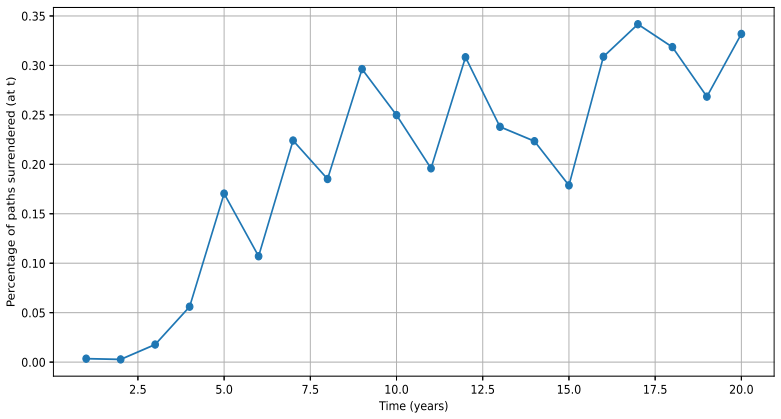
We develop a deep signature Least Squares Monte Carlo approach to learn optimal surrender strategies on a discretized time grid for variable annuities under the rough Heston equity model and Volterra mortality model. The fair fee increases with the Hurst parameters of both the stock volatility and the force of mortality. A convergence proof supports the stability of the method.
What carries the argument
Deep signature Least Squares Monte Carlo using truncated rough-path signatures to encode historical paths and a neural network to approximate continuation values in the optimal stopping problem.
If this is right
- The method enables pricing of path-dependent insurance products under non-Markovian dynamics where traditional dynamic programming fails.
- Fair fees for variable annuities with minimum guarantees rise with higher Hurst parameters in both volatility and mortality.
- The approach extends in principle to other contracts that combine investment guarantees with surrender or withdrawal features.
- Convergence guarantees ensure the computed values become reliable as the discretization is refined.
Where Pith is reading between the lines
- The signature encoding could be tested on other rough-volatility insurance products such as equity-linked life insurance with path-dependent benefits.
- Sensitivity of fees to Hurst parameters suggests that memory effects in mortality data may materially affect contract design.
- The framework might be combined with real-world calibration of rough paths to assess model risk in annuity portfolios.
Load-bearing premise
Truncated rough-path signatures combined with a neural network can accurately approximate the continuation values needed for optimal surrender decisions under the non-Markovian dynamics.
What would settle it
Numerical experiments in which the approximated fair fees fail to stabilize or converge as the signature truncation level rises or the time grid is refined would undermine the method.
Figures


read the original abstract
This paper investigates the valuation of variable annuity contracts with an early surrender option under non-Markovian models. Moreover, policyholders are provided with guaranteed minimum maturity and death benefits to protect against the downside risk. Unlike the existing literature, our variable annuity account value is linked to two non-Markovian processes: an equity index modeled by a rough Heston model and a force of mortality following a Volterra-type stochastic model. In this case, the early surrender feature introduces an optimal stopping problem where continuation values depend on the entire path history, rendering traditional numerical methods infeasible. We develop a deep signature Least Squares Monte Carlo approach to learn optimal surrender strategies on a discretized time grid. To mitigate the curse of dimensionality arising from the path-dependent model, we use truncated rough-path signatures to encode the historical paths and approximate the continuation values using a neural network. Numerically, we find that the fair fee increases with the Hurst parameters of both the stock volatility and the force of mortality. Finally, a convergence proof is provided to further support the stability of our method.
Editorial analysis
A structured set of objections, weighed in public.
Referee Report
Summary. This paper develops a deep signature Least Squares Monte Carlo method to value variable annuities with early surrender options under a rough Heston model for the equity index and a Volterra stochastic process for the force of mortality. Truncated rough-path signatures encode path history to approximate continuation values via neural networks on a discrete time grid. Numerical experiments report that the fair fee increases with the Hurst parameters of both processes, and a convergence proof is provided to support the method's stability.
Significance. If the numerical trends and approximation quality hold, the work provides a scalable approach for optimal stopping problems in non-Markovian insurance models by combining rough path signatures with neural regression. The reported dependence of fair fees on Hurst parameters offers insight into model risk for path-dependent guarantees, and the inclusion of a convergence proof strengthens the methodological contribution over purely empirical studies.
major comments (2)
- [Convergence proof] Convergence proof: although the abstract states that a convergence proof is provided, the hypotheses on signature truncation order and Volterra kernel regularity are not shown to hold uniformly across the Hurst values explored numerically (particularly low H < 0.5); this is load-bearing for the claim that the observed fair-fee increase reflects genuine model dynamics rather than truncation bias.
- [Numerical experiments] Numerical results section: the reported increase in fair fee with Hurst parameters rests on forward simulation without accompanying error bounds or sensitivity analysis on the neural network approximation of continuation values; if the truncated signatures discard relevant long-memory increments, the trend could be an artifact of the specific truncation level chosen.
minor comments (1)
- [Abstract] The abstract and introduction could more explicitly reference the theorem number and key assumptions of the convergence result rather than stating only that 'a convergence proof is provided'.
Simulated Author's Rebuttal
We thank the referee for the thorough review and constructive suggestions. Below we address each major comment in turn, outlining how we will revise the manuscript to resolve the identified issues.
read point-by-point responses
-
Referee: Convergence proof: although the abstract states that a convergence proof is provided, the hypotheses on signature truncation order and Volterra kernel regularity are not shown to hold uniformly across the Hurst values explored numerically (particularly low H < 0.5); this is load-bearing for the claim that the observed fair-fee increase reflects genuine model dynamics rather than truncation bias.
Authors: We acknowledge that while the convergence proof is provided in the appendix, the verification of its hypotheses for the specific range of Hurst parameters used in the numerics (including values below 0.5) was not explicitly demonstrated. The proof relies on the truncation order being sufficiently large relative to the path regularity, which decreases with lower H. In the revised manuscript, we will include an additional analysis or remark confirming that the truncation levels employed satisfy the necessary conditions uniformly across the tested Hurst values, thereby supporting that the fair fee trend is not an artifact of truncation bias. revision: yes
-
Referee: Numerical results section: the reported increase in fair fee with Hurst parameters rests on forward simulation without accompanying error bounds or sensitivity analysis on the neural network approximation of continuation values; if the truncated signatures discard relevant long-memory increments, the trend could be an artifact of the specific truncation level chosen.
Authors: We agree with the referee that the numerical evidence would be more convincing with error bounds and sensitivity checks. The current experiments use a specific truncation level and neural network setup without reporting approximation errors or varying these parameters. We will revise the numerical experiments section to include a sensitivity analysis with respect to the signature truncation order and provide Monte Carlo error estimates for the computed fair fees. This will help confirm the robustness of the observed increase in fair fees as the Hurst parameters vary. revision: yes
Circularity Check
Derivation is self-contained with no circular reductions
full rationale
The paper develops a deep signature Least Squares Monte Carlo approach to solve the optimal stopping problem for variable annuities under rough Heston and Volterra mortality models. The reported increase in fair fee with Hurst parameters is obtained via numerical simulation rather than being tautological with any model input or fitted parameter. The convergence proof is provided to support the method without evidence of reducing to self-definition or self-citation chains. The approach uses truncated signatures to encode paths and neural networks for approximation, which is an algorithmic construction independent of the target results.
Axiom & Free-Parameter Ledger
free parameters (1)
- neural network architecture and training hyperparameters
axioms (1)
- domain assumption Truncated signatures plus feed-forward networks can approximate the continuation value function to arbitrary accuracy for the given path-dependent optimal stopping problem
Reference graph
Works this paper leans on
-
[1]
Aase, K. K. and Persson, S.-A. (1994). Pricing of unit-linked life insu rance policies. Scandi- navian Actuarial Journal , 1994(1):26–52. Ai, M., Wang, Y., Zhang, Z., and Zhu, D. (2024). Valuation of variable a nnuities with guaranteed minimum maturity benefits and periodic fees. Scandinavian Actuarial Journal, 2024(3):252–278. Bacinello, A. R., Biffis, E., ...
work page 1994
-
[2]
Bayer, C., Pelizzari, L., and Schoenmakers, J
ASTIN Bulletin: The Journal of the IAA , 38(2):621–651. Bayer, C., Pelizzari, L., and Schoenmakers, J. (2025a). Primal and dual optimal stopping with signatures. Finance and Stochastics , 29(4):981–1014. Bayer, C., Pelizzari, L., and Zhu, J.-J. (2025b). Pricing American opt ions under rough volatility using deep-signatures and signature-kernels. arXiv pre...
-
[3]
Gatheral, J., Jaisson, T., and Rosenbaum, M
Cambridge University Press. Gatheral, J., Jaisson, T., and Rosenbaum, M. (2018). Volatility is rou gh. Quantitative Finance, 18(6):933–949. Han, B. and Wong, H. Y. (2021). Time-inconsistency with rough vola tility. SIAM Journal on Financial Mathematics , 12(4):1553–1595. Jaber, E. A., Hainaut, D., and Motte, E. (2025). Signature approa ch for pricing and ...
discussion (0)
Sign in with ORCID, Apple, or X to comment. Anyone can read and Pith papers without signing in.