Recognition: 1 theorem link
· Lean TheoremStrong coupling constant from the 1-loop improved static energy
Pith reviewed 2026-05-13 21:08 UTC · model grok-4.3
The pith
1-loop lattice perturbation theory improvement of the Wilson loop sharpens the extraction of the strong coupling constant α_s from the static energy.
A machine-rendered reading of the paper's core claim, the machinery that carries it, and where it could break.
Core claim
The static energy extracted from Wilson line correlators on the lattice can be improved at short distances by incorporating one-loop lattice perturbation theory corrections to the Wilson loop; this reduces discretization artifacts and yields a more accurate matching to the three-loop perturbative expression, thereby improving the determination of α_s when applied to (2+1)-flavor lattice data.
What carries the argument
The 1-loop lattice perturbation theory improved Wilson loop, which supplies additive corrections that suppress leading lattice artifacts in the static energy at short distances.
If this is right
- The improved static energy allows reliable use of shorter lattice distances in the α_s fit, increasing the lever arm against perturbative uncertainties.
- Systematic errors from lattice artifacts are reduced, leading to smaller total uncertainty in the extracted α_s.
- The method can be directly applied to future higher-statistics (2+1+1)-flavor ensembles without changing the continuum matching procedure.
- Consistency between lattice and perturbative static energy improves at the distances used for the fit.
Where Pith is reading between the lines
- Extending the improvement to two-loop order could further suppress residual cutoff effects and tighten the α_s error budget.
- The same correction technique may be portable to other short-distance observables involving Wilson lines, such as heavy-quark potentials or quarkonia correlators.
- If the improvement proves robust, it could become a standard preprocessing step for any lattice determination of α_s that relies on static-energy matching.
Load-bearing premise
The one-loop lattice perturbation theory correction is assumed to capture and remove the dominant discretization artifacts in the Wilson loop without introducing new biases that would distort the short-distance matching to continuum perturbation theory.
What would settle it
If the α_s value extracted after applying the one-loop improvement deviates by more than the quoted uncertainty from independent determinations such as those from the static potential at larger distances or from τ-decay data, the improvement claim would be falsified.
Figures
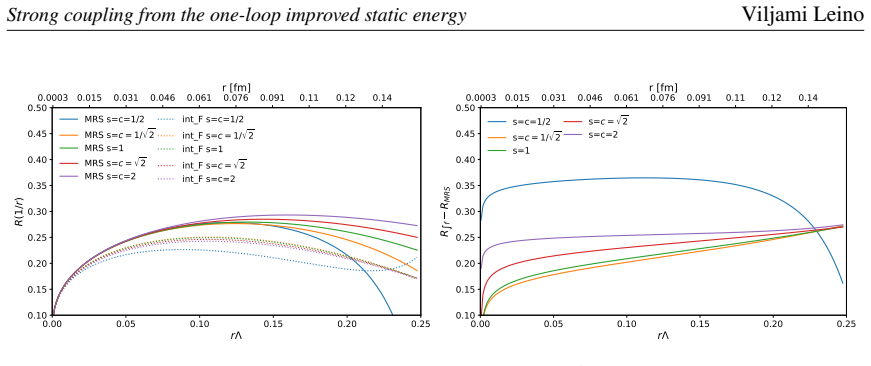


read the original abstract
The static energy is an excellent observable for extracting the strong coupling $\alpha_s$ on the lattice. For short distances, the static energy can be calculated both on the lattice using Wilson line correlators, and with perturbation theory up to three loop accuracy with leading ultrasoft log resummation. Comparing the perturbative expression and lattice data allows for precise determination of $\alpha_s$. We present early results for 1-loop lattice perturbation theory improvement of the Wilson loop and show how it improves the $\alpha_s$ extraction. We present a preliminary reanalysis of the TUMQCD (2+1)-flavor QCD data.
Editorial analysis
A structured set of objections, weighed in public.
Referee Report
Summary. The paper presents early results for applying 1-loop lattice perturbation theory to improve the Wilson loop observable used in the static energy, and demonstrates via a preliminary reanalysis of TUMQCD (2+1)-flavor ensembles how this correction enhances the extraction of the strong coupling α_s by matching short-distance lattice data to three-loop continuum perturbation theory with ultrasoft log resummation.
Significance. If the 1-loop improvement demonstrably reduces discretization errors without introducing new biases, the work would strengthen lattice determinations of α_s at short distances by providing a more controlled matching to high-order perturbative expressions, potentially reducing systematic uncertainties in a key input for precision QCD phenomenology.
major comments (2)
- [Abstract and Results] Abstract and Results section: The central claim that the 1-loop lattice PT improvement 'improves the α_s extraction' is asserted without any quantitative results, such as the numerical shift in the fitted α_s value, changes in fit quality (e.g., χ²/dof), or explicit error budgets before versus after the correction. This leaves the magnitude of the improvement unassessed.
- [Results] Results section: The preliminary reanalysis does not quantify residual O(a²) lattice artifacts after the 1-loop correction (e.g., via direct comparison to 2-loop lattice PT coefficients or to finer lattice spacings), nor propagate them into the final uncertainty on α_s. If these residuals are comparable to the ultrasoft resummation or 3-loop terms, they could shift the extracted α_s by an amount comparable to the target precision.
minor comments (2)
- [Methods] The notation for the improved Wilson loop (e.g., distinction between bare and tadpole-improved versions) should be defined explicitly in the Methods section to avoid ambiguity when comparing to continuum PT.
- [Figures] Figure captions for the static energy plots should include the specific r/a ranges used in the α_s fit and the corresponding perturbative orders shown.
Simulated Author's Rebuttal
We thank the referee for the constructive feedback on our manuscript. We address the major comments point by point below, noting that this work presents early and preliminary results. We will revise the manuscript to strengthen the quantitative presentation where feasible.
read point-by-point responses
-
Referee: [Abstract and Results] Abstract and Results section: The central claim that the 1-loop lattice PT improvement 'improves the α_s extraction' is asserted without any quantitative results, such as the numerical shift in the fitted α_s value, changes in fit quality (e.g., χ²/dof), or explicit error budgets before versus after the correction. This leaves the magnitude of the improvement unassessed.
Authors: We agree that the preliminary nature of the reanalysis means the current draft lacks explicit numerical comparisons. In the revised version we will add direct before/after values for the fitted α_s, the change in χ²/dof, and a concise error-budget table that isolates the effect of the 1-loop Wilson-loop improvement. revision: yes
-
Referee: [Results] Results section: The preliminary reanalysis does not quantify residual O(a²) lattice artifacts after the 1-loop correction (e.g., via direct comparison to 2-loop lattice PT coefficients or to finer lattice spacings), nor propagate them into the final uncertainty on α_s. If these residuals are comparable to the ultrasoft resummation or 3-loop terms, they could shift the extracted α_s by an amount comparable to the target precision.
Authors: The present results are preliminary and we do not yet have a complete estimate of the remaining O(a²) artifacts. We will add a comparison of the 1-loop improved data against the two available finer TUMQCD spacings and will include a conservative estimate of the residual discretization uncertainty in the final error budget on α_s. revision: partial
Circularity Check
Minor self-citation of prior ensembles; central α_s fit remains independent of inputs
full rationale
The paper computes the 1-loop lattice PT improvement of the Wilson loop as a separate perturbative calculation and then matches the corrected lattice static energy to an independent three-loop continuum PT expression (with ultrasoft log resummation) to extract α_s. The reanalysis uses existing TUMQCD ensembles as input data rather than deriving the coupling or the improvement factor from the same fitted quantities by construction. No load-bearing step reduces to a self-citation chain or to a fitted parameter renamed as a prediction.
Axiom & Free-Parameter Ledger
free parameters (1)
- α_s
axioms (1)
- domain assumption Perturbative expansion of the static energy up to three loops plus leading ultrasoft log resummation is reliable at the short distances considered.
Lean theorems connected to this paper
-
IndisputableMonolith/Foundation/AlphaDerivationExplicit.leanalphaProvenanceCert unclear?
unclearRelation between the paper passage and the cited Recognition theorem.
We present early results for 1-loop lattice perturbation theory improvement of the Wilson loop and show how it improves the α_s extraction. We present a preliminary reanalysis of the TUMQCD (2+1)-flavor QCD data.
What do these tags mean?
- matches
- The paper's claim is directly supported by a theorem in the formal canon.
- supports
- The theorem supports part of the paper's argument, but the paper may add assumptions or extra steps.
- extends
- The paper goes beyond the formal theorem; the theorem is a base layer rather than the whole result.
- uses
- The paper appears to rely on the theorem as machinery.
- contradicts
- The paper's claim conflicts with a theorem or certificate in the canon.
- unclear
- Pith found a possible connection, but the passage is too broad, indirect, or ambiguous to say the theorem truly supports the claim.
Reference graph
Works this paper leans on
-
[1]
G. S. Bali,QCD forces and heavy quark bound states,Phys. Rept.343(2001) 1 [hep-ph/0001312]
work page Pith review arXiv 2001
-
[2]
N. Brambilla, A. Pineda, J. Soto and A. Vairo,The infrared behavior of the static potential in perturbative QCD,Phys. Rev. D60(1999) 091502 [hep-ph/9903355]
-
[3]
The Renormalization Group Improvement of the QCD Static Potentials
A. Pineda and J. Soto,The renormalization group improvement of the QCD static potentials, Phys. Lett. B495(2000) 323 [hep-ph/0007197]
work page internal anchor Pith review Pith/arXiv arXiv 2000
-
[4]
N. Brambilla, X. Garcia i Tormo, J. Soto and A. Vairo,The logarithmic contribution to the QCD static energy at N4LO,Phys. Lett. B647(2007) 185 [hep-ph/0610143]
-
[5]
The QCD static energy at NNNLL
N. Brambilla, A. Vairo, X. Garcia i Tormo and J. Soto,The QCD static energy at N3LL, Phys. Rev. D80(2009) 034016 [0906.1390]
work page internal anchor Pith review Pith/arXiv arXiv 2009
- [6]
- [7]
-
[8]
d’Enterria et al.,The strong coupling constant: State of the art and the decade ahead,J
D. d’Enterria et al.,The strong coupling constant: State of the art and the decade ahead,J. Phys. G51(2024) 090501 [2203.08271]
-
[9]
N. Brambilla, X. Garcia i Tormo, J. Soto and A. Vairo,Precision determination of𝑟0ΛMS from the QCD static energy,Phys. Rev. Lett.105(2010) 212001 [1006.2066]. 8 Strong coupling from the one-loop improved static energyViljami Leino
- [10]
-
[11]
N. Brambilla, V. Leino, J. Mayer-Steudte and A. Vairo,Static force from generalized Wilson loops on the lattice using the gradient flow,Phys. Rev. D109(2024) 114517 [2312.17231]. [13]ETMcollaboration, K. Jansen, F. Karbstein, A. Nagy and M. Wagner,ΛMS from the static potential for QCD with𝑛𝑓 =2dynamical quark flavors,JHEP01(2012) 025 [1110.6859]
-
[12]
F. Karbstein, A. Peters and M. Wagner,Λ (𝑛 𝑓 =2) MS from a momentum space analysis of the quark-antiquark static potential,JHEP09(2014) 114 [1407.7503]
-
[13]
F. Karbstein, M. Wagner and M. Weber,Determination ofΛ (𝑛 𝑓 =2) MS and analytic parametrization of the static quark-antiquark potential,Phys. Rev. D98(2018) 114506 [1804.10909]
-
[14]
A. Bazavov, N. Brambilla, X. Garcia i Tormo, P. Petreczky, J. Soto and A. Vairo, Determination of𝛼𝑠 from the QCD static energy,Phys. Rev. D86(2012) 114031 [1205.6155]
-
[15]
A. Bazavov, N. Brambilla, X. Garcia i Tormo, P. Petreczky, J. Soto and A. Vairo, Determination of𝛼s from the QCD static energy: An update,Phys. Rev. D90(2014) 074038 [1407.8437]
-
[16]
H. Takaura, T. Kaneko, Y. Kiyo and Y. Sumino,Determination of𝛼s from static QCD potential: OPE with renormalon subtraction and lattice QCD,JHEP04(2019) 155 [1808.01643]. [19]TUMQCDcollaboration, A. Bazavov, N. Brambilla, X. Garcia i Tormo, P. Petreczky, J. Soto, A. Vairo et al.,Determination of the QCD coupling from the static energy and the free energy,P...
- [17]
-
[18]
J. M. Mena-Valle, V. Mateu and P. G. Ortega,A Precise𝛼𝑠 Determination from the R-improved QCD Static Energy,2510.24846. [22]TUMQCDcollaboration, V. Leino, A. Bazavov, N. Brambilla, A. S. Kronfeld, J. Mayer-Steudte, P. Petreczky et al.,Strong coupling in (2+1+1)-flavor QCD,PoS LATTICE2024(2025) 298 [2502.01453]
-
[19]
N. Brambilla, V. Leino, O. Philipsen, C. Reisinger, A. Vairo and M. Wagner,Lattice gauge theory computation of the static force,Phys. Rev. D105(2022) 054514 [2106.01794]. [24]TUMQCDcollaboration, N. Brambilla, J. Komijani, A. S. Kronfeld and A. Vairo,Relations between heavy-light meson and quark masses,Phys. Rev. D97(2018) 034503 [1712.04983]. 9 Strong co...
-
[20]
Komijani,A discussion on leading renormalon in the pole mass,JHEP08(2017) 062 [1701.00347]
J. Komijani,A discussion on leading renormalon in the pole mass,JHEP08(2017) 062 [1701.00347]
- [21]
- [22]
-
[23]
U. M. Heller and F. Karsch,One Loop Perturbative Calculation of Wilson Loops on Finite Lattices,Nucl. Phys. B251(1985) 254
work page 1985
-
[24]
P. Weisz and R. Wohlert,Continuum Limit Improved Lattice Action for Pure Yang-Mills Theory. 2.,Nucl. Phys. B236(1984) 397
work page 1984
-
[25]
J. R. Snippe,Computation of the one loop Symanzik coefficients for the square action,Nucl. Phys. B498(1997) 347 [hep-lat/9701002]
work page internal anchor Pith review Pith/arXiv arXiv 1997
-
[26]
Computation of the b-quark Mass with Perturbative Matching at the Next-to-Next-to-Leading Order
G. Martinelli and C. T. Sachrajda,Computation of the b quark mass with perturbative matching at the next-to-next-to-leading order,Nucl. Phys. B559(1999) 429 [hep-lat/9812001]
work page internal anchor Pith review Pith/arXiv arXiv 1999
-
[27]
A. Athenodorou and H. Panagopoulos,Large Wilson loops with overlap and clover fermions: Two-loop evaluation of the b-quark mass shift and the quark-antiquark potential,Nucl. Phys. B799(2008) 1 [hep-lat/0509039]
-
[28]
G. S. Bali and P. Boyle,Perturbative Wilson loops with massive sea quarks on the lattice, hep-lat/0210033. [34]HPQCDcollaboration, E. Follana, Q. Mason, C. Davies, K. Hornbostel, G. P. Lepage, J. Shigemitsu et al.,Highly improved staggered quarks on the lattice, with applications to charm physics,Phys. Rev. D75(2007) 054502 [hep-lat/0610092]
work page internal anchor Pith review Pith/arXiv arXiv 2007
- [29]
-
[30]
Effective Field Theory Approach to Pionium
D. Eiras and J. Soto,Effective field theory approach to pionium,Phys. Rev. D61(2000) 114027 [hep-ph/9905543]
work page internal anchor Pith review Pith/arXiv arXiv 2000
-
[31]
G. M. von Hippel, V. Leino and S. Steinbeißer,One loop improvement of the static potential with HISQ quarks,In preparation: TUM-EFT 171/22(2026)
work page 2026
- [32]
- [33]
discussion (0)
Sign in with ORCID, Apple, or X to comment. Anyone can read and Pith papers without signing in.