Recognition: 2 theorem links
· Lean TheoremMessage passing and cyclicity transition
Pith reviewed 2026-05-13 21:31 UTC · model grok-4.3
The pith
Message passing solutions for percolation identify reachability from cycles rather than giant component membership.
A machine-rendered reading of the paper's core claim, the machinery that carries it, and where it could break.
Core claim
We show that the message passing solutions commonly associated with the probability of belonging to the giant component actually identify reachability from cycles. This interpretation generally applies to bond and site percolation on any directed or undirected networks. Our findings highlight the distinction between transition in cyclicity and the emergence of the giant component.
What carries the argument
The fixed-point solutions of the standard message-passing recursion for percolation, reinterpreted as the indicator of reachability from a cycle.
If this is right
- The cyclicity transition threshold is generally different from the percolation threshold that produces a giant component.
- Message passing supplies a direct computational route to the set of nodes from which cycles are reachable.
- The same equations apply without change to both directed and undirected graphs and to both bond and site percolation.
- Analyses that previously equated message-passing outputs with giant-component probabilities must be revised.
Where Pith is reading between the lines
- The reinterpretation suggests that message passing could be repurposed to locate feedback loops in dynamical systems on networks.
- In directed networks the distinction may separate the onset of recurrent behavior from the onset of long-range reachability.
- Numerical checks on real-world graphs could reveal how often the two transitions coincide or diverge in practice.
Load-bearing premise
The usual message-passing fixed-point equations remain well-defined and capture exactly the set of nodes reachable from cycles once the percolation process is run.
What would settle it
Compute the message-passing fixed point on a small directed cycle graph with an added dangling edge; the output should mark the cycle nodes as reachable but exclude the dangling node, while the giant-component probability would mark all nodes.
Figures
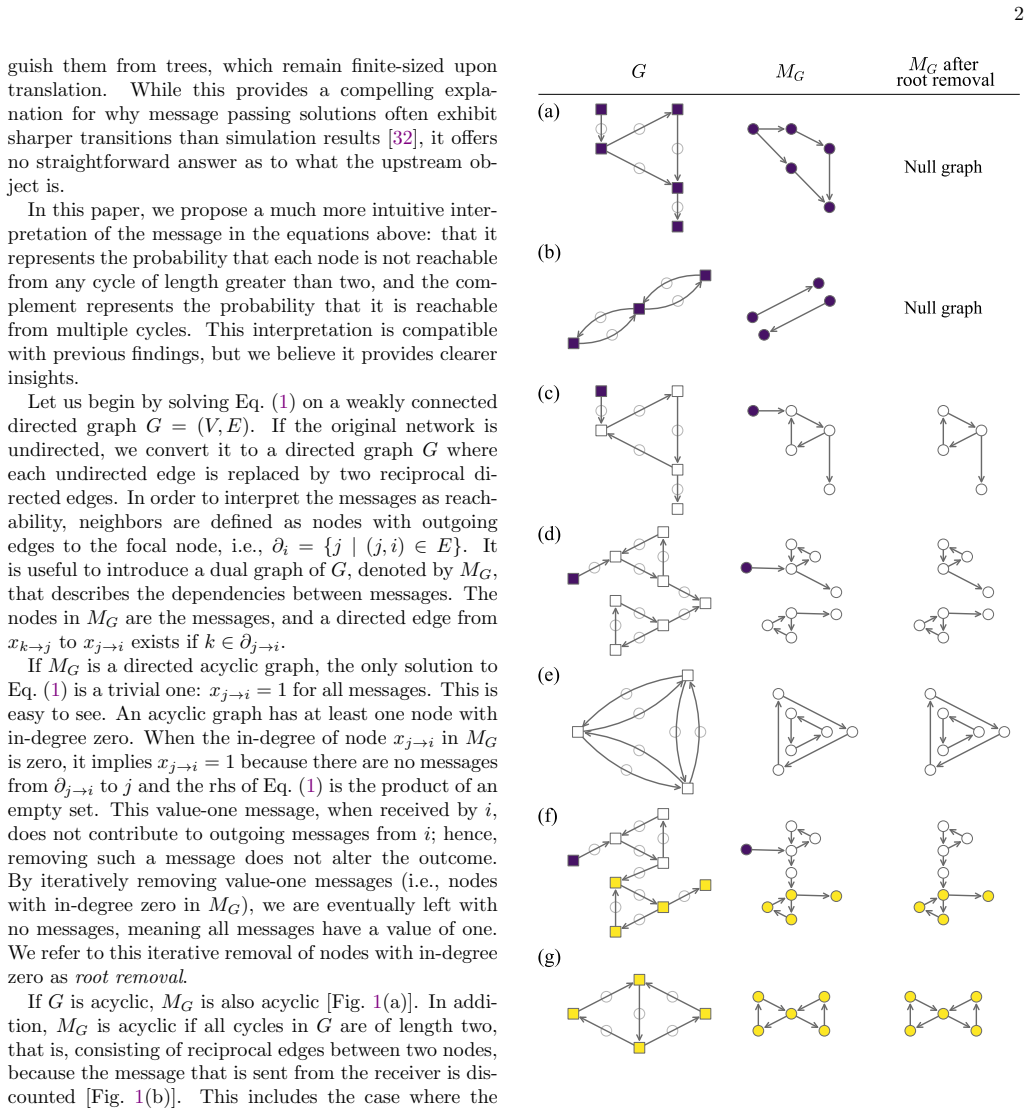


read the original abstract
Message passing, also known as belief propagation, is a versatile framework for analyzing models defined on graphs. Its most prototypical application is percolation; yet, the interpretation of the message passing formulation of percolation remains elusive. We show that the message passing solutions commonly associated with the probability of belonging to the giant component actually identify reachability from cycles. This interpretation generally applies to bond and site percolation on any directed or undirected networks. Our findings highlight the distinction between transition in cyclicity and the emergence of the giant component.
Editorial analysis
A structured set of objections, weighed in public.
Referee Report
Summary. The manuscript reinterprets the standard message-passing (belief propagation) fixed-point equations for percolation on networks. It claims that these solutions, conventionally taken to give the probability that a node belongs to the giant component, instead give the probability of reachability from cycles. The reinterpretation is asserted to hold without additional assumptions for both bond and site percolation on arbitrary directed or undirected graphs, thereby separating the cyclicity transition from giant-component emergence.
Significance. If the central claim is correct, the result would be significant for network science and statistical physics. It supplies a parameter-free reinterpretation of a foundational analytical tool used across percolation, epidemic spreading, and related models, and it applies uniformly to directed and undirected cases. This could resolve interpretive inconsistencies in existing literature and sharpen predictions involving cyclic structure.
minor comments (3)
- [Abstract] Abstract: the phrasing 'commonly associated with' could be replaced by a direct reference to the specific fixed-point equations being reinterpreted.
- [Section 2] Notation for directed networks (e.g., in the message-update rules) should be introduced with an explicit comparison to the undirected case to avoid ambiguity.
- [Figure 1] Figure captions should state the network ensemble and parameter values used for any numerical checks of the cycle-reachability interpretation.
Simulated Author's Rebuttal
We thank the referee for their positive summary of our work and the recommendation for minor revision. The central claim is that the fixed-point solutions of the standard message-passing equations for percolation identify the probability that a node is reachable from a cycle, rather than the probability that it belongs to the giant component. This reinterpretation requires no additional assumptions and applies uniformly to bond and site percolation on arbitrary directed or undirected networks, thereby separating the cyclicity transition from giant-component emergence.
Circularity Check
No significant circularity detected in derivation chain
full rationale
The paper reinterprets the fixed points of standard message-passing equations for bond and site percolation as computing reachability from cycles rather than giant-component membership probabilities. This holds for arbitrary directed or undirected networks and follows directly from the structure of the recursive equations without introducing fitted parameters, self-definitional reductions, or load-bearing self-citations whose validity depends on the present work. No step renames a known empirical pattern as a new result, smuggles an ansatz via prior citation, or imports a uniqueness theorem from overlapping authors; the central claim is a mathematical observation about existing equations and remains self-contained against external benchmarks.
Axiom & Free-Parameter Ledger
Lean theorems connected to this paper
-
IndisputableMonolith/Foundation/AlexanderDuality.leanalexander_duality_circle_linking unclear?
unclearRelation between the paper passage and the cited Recognition theorem.
We show that the message passing solutions commonly associated with the probability of belonging to the giant component actually identify reachability from cycles.
What do these tags mean?
- matches
- The paper's claim is directly supported by a theorem in the formal canon.
- supports
- The theorem supports part of the paper's argument, but the paper may add assumptions or extra steps.
- extends
- The paper goes beyond the formal theorem; the theorem is a base layer rather than the whole result.
- uses
- The paper appears to rely on the theorem as machinery.
- contradicts
- The paper's claim conflicts with a theorem or certificate in the canon.
- unclear
- Pith found a possible connection, but the passage is too broad, indirect, or ambiguous to say the theorem truly supports the claim.
Reference graph
Works this paper leans on
- [1]
-
[2]
M. E. J. Newman, X. Zhang, and R. R. Nadakuditi, Spec- tra of random networks with arbitrary degrees, Physical Review E99, 042309 (2019)
work page 2019
-
[3]
G. T. Cantwell, A. Kirkley, and F. Radicchi, Heteroge- neous message passing for heterogeneous networks, Phys- ical Review E108, 034310 (2023)
work page 2023
-
[4]
B. Karrer and M. E. J. Newman, Message passing ap- proach for general epidemic models, Physical Review E 82, 016101 (2010)
work page 2010
-
[5]
F. Altarelli, A. Braunstein, L. Dall’Asta, A. Lage- Castellanos, and R. Zecchina, Bayesian Inference of Epi- demics on Networks via Belief Propagation, Physical Re- view Letters112, 118701 (2014)
work page 2014
-
[6]
F. Altarelli, A. Braunstein, L. Dall’Asta, J. R. Wake- ling, and R. Zecchina, Containing Epidemic Outbreaks by Message-Passing Techniques, Physical Review X4, 021024 (2014)
work page 2014
-
[7]
A. Decelle, F. Krzakala, C. Moore, and L. Zdeborov´ a, In- ference and Phase Transitions in the Detection of Mod- ules in Sparse Networks, Physical Review Letters107, 065701 (2011)
work page 2011
-
[8]
F. Krzakala, C. Moore, E. Mossel, J. Neeman, A. Sly, L. Zdeborova, and P. Zhang, Spectral redemption in clustering sparse networks, Proceedings of the National Academy of Sciences110, 20935 (2013)
work page 2013
-
[9]
P. Zhang and C. Moore, Scalable detection of statisti- cally significant communities and hierarchies, using mes- sage passing for modularity, Proceedings of the National Academy of Sciences111, 18144 (2014)
work page 2014
-
[10]
M. M´ ezard and A. Montanari,Information, Physics, and Computation, 1st ed. (Oxford University Press, 2009)
work page 2009
-
[11]
S. Yoon, A. V. Goltsev, S. N. Dorogovtsev, and J. F. F. Mendes, Belief-propagation algorithm and the Ising model on networks with arbitrary distributions of mo- tifs, Physical Review E84, 041144 (2011)
work page 2011
-
[12]
M. M´ ezard, Mean-field message-passing equations in the Hopfield model and its generalizations, Physical Review E95, 022117 (2017)
work page 2017
-
[13]
A. Kirkley, G. T. Cantwell, and M. E. J. Newman, Belief propagation for networks with loops, Science Advances 7, eabf1211 (2021)
work page 2021
-
[14]
Y. Wang, Y. E. Zhang, F. Pan, and P. Zhang, Tensor Network Message Passing, Physical Review Letters132, 117401 (2024)
work page 2024
-
[15]
C. H. Yeung and D. Saad, Competition for Shortest Paths on Sparse Graphs, Physical Review Letters108, 208701 (2012)
work page 2012
-
[16]
C. H. Yeung, D. Saad, and K. Y. M. Wong, From the physics of interacting polymers to optimizing routes on the London Underground, Proceedings of the National Academy of Sciences110, 13717 (2013)
work page 2013
-
[17]
L. Zdeborov´ a and M. M´ ezard, The number of matchings in random graphs, Journal of Statistical Mechanics: The- ory and Experiment2006, P05003 (2006)
work page 2006
-
[18]
F. Altarelli, A. Braunstein, A. Ramezanpour, and R. Zecchina, Stochastic Matching Problem, Physical Re- view Letters106, 190601 (2011)
work page 2011
- [19]
-
[20]
G. T. Cantwell and C. Moore, Belief propagation for per- mutations, rankings, and partial orders, Physical Review E105, L052303 (2022)
work page 2022
-
[21]
Y. Shiraki and Y. Kabashima, Cavity analysis on the robustness of random networks against targeted attacks: Influences of degree-degree correlations, Physical Review E82, 036101 (2010). 6
work page 2010
-
[22]
M. E. J. Newman, Message passing methods on com- plex networks, Proceedings of the Royal Society A: Mathematical, Physical and Engineering Sciences479, 20220774 (2023)
work page 2023
-
[23]
K. E. Hamilton and L. P. Pryadko, Tight Lower Bound for Percolation Threshold on an Infinite Graph, Physical Review Letters113, 208701 (2014)
work page 2014
- [24]
-
[25]
F. Radicchi and C. Castellano, Breaking of the site-bond percolation universality in networks, Nature Communi- cations6, 10196 (2015)
work page 2015
-
[26]
R. K¨ uhn and T. Rogers, Heterogeneous micro-structure of percolation in sparse networks, EPL (Europhysics Let- ters)118, 68003 (2017)
work page 2017
-
[27]
G. Bianconi, Fluctuations in percolation of sparse com- plex networks, Physical Review E96, 012302 (2017)
work page 2017
-
[28]
G. T. Cantwell and M. E. J. Newman, Message pass- ing on networks with loops, Proceedings of the National Academy of Sciences116, 23398 (2019)
work page 2019
-
[29]
G. Tim´ ar, A. V. Goltsev, S. N. Dorogovtsev, and J. F. F. Mendes, Mapping the Structure of Directed Networks: Beyond the Bow-Tie Diagram, Physical Review Letters 118, 078301 (2017)
work page 2017
- [30]
-
[31]
F. Radicchi and C. Castellano, Beyond the locally treelike approximation for percolation on real networks, Physical Review E93, 030302 (2016)
work page 2016
-
[32]
G. Tim´ ar, R. A. Da Costa, S. N. Dorogovtsev, and J. F. F. Mendes, Nonbacktracking expansion of finite graphs, Physical Review E95, 042322 (2017)
work page 2017
-
[33]
A. Allard and L. H´ ebert-Dufresne, On the accuracy of message-passing approaches to percolation in complex networks (2019), arXiv:1906.10377
-
[34]
R. Pastor-Satorras and C. Castellano, The localization of non-backtracking centrality in networks and its physical consequences, Scientific Reports10, 21639 (2020)
work page 2020
- [35]
-
[36]
Bollob´ as,Random Graphs, 2nd ed
B. Bollob´ as,Random Graphs, 2nd ed. (Cambridge Uni- versity Press, 2001)
work page 2001
-
[37]
M. Molloy and B. Reed, A critical point for random graphs with a given degree sequence, Random Structures & Algorithms6, 161 (1995)
work page 1995
-
[38]
A. Braunstein, L. Dall’Asta, G. Semerjian, and L. Zde- borov´ a, Network dismantling, Proceedings of the Na- tional Academy of Sciences113, 12368 (2016)
work page 2016
-
[39]
L. Zdeborov´ a, P. Zhang, and H.-J. Zhou, Fast and simple decycling and dismantling of networks, Scientific Reports 6, 37954 (2016)
work page 2016
-
[40]
Message Passing and Cyclicity Transition
T. P. Peixoto, The Netzschleuder network catalogue and repository, Zenodo (2020). Supplemental Material for “Message Passing and Cyclicity Transition” Takayuki Hiraoka ∗ Department of Computer Science, Aalto University, 00076 Espoo, Finland A. REAL-WORLD NETWORK DATASETS Table S1 summarizes the real-world network datasets used in this study. The datasets ...
-
[41]
T. P. Peixoto, The Netzschleuder network catalogue and repository, Zenodo (2020)
work page 2020
-
[42]
M. E. J. Newman, Finding community structure in networks using the eigenvectors of matrices, Physical Review E74, 036104 (2006)
work page 2006
-
[43]
M. E. J. Newman, The structure of scientific collaboration networks, Proceedings of the National Academy of Sciences98, 404 (2001)
work page 2001
-
[44]
C. Seierstad and T. Opsahl, For the few not the many? The effects of affirmative action on presence, prominence, and social capital of women directors in Norway, Scandinavian Journal of Management27, 44 (2011)
work page 2011
-
[45]
J. Duch and A. Arenas, Community detection in complex networks using extremal optimization, Physical Review E72, 027104 (2005)
work page 2005
-
[46]
A. K. McCallum, K. Nigam, J. Rennie, and K. Seymore, Automating the Construction of Internet Portals with Machine Learning, Information Retrieval3, 127 (2000)
work page 2000
-
[47]
D. Lusseau, K. Schneider, O. J. Boisseau, P. Haase, E. Slooten, and S. M. Dawson, The bottlenose dolphin community of Doubtful Sound features a large proportion of long-lasting associations, Behavioral Ecology and Sociobiology54, 396 (2003)
work page 2003
-
[48]
H.-W. Tang, K. Spirohn, Y. Hu, T. Hao, I. A. Kov´ acs, Y. Gao, R. Binari, D. Yang-Zhou, K. H. Wan, J. S. Bader, D. Balcha, W. Bian, B. W. Booth, A. G. Cot´ e, S. De Rouck, A. Desbuleux, K. Y. Goh, D.-K. Kim, J. J. Knapp, W. X. Lee, I. Lemmens, C. Li, M. Li, R. Li, H. J. Lim, Y. Liu, K. Luck, D. Markey, C. Pollis, S. Rangarajan, J. Rodiger, S. Schlabach, Y...
work page 2023
-
[49]
S. S. Shen-Orr, R. Milo, S. Mangan, and U. Alon, Network motifs in the transcriptional regulation network of Escherichia coli, Nature Genetics31, 64 (2002)
work page 2002
-
[50]
L. ˇSubelj and M. Bajec, Robust network community detection using balanced propagation, The European Physical Journal B81, 353 (2011)
work page 2011
-
[51]
J. Kunegis, KONECT: the Koblenz network collection, inProceedings of the 22nd International Conference on World Wide Web(Association for Computing Machinery, Rio de Janeiro, Brazil, 2013) pp. 1343–1350
work page 2013
-
[52]
B. F. Maier and D. Brockmann, Cover time for random walks on arbitrary complex networks, Physical Review E96, 042307 (2017)
work page 2017
-
[53]
M. Fire and R. Puzis, Organization Mining Using Online Social Networks, Networks and Spatial Economics16, 545 (2016)
work page 2016
-
[54]
N. D. Martinez, Artifacts or Attributes? Effects of Resolution on the Little Rock Lake Food Web, Ecological Monographs 61, 367 (1991)
work page 1991
-
[55]
M. Girvan and M. E. J. Newman, Community structure in social and biological networks, Proceedings of the National Academy of Sciences99, 7821 (2002)
work page 2002
-
[56]
T. S. Evans, Clique graphs and overlapping communities, Journal of Statistical Mechanics: Theory and Experiment2010, P12037 (2010)
work page 2010
-
[57]
M. Ripeanu and I. Foster, Mapping the Gnutella Network: Macroscopic Properties of Large-Scale Peer-to-Peer Systems, inPeer-to-Peer Systems, Vol. 2429, edited by G. Goos, J. Hartmanis, J. Van Leeuwen, P. Druschel, F. Kaashoek, and A. Rowstron (Springer Berlin Heidelberg, Berlin, Heidelberg, 2002) pp. 85–93
work page 2002
- [58]
-
[59]
R. M. Ewing, P. Chu, F. Elisma, H. Li, P. Taylor, S. Climie, L. McBroom-Cerajewski, M. D. Robinson, L. O’Connor, M. Li, R. Taylor, M. Dharsee, Y. Ho, A. Heilbut, L. Moore, S. Zhang, O. Ornatsky, Y. V. Bukhman, M. Ethier, Y. Sheng, J. Vasilescu, M. Abu-Farha, J.-P. Lambert, H. S. Duewel, I. I. Stewart, B. Kuehl, K. Hogue, K. Colwill, K. Gladwish, B. Muskat...
work page 2007
-
[60]
U. Stelzl, U. Worm, M. Lalowski, C. Haenig, F. H. Brembeck, H. Goehler, M. Stroedicke, M. Zenkner, A. Schoenherr, S. Koeppen, J. Timm, S. Mintzlaff, C. Abraham, N. Bock, S. Kietzmann, A. Goedde, E. Toks¨ oz, A. Droege, S. Krobitsch, 3 B. Korn, W. Birchmeier, H. Lehrach, and E. E. Wanker, A Human Protein-Protein Interaction Network: A Resource for Annotati...
work page 2005
-
[61]
J.-F. Rual, K. Venkatesan, T. Hao, T. Hirozane-Kishikawa, A. Dricot, N. Li, G. F. Berriz, F. D. Gibbons, M. Dreze, N. Ayivi-Guedehoussou, N. Klitgord, C. Simon, M. Boxem, S. Milstein, J. Rosenberg, D. S. Goldberg, L. V. Zhang, S. L. Wong, G. Franklin, S. Li, J. S. Albala, J. Lim, C. Fraughton, E. Llamosas, S. Cevik, C. Bex, P. Lamesch, R. S. Sikorski, J. ...
work page 2005
-
[62]
S. Coulomb, M. Bauer, D. Bernard, and M.-C. Marsolier-Kergoat, Gene essentiality and the topology of protein interaction networks, Proceedings of the Royal Society B: Biological Sciences272, 1721 (2005)
work page 2005
- [63]
-
[64]
P. M. Gleiser and L. Danon, Community Structure in Jazz, Advances in Complex Systems06, 565 (2003)
work page 2003
-
[65]
W. W. Zachary, An Information Flow Model for Conflict and Fission in Small Groups, Journal of Anthropological Research 33, 452 (1977)
work page 1977
-
[66]
Marvel Universe looks almost like a real social network
R. Alberich, J. Miro-Julia, and F. Rossello, Marvel Universe looks almost like a real social network, arXiv:cond-mat/0202174 (2002)
work page internal anchor Pith review Pith/arXiv arXiv 2002
-
[67]
L. A. Adamic and N. Glance, The political blogosphere and the 2004 U.S. election: divided they blog, inProceedings of the 3rd International Workshop on Link Discovery(Association for Computing Machinery, Chicago, Illinois, 2005) pp. 36–43
work page 2004
-
[68]
Krebs, Books about US Politics,https://websites.umich.edu/ ~mejn/netdata/
V. Krebs, Books about US Politics,https://websites.umich.edu/ ~mejn/netdata/
-
[69]
D. J. Watts and S. H. Strogatz, Collective dynamics of ‘small-world’ networks, Nature393, 440 (1998)
work page 1998
-
[70]
G. Joshi-Tope, M. Gillespie, I. Vastrik, P. D’Eustachio, E. Schmidt, B. de Bono, B. Jassal, G. Gopinath, G. Wu, L. Matthews, S. Lewis, E. Birney, and L. Stein, Reactome: a knowledgebase of biological pathways, Nucleic Acids Research 33, D428 (2005)
work page 2005
-
[71]
J. Leskovec, J. Kleinberg, and C. Faloutsos, Graphs over time: densification laws, shrinking diameters and possible expla- nations, inProceedings of the Eleventh ACM SIGKDD International Conference on Knowledge Discovery in Data Mining (Association for Computing Machinery, Chicago, Illinois, USA, 2005) pp. 177–187
work page 2005
-
[72]
V. E. Krebs, Mapping Networks of Terrorist Cells, Connections24, 43 (2002)
work page 2002
-
[73]
Krebs, Uncloaking Terrorist Networks, First Monday7, 10.5210/fm.v7i4.941 (2002)
V. Krebs, Uncloaking Terrorist Networks, First Monday7, 10.5210/fm.v7i4.941 (2002)
-
[74]
G. F. Chami, S. E. Ahnert, N. B. Kabatereine, and E. M. Tukahebwa, Social network fragmentation and community health, Proceedings of the National Academy of Sciences114, E7425 (2017)
work page 2017
-
[75]
R. Guimer` a, L. Danon, A. D´ ıaz-Guilera, F. Giralt, and A. Arenas, Self-similar community structure in a network of human interactions, Physical Review E68, 065103 (2003)
work page 2003
-
[76]
R. Milo, S. Itzkovitz, N. Kashtan, R. Levitt, S. Shen-Orr, I. Ayzenshtat, M. Sheffer, and U. Alon, Superfamilies of Evolved and Designed Networks, Science303, 1538 (2004)
work page 2004
-
[77]
R. Milo, S. Shen-Orr, S. Itzkovitz, N. Kashtan, D. Chklovskii, and U. Alon, Network Motifs: Simple Building Blocks of Complex Networks, Science298, 824 (2002)
work page 2002
discussion (0)
Sign in with ORCID, Apple, or X to comment. Anyone can read and Pith papers without signing in.