Recognition: 2 theorem links
· Lean TheoremLights, Camera, Axion: Tracing Axions from Supernovae in the Diffuse γ-ray Sky
Pith reviewed 2026-05-13 21:39 UTC · model grok-4.3
The pith
Axions from supernovae convert to photons across cosmic magnetic fields, producing a diffuse gamma-ray background that constrains their coupling using existing telescope data.
A machine-rendered reading of the paper's core claim, the machinery that carries it, and where it could break.
Core claim
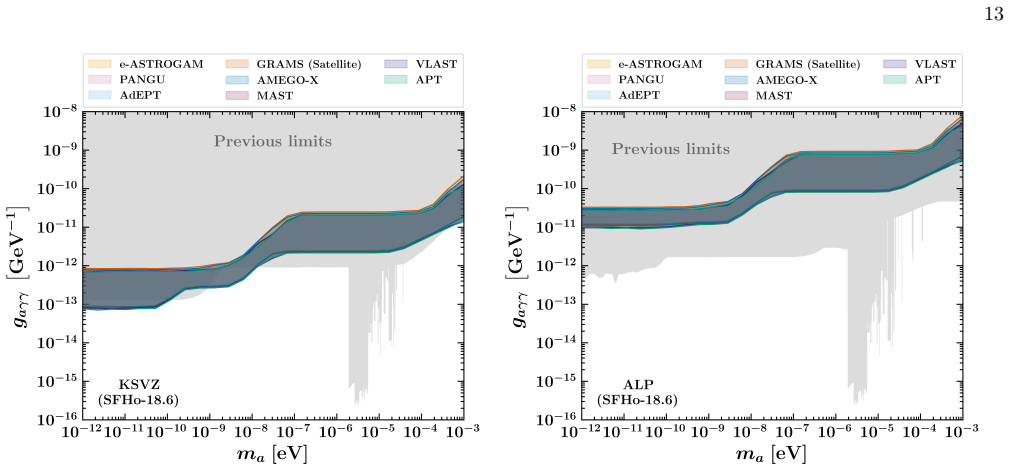
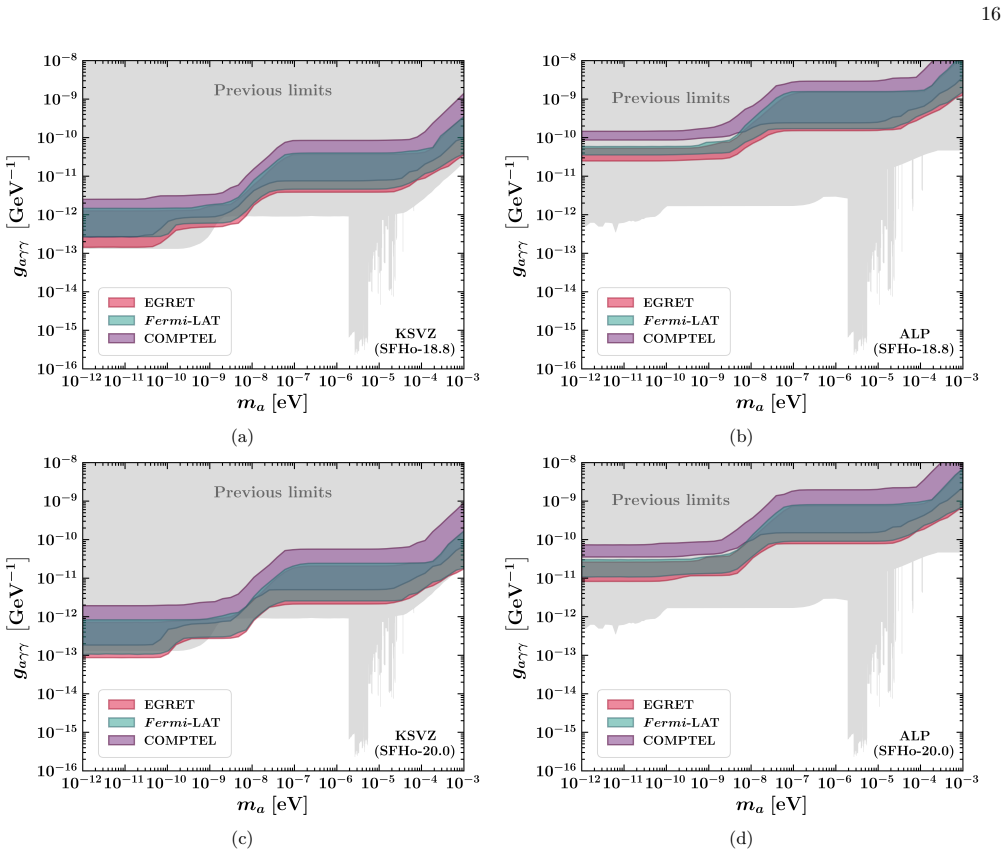
We develop a comprehensive framework to compute the diffuse gamma-ray flux by modeling axion production in supernovae and, for the first time, consistently accounting for their conversion into photons across all relevant magnetic field environments - progenitor, host galaxy, intergalactic medium, and the Milky Way - together with an updated cosmic star formation rate. Using measurements of the diffuse gamma-ray sky from COMPTEL, EGRET, and Fermi-LAT, we derive competitive constraints on the axion-photon coupling over a wide range of axion masses. We further forecast the sensitivity of upcoming MeV gamma-ray telescopes to this diffuse signal using a Fisher forecast analysis.
What carries the argument
The integrated diffuse gamma-ray flux produced by axion-photon conversion in the sequence of progenitor, host-galaxy, intergalactic, and Milky Way magnetic fields, summed over the cosmic supernova population.
If this is right
- Competitive upper limits on the axion-photon coupling are obtained across a broad interval of axion masses.
- The predicted signal strength scales with the adopted cosmic star-formation history.
- Fisher forecasts show that next-generation MeV telescopes can reach substantially smaller coupling values.
- Full inclusion of conversion in every magnetic-field stage reduces the uncertainty in the derived bounds.
Where Pith is reading between the lines
- The approach supplies an independent channel that can be combined with laboratory and stellar-cooling searches to narrow the allowed axion parameter space.
- Improved maps of galactic and extragalactic magnetic fields would directly tighten or relax the present constraints.
- If a diffuse excess matching the predicted shape is found, it would constitute evidence for axions independent of any single supernova event.
- Analogous diffuse signals could be calculated for other light bosons that mix with photons in magnetic fields.
Load-bearing premise
Axion production rates inside supernovae and the photon conversion probabilities in the modeled magnetic fields are accurate enough that any excess or deficit in the observed diffuse gamma-ray background can be attributed directly to the coupling strength.
What would settle it
A measurement of the diffuse gamma-ray intensity in the relevant bands that falls well below the minimum level predicted for any coupling value still allowed by other experiments, or a clear detection whose energy spectrum, angular distribution, and redshift dependence match the calculated axion-conversion component.
Figures





read the original abstract
Axions produced copiously in core-collapse supernovae can convert into photons as they propagate through various astrophysical magnetic fields. The cumulative emission from the cosmic population of supernovae can therefore generate a diffuse gamma-ray signal through axion-photon conversion. In this work, we develop a comprehensive framework to compute the diffuse gamma-ray flux by modeling axion production in supernovae and, \textit{for the first time}, consistently accounting for their conversion into photons across all relevant magnetic field environments - progenitor, host galaxy, intergalactic medium, and the Milky Way - together with an updated cosmic star formation rate. Using measurements of the diffuse gamma-ray sky from COMPTEL, EGRET, and \textit{Fermi}-LAT, we derive competitive constraints on the axion-photon coupling over a wide range of axion masses. We further forecast the sensitivity of upcoming MeV gamma-ray telescopes to this diffuse signal using a Fisher forecast analysis.
Editorial analysis
A structured set of objections, weighed in public.
Referee Report
Summary. The manuscript develops a comprehensive framework to compute the diffuse gamma-ray flux from axions produced in core-collapse supernovae, modeling production and, for the first time, consistent photon conversion across progenitor, host-galaxy, intergalactic-medium, and Milky-Way magnetic fields together with an updated cosmic star-formation rate. The predicted flux is compared to diffuse gamma-ray measurements from COMPTEL, EGRET, and Fermi-LAT to derive competitive constraints on the axion-photon coupling g_{aγ} over a wide range of axion masses; Fisher forecasts for the sensitivity of upcoming MeV telescopes are also presented.
Significance. If the astrophysical modeling holds, the work supplies a new, multi-environment probe of axion parameters that links supernova populations directly to the diffuse gamma-ray background. The consistent treatment of conversion probabilities across all relevant magnetic-field environments is a clear advance over prior single-site calculations and could yield genuinely competitive limits. The inclusion of an updated star-formation rate and forward-looking Fisher forecasts further strengthens the paper’s utility for the axion and MeV-astronomy communities.
major comments (2)
- [multi-environment conversion framework] The central claim that competitive constraints on g_{aγ} are obtained rests on the photon-conversion probability P_{a→γ} being known to sufficient precision. The framework description adopts fixed central values for IGM and host-galaxy B-field strength and coherence length without marginalization, even though literature values span more than an order of magnitude; because the conversion probability scales as B², this choice can shift the predicted flux (and therefore the derived limits) by factors of several. This issue is load-bearing for the competitiveness assertion and must be addressed by explicit variation of these parameters as nuisance parameters in the likelihood or by a dedicated robustness study.
- [§5] §5 (data comparison and likelihood): the comparison to COMPTEL/EGRET/Fermi-LAT diffuse data does not indicate that astrophysical systematics (B-field uncertainties, star-formation-rate variations) are propagated into the final posterior on g_{aγ}. If only instrumental statistical errors are used, the reported bounds may be artificially tight; the manuscript should show the impact of these systematics on the final limits.
minor comments (2)
- [Abstract / Introduction] The abstract states that conversion is accounted for “for the first time” across all environments; an explicit side-by-side comparison with earlier single-environment calculations should be added to the introduction to substantiate the novelty claim.
- Notation for the conversion probability P_{a→γ} and its dependence on coherence length should be introduced with a dedicated equation early in the text rather than being defined piecewise in the environment-by-environment sections.
Simulated Author's Rebuttal
We thank the referee for the detailed and constructive report. We appreciate the recognition of the novelty in our multi-environment conversion framework and the inclusion of updated star-formation rates and forecasts. We address the major comments below and have made revisions to strengthen the robustness of our results.
read point-by-point responses
-
Referee: [multi-environment conversion framework] The central claim that competitive constraints on g_{aγ} are obtained rests on the photon-conversion probability P_{a→γ} being known to sufficient precision. The framework description adopts fixed central values for IGM and host-galaxy B-field strength and coherence length without marginalization, even though literature values span more than an order of magnitude; because the conversion probability scales as B², this choice can shift the predicted flux (and therefore the derived limits) by factors of several. This issue is load-bearing for the competitiveness assertion and must be addressed by explicit variation of these parameters as nuisance parameters in the likelihood or by a dedicated robustness study.
Authors: We agree with the referee that the uncertainties in the magnetic field parameters are important and should be accounted for to support the competitiveness of the constraints. In the revised manuscript, we have performed a dedicated robustness study by varying the IGM and host-galaxy B-field strengths and coherence lengths over the ranges reported in the literature. We present the resulting variation in the predicted flux and the corresponding shifts in the derived limits on g_{aγ}. While the limits do shift by up to a factor of a few, they remain competitive with existing bounds. We have updated the text to include this analysis and discuss the implications for the final results. revision: yes
-
Referee: [§5] §5 (data comparison and likelihood): the comparison to COMPTEL/EGRET/Fermi-LAT diffuse data does not indicate that astrophysical systematics (B-field uncertainties, star-formation-rate variations) are propagated into the final posterior on g_{aγ}. If only instrumental statistical errors are used, the reported bounds may be artificially tight; the manuscript should show the impact of these systematics on the final limits.
Authors: We acknowledge that the original analysis used only the statistical uncertainties from the gamma-ray data. In the revised version, we have extended the likelihood analysis to include astrophysical systematics as nuisance parameters, specifically marginalizing over variations in B-field parameters and the star-formation rate. We show the impact on the posterior distributions and the resulting limits, which are mildly weakened but still competitive. This is now explicitly described in §5 and the associated figures. revision: yes
Circularity Check
No circularity: flux prediction uses independent astrophysical inputs and external gamma-ray data
full rationale
The derivation computes axion production rates from standard supernova models and conversion probabilities across magnetic fields using literature values for B-fields and star-formation rates, then compares the resulting diffuse flux to independent COMPTEL/EGRET/Fermi-LAT measurements to set limits on g_aγ. No equation reduces the output to a fitted parameter by construction, no self-citation supplies the central uniqueness or ansatz, and the comparison is to external benchmarks. The framework is self-contained against those benchmarks.
Axiom & Free-Parameter Ledger
axioms (3)
- domain assumption Axion production rates in core-collapse supernovae follow standard calculations based on temperature and density profiles.
- domain assumption Magnetic field strengths and coherence lengths in progenitor stars, host galaxies, IGM, and Milky Way are known well enough for conversion probability estimates.
- domain assumption The cosmic star formation rate history is accurately described by the updated parametrization used.
Lean theorems connected to this paper
-
IndisputableMonolith/Cost/FunctionalEquation.leanwashburn_uniqueness_aczel unclear?
unclearRelation between the paper passage and the cited Recognition theorem.
We develop a comprehensive framework to compute the diffuse gamma-ray flux by modeling axion production in supernovae and... consistently accounting for their conversion into photons across all relevant magnetic field environments
-
IndisputableMonolith/Foundation/AlexanderDuality.leanalexander_duality_circle_linking unclear?
unclearRelation between the paper passage and the cited Recognition theorem.
Using measurements of the diffuse gamma-ray sky from COMPTEL, EGRET, and Fermi-LAT, we derive competitive constraints on the axion-photon coupling
What do these tags mean?
- matches
- The paper's claim is directly supported by a theorem in the formal canon.
- supports
- The theorem supports part of the paper's argument, but the paper may add assumptions or extra steps.
- extends
- The paper goes beyond the formal theorem; the theorem is a base layer rather than the whole result.
- uses
- The paper appears to rely on the theorem as machinery.
- contradicts
- The paper's claim conflicts with a theorem or certificate in the canon.
- unclear
- Pith found a possible connection, but the passage is too broad, indirect, or ambiguous to say the theorem truly supports the claim.
Reference graph
Works this paper leans on
-
[1]
R. D. Peccei and H. R. Quinn, CP Conservation in the Presence of Instantons, Phys. Rev. Lett. 38 (1977) 1440
work page 1977
-
[2]
R. D. Peccei and H. R. Quinn, Constraints Imposed by CP Conservation in the Presence of Instantons , Phys. Rev. D 16 (1977) 1791
work page 1977
-
[3]
Weinberg, A New Light Boson? , Phys
S. Weinberg, A New Light Boson? , Phys. Rev. Lett. 40 (1978) 223
work page 1978
-
[4]
Wilczek, Problem of Strong P and T Invariance in the Presence of Instantons , Phys
F. Wilczek, Problem of Strong P and T Invariance in the Presence of Instantons , Phys. Rev. Lett. 40 (1978) 279
work page 1978
-
[5]
M. Dine, W. Fischler and M. Srednicki, A Simple Solution to the Strong CP Problem with a Harmless Axion, Phys. Lett. B 104 (1981) 199
work page 1981
- [6]
-
[7]
D. J. E. Marsh, Axion Cosmology, Phys. Rept. 643 (2016) 1 [ 1510.07633]
work page Pith review arXiv 2016
-
[8]
P. Svrcek and E. Witten, Axions In String Theory , JHEP 06 (2006) 051 [ hep-th/0605206]
work page internal anchor Pith review arXiv 2006
-
[9]
J. P. Conlon, The QCD axion and moduli stabilisation , JHEP 05 (2006) 078 [ hep-th/0602233]
work page Pith review arXiv 2006
-
[10]
A. Arvanitaki, S. Dimopoulos, S. Dubovsky, N. Kaloper and J. March-Russell, String Axiverse, Phys. Rev. D 81 (2010) 123530 [ 0905.4720]
work page internal anchor Pith review arXiv 2010
-
[11]
The type IIB string axiverse and its low-energy phenomenology
M. Cicoli, M. Goodsell and A. Ringwald, The type IIB string axiverse and its low-energy phenomenology , JHEP 10 (2012) 146 [ 1206.0819]
work page Pith review arXiv 2012
-
[12]
L. Di Luzio, M. Giannotti, E. Nardi and L. Visinelli, The landscape of QCD axion models , Phys. Rept. 870 (2020) 1 [ 2003.01100]
-
[13]
N. Gendler and D. J. E. Marsh, Possible Implications of QCD Axion Dark Matter Constraints from Helioscopes and Haloscopes for the String Theory Landscape , Phys. Rev. Lett. 134 (2025) 081602 [ 2407.07143]
-
[14]
M. Cicoli et al., Axions at the meV Crossroads: Theory, Cosmology, Astrophysics, and Experiments , 2603.18167
-
[15]
J. Preskill, M. B. Wise and F. Wilczek, Cosmology of the Invisible Axion , Phys. Lett. B 120 (1983) 127
work page 1983
-
[16]
L. F. Abbott and P. Sikivie, A Cosmological Bound on the Invisible Axion , Phys. Lett. B 120 (1983) 133
work page 1983
-
[17]
P. Arias, D. Cadamuro, M. Goodsell, J. Jaeckel, J. Redondo and A. Ringwald, WISPy Cold Dark Matter, JCAP 06 (2012) 013 [ 1201.5902]
work page Pith review arXiv 2012
- [18]
-
[19]
C. Er¨ oncel, R. Sato, G. Servant and P. Sørensen,ALP dark matter from kinetic fragmentation: opening up the parameter window, JCAP 10 (2022) 053 [ 2206.14259]
-
[20]
J. E. Kim, Weak Interaction Singlet and Strong CP Invariance, Phys. Rev. Lett. 43 (1979) 103
work page 1979
-
[21]
M. A. Shifman, A. I. Vainshtein and V. I. Zakharov, Can Confinement Ensure Natural CP Invariance of Strong Interactions?, Nucl. Phys. B 166 (1980) 493
work page 1980
-
[22]
Kamiokande-II collaboration, Observation of a Neutrino Burst from the Supernova SN 1987a , Phys. Rev. Lett. 58 (1987) 1490
work page 1987
-
[23]
IMB collaboration, Observation of a Neutrino Burst in Coincidence with Supernova 1987A in the Large Magellanic Cloud , Phys. Rev. Lett. 58 (1987) 1494
work page 1987
-
[24]
K. S. Hirata et al., Observation in the Kamiokande-II Detector of the Neutrino Burst from Supernova SN 1987a, Phys. Rev. D 38 (1988) 448
work page 1988
-
[25]
IMB collaboration, Angular Distribution of Events From Sn1987a, Phys. Rev. D 37 (1988) 3361
work page 1988
-
[26]
E. N. Alekseev, L. N. Alekseeva, I. V. Krivosheina and V. I. Volchenko, Detection of the Neutrino Signal From SN1987A in the LMC Using the INR Baksan Underground Scintillation Telescope, Phys. Lett. B 205 (1988) 209
work page 1988
-
[27]
M. S. Turner, Axions from SN 1987a , Phys. Rev. Lett. 60 (1988) 1797
work page 1988
-
[28]
A. Burrows, M. S. Turner and R. P. Brinkmann, Axions and SN 1987a , Phys. Rev. D 39 (1989) 1020
work page 1989
- [29]
-
[30]
P. Carenza, T. Fischer, M. Giannotti, G. Guo, G. Mart´ ınez-Pinedo and A. Mirizzi,Improved axion emissivity from a supernova via nucleon-nucleon bremsstrahlung, JCAP 10 (2019) 016 [ 1906.11844]. 20
-
[31]
P. Carenza, B. Fore, M. Giannotti, A. Mirizzi and S. Reddy, Enhanced Supernova Axion Emission and its Implications, Phys. Rev. Lett. 126 (2021) 071102 [2010.02943]
-
[32]
P. Carenza and G. Lucente, Supernova bound on axionlike particles coupled with electrons , Phys. Rev. D 104 (2021) 103007 [ 2107.12393]
- [33]
-
[34]
Carenza, Axion emission from supernovae: a cheatsheet, Eur
P. Carenza, Axion emission from supernovae: a cheatsheet, Eur. Phys. J. Plus 138 (2023) 836 [2309.14798]
- [35]
-
[36]
G. G. Raffelt, Astrophysical methods to constrain axions and other novel particle phenomena , Phys. Rept. 198 (1990) 1
work page 1990
-
[37]
G. G. Raffelt, Stars as laboratories for fundamental physics: The astrophysics of neutrinos, axions, and other weakly interacting particles . 5, 1996
work page 1996
-
[38]
J. A. Grifols, E. Masso and R. Toldra, Gamma-rays from SN1987A due to pseudoscalar conversion , Phys. Rev. Lett. 77 (1996) 2372 [ astro-ph/9606028]
work page internal anchor Pith review Pith/arXiv arXiv 1996
-
[39]
J. W. Brockway, E. D. Carlson and G. G. Raffelt, SN1987A gamma-ray limits on the conversion of pseudoscalars, Phys. Lett. B 383 (1996) 439 [astro-ph/9605197]
work page internal anchor Pith review Pith/arXiv arXiv 1996
- [40]
-
[41]
S. Hoof and L. Schulz, Updated constraints on axion-like particles from temporal information in supernova SN1987A gamma-ray data , JCAP 03 (2023) 054 [2212.09764]
- [42]
-
[43]
A. Caputo and G. Raffelt, Astrophysical Axion Bounds: The 2024 Edition , PoS COSMICWISPers (2024) 041 [2401.13728]
- [44]
- [45]
- [46]
- [47]
-
[48]
P. Carenza, M. Giannotti, J. Isern, A. Mirizzi and O. Straniero, Axion astrophysics, Phys. Rept. 1117 (2025) 1 [ 2411.02492]
-
[49]
Z. Xie, J. Liu, B. Liu and R. Yang, Unveiling axion signals in galactic supernovae with future MeV telescopes*, Chin. Phys. 49 (2025) 085101
work page 2025
- [50]
- [51]
- [52]
- [53]
- [54]
-
[55]
S. C. Kappadath, Measurement of the Cosmic Diffuse Gamma-Ray Spectrum from 800 KEV to 30 Mev , Ph.D. thesis, University of New Hampshire, Jan., 1998
work page 1998
-
[56]
G. Weidenspointner, M. Varendorff, S. C. Kappadath, K. Bennett, H. Bloemen, R. Diehl et al., The cosmic diffuse gamma-ray background measured with COMPTEL, in The Fifth Compton Symposium , M. L. McConnell and J. M. Ryan, eds., vol. 510 of American Institute of Physics Conference Series , pp. 467–470, AIP, Apr., 2000, DOI
work page 2000
-
[57]
EGRET collaboration, EGRET observations of the extragalactic gamma-ray emission, Astrophys. J. 494 (1998) 523 [ astro-ph/9709257]
work page Pith review arXiv 1998
-
[58]
A. W. Strong, I. V. Moskalenko and O. Reimer, A new determination of the extragalactic diffuse gamma-ray background from egret data, Astrophys. J. 613 (2004) 956 [astro-ph/0405441]
work page internal anchor Pith review Pith/arXiv arXiv 2004
-
[59]
D. J. Thompson, Gamma ray astrophysics: the EGRET results, Rept. Prog. Phys. 71 (2008) 116901 [ 0811.0738]
work page internal anchor Pith review Pith/arXiv arXiv 2008
-
[60]
Fermi-LAT collaboration, The Large Area Telescope on the Fermi Gamma-ray Space Telescope Mission, Astrophys. J. 697 (2009) 1071 [ 0902.1089]
work page Pith review arXiv 2009
-
[61]
Fermi-LAT collaboration, The spectrum of isotropic diffuse gamma-ray emission between 100 MeV and 820 GeV, Astrophys. J. 799 (2015) 86 [ 1410.3696]
work page Pith review arXiv 2015
- [62]
- [63]
-
[64]
T. Dzhatdoev and E. Podlesnyi, Massive Argon Space Telescope (MAST): A concept of heavy time projection chamber for γ-ray astronomy in the 100 MeV–1 TeV energy range, Astropart. Phys. 112 (2019) 1 [1902.01491]
-
[65]
GRAMS collaboration, Overview of the GRAMS (Gamma-Ray AntiMatter Survey) Project , PoS ICRC2021 (2021) 653
work page 2021
-
[66]
T. Aramaki, P. Hansson Adrian, G. Karagiorgi and H. Odaka, Dual MeV Gamma-Ray and Dark Matter Observatory - GRAMS Project , Astropart. Phys. 114 (2020) 107 [ 1901.03430]
- [67]
- [68]
-
[69]
APT collaboration, The Advanced Particle-astrophysics Telescope (APT) Project Status, PoS ICRC2021 (2021) 655
work page 2021
- [70]
-
[71]
G. Raffelt and L. Stodolsky, Mixing of the Photon with Low Mass Particles , Phys. Rev. D 37 (1988) 1237
work page 1988
-
[72]
M. Carena and R. D. Peccei, The Effective Lagrangian for Axion Emission From SN1987A , Phys. Rev. D 40 (1989) 652
work page 1989
-
[73]
Hadronic axion window and the big-bang nucleosynthesis
S. Chang and K. Choi, Hadronic axion window and the big bang nucleosynthesis, Phys. Lett. B 316 (1993) 51 [hep-ph/9306216]
work page internal anchor Pith review Pith/arXiv arXiv 1993
-
[74]
Particle Data Group collaboration, Review of particle physics, Phys. Rev. D 110 (2024) 030001
work page 2024
-
[75]
Garching core-collapse supernova archive
Garching Core-Collapse Supernova Modeling Group, “Garching core-collapse supernova archive.” https: //wwwmpa.mpa-garching.mpg.de/ccsnarchive/, 2018
work page 2018
-
[76]
G. G. Raffelt, ASTROPHYSICAL AXION BOUNDS DIMINISHED BY SCREENING EFFECTS , Phys. Rev. D 33 (1986) 897
work page 1986
-
[77]
D. F. G. Fiorillo, ´A. Gil Muyor, H.-T. Janka, G. G. Raffelt and E. Vitagliano, Axion-photon conversion in transient compact stars: Systematics, constraints, and opportunities, 2509.13322
work page internal anchor Pith review Pith/arXiv arXiv
-
[78]
Muonic Boson Limits: Supernova Redux
A. Caputo, G. Raffelt and E. Vitagliano, Muonic boson limits: Supernova redux , Phys. Rev. D 105 (2022) 035022 [2109.03244]
work page internal anchor Pith review Pith/arXiv arXiv 2022
-
[79]
R. P. Brinkmann and M. S. Turner, Numerical Rates for Nucleon-Nucleon Axion Bremsstrahlung, Phys. Rev. D 38 (1988) 2338
work page 1988
-
[80]
Theory of Core-Collapse Supernovae
H.-T. Janka, K. Langanke, A. Marek, G. Martinez-Pinedo and B. Mueller, Theory of Core-Collapse Supernovae, Phys. Rept. 442 (2007) 38 [astro-ph/0612072]
work page internal anchor Pith review Pith/arXiv arXiv 2007
discussion (0)
Sign in with ORCID, Apple, or X to comment. Anyone can read and Pith papers without signing in.