Recognition: 2 theorem links
· Lean TheoremMassive scalar field perturbations in noncommutative-geometry-inspired Schwarzschild black hole
Pith reviewed 2026-05-13 20:54 UTC · model grok-4.3
The pith
Massive scalar perturbations on noncommutative Schwarzschild black holes yield quasinormal frequencies that recover classical values when mass and noncommutativity balance at extreme limits.
A machine-rendered reading of the paper's core claim, the machinery that carries it, and where it could break.
Core claim
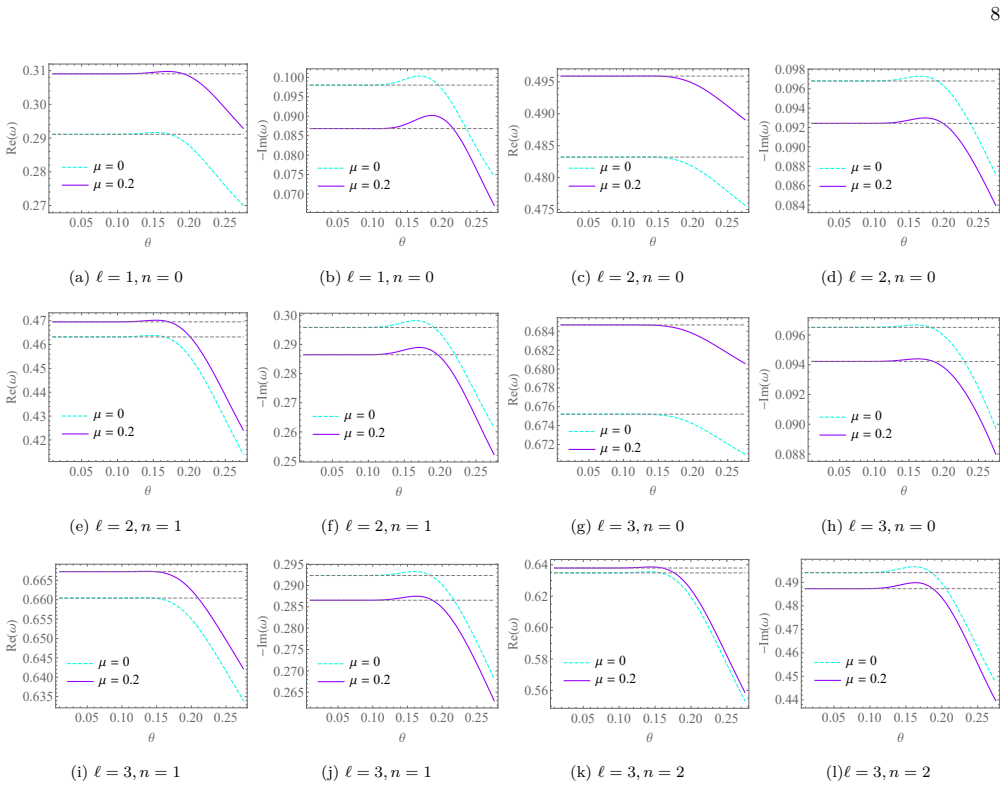
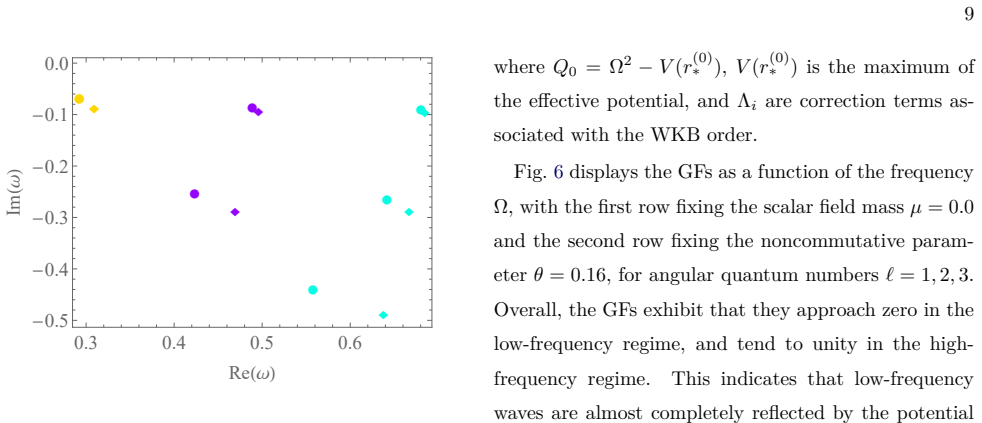
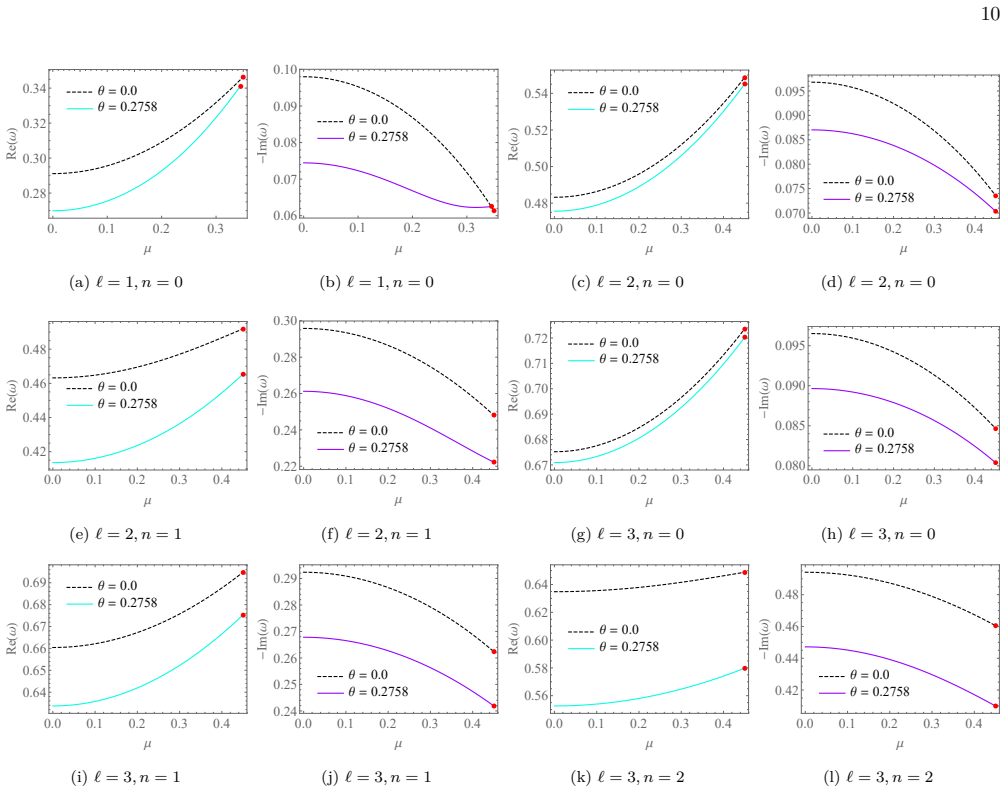
Using the noncommutative-geometry-inspired Schwarzschild metric and a third-order WKB approximation, the quasinormal frequencies of massive scalar perturbations satisfy Im(ω) < 0 for all explored parameters, confirming stability. Increasing the noncommutative parameter θ lowers both the real and imaginary parts of ω in absolute value, while increasing the scalar mass μ raises the real part and lowers the absolute imaginary part. Greybody factors and absorption cross sections rise with θ and fall with μ. For the extreme black hole at ℓ = 1 and large μ the frequencies converge to the classical Schwarzschild values, indicating that mass and noncommutative corrections partially cancel.
What carries the argument
Third-order WKB approximation applied to the effective potential derived from the noncommutative-geometry-inspired Schwarzschild metric and the massive scalar wave equation.
If this is right
- The black hole spacetime remains linearly stable against massive scalar perturbations for all noncommutative parameters and scalar masses considered.
- Noncommutative corrections and scalar mass shift the oscillation frequency and damping rate in opposite directions.
- Greybody factors and absorption cross sections are enhanced by noncommutativity and suppressed by scalar mass.
- In the extreme black-hole limit the noncommutative and mass corrections can cancel, restoring classical frequencies at ℓ = 1 and sufficiently large μ.
Where Pith is reading between the lines
- The observed cancellation may indicate that noncommutative geometry and mass corrections can be tuned to produce an effectively classical limit detectable only through higher-order observables.
- Future gravitational-wave ringdown measurements at high mass and low angular momentum might not easily distinguish noncommutative corrections from ordinary Schwarzschild behavior.
- Analog gravity experiments with massive fields could test whether the same cancellation appears in laboratory-scale effective metrics.
Load-bearing premise
The third-order WKB approximation remains accurate enough for the effective potential created by the noncommutative metric and massive scalar field over the full range of parameters examined.
What would settle it
A direct numerical integration of the radial wave equation for the noncommutative metric at ℓ = 1 and large μ that produces frequencies differing from the classical Schwarzschild values by more than the reported WKB uncertainty.
Figures




read the original abstract
In this paper, based on noncommutative-geometry-inspired Schwarzschild black hole, we employ a third-order WKB approximation approach to systematically calculate the quasinormal mode frequencies (QNFs), greybody factors (GFs), and absorption cross section (ACS) under massive scalar field perturbations. The results show that the QNFs satisfy Im($\omega$)<0, confirming the stability of the black hole under perturbations. Furthermore, increasing the noncommutative parameter $\theta$ reduces the absolute values of both the real and imaginary parts of the frequency, while increasing mass $\mu$ increases the real part and reduces the imaginary part. The GFs and ACS increase with increasing $\theta$ and decrease with increasing $\mu$, indicating opposite modulation effects of these two types of parameters. It is worth emphasizing that the QNFs of the extreme black hole approach the corresponding values of the classical Schwarzschild black hole at angular quantum number $\ell=1$ and large $\mu$, suggesting that, the effects of mass and noncommutative geometry quantum corrections cancel each other out to some extent. It is hoped that these results provide a viable theoretical basis for both the theoretical and experimental aspects of the perturbative dynamics of black hole.
Editorial analysis
A structured set of objections, weighed in public.
Referee Report
Summary. The paper computes quasinormal frequencies (QNFs), greybody factors (GFs), and absorption cross sections (ACS) for massive scalar perturbations on a noncommutative-geometry-inspired Schwarzschild black hole using the third-order WKB approximation. It reports Im(ω) < 0 for all explored parameters, confirming stability, with |Re(ω)| and |Im(ω)| decreasing as the noncommutative parameter θ increases and Re(ω) increasing while |Im(ω)| decreases as the scalar mass μ increases. GFs and ACS increase with θ and decrease with μ. The central claim is that, at ℓ = 1 and large μ, the QNFs of the extreme noncommutative black hole approach the corresponding classical Schwarzschild values, suggesting partial cancellation between mass and noncommutative corrections.
Significance. If the third-order WKB results hold, the work supplies concrete trends for how noncommutative geometry and scalar mass jointly modulate black-hole ringdown and scattering observables, including a suggestive cancellation effect at ℓ = 1. These trends are internally consistent with the given metric and wave equation and could inform future studies of quantum-corrected black-hole spectroscopy, though the quantitative reliability of the reported numbers remains tied to the unverified accuracy of the WKB truncation in the large-μ regime.
major comments (1)
- [WKB implementation and extreme-limit discussion] The headline result that QNFs of the extreme noncommutative black hole approach classical Schwarzschild values at ℓ = 1 and large μ is obtained exclusively from the third-order WKB formula applied to the effective potential that combines the noncommutative metric function with the μ² term. No higher-order WKB, Leaver continued-fraction, or time-domain comparison is reported to bound the truncation error when the potential peak broadens or shifts at large μ; this directly affects the load-bearing claim of approach to the classical limit.
minor comments (2)
- [Abstract] The abstract states Im(ω) < 0 without first defining the sign convention for the time dependence e^{-iωt}; a brief clarification would aid readers.
- [Metric and perturbation setup] Notation for the noncommutative parameter θ and the scalar mass μ is introduced without an explicit statement of the units or normalization chosen (e.g., M = 1); adding this once in the metric section would improve reproducibility.
Simulated Author's Rebuttal
We thank the referee for the careful reading of our manuscript and the constructive comment on the WKB implementation. We address the major concern below.
read point-by-point responses
-
Referee: [WKB implementation and extreme-limit discussion] The headline result that QNFs of the extreme noncommutative black hole approach classical Schwarzschild values at ℓ = 1 and large μ is obtained exclusively from the third-order WKB formula applied to the effective potential that combines the noncommutative metric function with the μ² term. No higher-order WKB, Leaver continued-fraction, or time-domain comparison is reported to bound the truncation error when the potential peak broadens or shifts at large μ; this directly affects the load-bearing claim of approach to the classical limit.
Authors: We agree that the absence of higher-order WKB, continued-fraction, or time-domain validation limits the quantitative precision of the reported approach to the classical Schwarzschild values at large μ and ℓ=1. The third-order WKB method is standard for exploring trends in modified black-hole spacetimes, and our emphasis was on the opposing parametric effects of θ and μ together with the observed cancellation. To address the concern we will add an explicit discussion paragraph noting the truncation-error issue in the large-μ regime and stating that the classical-limit claim is indicative rather than definitive, pending future cross-checks. This is a partial revision. revision: partial
Circularity Check
No significant circularity in WKB-based QNF computation
full rationale
The paper derives quasinormal frequencies, greybody factors, and absorption cross sections by applying the standard third-order WKB approximation directly to the wave equation constructed from the noncommutative-geometry-inspired metric and the massive scalar field term. This is a forward numerical procedure on a fixed background metric; no parameters are fitted to the output frequencies, no results are redefined as inputs, and no load-bearing steps reduce to self-citations or ansatze introduced by the same authors. The reported approach of extreme-black-hole QNFs to classical Schwarzschild values at ℓ=1 and large μ is an observed numerical outcome, not a definitional identity.
Axiom & Free-Parameter Ledger
free parameters (2)
- noncommutative parameter θ
- scalar field mass μ
axioms (2)
- domain assumption The noncommutative-geometry-inspired Schwarzschild metric provides a valid background spacetime for linear perturbations.
- domain assumption Third-order WKB approximation yields sufficiently accurate quasinormal frequencies for the parameter ranges considered.
Lean theorems connected to this paper
-
IndisputableMonolith/Foundation/RealityFromDistinction.leanreality_from_one_distinction unclear?
unclearRelation between the paper passage and the cited Recognition theorem.
We employ a third-order WKB approximation approach to systematically calculate the quasinormal mode frequencies (QNFs), greybody factors (GFs), and absorption cross section (ACS) under massive scalar field perturbations.
-
IndisputableMonolith/Cost/FunctionalEquation.leanwashburn_uniqueness_aczel unclear?
unclearRelation between the paper passage and the cited Recognition theorem.
the effective potential V(r) = f(r)[ℓ(ℓ+1)/r² + (1/r)df/dr + μ²]
What do these tags mean?
- matches
- The paper's claim is directly supported by a theorem in the formal canon.
- supports
- The theorem supports part of the paper's argument, but the paper may add assumptions or extra steps.
- extends
- The paper goes beyond the formal theorem; the theorem is a base layer rather than the whole result.
- uses
- The paper appears to rely on the theorem as machinery.
- contradicts
- The paper's claim conflicts with a theorem or certificate in the canon.
- unclear
- Pith found a possible connection, but the passage is too broad, indirect, or ambiguous to say the theorem truly supports the claim.
Forward citations
Cited by 1 Pith paper
-
Quasinormal modes of coupled metric-dilaton perturbations in two-dimensional stringy black holes
Coupled intrinsic perturbations of the MSW black hole yield complex quasinormal frequencies with negative imaginary parts confirming stability and non-zero real parts indicating oscillatory behavior, with damping rate...
Reference graph
Works this paper leans on
-
[1]
Two-horizon case (ξ >ξc≈1.90412): There exist two horizons, including an outer horizon, which defines the region from which nothing can escape, and the inner horizon arises from the modification of the metric behavior due to quantum corrections and is a common feature of many quantum black hole models
-
[2]
Extreme black hole case (ξ=ξc): One degenerate horizon. In this case, the black hole possesses a minimum non-zero horizon radiusr min H ≈3.0 √ θ, so that the surface gravity vanishes, implying zero Hawking temperature
-
[3]
No-horizon case (ξ <ξc): The matter distribution is sufficiently diffuse that no event horizon forms, corresponding to a singularity-free quantum grav- itational object. This implies that, within the noncommutative geometry framework, only black hole with mass above the Planck scale can form classical horizons. This result is qualita- tively consistent wi...
-
[4]
0.1 0.2 0.3 0.28 0.30 0.32 0.34 μ Re(ω) (a)ℓ= 1,n= 0 θ=0.0 θ=0.2758
-
[5]
0.1 0.2 0.3 0.06 0.07 0.08 0.09 0.10 μ -Im(ω) (b)ℓ= 1,n= 0 θ=0.0 θ=0.2758 0.0 0.1 0.2 0.3 0.4 0.48 0.50 0.52 0.54 μ Re(ω) (c)ℓ= 2,n= 0 θ=0.0 θ=0.2758 0.0 0.1 0.2 0.3 0.4 0.070 0.075 0.080 0.085 0.090 0.095 μ -Im(ω) (d)ℓ= 2,n= 0 θ=0.0 θ=0.2758 0.0 0.1 0.2 0.3 0.4 0.42 0.44 0.46 0.48 μ Re(ω) (e)ℓ= 2,n= 1 θ=0.0 θ=0.2758 0.0 0.1 0.2 0.3 0.4 0.22 0.24 0.26 0.2...
work page 2097
-
[6]
Information loss in black holes,
S. W. Hawking, “Information loss in black holes,” Phys. Rev. D72, 084013 (2005)
work page 2005
-
[7]
Noncom- mutative geometry inspired schwarzschild black hole,
P. Nicolini, A. Smailagic, and E. Spallucci, “Noncom- mutative geometry inspired schwarzschild black hole,” Phys. Lett. B632, 547–551 (2006)
work page 2006
-
[8]
Noncommutative Black Holes, The Final Appeal To Quantum Gravity: A Review,
P. Nicolini, “Noncommutative Black Holes, The Final Appeal To Quantum Gravity: A Review,” Int. J. Mod. Phys. A24, 1229–1308 (2009)
work page 2009
-
[9]
Noncommutative geometry inspired Ein- stein–Gauss–Bonnet black holes,
S. G. Ghosh, “Noncommutative geometry inspired Ein- stein–Gauss–Bonnet black holes,” Class. Quant. Grav. 35, 085008 (2018)
work page 2018
-
[10]
Properties of an axisymmetric Lorentzian non-commutative black hole
A. A. Ara´ ujo Filho, J. R. Nascimento, A. Y. Petrov, P. J. Porf´ ırio, A.¨Ovg¨ un, “Properties of an axisymmetric Lorentzian non-commutative black hole”, Phys. Dark Univ.47, 101796 (2025)
work page 2025
-
[11]
Particle production induced by a Lorentzian non-commutative spacetime
A. A. Ara´ ujo Filho, “Particle production induced by a Lorentzian non-commutative spacetime”, Annals Phys. 481, 170167 (2025)
work page 2025
-
[12]
A non- commutative Kalb-Ramond black hole
A. A. Ara´ ujo Filho, N. Heidari, Iarley P. Lobo, “A non- commutative Kalb-Ramond black hole”, JCAP09, 076 (2025)
work page 2025
-
[13]
A. A. Ara´ ujo Filho, N. Heidari, Ali¨Ovg¨ un, “Geodesics, accretion disk, gravitational lensing, time delay, and ef- fects on neutrinos induced by a non-commutative black hole”, JCAP06, 062 (2025)
work page 2025
-
[14]
Noncommutative inspired black holes in extra dimensions,
T. G. Rizzo, “Noncommutative inspired black holes in extra dimensions,” JHEP2006, 021 (2006)
work page 2006
-
[15]
Non-commutative geometry inspired charged black holes,
S. Ansoldi, P. Nicolini, A. Smailagic, and E. Spallucci, “Non-commutative geometry inspired charged black holes,” Phys. Lett. B645, 261–266 (2007)
work page 2007
-
[16]
Non- commutative geometry inspired higher-dimensional charged black holes,
E. Spallucci, A. Smailagic, and P. Nicolini, “Non- commutative geometry inspired higher-dimensional charged black holes,” Phys. Lett. B670, 449–454 (2009)
work page 2009
-
[17]
Charged rotating noncom- mutative black holes,
L. Modesto and P. Nicolini, “Charged rotating noncom- mutative black holes,” Phys. Rev. D82, 104035 (2010)
work page 2010
-
[18]
Greybody factors for higher-dimensional non-commutative geometry inspired black holes,
Z. Cox and D. M. Gingrich, “Greybody factors for higher-dimensional non-commutative geometry inspired black holes,” Class. Quant. Grav.40, 175013 (2023)
work page 2023
-
[19]
Quasinormal modes and grey- body factor of charged black hole in non-commutative geometry,
S.-J. Ma, R.-B. Wang, T.-C. Ma, H.-X. Zhang, J.-B. Deng, and X.-R. Hu, “Quasinormal modes and grey- body factor of charged black hole in non-commutative geometry,” Eur. Phys. J. Plus140, 647 (2024)
work page 2024
-
[20]
Strong gravitational lensing in a noncommutative black-hole spacetime,
C. Ding, S. Kang, C.-Y. Chen, S. Chen, and J. Jing, “Strong gravitational lensing in a noncommutative black-hole spacetime,” Phys. Rev. D83, 084005 (2011)
work page 2011
-
[21]
Probing spacetime noncommuta- tive constant via charged astrophysical black hole lens- ing,
C. Ding and J. Jing, “Probing spacetime noncommuta- tive constant via charged astrophysical black hole lens- ing,” JHEP10, 052 (2011)
work page 2011
-
[22]
Shadow of noncommutative geometry inspired black hole,
S.-W. Wei, P. Cheng, Y. Zhong, and X.-N. Zhou, “Shadow of noncommutative geometry inspired black hole,” JCAP08, 004 (2015)
work page 2015
-
[23]
Shadow of a Charged Rotat- ing Non-Commutative Black Hole,
M. Sharif and S. Iftikhar, “Shadow of a Charged Rotat- ing Non-Commutative Black Hole,” Eur. Phys. J. C76, 630 (2016)
work page 2016
-
[24]
Perturbing microscopic black holes inspired by noncommutativity,
D. Batic, N. G. Kelkar, M. Nowakowski, and K. Red- 17 way, “Perturbing microscopic black holes inspired by noncommutativity,” Eur. Phys. J. C79, 581 (2019)
work page 2019
-
[25]
Shadow cast of noncommutative black holes in Rastall gravity,
A. ¨Ovg¨ un,˙I. Sakallı, J. Saavedra, and C. Leiva, “Shadow cast of noncommutative black holes in Rastall gravity,” Mod. Phys. Lett. A35, 2050163 (2020)
work page 2020
-
[26]
Effects of non-commutative geometry on black hole properties,
A. A. A. Filho, J. R. Nascimento, A. Y. Petrov, P. J. Porf´ ırio, and A.¨Ovg¨ un, “Effects of non-commutative geometry on black hole properties,” Phys. Dark Univ. 46, 101630 (2024)
work page 2024
-
[27]
Quasinormal modes in non- commutative schwarzschild black holes: a spectral anal- ysis,
D. Batic and D. Dutykh, “Quasinormal modes in non- commutative schwarzschild black holes: a spectral anal- ysis,” Eur. Phys. J. C84, 622 (2024)
work page 2024
-
[28]
Non- commutativity in Hayward spacetime
N. Heidari, A. A. Ara´ ujo Filho, Iarley P. Lobo, “Non- commutativity in Hayward spacetime”, JCAP09, 051 (2025)
work page 2025
-
[29]
Scattering of gravitational radia- tion by a schwarzschild black-hole,
C. V. Vishveshwara, “Scattering of gravitational radia- tion by a schwarzschild black-hole,” Nature227, 936– 938 (1970)
work page 1970
-
[30]
E. Berti, V. Cardoso, J. A. Gonzalez, and U. Sperhake, “Mining information from binary black hole mergers: A Comparison of estimation methods for complex expo- nentials in noise,” Phys. Rev. D75, 124017 (2007)
work page 2007
-
[31]
Gravitational-wave measurements of the mass and angular momentum of a black hole,
F. Echeverria, “Gravitational-wave measurements of the mass and angular momentum of a black hole,” Phys. Rev. D40, 3194–3203 (1989)
work page 1989
-
[32]
On gravitational-wave spectroscopy of massive black holes with the space interferometer LISA,
E. Berti, V. Cardoso, and C. M. Will, “On gravitational-wave spectroscopy of massive black holes with the space interferometer LISA,” Phys. Rev. D73, 064030 (2006)
work page 2006
-
[33]
Matched-filtering and parameter estimation of ring- down waveforms,
E. Berti, J. Cardoso, V. Cardoso, and M. Cavaglia, “Matched-filtering and parameter estimation of ring- down waveforms,” Phys. Rev. D76, 104044 (2007)
work page 2007
-
[34]
Echoes from classical black holes,
H. Huang, M.-Y. Ou, M.-Y. Lai, and H. Lu, “Echoes from classical black holes,” Phys. Rev. D105, 104049 (2022)
work page 2022
-
[35]
Long Wave Trains of Gravitational Waves from a Vibrating Black Hole,
W. H. Press, “Long Wave Trains of Gravitational Waves from a Vibrating Black Hole,” Astrophys. J. Lett.170, L105–L108 (1971)
work page 1971
-
[36]
Black hole normal modes: A semianalytic approach,
B. F. Schutz and C. M. Will, “Black hole normal modes: A semianalytic approach,” Astrophys. J. Lett.291, L33–L36 (1985)
work page 1985
-
[37]
An analytic representation for the quasi- normal modes of kerr black holes,
E. W. Leaver, “An analytic representation for the quasi- normal modes of kerr black holes,” Proc. R. Soc. A: Math. Phys. Eng. Sci.402, 285–298 (1985)
work page 1985
-
[38]
S. Iyer and C. M. Will, “Black-hole normal modes: A wkb approach. i. foundations and application of a higher-order wkb analysis of potential-barrier scatter- ing,” Phys. Rev. D35, 3621–3631 (1987)
work page 1987
-
[39]
Black-hole normal modes: A wkb approach. ii. schwarzschild black holes,
S. Iyer, “Black-hole normal modes: A wkb approach. ii. schwarzschild black holes,” Phys. Rev. D35, 3632–3636 (1987)
work page 1987
-
[40]
Quasinormal modes of schwarzschild black holes: Defined and calculated via laplace transformation,
H.-P. Nollert and B. G. Schmidt, “Quasinormal modes of schwarzschild black holes: Defined and calculated via laplace transformation,” Phys. Rev. D45, 2617–2627 (1992)
work page 1992
-
[41]
Black-hole normal modes: Phase-integral treatment,
N. Fr¨ oman, P. O. Fr¨ oman, N. Andersson, and A. H¨ okback, “Black-hole normal modes: Phase-integral treatment,” Phys. Rev. D45, 2609–2616 (1992)
work page 1992
-
[42]
Late-time behavior of stellar collapse and explosions. i. linearized perturbations,
C. Gundlach, R. H. Price, and J. Pullin, “Late-time behavior of stellar collapse and explosions. i. linearized perturbations,” Phys. Rev. D49, 883–889 (1994)
work page 1994
-
[43]
Quasinormal behavior of the d- dimensional Schwarzschild black hole and higher order WKB approach,
R. A. Konoplya, “Quasinormal behavior of the d- dimensional Schwarzschild black hole and higher order WKB approach,” Phys. Rev. D68, 024018 (2003)
work page 2003
-
[44]
Advanced Methods in Black-Hole Perturba- tion Theory,
P. Pani, “Advanced Methods in Black-Hole Perturba- tion Theory,” Int. J. Mod. Phys. A28, 1340018 (2013)
work page 2013
-
[45]
Quasinormal modes of black holes. The improved semianalytic approach,
J. Matyjasek and M. Opala, “Quasinormal modes of black holes. The improved semianalytic approach,” Phys. Rev. D96, 024011 (2017)
work page 2017
-
[46]
Quasinormal modes of a noncommutative- geometry-inspired schwarzschild black hole,
J. Liang, “Quasinormal modes of a noncommutative- geometry-inspired schwarzschild black hole,” Chin. Phys. Lett.35, 010401–010401 (2018)
work page 2018
-
[47]
J. Liang, “Quasinormal modes of a noncommutative- geometry-inspired schwarzschild black hole: Gravita- tional, electromagnetic and massless dirac perturba- tions*,” Chin. Phys. Lett.35, 050401 (2018)
work page 2018
-
[48]
M. Karimabadi, D. M. Yekta, and S. A. Alavi, “Ef- fects of non-minimal scalar field couplings with cur- vature tensors on perturbations in non-commutative Schwarzschild spacetimes,” (2025), arXiv:2508.13820 [gr-qc]
-
[49]
S.-H. Fan, C. Wu, and W.-J. Guo, “Grey-body Factors 18 and Absorption Cross Sections of Non-Commutative Black Holes under Einstein-Coupled Scalar Fields,” (2025), arXiv:2511.16012 [gr-qc]
-
[50]
Absorption and emission spectra of a schwarzschild black hole,
N. Sanchez, “Absorption and emission spectra of a schwarzschild black hole,” Phys. Rev. D18, 1030–1036 (1978)
work page 1978
-
[51]
Scattering of massless scalar waves by a schwarzschild black hole: A phase-integral study,
N. Andersson, “Scattering of massless scalar waves by a schwarzschild black hole: A phase-integral study,” Phys. Rev. D52, 1808–1820 (1995)
work page 1995
-
[52]
Calculable corrections to brane black hole decay. 1. The scalar case,
P. Kanti and J. March-Russell, “Calculable corrections to brane black hole decay. 1. The scalar case,” Phys. Rev. D66, 024023 (2002)
work page 2002
-
[53]
Black Hole Particle Emission in Higher-Dimensional Spacetimes,
V. Cardoso, M. Cavaglia, and L. Gualtieri, “Black Hole Particle Emission in Higher-Dimensional Spacetimes,” Phys. Rev. Lett.96, 071301 (2006)
work page 2006
-
[54]
R. A. Konoplya and A. F. Zinhailo, “Hawking radia- tion of non-Schwarzschild black holes in higher deriva- tive gravity: a crucial role of grey-body factors,” Phys. Rev. D99, 104060 (2019)
work page 2019
-
[55]
Scattering of electromagnetic radiation from a black hole,
B. Mashhoon, “Scattering of electromagnetic radiation from a black hole,” Phys. Rev. D7, 2807–2814 (1973)
work page 1973
-
[56]
Scattering and absorption of electromag- netic waves by a schwarzschild black hole,
R. Fabbri, “Scattering and absorption of electromag- netic waves by a schwarzschild black hole,” Phys. Rev. D12, 933–942 (1975)
work page 1975
-
[57]
Black hole absorption cross sec- tions: Spin and Regge poles,
M. Ould El Hadj, “Black hole absorption cross sec- tions: Spin and Regge poles,” Phys. Rev. D111, 124041 (2025)
work page 2025
-
[58]
A. Ohashi and M. a. Sakagami, “Massive quasi-normal mode,” Class. Quant. Grav.21, 3973–3984 (2004)
work page 2004
-
[59]
Decay of massive scalar field in a Schwarzschild background,
R. A. Konoplya and A. V. Zhidenko, “Decay of massive scalar field in a Schwarzschild background,” Phys. Lett. B609, 377–384 (2005)
work page 2005
-
[60]
Massive scalar field quasinormal modes of higher dimensional black holes,
A. Zhidenko, “Massive scalar field quasinormal modes of higher dimensional black holes,” Phys. Rev. D74, 064017 (2006)
work page 2006
-
[61]
R. A. Konoplya, “Massive vector field perturbations in the Schwarzschild background: Stability and un- usual quasinormal spectrum,” Phys. Rev. D73, 024009 (2006)
work page 2006
-
[62]
R. A. Konoplya, Z. Stuchl´ ık, and A. Zhidenko, “Ax- isymmetric black holes allowing for separation of vari- ables in the Klein-Gordon and Hamilton-Jacobi equa- tions,” Phys. Rev. D97, 084044 (2018)
work page 2018
-
[63]
Quasinormal modes of massive fermions in Kerr spacetime: Long-lived modes and the fine structure,
R. A. Konoplya and A. Zhidenko, “Quasinormal modes of massive fermions in Kerr spacetime: Long-lived modes and the fine structure,” Phys. Rev. D97, 084034 (2018)
work page 2018
-
[64]
The longlived charged massive scalar field in the higher-dimensional Reissner–Nordstr¨ om spacetime,
M. Zhang, J. Jiang, and Z. Zhong, “The longlived charged massive scalar field in the higher-dimensional Reissner–Nordstr¨ om spacetime,” Phys. Lett. B789, 13– 18 (2019)
work page 2019
-
[65]
A. Arag´ on, R. B´ ecar, P. A. Gonz´ alez, and Y. V´ asquez, “Massive Dirac quasinormal modes in Schwarzschild–de Sitter black holes: Anomalous decay rate and fine struc- ture,” Phys. Rev. D103, 064006 (2021)
work page 2021
-
[66]
B. C. L¨ utf¨ uo˘ glu, “Long-lived quasinormal modes, shad- ows and particle motion in four-dimensional quasi- topological gravity,” (2026), arXiv:2603.10844 [gr-qc]
work page internal anchor Pith review Pith/arXiv arXiv 2026
-
[67]
Feynman path integral on the noncommutative plane,
A. Smailagic and E. Spallucci, “Feynman path integral on the noncommutative plane,” J. Phys. A36, L467 (2003)
work page 2003
-
[68]
Noncommutative field with constant background fields and neutral fermions,
C.-B. Luo, F.-Y. Hou, Z.-F. Cui, X.-J. Liu, and H.-S. Zong, “Noncommutative field with constant background fields and neutral fermions,” Phys. Rev. D91, 036009 (2015)
work page 2015
-
[69]
Quasinormal modes of five-dimensional black holes in non-commutative ge- ometry,
G. Panotopoulos and ´A. Rinc´ on, “Quasinormal modes of five-dimensional black holes in non-commutative ge- ometry,” Eur. Phys. J. Plus135, 33 (2020)
work page 2020
-
[70]
Quasinormal mode spectra for odd parity perturbations in spacetimes with smeared matter sources
K. Das, S. Pramanik, S. Ghosh, “Quasinormal mode spectra for odd parity perturbations in spacetimes with smeared matter sources”, Phys. Rev. D99, 2, 024039 (2019)
work page 2019
-
[71]
Hilbert space representation of the minimal length uncertainty relation,
A. Kempf, G. Mangano, and R. B. Mann, “Hilbert space representation of the minimal length uncertainty relation,” Phys. Rev. D52, 1108–1118 (1995)
work page 1995
-
[72]
F. Scardigli, “Generalized uncertainty principle in quan- tum gravity from micro - black hole Gedanken experi- ment,” Phys. Lett. B452, 39–44 (1999)
work page 1999
-
[73]
Separation of vari- ables for the klein-gordon equation in special stackel spacetimes,
V. G. Bagrov and V. V. Obukhov, “Separation of vari- ables for the klein-gordon equation in special stackel spacetimes,” Class. Quant. Grav.7, 19 (1990)
work page 1990
-
[74]
Quasinormal modes 19 of black holes: From astrophysics to string theory,
R. A. Konoplya and A. Zhidenko, “Quasinormal modes 19 of black holes: From astrophysics to string theory,” Rev. Mod. Phys.83, 793–836 (2011)
work page 2011
-
[75]
Proper-time approach in asymptotic safety via black hole quasinormal modes and grey-body factors,
B. C. L¨ utf¨ uo˘ glu, E. U. Saka, A. Shermatov,et al., “Proper-time approach in asymptotic safety via black hole quasinormal modes and grey-body factors,” Eur. Phys. J. C85, 1190 (2025)
work page 2025
-
[76]
R. A. Konoplya, A. Zhidenko, and A. F. Zinhailo, “Higher order WKB formula for quasinormal modes and grey-body factors: recipes for quick and accurate calcu- lations,” Class. Quant. Grav.36, 155002 (2019)
work page 2019
-
[77]
C. Tang, Y. Ling, and Q.-Q. Jiang, “Correspondence between grey-body factors and quasinormal modes for regular black holes with sub-planckian curvature,” Chin. Phys. C49, 125110 (2025)
work page 2025
-
[78]
M. Zhang, G.-X. Chen, L. Zhang, S.-Y. Li, X. Zhang, and D.-C. Zou, “Quasinormal modes and greybody fac- tors of magnetically charged de Sitter black holes probed by massless external fields in Einstein–Euler–Heisenberg gravity,” Commun. Theor. Phys.78, 055406 (2026)
work page 2026
-
[79]
Grey-body factors of higher dimen- sional regular black holes in quasi-topological theories,
J. P. Arbelaez, “Grey-body factors of higher dimen- sional regular black holes in quasi-topological theories,” (2026), arXiv:2601.22340 [gr-qc]
-
[80]
Anomalous Decay Rate and Greybody Factors for Regular Black Holes with Scalar Hair
R. B´ ecar, P. A. Gonz´ alez, E. Papantonopoulos, and Y. V´ asquez, “Anomalous Decay Rate and Greybody Factors for Regular Black Holes with Scalar Hair,” (2026), arXiv:2602.16972 [gr-qc]
work page internal anchor Pith review Pith/arXiv arXiv 2026
discussion (0)
Sign in with ORCID, Apple, or X to comment. Anyone can read and Pith papers without signing in.