Recognition: 2 theorem links
· Lean TheoremAnomalous Decay Rate and Greybody Factors for Regular Black Holes with Scalar Hair
Pith reviewed 2026-05-15 21:44 UTC · model grok-4.3
The pith
Regular black holes with scalar hair produce an anomalous decay rate for massive scalar perturbations, reversing the usual ordering of longest-lived modes above a critical mass.
A machine-rendered reading of the paper's core claim, the machinery that carries it, and where it could break.
Core claim
We demonstrate the occurrence of an anomalous decay rate for massive scalar perturbations, and above a critical field mass, the longest-lived modes correspond to lower angular momentum, in contrast with the massless case. We derive analytical expressions for the critical mass and study its dependence on the scalar charge and overtone number. The presence of scalar hair modifies both the oscillation frequencies and damping rates of quasinormal modes, and regularity effects appear in the reflection and transmission coefficients.
What carries the argument
The effective potential for scalar perturbations, modified by the scalar charge A that removes the central singularity, analyzed with the WKB approximation beyond the eikonal limit.
If this is right
- The critical mass scales with the scalar charge A and increases with overtone number.
- Quasinormal frequencies computed by WKB and Horowitz-Hubeny methods agree closely inside their common validity range.
- Greybody factors for scattering are altered by the regularity parameter, changing transmission probabilities relative to singular black holes.
- The anomalous ordering affects the dominant ringdown signal once the field mass crosses the critical threshold.
Where Pith is reading between the lines
- Ringdown observations could in principle distinguish regular black holes with scalar hair from classical ones if the anomalous mode ordering is detected.
- The same potential modification might produce analogous anomalies for other bosonic fields or in non-asymptotically flat settings.
- Testing the critical mass formula against exact numerical spectra would provide a direct check on the WKB results.
Load-bearing premise
The WKB approximation remains reliable for the modified effective potential even outside the high-frequency limit, and the background is an asymptotically flat regular black hole supported by a phantom scalar field.
What would settle it
Direct numerical integration of the wave equation for a specific regular black hole with charge A and scalar field mass above the derived critical value, checking whether the imaginary part of the quasinormal frequency is smaller for l=0 than for l=2.
Figures


read the original abstract
We study the propagation of massive scalar fields in the background of asymptotically flat regular black holes supported by a phantom scalar field with a scalar charge $A$. This parameter regularizes the geometry by removing the central singularity. Focusing on wave dynamics, we analyze scalar perturbations, quasinormal modes, and greybody factors, emphasizing the role of the regularization parameter on the effective potential and the decay properties of the modes. Using WKB methods beyond the eikonal limit, we show that the presence of scalar hair modifies both the oscillation frequencies and damping rates of quasinormal modes. In particular, we demonstrate the occurrence of an anomalous decay rate for massive scalar perturbations, and above a critical field mass, the longest-lived modes correspond to lower angular momentum, in contrast with the massless case. We derive analytical expressions for the critical mass and study its dependence on the scalar charge and overtone number. Furthermore, we apply the Horowitz-Hubeny method to compute the quasinormal frequencies and show that the results obtained from the WKB and Horowitz-Hubeny approaches exhibit excellent agreement in the regime where both methods are valid. In addition, we compute reflection and transmission coefficients and analyze the corresponding greybody factors, clarifying how regularity effects imprint themselves on black-hole scattering properties. Our results show that regular black holes with scalar hair exhibit distinctive dynamical signatures that can be probed through quasinormal ringing and wave propagation.
Editorial analysis
A structured set of objections, weighed in public.
Referee Report
Summary. The manuscript examines the dynamics of massive scalar fields around asymptotically flat regular black holes regularized by a phantom scalar field with charge A. Using WKB methods beyond the eikonal limit and the Horowitz-Hubeny technique, it computes quasinormal modes, revealing an anomalous decay rate and, above a critical scalar mass, an inversion in the angular momentum dependence of the longest-lived modes compared to the massless case. Analytical expressions for the critical mass are provided, and greybody factors are computed to illustrate the impact of regularity on scattering properties.
Significance. If substantiated, the identification of anomalous decay rates and the l-inversion phenomenon in quasinormal modes for massive scalars in regular black hole backgrounds with scalar hair would provide distinctive observational signatures for such spacetimes. The derivation of analytical critical mass expressions and cross-validation between WKB and Horowitz-Hubeny methods add value, potentially advancing studies in modified gravity and black hole perturbation theory.
major comments (2)
- [WKB section] WKB section: The higher-order WKB application to the effective potential V(r) = f(r)[μ² + l(l+1)/r² + curvature terms] with f(r) incorporating scalar charge A requires explicit checks on turning-point separation and higher derivatives for low l near the reported critical μ, since the mass term modifies barrier shape and asymptotic falloff, potentially violating standard WKB assumptions.
- [Horowitz-Hubeny section] Horowitz-Hubeny section: The implementation for asymptotically flat boundaries needs detailed justification of the boundary conditions and convergence criteria, as the method is non-standard in this setting and any shared systematic bias with WKB could undermine the claimed excellent agreement and the l-inversion result.
minor comments (2)
- [Abstract] The abstract states 'excellent agreement' but should specify the ranges of A, μ, and overtone number where WKB and Horowitz-Hubeny results overlap within stated errors.
- Inclusion of plots of the effective potential for varying A would clarify how the regularization parameter alters the barrier and supports the anomalous decay claim.
Simulated Author's Rebuttal
We thank the referee for the careful reading of our manuscript and the constructive comments on the WKB and Horowitz-Hubeny sections. We have addressed each point below and will incorporate the necessary clarifications and additional checks into the revised version to strengthen the presentation of our results on anomalous decay rates and the l-inversion phenomenon.
read point-by-point responses
-
Referee: [WKB section] WKB section: The higher-order WKB application to the effective potential V(r) = f(r)[μ² + l(l+1)/r² + curvature terms] with f(r) incorporating scalar charge A requires explicit checks on turning-point separation and higher derivatives for low l near the reported critical μ, since the mass term modifies barrier shape and asymptotic falloff, potentially violating standard WKB assumptions.
Authors: We appreciate this observation regarding the validity of the WKB approximation for low angular momenta near the critical mass. In the original analysis we employed the higher-order WKB formula from the literature (beyond the eikonal limit) and cross-checked results against the Horowitz-Hubeny method in the overlapping regime. To directly address the concern, we have now performed explicit numerical verification of turning-point separation and the magnitude of higher derivatives of the effective potential for l = 0,1,2 at and above the critical μ values. These checks confirm that the WKB assumptions remain satisfied within the parameter range reported. We will add a short subsection (or appendix) presenting these verification results, including plots of the potential and derivative ratios, to make the applicability transparent. revision: yes
-
Referee: [Horowitz-Hubeny section] Horowitz-Hubeny section: The implementation for asymptotically flat boundaries needs detailed justification of the boundary conditions and convergence criteria, as the method is non-standard in this setting and any shared systematic bias with WKB could undermine the claimed excellent agreement and the l-inversion result.
Authors: We agree that the Horowitz-Hubeny approach is conventionally formulated for AdS asymptotics and requires careful adaptation for asymptotically flat spacetimes. In our implementation we impose the purely outgoing boundary condition at spatial infinity by factoring out the appropriate asymptotic behavior of the massive scalar wave function (exponential decay modified by the mass term) and expand the solution in a power series around the horizon. Convergence is monitored by increasing the truncation order until the quasinormal frequencies stabilize to a prescribed tolerance (typically 10^{-6} or better). To eliminate concerns about shared systematic bias, we have additionally compared both methods against the known massless limit and against direct numerical integration of the wave equation for selected cases. We will expand the relevant section with a detailed account of the boundary-condition ansatz, the convergence tests performed, and these cross-checks, thereby reinforcing that the reported l-inversion is robust. revision: yes
Circularity Check
No significant circularity: results follow from standard WKB/Horowitz-Hubeny on metric-derived potential
full rationale
The derivation begins with the given asymptotically flat regular black-hole metric supported by phantom scalar field with charge A. The effective potential for massive scalar perturbations is obtained directly from the Klein-Gordon equation on this background, incorporating the mass term μ² and angular momentum. Quasinormal frequencies are then computed via the standard WKB formula (beyond eikonal) and independently via the Horowitz-Hubeny continued-fraction method; their reported agreement is a cross-check, not a definitional reduction. The critical mass for l-inversion of longest-lived modes is extracted analytically from the shape of this potential. Greybody factors follow from standard scattering computations on the same potential. No step renames a fit as a prediction, imports uniqueness via self-citation, or defines the output in terms of itself. The chain is self-contained against external numerical methods and does not reduce to its inputs by construction.
Axiom & Free-Parameter Ledger
free parameters (1)
- scalar charge A
axioms (1)
- domain assumption The spacetime is an asymptotically flat regular black hole supported by a phantom scalar field.
Lean theorems connected to this paper
-
IndisputableMonolith/Cost/FunctionalEquation.leanwashburn_uniqueness_aczel unclear?
unclearRelation between the paper passage and the cited Recognition theorem.
Veff(r) = b(r) (m-bar^2 - kappa/w(r)^2 + (b w')'/w) ... WKB: omega^2 = V(rmax) - 2i U with higher derivatives up to V^(6)
-
IndisputableMonolith/Foundation/RealityFromDistinction.leanreality_from_one_distinction unclear?
unclearRelation between the paper passage and the cited Recognition theorem.
critical mass m_c = 1/(A^3 c) sqrt(137+235n(n+1))/29160 + ... ; anomalous decay for m > m_c inverts l-hierarchy
What do these tags mean?
- matches
- The paper's claim is directly supported by a theorem in the formal canon.
- supports
- The theorem supports part of the paper's argument, but the paper may add assumptions or extra steps.
- extends
- The paper goes beyond the formal theorem; the theorem is a base layer rather than the whole result.
- uses
- The paper appears to rely on the theorem as machinery.
- contradicts
- The paper's claim conflicts with a theorem or certificate in the canon.
- unclear
- Pith found a possible connection, but the passage is too broad, indirect, or ambiguous to say the theorem truly supports the claim.
Forward citations
Cited by 2 Pith papers
-
Massive scalar field perturbations in noncommutative-geometry-inspired Schwarzschild black hole
Noncommutative parameter θ and scalar mass μ exert opposing influences on quasinormal modes and greybody factors in this modified black hole, with stability confirmed and extreme cases approaching classical Schwarzsch...
-
Time Like Geodesics of Regular Black Holes with Scalar Hair
Timelike geodesics around asymptotically flat regular black holes with phantom scalar hair show shifted circular orbits, ISCO locations, and perihelion precession corrections proportional to the scalar charge A that c...
Reference graph
Works this paper leans on
-
[1]
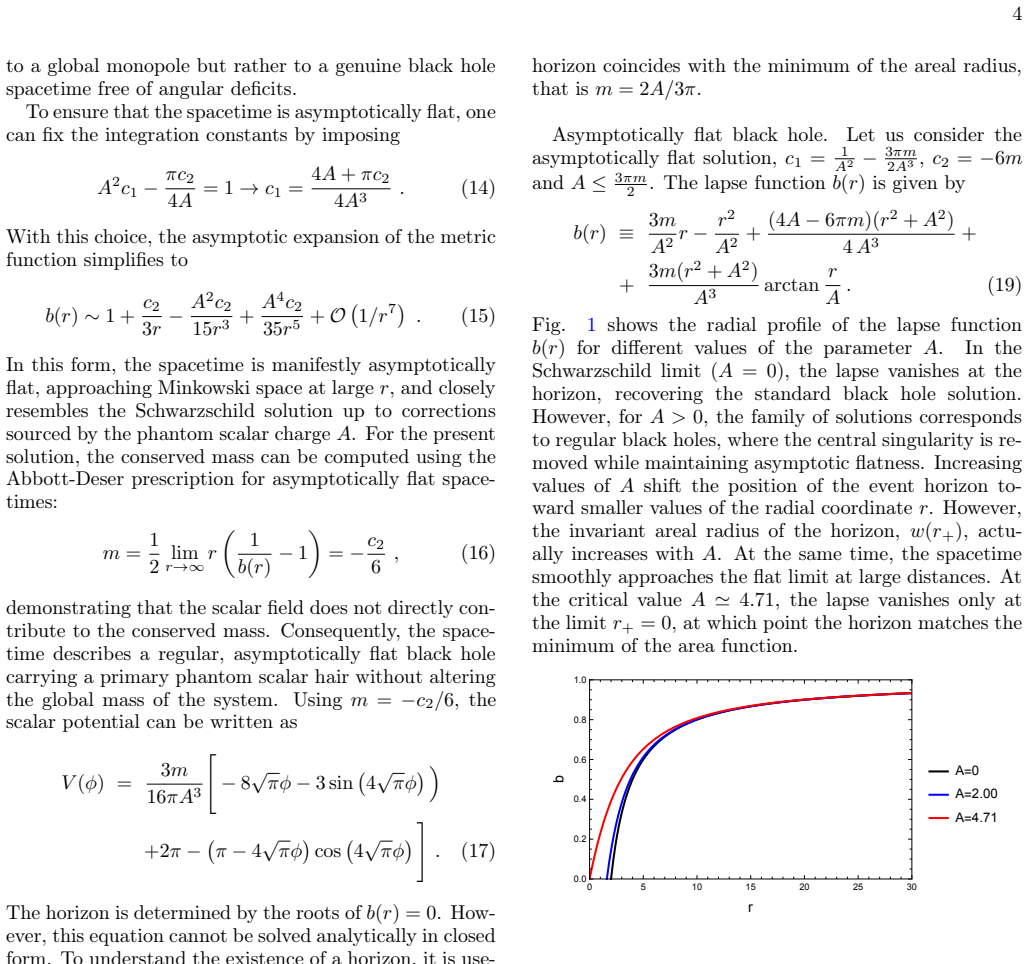
The different curves correspond to distinct values of the parameterA,A= 0.9(black curve),A= 1.0(blue curve), andA= 1.2(red curve) while the angular momentum number ℓis kept fixed (ℓ= 1). 13 VI. CONCLUSIONS In this work, we have investigated the dynamical re- sponse of asymptotically flat regular black holes sup- ported by a phantom scalar field, focusing ...
-
[2]
B. Wang, E. Abdalla, F. Atrio-Barandela, D. Pavón “ Dark Matter and Dark Energy Interactions: Theoretical Challenges, CosmologicalImplicationsandObservational Signatures,” Rept.Prog.Phys. 79 (2016) 9, 096901
work page 2016
-
[3]
Dynamical dark energy: Current constraints and forecasts
A. Upadhye, M. Ishak and P. J. Steinhardt, “Dynam- ical dark energy: Current constraints and forecasts,” Phys. Rev. D72(2005), 063501 [arXiv:astro-ph/0411803 [astro-ph]]
work page internal anchor Pith review Pith/arXiv arXiv 2005
-
[4]
New dark energy constraints from supernovae, microwave background and galaxy clus- tering,
Y. Wang and M. Tegmark, “New dark energy constraints from supernovae, microwave background and galaxy clus- tering,” Phys. Rev. Lett.92(2004), 241302 [arXiv:astro- ph/0403292 [astro-ph]]
-
[5]
U. Seljaket al.[SDSS], “Cosmological parameter analysis including SDSS Ly-alpha forest and galaxy bias: Con- straints on the primordial spectrum of fluctuations, neu- trino mass, and dark energy,” Phys. Rev. D71(2005), 103515 [arXiv:astro-ph/0407372 [astro-ph]]
work page internal anchor Pith review Pith/arXiv arXiv 2005
-
[6]
Cosmological constraints on the dark energy equation of state and its evolution
S. Hannestad and E. Mortsell, “Cosmological constraints on the dark energy equation of state and its evolution,” JCAP09(2004), 001 [arXiv:astro-ph/0407259 [astro- ph]]
work page internal anchor Pith review Pith/arXiv arXiv 2004
-
[7]
Is there Supernova Evidence for Dark Energy Metamorphosis ?
U. Alam, V. Sahni, T. D. Saini and A. A. Starobinsky, “Is there supernova evidence for dark energy metamor- phosis ?,” Mon. Not. Roy. Astron. Soc.354(2004), 275 [arXiv:astro-ph/0311364 [astro-ph]]
work page internal anchor Pith review Pith/arXiv arXiv 2004
-
[8]
Constraints on dark energy from Chandra observations of the largest relaxed galaxy clusters
S. W. Allen, R. W. Schmidt, H. Ebeling, A. C. Fabian and L. van Speybroeck, “Constraints on dark energy from Chandra observations of the largest relaxed galaxy clusters,” Mon. Not. Roy. Astron. Soc.353(2004), 457 [arXiv:astro-ph/0405340 [astro-ph]]
work page internal anchor Pith review Pith/arXiv arXiv 2004
-
[9]
A. Sen, “Rolling tachyon,” JHEP04(2002), 048 [arXiv:hep-th/0203211 [hep-th]]. “Tachyon matter,” JHEP07(2002), 065 [arXiv:hep-th/0203265 [hep-th]]
work page internal anchor Pith review Pith/arXiv arXiv 2002
-
[10]
Tachyons, Scalar Fields and Cosmology
V. Gorini, A. Y. Kamenshchik, U. Moschella and V. Pasquier, “Tachyons, scalar fields and cosmology,” Phys. Rev. D69(2004), 123512 [arXiv:hep-th/0311111 [hep-th]]
work page internal anchor Pith review Pith/arXiv arXiv 2004
-
[11]
Phantom cosmology with general potentials
V. Faraoni, “Phantom cosmology with general po- tentials,” Class. Quant. Grav.22(2005), 3235-3246 [arXiv:gr-qc/0506095 [gr-qc]]
work page internal anchor Pith review Pith/arXiv arXiv 2005
-
[12]
Quantum deSitter cosmology and phantom matter
S. Nojiri and S. D. Odintsov, “Quantum de Sitter cos- mology and phantom matter,” Phys. Lett. B562(2003), 147-152 [arXiv:hep-th/0303117 [hep-th]]
work page internal anchor Pith review Pith/arXiv arXiv 2003
-
[13]
Can the dark energy equation-of-state parameterwbe less than −1?,
S. M. Carroll, M. Hoffman and M. Trodden, “Can the dark energy equation-of-state parameterwbe less than −1?,” Phys. Rev. D68(2003), 023509, [arXiv:astro- ph/0301273 [astro-ph]]
-
[14]
Bardeen, In: Proceedings of GR5, Tiflis, USSR (1968)
J. Bardeen, In: Proceedings of GR5, Tiflis, USSR (1968)
work page 1968
-
[15]
D. Farrah, K. S. Croker, G. Tarlé, V. Faraoni, S. Petty, J. Afonso, N. Fernandez, K. A. Nishimura, C. Pearson and L. Wang,et al.“Observational Evidence for Cos- mological Coupling of Black Holes and its Implications for an Astrophysical Source of Dark Energy,” Astrophys. J. Lett.944, no.2, L31 (2023) [arXiv:2302.07878 [astro- ph.CO]]
-
[16]
2022, The Astrophysical Journal Letters, 930, L12
Akiyama, K., Alberdi, A., Alef, W., et al. 2022, The Astrophysical Journal Letters, 930, L12
work page 2022
-
[17]
K. A. Bronnikov and J. C. Fabris, “Regular phan- tom black holes,” Phys. Rev. Lett.96(2006), 251101 [arXiv:gr-qc/0511109 [gr-qc]]. K. A. Bronnikov, “Scalar fields as sources for wormholes and regular black holes,” Particles1(2018) no.1, 56-81 [arXiv:1802.00098 [gr-qc]]
work page internal anchor Pith review Pith/arXiv arXiv 2006
-
[18]
Vacuum nonsingular black hole,
I. Dymnikova, “Vacuum nonsingular black hole,” Gen. Rel. Grav.24, 235-242 (1992)
work page 1992
-
[19]
Regular Magnetic Black Holes and Monopoles from Nonlinear Electrodynamics
K. A. Bronnikov, “Regular magnetic black holes and monopoles from nonlinear electrodynamics,” Phys. Rev. D63(2001), 044005. [arXiv:gr-qc/0006014 [gr-qc]]
work page internal anchor Pith review Pith/arXiv arXiv 2001
-
[20]
Nonsingular vacuum cosmologies with a variable cosmological term
K. A. Bronnikov, A. Dobosz and I. G. Dymnikova, “Non- singular vacuum cosmologies with a variable cosmolog- ical term,” Class. Quant. Grav.20(2003), 3797-3814 [arXiv:gr-qc/0302029 [gr-qc]]
work page internal anchor Pith review Pith/arXiv arXiv 2003
-
[21]
Regular compact objects with scalar hair,
T. Karakasis, N. E. Mavromatos and E. Papantonopou- los, “Regular compact objects with scalar hair,” Phys. Rev. D108, no.2, 024001 (2023) [arXiv:2305.00058 [gr- qc]]
-
[22]
Quasi-Normal Modes of Stars and Black Holes
K. D. Kokkotas and B. G. Schmidt, “Quasinormal modes of stars and black holes,” Living Rev. Rel.2, 2 (1999) [arXiv:gr-qc/9909058 [gr-qc]]
work page internal anchor Pith review Pith/arXiv arXiv 1999
-
[23]
Quasinormal modes of black holes and black branes
E. Berti, V. Cardoso and A. O. Starinets, “Quasinormal modes of black holes and black branes,” Class. Quant. Grav.26, 163001 (2009) [arXiv:0905.2975 [gr-qc]]
work page internal anchor Pith review Pith/arXiv arXiv 2009
-
[24]
Quasinormal modes of black holes: from astrophysics to string theory
R. A. Konoplya and A. Zhidenko, “Quasinormal modes of black holes: From astrophysics to string theory,” Rev. Mod. Phys.83, 793-836 (2011) [arXiv:1102.4014 [gr-qc]]
work page internal anchor Pith review Pith/arXiv arXiv 2011
-
[25]
Instabilities of wormholes and regular black holes supported by a phantom scalar field
K. A. Bronnikov, R. A. Konoplya and A. Zhidenko, “Instabilities of wormholes and regular black holes sup- ported by a phantom scalar field,” Phys. Rev. D86 (2012), 024028 [arXiv:1205.2224 [gr-qc]]
work page internal anchor Pith review Pith/arXiv arXiv 2012
-
[26]
Black Hole Spectroscopy: Testing General Relativity through Gravitational Wave Observations
O. Dreyer, B. J. Kelly, B. Krishnan, L. S. Finn, D. Gar- rison and R. Lopez-Aleman, “Black hole spectroscopy: Testing general relativity through gravitational wave observations,” Class. Quant. Grav.21(2004), 787-804 [arXiv:gr-qc/0309007 [gr-qc]]
work page internal anchor Pith review Pith/arXiv arXiv 2004
-
[27]
On gravitational-wave spectroscopy of massive black holes with the space interferometer LISA
E. Berti, V. Cardoso and C. M. Will, “On gravitational- wave spectroscopy of massive black holes with the space interferometer LISA,” Phys. Rev. D73(2006), 064030 [arXiv:gr-qc/0512160 [gr-qc]]
work page internal anchor Pith review Pith/arXiv arXiv 2006
-
[28]
Is the gravitational-wave ringdown a probe of the event horizon?
V. Cardoso, E. Franzin and P. Pani, “Is the gravitational- wave ringdown a probe of the event horizon?,” Phys. Rev. Lett.116(2016) no.17, 171101 [erratum: Phys. Rev. Lett.117(2016) no.8, 089902] [arXiv:1602.07309 [gr-qc]]
work page internal anchor Pith review Pith/arXiv arXiv 2016
-
[29]
Testing the no-hair theorem with GW150914,
M. Isi, M. Giesler, W. M. Farr, M. A. Scheel and S. A. Teukolsky, “Testing the no-hair theorem with GW150914,” Phys. Rev. Lett.123(2019) no.11, 111102 [arXiv:1905.00869 [gr-qc]]
-
[30]
Transition from inspiral to plunge in binary black hole coalescences
A. Buonanno and T. Damour, “Transition from inspiral to plunge in binary black hole coalescences,” Phys. Rev. D62(2000), 064015 [arXiv:gr-qc/0001013 [gr-qc]]
work page internal anchor Pith review Pith/arXiv arXiv 2000
-
[31]
P. Ajith, S. Babak, Y. Chen, M. Hewitson, B. Krishnan, A.M.Sintes, J.T.Whelan, B.Bruegmann, P.Dienerand 17 N. Dorband,et al.“A Template bank for gravitational waveforms from coalescing binary black holes. I. Non- spinning binaries,” Phys. Rev. D77(2008), 104017 [erra- tum: Phys. Rev. D79(2009), 129901] [arXiv:0710.2335 [gr-qc]]
work page internal anchor Pith review Pith/arXiv arXiv 2008
-
[32]
S. Husa, S. Khan, M. Hannam, M. Pürrer, F. Ohme, X. Jiménez Forteza and A. Bohé, “Frequency-domain gravitational waves from nonprecessing black-hole bi- naries. I. New numerical waveforms and anatomy of the signal,” Phys. Rev. D93(2016) no.4, 044006 [arXiv:1508.07250 [gr-qc]]
work page internal anchor Pith review Pith/arXiv arXiv 2016
-
[33]
S. Khan, S. Husa, M. Hannam, F. Ohme, M. Pürrer, X. Jiménez Forteza and A. Bohé, “Frequency-domain gravitational waves from nonprecessing black-hole bina- ries. II. A phenomenological model for the advanced detector era,” Phys. Rev. D93(2016) no.4, 044007 [arXiv:1508.07253 [gr-qc]]
work page internal anchor Pith review Pith/arXiv arXiv 2016
-
[34]
Anomalous decay rate of quasinormal modes in Schwarzschild-dS and Schwarzschild-AdS black holes,
A. Aragón, P. A. González, E. Papantonopoulos and Y. Vásquez, “Anomalous decay rate of quasinormal modes in Schwarzschild-dS and Schwarzschild-AdS black holes,” JHEP08(2020), 120 [arXiv:2004.09386 [gr-qc]]
-
[35]
Quasinormal modes and their anomalous behavior for black holes inf(R)gravity,
A. Aragón, P. A. González, E. Papantonopoulos and Y. Vásquez, “Quasinormal modes and their anomalous behavior for black holes inf(R)gravity,” Eur. Phys. J. C81(2021) no.5, 407 [arXiv:2005.11179 [gr-qc]]
-
[36]
Anomalous decay rate of quasinormal modes in Reissner-Nordström black holes,
R. D. B. Fontana, P. A. González, E. Papantonopoulos and Y. Vásquez, “Anomalous decay rate of quasinormal modes in Reissner-Nordström black holes,” Phys. Rev. D 103(2021) no.6, 064005 [arXiv:2011.10620 [gr-qc]]
-
[37]
Massive scalar field perturbations in Weyl black holes,
R. Bécar, P. A. González, F. Moncada and Y. Vásquez, “Massive scalar field perturbations in Weyl black holes,” Eur. Phys. J. C83, no.10, 942 (2023) [arXiv:2304.00663 [gr-qc]]
-
[38]
Stability and quasi- normal modes of the massive scalar field around Kerr black holes,
R. A. Konoplya and A. Zhidenko, “Stability and quasi- normal modes of the massive scalar field around Kerr black holes,” Phys. Rev. D73(2006), 124040 [arXiv:gr- qc/0605013 [gr-qc]]
-
[39]
Instability of the massive Klein-Gordon field on the Kerr spacetime
S. R. Dolan, “Instability of the massive Klein-Gordon field on the Kerr spacetime,” Phys. Rev. D76(2007), 084001 [arXiv:0705.2880 [gr-qc]]
work page internal anchor Pith review Pith/arXiv arXiv 2007
-
[40]
Anomalous decay rate of quasinormal modes,
M.Lagos, P.G.FerreiraandO.J.Tattersall, “Anomalous decay rate of quasinormal modes,” Phys. Rev. D101 (2020) no.8, 084018 [arXiv:2002.01897 [gr-qc]]
-
[41]
Massive scalar field perturbations of black holes surrounded by dark matter,
R. Bécar, P. A. González, E. Papantonopoulos and Y. Vásquez, “Massive scalar field perturbations of black holes surrounded by dark matter,” Eur. Phys. J. C84 (2024) no.3, 329 [arXiv:2310.00857 [gr-qc]]
-
[42]
Massive scalar field perturbations of black holes immersed in Chaplygin-like dark fluid,
R. Bécar, P. A. González, E. Papantonopoulos and Y. Vásquez, “Massive scalar field perturbations of black holes immersed in Chaplygin-like dark fluid,” JCAP06, 061 (2024) [arXiv:2403.11306 [gr-qc]]
-
[43]
Massive scalar field perturbations of 4D de Sitter–Einstein-Gauss-Bonnet black holes,
R. Bécar, P. A. González, E. Papantonopoulos and Y. Vásquez, “Massive scalar field perturbations of 4D de Sitter–Einstein-Gauss-Bonnet black holes,” Phys. Rev. D 111, no.12, 124013 (2025) [arXiv:2505.17161 [gr-qc]]
-
[44]
Near-horizon geodesic instabilities and anomalous decay of quasinormal modes in Weyl black holes,
G. Kouniatalis, P. A. González, E. Papantonopoulos and Y. Vásquez, “Near-horizon geodesic instabilities and anomalous decay of quasinormal modes in Weyl black holes,” Phys. Rev. D112, no.12, 124061 (2025) [arXiv:2509.05164 [gr-qc]]
-
[45]
P. A. González, E. Papantonopoulos, J. Saavedra and Y. Vásquez, “Quasinormal modes for massive charged scalar fields in Reissner-Nordström dS black holes: anomalous decay rate,” JHEP06(2022), 150 [arXiv:2204.01570 [gr-qc]]
-
[46]
Quasinormal modes of a charged scalar field in Ernst black holes,
R. Bécar, P. A. González and Y. Vásquez, “Quasinormal modes of a charged scalar field in Ernst black holes,” Eur. Phys. J. C83, no.1, 75 (2023) [arXiv:2211.02931 [gr-qc]]
-
[47]
A. Aragón, R. Bécar, P. A. González and Y. Vásquez, “Massive Dirac quasinormal modes in Schwarzschild–de Sitter black holes: Anomalous decay rate and fine structure,” Phys. Rev. D103, no.6, 064006 (2021) [arXiv:2009.09436 [gr-qc]]
-
[48]
Ac- celerating black holes: quasinormal modes and late- time tails,
K. Destounis, R. D. B. Fontana and F. C. Mena, “Ac- celerating black holes: quasinormal modes and late- time tails,” Phys. Rev. D102, no.4, 044005 (2020) [arXiv:2005.03028 [gr-qc]]
-
[49]
Quasinormal modes of massive scalar fields in four-dimensional wormholes: Anomalous decay rate,
P. A. González, E. Papantonopoulos, Á. Rincón and Y. Vásquez, “Quasinormal modes of massive scalar fields in four-dimensional wormholes: Anomalous decay rate,” Phys. Rev. D106(2022) no.2, 024050 [arXiv:2205.06079 [gr-qc]]
-
[50]
Quasinormal modes and bound states of massive scalar fields in wormhole spacetimes,
S. Alfaro, P. A. González, D. Olmos, E. Papantonopoulos and Y. Vásquez, “Quasinormal modes and bound states of massive scalar fields in wormhole spacetimes,” Phys. Rev. D109(2024) no.10, 104009 [arXiv:2402.15575 [gr- qc]]
-
[51]
Observational Tests of Regular Black Holes with Scalar Hair and their Stability,
P. A. González, M. Olivares, E. Papantonopoulos and Y. Vásquez, “Observational Tests of Regular Black Holes with Scalar Hair and their Stability,” [arXiv:2510.18647 [gr-qc]]
-
[52]
Black hole with pri- mary scalar hair in Einstein-Weyl-Maxwell-conformal scalar theory,
D. C. Zou and Y. S. Myung, “Black hole with pri- mary scalar hair in Einstein-Weyl-Maxwell-conformal scalar theory,” Phys. Rev. D101, no.8, 084021 (2020) [arXiv:2001.01351 [gr-qc]]; A. Anabalon, F. Canfora, A. Giacomini and J. Oliva, “Black Holes with Primary Hair in gauged N=8 Super- gravity,” JHEP06, 010(2012)[arXiv:1203.6627[hep-th]]; S. Mignemi and D....
-
[53]
Quasi-normal modes of a black hole,
B. Mashhoon, “Quasi-normal modes of a black hole,” Third Marcel Grossmann Meeting on General Relativity 1983
work page 1983
-
[54]
Blackholenormalmodes: a semianalytic approach,
B.F.SchutzandC.M.Will, “Blackholenormalmodes: a semianalytic approach,” Astrophys. J. Lett.291(1985), L33-L36
work page 1985
-
[55]
S. Iyer and C. M. Will, “Black Hole Normal Modes: A WKB Approach. 1. Foundations and Application of a Higher Order WKB Analysis of Potential Barrier Scat- tering,” Phys. Rev. D35(1987), 3621
work page 1987
-
[56]
Quasinormal behavior of the D-dimensional Schwarzshild black hole and higher order WKB approach
R. A. Konoplya, “Quasinormal behavior of the d- dimensional Schwarzschild black hole and higher or- der WKB approach,” Phys. Rev. D68(2003), 024018 [arXiv:gr-qc/0303052 [gr-qc]]
work page internal anchor Pith review Pith/arXiv arXiv 2003
-
[57]
Quasinormal modes of black holes. The improved semianalytic approach
J.MatyjasekandM.Opala, “Quasinormalmodesofblack holes. The improved semianalytic approach,” Phys. Rev. D96(2017) no.2, 024011 [arXiv:1704.00361 [gr-qc]]
work page internal anchor Pith review Pith/arXiv arXiv 2017
-
[58]
R. A. Konoplya, A. Zhidenko and A. F. Zinhailo, “Higher order WKB formula for quasinormal modes 18 and grey-body factors: recipes for quick and accurate calculations,” Class. Quant. Grav.36(2019), 155002 [arXiv:1904.10333 [gr-qc]]
work page internal anchor Pith review Pith/arXiv arXiv 2019
-
[59]
QuasinormalmodesofblackholesandBorel summation,
Y.Hatsuda, “QuasinormalmodesofblackholesandBorel summation,” Phys. Rev. D101, no.2, 024008 (2020) [arXiv:1906.07232 [gr-qc]]
-
[60]
Quasinormal modes of AdS black holes and the approach to thermal equi- librium,
G. T. Horowitz and V. E. Hubeny, “Quasinormal modes of AdS black holes and the approach to thermal equi- librium,” Phys. Rev. D62, 024027 (2000) [arXiv:hep- th/9909056 [hep-th]]
-
[61]
A Method for Solving Algebraic Equa- tions Using an Automatic Computer,
Müller, David E., “A Method for Solving Algebraic Equa- tions Using an Automatic Computer,” MTAC, 10 (1956), 208-215
work page 1956
-
[62]
R. L. Burden and J. D. Faires, “Numerical Analysis,” 7th Edition, Addison-Wesley Inc., New York, 2000
work page 2000
-
[63]
Geodesic stability, Lyapunov exponents and quasinormal modes
V. Cardoso, A. S. Miranda, E. Berti, H. Witek and V. T. Zanchin, “Geodesic stability, Lyapunov exponents and quasinormal modes,” Phys. Rev. D79, no.6, 064016 (2009) [arXiv:0812.1806 [hep-th]]
work page internal anchor Pith review Pith/arXiv arXiv 2009
-
[64]
A WKB approach to scalar fields dynamics in curved space-time
J. Grain and A. Barrau, Nucl. Phys. B 742, 253 (2006) [arXiv:hep-th/0603042]. P. Kanti and R. A. Konoplya, Phys. Rev. D 73, 044002 (2006) [arXiv:hep- th/0512257]; H. Kodama, R. A. Konoplya and A. Zhi- denko, arXiv:0904.2154 [gr-qc]; S. K. Chakrabarti, Eur. Phys. J. C 61, 477 (2009) [arXiv:0809.1004 [gr-qc]]; Y. Zhang, Y. X. Gui and F. Yu, Chin. Phys. Lett...
work page internal anchor Pith review Pith/arXiv arXiv 2006
discussion (0)
Sign in with ORCID, Apple, or X to comment. Anyone can read and Pith papers without signing in.