Recognition: no theorem link
Millicharged Particle Production During Late-Stage Stellar Evolution
Pith reviewed 2026-05-13 20:45 UTC · model grok-4.3
The pith
Millicharged particles are emitted from pre-supernova stars through three distinct processes that depend on particle mass and plasma temperature.
A machine-rendered reading of the paper's core claim, the machinery that carries it, and where it could break.
Core claim
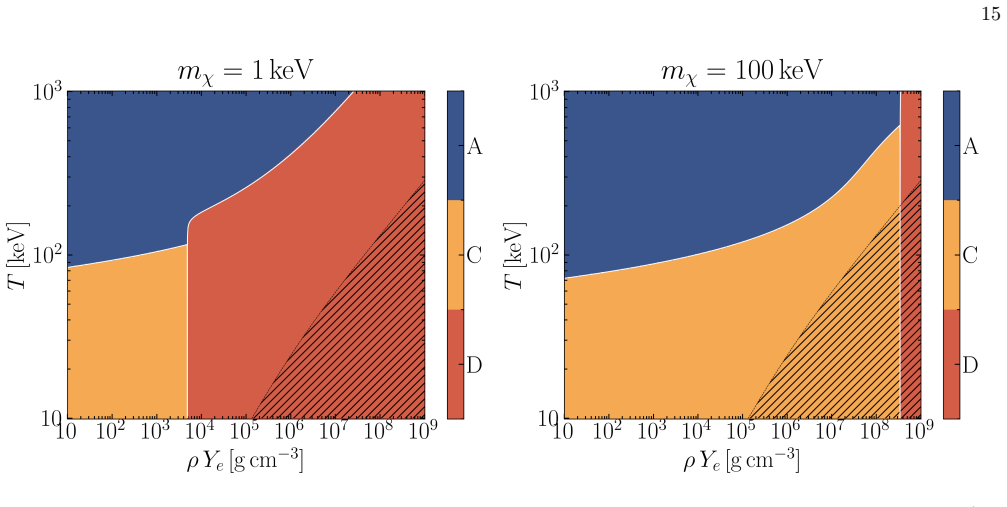
We compute the MCP energy-loss rates relevant for pre-supernova objects, finding three different regimes in which the dominant processes are respectively plasmon decay (m_χ < ω_pl/2), Compton-like scattering (m_χ > ω_pl/2, T ≲ 0.5 MeV), and electron-positron annihilation. We obtain semi-analytical fits for the energy-loss rates suitable for implementation in stellar evolution codes.
What carries the argument
Energy-loss rates computed from millicharged particle production via plasmon decay, Compton-like scattering off electrons, and electron-positron annihilation, under plasma conditions T ≃ 10-100 keV with ω_pl ≪ T.
If this is right
- Stellar evolution codes can now include MCP energy loss without performing full phase-space integrations at each time step.
- For particle masses below half the plasma frequency, plasmon decay sets the dominant cooling channel throughout the pre-supernova phase.
- Compton-like scattering governs energy loss once the particle mass exceeds half the plasma frequency but remains below roughly 0.5 MeV at temperatures below 0.5 MeV.
- Electron-positron annihilation becomes the leading source once temperatures rise above 0.5 MeV, independent of the precise mass value within the considered range.
- The supplied fitting functions allow rapid evaluation across the entire parameter space relevant to massive-star cores.
Where Pith is reading between the lines
- These rates could alter the predicted neutrino burst timing or total energy released in a core-collapse supernova if millicharged particles carry away a non-negligible fraction of the core energy.
- Similar regime analysis might be applied to other feebly interacting particles, such as axion-like particles, in the same stellar environments.
- Deviations between observed supernova progenitor properties and standard models could be used to place new bounds on millicharged particle parameters once the rates are implemented.
- The three-regime structure suggests that early-universe production calculations at comparable temperatures may also require separate treatment of plasmon, Compton, and annihilation channels.
Load-bearing premise
The three listed processes dominate the production rate under the stated temperature and mass conditions, and the semi-analytical approximations remain accurate over the full range of masses and temperatures in pre-supernova cores.
What would settle it
A numerical integration of the production matrix elements at T = 50 keV and m_χ = 10 keV that yields an energy-loss rate differing by more than 30 percent from the supplied semi-analytical fit.
Figures



read the original abstract
Stars are natural sources of feebly interacting particles, including putative particles with mass $m_\chi$ and electric charge $qe$. The emission of such millicharged particles (MCPs) causes an energy loss which can alter stellar evolution. While MCP production rates have been computed for different plasma parameters, they have yet to be derived for the conditions relevant to late stages of stellar evolution, in which the temperature can reach values $T\simeq 10-100\,\rm keV$ while the plasma frequency is $\omega_{\rm pl}\ll T$. In this paper, we compute the MCP energy-loss rates relevant for pre-supernova objects, finding three different regimes in which the dominant processes are respectively plasmon decay ($m_\chi< \omega_{\rm pl}/2$), Compton-like scattering ($m_\chi> \omega_{\rm pl}/2$, $T\lesssim 0.5\,\rm MeV$), and electron-positron annihilation. We obtain semi-analytical fits for the energy-loss rates suitable for implementation in stellar evolution codes.
Editorial analysis
A structured set of objections, weighed in public.
Referee Report
Summary. The paper computes MCP energy-loss rates for pre-supernova stellar conditions (T ≃ 10-100 keV, ω_pl ≪ T), identifying three regimes where the dominant processes are plasmon decay (m_χ < ω_pl/2), Compton-like scattering (m_χ > ω_pl/2, T ≲ 0.5 MeV), and electron-positron annihilation. Semi-analytical fits to these rates are derived for direct implementation in stellar evolution codes.
Significance. If the fits prove accurate, the work supplies a practical, ready-to-use tool for including MCP energy losses in pre-supernova simulations, which could tighten astrophysical bounds on millicharged particles. The regime classification follows standard QED kinematics and addresses a previously underexplored temperature window, but the overall impact hinges on quantitative validation of the approximations.
major comments (2)
- [Section 4] Section 4 (semi-analytical fits): no maximum fractional deviation, RMS error, or direct comparison to numerical integration of the exact rate expressions is reported over the full (m_χ, T) domain relevant to pre-supernova cores. Without these metrics, it is impossible to assess whether the fits remain sufficiently accurate for stellar codes, where even modest rate errors can alter core evolution.
- [Section 3] Section 3 (regime boundaries): the transition regions near m_χ ≈ ω_pl/2 and T ≈ 0.5 MeV are not checked for continuity or smoothness of the piecewise rates; a discontinuity or rapid change in the fitted expressions could affect numerical stability in evolution codes.
minor comments (1)
- Notation for the plasma frequency and the precise definition of the Compton-like process should be stated explicitly at first use to avoid ambiguity with standard QED Compton scattering.
Simulated Author's Rebuttal
We thank the referee for the careful reading and constructive comments on our manuscript. We address each major comment below and will revise the manuscript to incorporate quantitative validation of the fits and explicit checks on continuity at the regime boundaries.
read point-by-point responses
-
Referee: [Section 4] Section 4 (semi-analytical fits): no maximum fractional deviation, RMS error, or direct comparison to numerical integration of the exact rate expressions is reported over the full (m_χ, T) domain relevant to pre-supernova cores. Without these metrics, it is impossible to assess whether the fits remain sufficiently accurate for stellar codes, where even modest rate errors can alter core evolution.
Authors: We agree that quantitative error metrics are necessary to demonstrate the reliability of the semi-analytical fits for use in stellar evolution codes. We have now performed direct numerical integrations of the exact rate expressions and compared them to the fits across the full relevant domain (m_χ from ~0 to several MeV and T from 10 keV to 100 keV, with ω_pl ≪ T). The maximum fractional deviation is below 8% in all regimes, with an RMS error of ~2%. In the revised manuscript we will add these metrics to Section 4, including a table of errors per regime and a brief discussion of the comparison. revision: yes
-
Referee: [Section 3] Section 3 (regime boundaries): the transition regions near m_χ ≈ ω_pl/2 and T ≈ 0.5 MeV are not checked for continuity or smoothness of the piecewise rates; a discontinuity or rapid change in the fitted expressions could affect numerical stability in evolution codes.
Authors: We have re-examined the rates at the boundaries. By construction of the kinematic thresholds, the plasmon-decay and Compton-like rates match exactly at m_χ = ω_pl/2. At T ≈ 0.5 MeV the annihilation channel connects smoothly to the Compton-like rate. We will add an explicit statement in the revised Section 3 confirming continuity (mismatch < 1% at the boundaries) and smoothness, together with a short note that no discontinuities arise that would impact numerical stability in evolution codes. revision: yes
Circularity Check
No significant circularity; derivation from standard QED processes is self-contained
full rationale
The paper derives MCP energy-loss rates directly from standard QED matrix elements for plasmon decay, Compton-like scattering, and e+e- annihilation under the stated plasma conditions. Regime boundaries follow from kinematics (m_χ < ω_pl/2 etc.) without self-definition. Semi-analytical fits are presented as approximations to the computed integrals, not as inputs that redefine the result. No load-bearing self-citations, uniqueness theorems, or ansatze imported from prior author work are used; the central claim rests on explicit calculation rather than reduction to fitted parameters or renamed patterns. This is the normal case of an independent derivation.
Axiom & Free-Parameter Ledger
axioms (1)
- standard math Standard QED processes govern MCP production in hot plasma
Reference graph
Works this paper leans on
-
[1]
Foot,New Physics From Electric Charge Quantization?,Mod
R. Foot,New Physics From Electric Charge Quantization?,Mod. Phys. Lett. A6(1991) 527
work page 1991
-
[2]
R. N. Mohapatra and I. Z. Rothstein,Astrophysical constraints on mini-charged particles,Phys. Lett. B247 (1990) 593
work page 1990
-
[3]
C. Giunti and A. Studenikin,Neutrino electromagnetic interactions: a window to new physics,Rev. Mod. Phys. 87(2015) 531 [1403.6344]
-
[4]
Holdom,Two U(1)’s and Epsilon Charge Shifts, Phys
B. Holdom,Two U(1)’s and Epsilon Charge Shifts, Phys. Lett. B166(1986) 196
work page 1986
-
[5]
G. G. Raffelt,Stars as laboratories for fundamental physics: The astrophysics of neutrinos, axions, and other weakly interacting particles. 5, 1996
work page 1996
-
[6]
N. Vinyoles and H. Vogel,Minicharged Particles from the Sun: A Cutting-Edge Bound,JCAP03(2016) 002 [1511.01122]
-
[7]
M. I. Dobroliubov and A. Y. Ignatiev,Millicharged particles,Phys. Rev. Lett.65(1990) 679
work page 1990
-
[8]
S. Davidson, B. Campbell and D. C. Bailey,Limits on particles of small electric charge,Phys. Rev. D43 (1991) 2314
work page 1991
- [9]
-
[10]
M. Haft, G. Raffelt and A. Weiss,Standard and nonstandard plasma neutrino emission revisited, Astrophys. J.425(1994) 222 [astro-ph/9309014]. [Erratum: Astrophys.J. 438, 1017 (1995)]
work page internal anchor Pith review Pith/arXiv arXiv 1994
-
[11]
Astrophysical Bounds on Milli-Charged Particles in Models with a Paraphoton
S. Davidson and M. E. Peskin,Astrophysical bounds on millicharged particles in models with a paraphoton, Phys. Rev. D49(1994) 2114 [hep-ph/9310288]
work page internal anchor Pith review Pith/arXiv arXiv 1994
-
[12]
Updated Bounds on Milli-Charged Particles
S. Davidson, S. Hannestad and G. Raffelt,Updated bounds on millicharged particles,JHEP05(2000) 003 [hep-ph/0001179]
work page Pith review arXiv 2000
- [13]
-
[14]
H. Vogel and J. Redondo,Dark Radiation constraints on minicharged particles in models with a hidden photon,JCAP02(2014) 029 [1311.2600]
- [15]
- [16]
- [17]
-
[18]
Theory of Core-Collapse Supernovae
H.-T. Janka, K. Langanke, A. Marek, G. Martinez-Pinedo and B. Mueller,Theory of Core-Collapse Supernovae,Phys. Rept.442(2007) 38 [astro-ph/0612072]
work page internal anchor Pith review Pith/arXiv arXiv 2007
-
[19]
Janka,Explosion Mechanisms of Core-Collapse Supernovae,Ann
H.-T. Janka,Explosion Mechanisms of Core-Collapse Supernovae,Ann. Rev. Nucl. Part. Sci.62(2012) 407 [1206.2503]
-
[20]
E. Vitagliano, I. Tamborra and G. Raffelt,Grand Unified Neutrino Spectrum at Earth: Sources and Spectral Components,Rev. Mod. Phys.92(2020) 45006 [1910.11878]
- [21]
-
[22]
K. S. Hirata et al.,Observation in the Kamiokande-II Detector of the Neutrino Burst from Supernova SN 1987a,Phys. Rev. D38(1988) 448
work page 1988
-
[23]
R. M. Bionta et al.,Observation of a Neutrino Burst in Coincidence with Supernova SN 1987a in the Large Magellanic Cloud,Phys. Rev. Lett.58(1987) 1494. [25]IMBCollaboration, C. B. Bratton et al.,Angular distribution of events from SN1987A,Phys. Rev. D37 (1988) 3361
work page 1987
-
[24]
Koshiba,Observational neutrino astrophysics,Phys
M. Koshiba,Observational neutrino astrophysics,Phys. Rept.220(1992) 229
work page 1992
- [25]
-
[26]
S. E. Woosley, A. Heger and T. A. Weaver,The evolution and explosion of massive stars,Rev. Mod. Phys.74(2002) 1015
work page 2002
-
[27]
Langer,Pre-Supernova Evolution of Massive Single and Binary Stars,Ann
N. Langer,Pre-Supernova Evolution of Massive Single and Binary Stars,Ann. Rev. Astron. Astrophys.50 (2012) 107 [1206.5443]
-
[28]
E. Laplace, S. Justham, M. Renzo, Y. G¨ otberg, R. Farmer, D. Vartanyan and S. E. de Mink,Different to the core: The pre-supernova structures of massive single and binary-stripped stars,Astron. Astrophys.656 (2021) A58 [2102.05036]
-
[29]
J. B. Adams, M. A. Ruderman and C. H. Woo, Neutrino Pair Emission by a Stellar Plasma,Phys. Rev. 129(1963) 1383
work page 1963
-
[30]
M. H. Zaidi,Emission of neutrino-pairs from a stellar plasma,Nuovo Cimento A Serie40(1965) 502
work page 1965
-
[31]
G. Beaudet, V. Petrosian and E. E. Salpeter,Energy Losses due to Neutrino Processes,Astrophys. J.150 (1967) 979
work page 1967
-
[32]
D. A. Dicus,Stellar energy-loss rates in a convergent theory of weak and electromagnetic interactions,Phys. Rev. D6(1972) 941. 18
work page 1972
-
[33]
E. Braaten and D. Segel,Neutrino energy loss from the plasma process at all temperatures and densities,Phys. Rev. D48(1993) 1478 [hep-ph/9302213]
-
[34]
Differential Neutrino Rates and Emissivities from the Plasma Process in Astrophysical Systems
S. Ratkovic, S. I. Dutta and M. Prakash,Differential neutrino rates and emissivities from the plasma process in astrophysical systems,Phys. Rev. C67(2003) 123002 [astro-ph/0303501]
work page internal anchor Pith review Pith/arXiv arXiv 2003
-
[35]
E. Vitagliano, J. Redondo and G. Raffelt,Solar neutrino flux at keV energies,JCAP12(2017) 010 [1708.02248]
-
[36]
Redondo,Solar axion flux from the axion-electron coupling,JCAP12(2013) 008 [1310.0823]
J. Redondo,Solar axion flux from the axion-electron coupling,JCAP12(2013) 008 [1310.0823]
-
[37]
E. Vitagliano, J. Redondo and G. Raffelt,Solar neutrinos at keV energies: thermal flux,J. Phys. Conf. Ser.1342(2020) 012050 [1709.02811]
-
[38]
Helioscope Bounds on Hidden Sector Photons
J. Redondo,Helioscope Bounds on Hidden Sector Photons,JCAP07(2008) 008 [0801.1527]
work page internal anchor Pith review Pith/arXiv arXiv 2008
- [39]
-
[40]
J. Redondo and G. Raffelt,Solar constraints on hidden photons re-visited,JCAP08(2013) 034 [1305.2920]
-
[41]
N. Itoh, H. Hayashi, A. Nishikawa and Y. Kohyama, Neutrino Energy Loss in Stellar Interiors. VII. Pair, Photo-, Plasma, Bremsstrahlung, and Recombination Neutrino Processes,ApJS102(1996) 411
work page 1996
- [42]
-
[43]
D. F. G. Fiorillo, G. Lucente, J. Sakstein, E. Vitagliano and M. Cantiello,The black hole mass gap as a new probe of millicharged particles, In preparation
-
[44]
D. F. G. Fiorillo, G. Lucente, J. Sakstein and E. Vitagliano. In preparation
discussion (0)
Sign in with ORCID, Apple, or X to comment. Anyone can read and Pith papers without signing in.