Recognition: 1 theorem link
· Lean TheoremUnderstanding the Symmetric Mass Generation in Lattice-QCD
Pith reviewed 2026-05-13 20:50 UTC · model grok-4.3
The pith
Staggered fermions satisfy the general criteria for symmetric mass generation in lattice QCD
A machine-rendered reading of the paper's core claim, the machinery that carries it, and where it could break.
Core claim
The central claim is that the staggered fermion action, particularly its continuum form derived by Lee and Sharpe, satisfies the general criteria for symmetric mass generation. The work proposes an RG flow around the SMG transition informed by existing numerical results and identifies the Goldstone tetraquark meson states as a phenomenological signature of the type-II SMG phase.
What carries the argument
The staggered fermion action in its Lee-Sharpe continuum limit, which preserves the symmetries required for fermions to gain mass symmetrically without explicit breaking.
If this is right
- Recent numerical observations of SMG in staggered-fermion lattice QCD are explained by the action satisfying the required conditions.
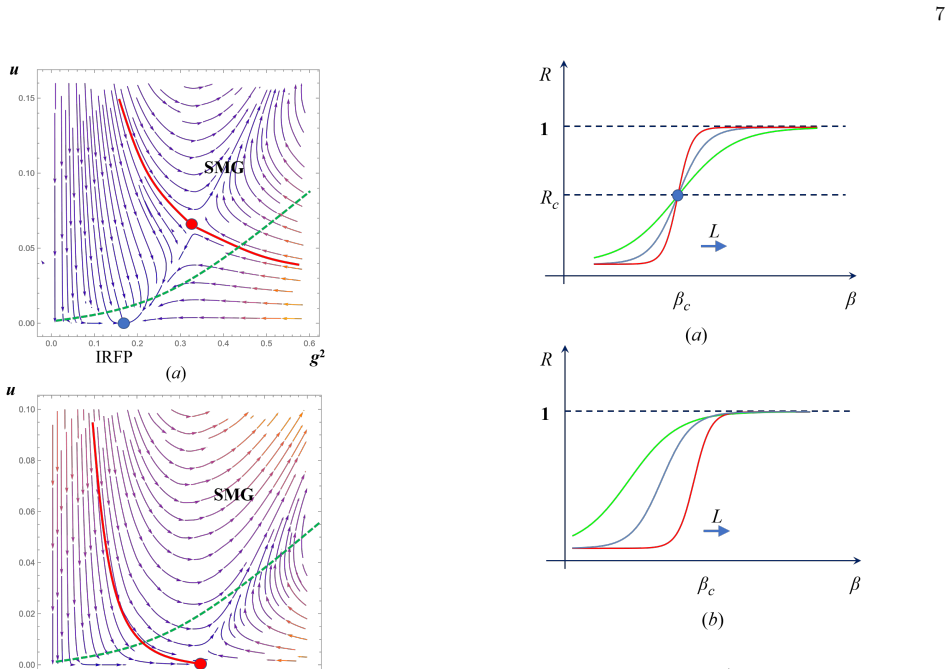
- A renormalization group flow can be constructed around the SMG transition point.
- Goldstone tetraquark meson states serve as a detectable signature of the type-II SMG phase.
Where Pith is reading between the lines
- SMG could provide a symmetry-preserving route to realistic quark masses in future lattice simulations of QCD.
- The same symmetry-matching logic might be tested on other fermion discretizations beyond staggered fermions.
- Tetraquark mass splittings could be measured in existing or planned lattice ensembles to confirm the type-II phase.
Load-bearing premise
The general criteria for SMG are correctly formulated and apply directly to the staggered fermion action.
What would settle it
A lattice simulation or analytical calculation in which the Lee-Sharpe continuum action fails to generate fermion masses while preserving all symmetries would falsify the claim.
Figures

read the original abstract
Signatures of symmetric mass generation (SMG) have recently been reported in lattice QCD calculations employing staggered fermions. We discuss the general criteria for SMG, and demonstrate that these conditions are indeed met by the staggered fermion action, in particular by the continuum action derived by Lee and Sharpe. We propose possible RG flow around the SMG transition, guided by the numerical results. We also point out that the Goldstone tetraquark meson states provide a phenomenological signature of the "type-II" SMG phase.
Editorial analysis
A structured set of objections, weighed in public.
Referee Report
Summary. The paper claims that staggered fermion actions satisfy the general criteria for symmetric mass generation (SMG) in lattice QCD, with particular emphasis on the continuum limit derived by Lee and Sharpe. It discusses these criteria, proposes an RG flow around the SMG transition informed by existing numerical results, and identifies Goldstone tetraquark meson states as a phenomenological signature of the type-II SMG phase.
Significance. If the central demonstration holds, the work supplies a needed theoretical bridge between recent lattice QCD observations of SMG signatures and continuum effective theory, clarifying how reduced taste symmetry can protect against explicit mass terms. The identification of tetraquark states as a diagnostic offers a concrete, falsifiable prediction for future simulations and strengthens the case for SMG as a viable mechanism in QCD-like theories.
major comments (2)
- [Section discussing the Lee-Sharpe continuum action] The demonstration that the Lee-Sharpe continuum action meets SMG criteria rests on symmetry counting alone. An explicit operator analysis is required to confirm that no relevant (dimension-6 or lower) taste-mixing four-fermion or mass operators allowed by the reduced taste symmetry are present and would violate the protecting symmetry; without this check the applicability of the general SMG criteria remains unverified.
- [Section on RG flow proposal] The proposed RG flow around the SMG transition is guided by numerical results but lacks quantitative matching to specific lattice observables (e.g., mass ratios or order parameters) or a clear statement of the relevant scaling exponents; this weakens the predictive content of the flow diagram.
minor comments (2)
- [Abstract] The abstract introduces the 'type-II' SMG phase without a prior definition or reference; a one-sentence clarification would improve readability.
- [Introduction] Notation for the taste symmetry group and its breaking pattern should be stated explicitly at first use rather than assumed from prior literature.
Simulated Author's Rebuttal
We thank the referee for their careful reading of our manuscript and for the constructive comments. We are pleased that the referee recognizes the potential significance of our work. We address each major comment below and have made revisions to the manuscript where appropriate.
read point-by-point responses
-
Referee: The demonstration that the Lee-Sharpe continuum action meets SMG criteria rests on symmetry counting alone. An explicit operator analysis is required to confirm that no relevant (dimension-6 or lower) taste-mixing four-fermion or mass operators allowed by the reduced taste symmetry are present and would violate the protecting symmetry; without this check the applicability of the general SMG criteria remains unverified.
Authors: We thank the referee for pointing this out. Although our original argument relied on the symmetry properties of the Lee-Sharpe action, we agree that an explicit operator analysis is valuable for completeness. In the revised manuscript, we have added an explicit enumeration of possible relevant operators consistent with the reduced taste symmetry, demonstrating that none violate the protecting symmetries required for SMG. revision: yes
-
Referee: The proposed RG flow around the SMG transition is guided by numerical results but lacks quantitative matching to specific lattice observables (e.g., mass ratios or order parameters) or a clear statement of the relevant scaling exponents; this weakens the predictive content of the flow diagram.
Authors: The RG flow diagram in our manuscript is a qualitative proposal based on the phase structure observed in existing lattice simulations. To strengthen this section, we have now included references to specific numerical observables, such as the reported mass ratios between Goldstone modes and other states, and have clarified the relevant scaling exponents drawn from the literature on similar transitions. A fully quantitative matching to lattice data would require new high-precision simulations, which we believe is beyond the scope of the present theoretical analysis but could be pursued in future work. revision: partial
Circularity Check
No significant circularity detected in derivation chain
full rationale
The paper discusses external general criteria for SMG and demonstrates their satisfaction by the staggered fermion action via the independently derived Lee-Sharpe continuum limit. No steps reduce by construction to fitted inputs, self-definitions, or load-bearing self-citations; the central demonstration rests on symmetry analysis and cited numerical results without renaming or smuggling ansatze. The derivation remains self-contained against external benchmarks.
Axiom & Free-Parameter Ledger
axioms (1)
- domain assumption General criteria for symmetric mass generation are correctly identified and universal
Reference graph
Works this paper leans on
- [1]
- [2]
-
[3]
J. Wang and X.-G. Wen, Nonperturbative regularization of (1 + 1)-dimensional anomaly-free chiral fermions and bosons: On the equivalence of anomaly matching con- ditions and boundary gapping rules, Phys. Rev. B107, 014311 (2023)
work page 2023
-
[4]
K. Slagle, Y.-Z. You, and C. Xu, Exotic quantum phase transitions of strongly interacting topological insulators, Phys. Rev. B91, 115121 (2015)
work page 2015
-
[5]
V. Ayyar and S. Chandrasekharan, Massive fermions without fermion bilinear condensates, Phys. Rev. D91, 065035 (2015)
work page 2015
-
[6]
V. Ayyar and S. Chandrasekharan, Origin of fermion masses without spontaneous symmetry breaking, Phys. Rev. D93, 081701 (2016)
work page 2016
-
[7]
V. Ayyar and S. Chandrasekharan, Fermion masses through four-fermion condensates, Journal of High En- ergy Physics2016, 10.1007/jhep10(2016)058 (2016)
-
[8]
S. Catterall, Fermion mass without symmetry breaking, Journal of High Energy Physics2016, 10.1007/jhep01(2016)121 (2016)
-
[9]
S. Catterall and D. Schaich, Novel phases in strongly coupled four-fermion theories, Phys. Rev. D96, 034506 (2017)
work page 2017
- [10]
-
[11]
N. Butt, S. Catterall, and D. Schaich,so(4) invariant higgs-yukawa model with reduced staggered fermions, Phys. Rev. D98, 114514 (2018)
work page 2018
- [12]
-
[13]
N. Butt, S. Catterall, and A. Hasenfratz, Symmetric mass generation with four su(2) doublet fermions, Phys. Rev. Lett.134, 031602 (2025)
work page 2025
- [14]
- [15]
-
[16]
S. S. Razamat and D. Tong, Gapped chiral fermions, Physical Review X11, 10.1103/physrevx.11.011063 (2021)
-
[17]
D. Tong, Comments on symmetric mass generation in 2d and 4d, Journal of High Energy Physics2022, 10.1007/jhep07(2022)001 (2022)
-
[18]
M. Zeng, Z. Zhu, J. Wang, and Y.-Z. You, Symmetric mass generation in the 1 + 1 dimensional chiral fermion 3-4-5-0 model, Phys. Rev. Lett.128, 185301 (2022)
work page 2022
-
[19]
Z. H. Liu, Y. Da Liao, G. Pan, M. Song, J. Zhao, W. Jiang, C.-M. Jian, Y.-Z. You, F. F. Assaad, Z. Y. Meng, and C. Xu, Disorder operator and r´ enyi entangle- ment entropy of symmetric mass generation, Phys. Rev. Lett.132, 156503 (2024)
work page 2024
-
[20]
J. Wang and Y.-Z. You, Symmetric mass generation, Symmetry14, 1475 (2022)
work page 2022
-
[21]
A. Hasenfratz and O. Witzel, Investigating su(3) with nf=8 fundamental fermions at strong renormalized cou- pling (2024), arXiv:2412.10322 [hep-lat]
- [22]
- [23]
- [24]
-
[25]
J. Wang and X.-G. Wen, Nonperturbative definition of the standard models, Physical Review Research2, 10.1103/physrevresearch.2.023356 (2020)
- [26]
-
[27]
Y. Tachikawa and K. Yonekura, Why are fractional charges of orientifolds compatible with dirac quantiza- tion?, SciPost Physics7, 10.21468/scipostphys.7.5.058 (2019)
-
[28]
I. Garc¨ªa-Etxebarria and M. Montero, Dai-freed anoma- lies in particle physics, Journal of High Energy Physics 2019, 10.1007/jhep08(2019)003 (2019)
-
[29]
S. Catterall, ’t hooft anomalies for staggered fermions, Physical Review D107, 10.1103/physrevd.107.014501 (2023)
-
[30]
A non-onsite symmetry would generally involve lattice transformations, such as translation
An onsite symmetry means that the symmetry operator is the product of operators acting on local tensor-product Hilbert spaces; it also implies that the symmetry can be promoted to a gauge symmetry. A non-onsite symmetry would generally involve lattice transformations, such as translation
-
[31]
H. Nielsen and M. Ninomiya, Absence of neutrinos on a lattice: (i). proof by homotopy theory, Nuclear Physics B185, 20 (1981)
work page 1981
-
[32]
H. Nielsen and M. Ninomiya, Absence of neutrinos on a lattice: (ii). intuitive topological proof, Nuclear Physics B193, 173 (1981)
work page 1981
-
[33]
Shamir, Constraints on the existence of chiral fermions in interacting lattice theories, Phys
Y. Shamir, Constraints on the existence of chiral fermions in interacting lattice theories, Phys. Rev. Lett.71, 2691 (1993)
work page 1993
-
[34]
M. Golterman and Y. Shamir, Constraints on the sym- metric mass generation paradigm for lattice chiral gauge 10 theories (2025), arXiv:2505.20436 [hep-lat]
-
[35]
L. Fidkowski and C. Xu, A no-go result for implement- ing chiral symmetries by locality-preserving unitaries in a three-dimensional hamiltonian lattice model of fermions, Phys. Rev. Lett.131, 196601 (2023)
work page 2023
-
[36]
Y. Tanizaki, Anomaly constraint on massless qcd and the role of skyrmions in chiral symmetry breaking, Journal of High Energy Physics2018, 10.1007/jhep08(2018)171 (2018)
-
[37]
C. C´ ordova, D. S. Freed, H. T. Lam, and N. Seiberg, Anomalies in the space of coupling constants and their dynamical applications II, SciPost Phys.8, 002 (2020)
work page 2020
- [38]
-
[39]
D. Gaiotto, Z. Komargodski, and N. Seiberg, Time- reversal breaking in qcd4, walls, and dualities in 2 + 1 dimensions, Journal of High Energy Physics2018, 10.1007/jhep01(2018)110 (2018)
-
[40]
H. T. Lam, D. Sehayek, and C. Xu, Anomaly analysis for symmetric mass generation, (2026), to appear
work page 2026
-
[41]
Weingarten, Mass inequalities for quantum chromo- dynamics, Phys
D. Weingarten, Mass inequalities for quantum chromo- dynamics, Phys. Rev. Lett.51, 1830 (1983)
work page 1983
-
[42]
In fact, if /DA,0 has no zero mode, det /DA is already pos- itive. If we take into account of zero modes of /DA,0, (det /DA)Nf also includes a factorm Nf n0, wheren 0 is the number of zero modes of /DA,0. Therefore an even in- tegerN f ensures that (det /DA)Nf being positive for any nonzerom
-
[43]
Witten, Some inequalities among hadron masses, Phys
E. Witten, Some inequalities among hadron masses, Phys. Rev. Lett.51, 2351 (1983)
work page 1983
-
[44]
C. Vafa and E. Witten, Restrictions on symmetry break- ing in vector-like gauge theories, Nuclear Physics B234, 173 (1984)
work page 1984
-
[45]
C. Vafa and E. Witten, Eigenvalue inequalities for fermions in gauge theories, Communications in Mathe- matical Physics95, 257 (1984)
work page 1984
-
[46]
I. I. Kogan, A. Kovner, and M. Shifman, Chiral symme- try breaking without bilinear condensates, unbroken ax- ialZ N symmetry, and exact qcd inequalities, Phys. Rev. D59, 016001 (1998)
work page 1998
-
[47]
M. Golterman, Staggered fermions (2024), arXiv:2406.02906 [hep-lat]
-
[48]
X. Chen, Y.-M. Lu, and A. Vishwanath, Nature Commu- nications5, 3507 (2014)
work page 2014
-
[49]
A. Vishwanath and T. Senthil, Physics of three- dimensional bosonic topological insulators: Surface- deconfined criticality and quantized magnetoelectric ef- fect, Phys. Rev. X3, 011016 (2013)
work page 2013
-
[50]
D. V. Else and R. Thorngren, Crystalline topological phases as defect networks, Phys. Rev. B99, 115116 (2019)
work page 2019
-
[51]
L. Li, M. Oshikawa, and Y. Zheng, Decorated defect construction of gapless-spt states, SciPost Physics17, 10.21468/scipostphys.17.1.013 (2024)
- [52]
-
[53]
M. Shifman and A. Yung, Non-abelian string junctions as confined monopoles, Phys. Rev. D70, 045004 (2004)
work page 2004
-
[54]
A. Hanany and D. Tong, Vortices, instantons and branes, Journal of High Energy Physics2003, 037–037 (2003)
work page 2003
-
[55]
Tong, Quantum vortex strings: A review, Annals of Physics324, 30–52 (2009)
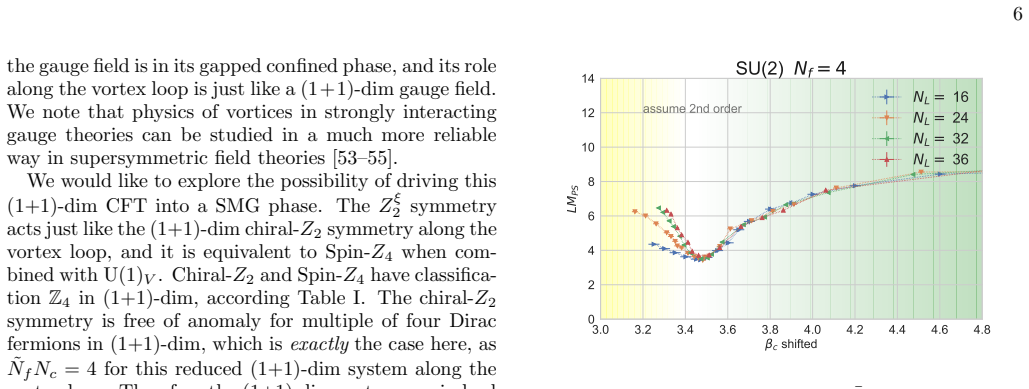
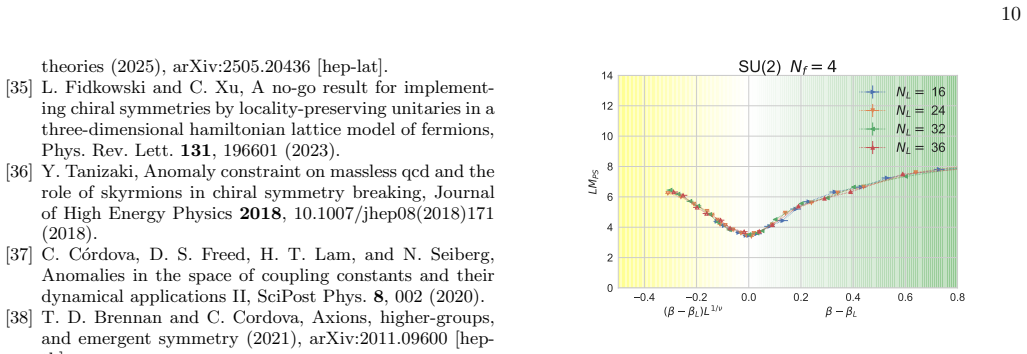
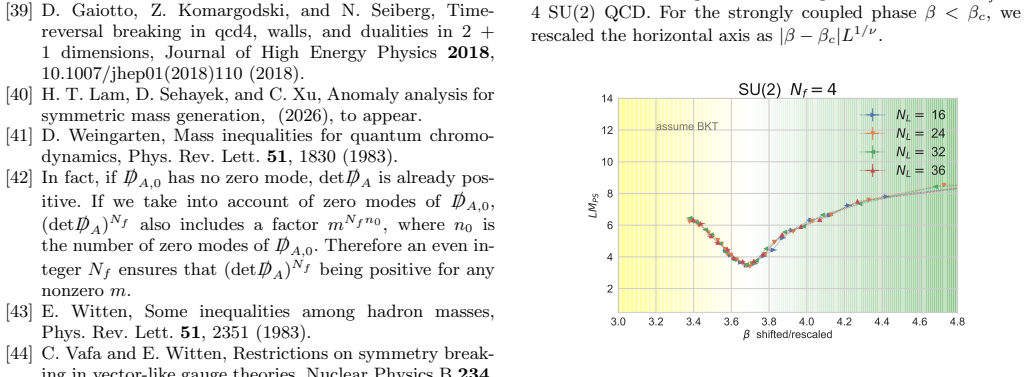
D. Tong, Quantum vortex strings: A review, Annals of Physics324, 30–52 (2009). 0.4 0.2 0.0 0.2 0.4 0.6 0.8 ( L)L1/ L 0 2 4 6 8 10 12 14LMPS SU(2) Nf = 4 NL = 16 NL = 24 NL = 32 NL = 36 FIG. 5. The attempted data collapse forLM PS forN f = 4 SU(2) QCD. For the strongly coupled phaseβ < β c, we rescaled the horizontal axis as|β−β c|L1/ν. 3.0 3.2 3.4 3.6 3.8...
work page 2009
-
[56]
T. Karavirta, J. Rantaharju, K. Rummukainen, and K. Tuominen, Determining the conformal window: Su(2) gauge theory with n f = 4, 6 and 10 fermion flavours, Journal of High Energy Physics2012, 10.1007/jhep05(2012)003 (2012)
-
[57]
A. Amato, V. Leino, K. Rummukainen, K. Tuominen, and S. T¨ ahtinen, From chiral symmetry breaking to con- formality in su(2) gauge theory (2018), arXiv:1806.07154 [hep-lat]. Appendix A: Extra Data In Fig. 5 we demonstrate the attempted data collapse ofLM PS for theN f = 4 SU(2)-QCD. For the strongly coupled phaseβ < β c, the horizontal axis is rescaled as...
discussion (0)
Sign in with ORCID, Apple, or X to comment. Anyone can read and Pith papers without signing in.