Recognition: no theorem link
Simulation Platform To Evaluate Inversion Techniques For Magnetic Resonance Elastography Data
Pith reviewed 2026-05-13 20:48 UTC · model grok-4.3
The pith
A simulation platform for magnetic resonance elastography shows inversion accuracy depends non-monotonically on resolution due to frequency-domain errors.
A machine-rendered reading of the paper's core claim, the machinery that carries it, and where it could break.
Core claim
The paper establishes a new simulation-based benchmarking platform for MRE inversion techniques by generating displacement data from finite element solutions of the forward problem in linear visco-elastic media. Application to direct inversion reveals that reconstruction accuracy for the visco-elastic parameters depends non-monotonically on spatial and temporal resolution of the measurement grid, caused by compromised convergence properties of frequency-domain stencils due to truncation and subtractive cancellation errors. Reconstructions on inhomogeneous domains recover interface boundaries successfully, while pressurized vascular inclusions produce an apparent stiffening of the surrounding
What carries the argument
The in-silico dataset generated by finite element forward simulations of shear wave propagation, providing known ground-truth mechanical properties for testing inversion schemes such as direct inversion.
Load-bearing premise
The linear visco-elastic material model together with the finite element forward simulations accurately represent the physics of shear wave propagation without major numerical or modeling errors.
What would settle it
Directly comparing the shear modulus and viscosity values recovered by direct inversion against the exact values prescribed in the finite element model; systematic deviation that does not follow the predicted non-monotonic pattern with resolution would falsify the claim.
Figures


read the original abstract
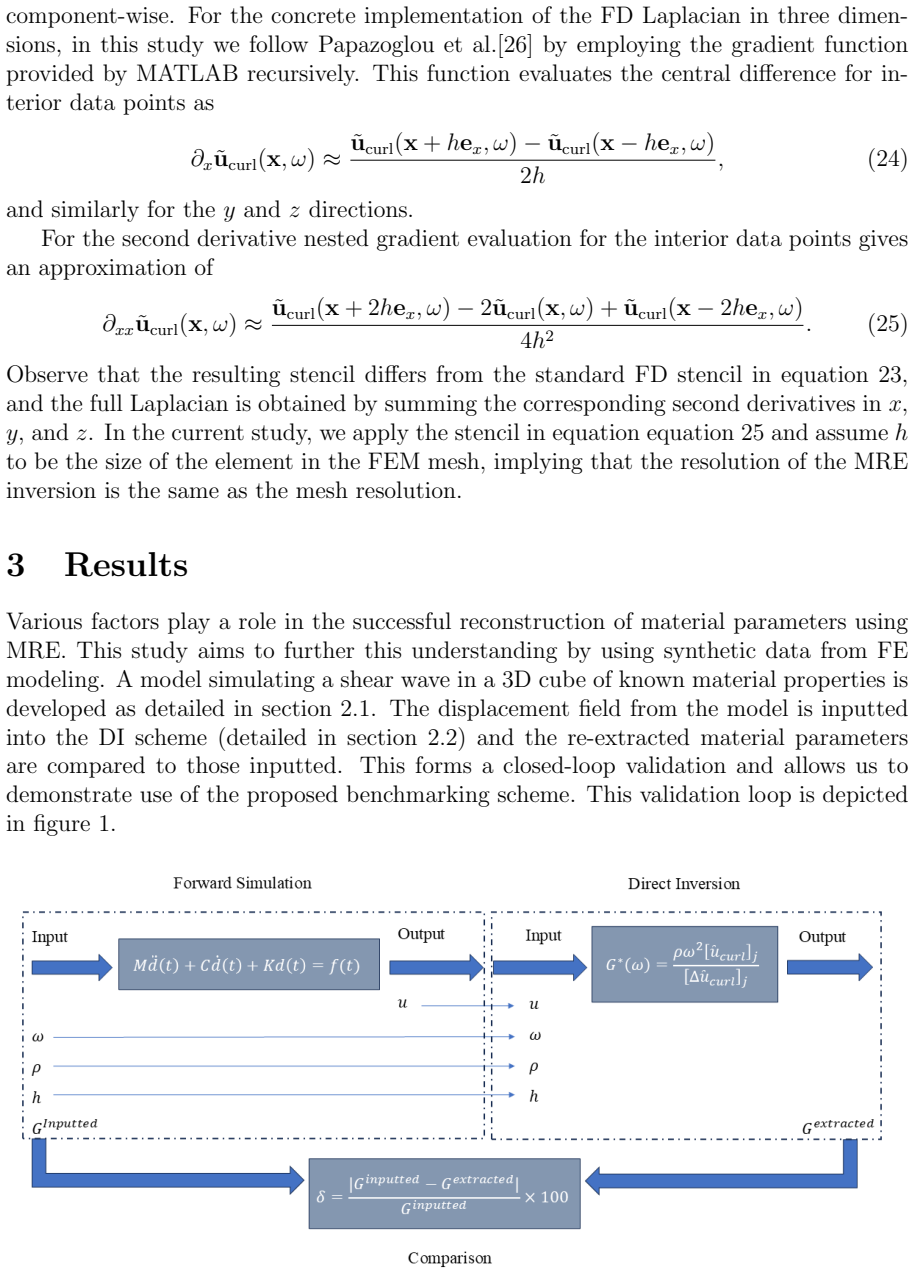
Magnetic Resonance Elastography (MRE) has become an essential tool in assessing the mechanical properties of soft tissues in-vivo, prompting significant progress in new inversion algorithms. This creates a need for a benchmarking framework to promote uniformity and accessibility. To address this, we introduce a comprehensive in-silico dataset acquired by solving the forward Finite Element calculations of shear wave propagation in a linear visco-elastic material. This dataset aims to serve as a platform for evaluating inversion schemes by providing data that can be used as input with known mechanical properties to these methods. It includes simulations on homogeneous cuboidal domains of varying spatial and temporal resolution, and an extension to more physiological variations, including material inhomogeneity and internal arterial pulsation. We present a comprehensive case study using simulated data as an input to a direct inversion (DI) scheme, which allows for an expedient local inversion into the underlying material parameters. When aiming to reconstruct the parameters describing the linear visco-elastic material behavior via DI, we find that due to compromised convergence properties of frequency-domain stencils, stemming from truncation and subtractive cancellation errors, the reconstruction accuracy depends non-monotonically on the spatial and temporal resolution of the measurement grid. For inhomogeneous domains, the reconstruction was successful with notable interface boundaries. In the presence of pressurized vascular inclusions, a general stiffening of the domain was noted, as the recovered shear modulus was higher than the one assumed in forward modeling. Our study highlights the potential of this dataset as a vital benchmarking tool for advancing the development and refinement of MRE techniques, contributing to more accurate and reliable assessment of soft tissue mechanics.
Editorial analysis
A structured set of objections, weighed in public.
Referee Report
Summary. The manuscript introduces a simulation platform consisting of finite-element solutions to the linear visco-elastic wave equation on homogeneous and inhomogeneous cuboidal domains, intended as a benchmarking dataset for MRE inversion algorithms. A case study applies a direct-inversion (DI) scheme to the generated data and reports that reconstruction accuracy for the shear modulus and viscosity depends non-monotonically on spatial and temporal grid resolution, which the authors attribute to truncation and subtractive-cancellation errors in the frequency-domain stencils.
Significance. If the forward simulations are shown to be converged to tolerances tighter than the reported reconstruction errors, the platform would supply a reproducible, parameter-controlled testbed that directly exposes numerical pathologies of frequency-domain inversion methods. The inclusion of material inhomogeneity and pressurized inclusions extends the dataset beyond idealized cases and could accelerate development of robust MRE techniques, provided the forward-model fidelity is documented.
major comments (1)
- [Case study / Results] The central claim that non-monotonic DI reconstruction error arises from truncation and subtractive cancellation in the frequency-domain stencils (abstract and case-study section) presupposes that the forward FE fields themselves have converged to within the reconstruction tolerances at every resolution examined. No residual-norm check, manufactured-solution test, or comparison against an analytical solution is reported to confirm that forward discretization error is both small and monotonically decreasing with refinement; at coarse grids the observed non-monotonicity could therefore be dominated by the forward solver rather than the inversion operator.
minor comments (2)
- [Methods] The description of the DI scheme implementation (stencil construction, handling of complex-valued fields, and boundary conditions) is too brief to allow independent reproduction; explicit pseudocode or a reference to the precise discretization would strengthen the manuscript.
- [Figures] Figure captions should state the exact grid resolutions (h and Δt) and the precise error metric (e.g., L2 relative error on μ) used to generate the non-monotonic curves.
Simulated Author's Rebuttal
We thank the referee for the constructive comment on forward-solver validation. We agree that explicit convergence evidence is required to isolate the source of the observed non-monotonic reconstruction errors.
read point-by-point responses
-
Referee: [Case study / Results] The central claim that non-monotonic DI reconstruction error arises from truncation and subtractive cancellation in the frequency-domain stencils (abstract and case-study section) presupposes that the forward FE fields themselves have converged to within the reconstruction tolerances at every resolution examined. No residual-norm check, manufactured-solution test, or comparison against an analytical solution is reported to confirm that forward discretization error is both small and monotonically decreasing with refinement; at coarse grids the observed non-monotonicity could therefore be dominated by the forward solver rather than the inversion operator.
Authors: We acknowledge that the current manuscript does not report residual-norm histories, manufactured-solution tests, or direct comparisons to analytical solutions for the forward finite-element solver. In the revised version we will add a new subsection (Methods/Forward Solver Validation) that (i) documents the L2 residual norm of the discrete visco-elastic wave equation at each spatial-temporal resolution, (ii) compares the homogeneous-domain solutions against the known analytical plane-wave solution, and (iii) shows that the forward discretization error decreases monotonically and lies at least one order of magnitude below the reconstruction errors reported in the case study. These additions will confirm that the non-monotonic dependence on grid resolution originates from the frequency-domain inversion stencils rather than from the forward fields. revision: yes
Circularity Check
No circularity: forward simulation with known ground truth feeds independent inversion tests
full rationale
The paper constructs an in-silico dataset by solving the forward linear visco-elastic wave equation via finite elements on grids of varying resolution, then feeds those fields into a direct-inversion scheme whose output is compared against the known input parameters. The reported non-monotonic dependence of reconstruction error on grid resolution is an empirical observation from this workflow, not a quantity that is fitted or defined in terms of itself. No load-bearing self-citation, ansatz smuggling, or uniqueness theorem imported from the authors' prior work appears in the derivation chain; the central claim remains an external check against independently generated data.
Axiom & Free-Parameter Ledger
axioms (1)
- domain assumption Shear wave propagation in linear visco-elastic material can be accurately modeled by finite element method
Reference graph
Works this paper leans on
-
[1]
The deal.II Library, Version 9.5.Journal of Numeri- cal Mathematics, 31(3):231–246, September 2023
Daniel Arndt, Wolfgang Bangerth, Maximilian Bergbauer, Marco Feder, Marc Fehling, Johannes Heinz, Timo Heister, Luca Heltai, Martin Kronbichler, Matthias Maier, Peter Munch, Jean-Paul Pelteret, Bruno Turcksin, David Wells, and Stefano Zampini. The deal.II Library, Version 9.5.Journal of Numeri- cal Mathematics, 31(3):231–246, September 2023. ISSN 1569-395...
-
[2]
Davies, Cemre Ariyurek, Andreas Fehlner, J¨ urgen Braun, and Ingolf Sack
Eric Barnhill, Penny J. Davies, Cemre Ariyurek, Andreas Fehlner, J¨ urgen Braun, and Ingolf Sack. Heterogeneous Multifrequency Direct Inversion (HMDI) for mag- netic resonance elastography with application to a clinical brain exam.Med- ical Image Analysis, 46:180–188, May 2018. ISSN 1361-8415. doi: 10.1016/ j.media.2018.03.003. URLhttps://www.sciencedirec...
work page 2018
-
[3]
John W. Barrett and Charles M. Elliott. Finite element approximation of the Dirichlet problem using the boundary penalty method.Numerische Mathematik, 49(4):343–366, July 1986. ISSN 0945-3245. doi: 10.1007/BF01389536. URL https://doi.org/10.1007/BF01389536. 20
-
[4]
Camilla Belponer, Alfonso Caiazzo, and Luca Heltai. Reduced Lagrange multi- plier approach for non-matching coupled problems in multiscale elasticity, September
- [5]
-
[6]
Joseph Benzaken, John A. Evans, and Rasmus Tamstorf. Constructing Nitsche’s Method for Variational Problems.Archives of Computational Methods in Engineer- ing, 31(4):1867–1896, May 2024. ISSN 1886-1784. doi: 10.1007/s11831-023-09953-6. URLhttps://doi.org/10.1007/s11831-023-09953-6
-
[7]
Jean-Pierre Berenger. A perfectly matched layer for the absorption of electromag- netic waves.Journal of Computational Physics, 114(2):185–200, October 1994. ISSN 0021-9991. doi: 10.1006/jcph.1994.1159. URLhttps://www.sciencedirect.com/ science/article/pii/S0021999184711594
-
[8]
Optimiza- tion with Gradient and Hessian Information Calculated Using Hyper-Dual Numbers
Jeffrey Fike, Sietse Jongsma, Juan Alonso, and Edwin Van Der Weide. Optimiza- tion with Gradient and Hessian Information Calculated Using Hyper-Dual Numbers. In29th AIAA Applied Aerodynamics Conference, Honolulu, Hawaii, June 2011. American Institute of Aeronautics and Astronautics. ISBN 9781624101458. doi: 10.2514/6.2011-3807. URLhttps://arc.aiaa.org/doi...
-
[9]
Luca Heltai and Alfonso Caiazzo. Multiscale modeling of vascularized tissues via nonmatching immersed methods.International Journal for Numerical Methods in Biomedical Engineering, 35(12):e3264, December 2019. ISSN 2040-7947. doi: 10. 1002/cnm.3264
work page 2019
-
[10]
Luca Heltai and Paolo Zunino. Reduced lagrange multiplier approach for non- matching coupling of mixed-dimensional domains.Mathematical Models and Methods in Applied Sciences, 33(12):2425–2462, 2023
work page 2023
-
[11]
Wiley-VCH Verlag, Weinheim, 2017
Sebastian Hirsch, J¨ urgen Braun, and Ingolf Sack.Magnetic Resonance Elastography: Physical Background And Medical Applications. Wiley-VCH Verlag, Weinheim, 2017. ISBN 978-3-527-34008-8
work page 2017
-
[12]
Hollis, Eric Barnhill, Noel Conlisk, L
Lyam M. Hollis, Eric Barnhill, Noel Conlisk, L. E. J. Thomas-Seale, John Roberts, Pankaj Pankaj, and Peter Hoskins. Finite Element Analysis to Compare the Accuracy of the Direct and MDEV Inversion Algorithms in MR Elastography. IAENG International Journal of Computer Science, 43(2):137–146, May 2016. ISSN 1819-656X. URLhttps://www.research.ed.ac.uk/en/pub...
work page 2016
-
[13]
M Honarvar, R Rohling, and S E Salcudean. A comparison of direct and it- erative finite element inversion techniques in dynamic elastography.Physics in Medicine and Biology, 61(8):3026–3048, April 2016. ISSN 0031-9155, 1361-6560. doi: 10.1088/0031-9155/61/8/3026. URLhttps://iopscience.iop.org/article/10. 1088/0031-9155/61/8/3026
-
[14]
Sahebjavaher, Robert Rohling, and Septimiu E
Mohammad Honarvar, Ramin S. Sahebjavaher, Robert Rohling, and Septimiu E. Salcudean. A Comparison of Finite Element-Based Inversion Algorithms, Lo- cal Frequency Estimation, and Direct Inversion Approach Used in MRE.IEEE Transactions on Medical Imaging, 36(8):1686–1698, August 2017. ISSN 1558-254X. doi: 10.1109/TMI.2017.2686388. URLhttps://ieeexplore.ieee...
-
[15]
Thomas J. R. Hughes.The finite element method: linear static and dynamic finite element analysis. Prentice Hall, Englewood Cliffs, N.J., 1. dr. edition, 1987. ISBN 9780133170252 9780133170177
work page 1987
-
[16]
A. Javili, S. Firooz, A. T. McBride, and P. Steinmann. The computational framework for continuum-kinematics-inspired peridynamics.Computational Mechanics, 66(4): 795–824, October 2020. ISSN 1432-0924. doi: 10.1007/s00466-020-01885-3. URL https://doi.org/10.1007/s00466-020-01885-3
- [17]
-
[18]
Oh In Kwon, Chunjae Park, Hyun Soo Nam, Eung Je Woo, Jin Keun Seo, K. J. Glaser, A. Manduca, and R. L. Ehman. Shear Modulus Decomposition Algorithm in Magnetic Resonance Elastography.IEEE Transactions on Medical Imaging, 28 (10):1526–1533, October 2009. ISSN 1558-254X. doi: 10.1109/TMI.2009.2019823. URLhttps://ieeexplore.ieee.org/document/5265288/?arnumbe...
-
[19]
K. L. Lai and J. L. Crassidis. Extensions of the first and second complex-step derivative approximations.Journal of Computational and Applied Mathematics, 219 (1):276–293, September 2008. ISSN 0377-0427. doi: 10.1016/j.cam.2007.07.026. URL https://www.sciencedirect.com/science/article/pii/S0377042707004086
-
[20]
M. D. J. McGarry, C. L. Johnson, B. P. Sutton, J. G. Georgiadis, E. E. W. Van Houten, A. J. Pattison, J. B. Weaver, and K. D. Paulsen. Suitability of poroelas- tic and viscoelastic mechanical models for high and low frequency MR elastography. Medical Physics, 42(2):947–957, 2015. ISSN 2473-4209. doi: 10.1118/1.4905048. URLhttps://onlinelibrary.wiley.com/d...
-
[21]
Matthew McGarry, Elijah Van Houten, Damian Sowinski, Dhrubo Jyoti, Daniel R. Smith, Diego A. Caban-Rivera, Grace McIlvain, Philip Bayly, Curtis L. John- son, John Weaver, and Keith Paulsen. Mapping heterogenous anisotropic tissue mechanical properties with transverse isotropic nonlinear inversion MR elastog- raphy.Medical Image Analysis, 78:102432, May 20...
-
[22]
McGrath, Nishant Ravikumar, Iain D
Deirdre M. McGrath, Nishant Ravikumar, Iain D. Wilkinson, Alejandro F. Frangi, and Zeike A. Taylor. Magnetic resonance elastography of the brain: An in silico study to determine the influence of cranial anatomy.Magnetic Resonance in Medicine, 76(2):645–662, 2016. ISSN 1522-2594. doi: 10.1002/mrm.25881. URLhttps:// onlinelibrary.wiley.com/doi/abs/10.1002/mrm.25881
-
[23]
Deirdre M McGrath, Christopher R Bradley, and Susan T Francis. In silico evalu- ation and optimisation of magnetic resonance elastography of the liver.Physics in Medicine & Biology, 66(22):225005, November 2021. ISSN 0031-9155. doi: 10.1088/ 1361-6560/ac3263. URLhttps://dx.doi.org/10.1088/1361-6560/ac3263. 22
-
[24]
Tom Meyer, Stephan Marticorena Garcia, Heiko Tzsch¨ atzsch, Helge Herthum, Mehrgan Shahryari, Lisa Stencel, J¨ urgen Braun, Prateek Kalra, Arunark Kolipaka, and Ingolf Sack. Comparison of inversion methods in mr elastography: An open- access pipeline for processing multifrequency shear-wave data and demonstration in a phantom, human kidneys, and brain.Mag...
-
[25]
Joaquin Mura, Felix Schrank, and Ingolf Sack. An analytical solution to the dispersion-by-inversion problem in magnetic resonance elastography.Magnetic Res- onance in Medicine, 84(1):61–71, July 2020. ISSN 1522-2594. doi: 10.1002/mrm. 28247
work page doi:10.1002/mrm 2020
-
[26]
Nathan M. Newmark. A Method of Computation for Structural Dynamics.Journal of the Engineering Mechanics Division, 85(3):67–94, July 1959. ISSN 0044-7951, 2690-2427. doi: 10.1061/JMCEA3.0000098. URLhttps://ascelibrary.org/doi/ 10.1061/JMCEA3.0000098
-
[27]
S. Papazoglou, U. Hamhaber, J. Braun, and I. Sack. Algebraic Helmholtz inversion in planar magnetic resonance elastography.Physics in Medicine and Biology, 53(12): 3147–3158, June 2008. ISSN 0031-9155. doi: 10.1088/0031-9155/53/12/005
-
[28]
Kay M. Pepin, Richard L. Ehman, and Kiaran P. McGee. Magnetic resonance elastography (MRE) in cancer: Technique, analysis, and applications.Progress in nuclear magnetic resonance spectroscopy, 0:32–48, November 2015. ISSN 0079-
work page 2015
-
[29]
URLhttps://www.ncbi.nlm.nih.gov/ pmc/articles/PMC4660259/
doi: 10.1016/j.pnmrs.2015.06.001. URLhttps://www.ncbi.nlm.nih.gov/ pmc/articles/PMC4660259/
-
[30]
Ingolf Sack. Magnetic resonance elastography from fundamental soft-tissue me- chanics to diagnostic imaging.Nature Reviews Physics, 5(1):25–42, January 2023. ISSN 2522-5820. doi: 10.1038/s42254-022-00543-2. URLhttps://www.nature. com/articles/s42254-022-00543-2
-
[31]
Ingolf Sack, Korinna J¨ ohrens, Jens W¨ urfel, and J¨ urgen Braun. Structure-sensitive elastography: on the viscoelastic powerlaw behavior of in vivo human tissue in health and disease.Soft Matter, 9(24):5672–5680, May 2013. ISSN 1744-6848. doi: 10.1039/ C3SM50552A. URLhttps://pubs.rsc.org/en/content/articlelanding/2013/ sm/c3sm50552a. 23
work page 2013
discussion (0)
Sign in with ORCID, Apple, or X to comment. Anyone can read and Pith papers without signing in.