Recognition: 1 theorem link
· Lean TheoremSpeed-Error Cross-Correlation Dating of Ancient Star Catalogues, with Application to the Almagest
Pith reviewed 2026-05-13 20:10 UTC · model grok-4.3
The pith
The Almagest star catalogue originates from the Hipparchan era rather than Ptolemy's time, according to speed-error cross-correlation dating.
A machine-rendered reading of the paper's core claim, the machinery that carries it, and where it could break.
Core claim
At the true observation epoch, positional residuals in a star catalogue become independent of proper-motion speeds. SESCC estimates the date by minimising the cross-correlation between these quantities across the catalogue stars. For the Almagest, both coordinates produce bootstrap distributions with 74 percent pre-Christian minima, consistent with a Hipparchan origin and inconsistent with a Ptolemaic one. The scarcity of quarter-degree fractions in the longitudes follows deterministically from Ptolemy's precession correction applied to Hipparchan data.
What carries the argument
SESCC, the speed-error signals cross-correlation that minimises dependence between proper-motion speeds and positional residuals, using direct dot products for latitudes and pairwise longitude differences for longitudes to eliminate global offsets by construction.
Load-bearing premise
Positional residuals in the catalogue are independent of proper-motion speeds precisely at the true observation epoch, with no significant later corrections, multiple-source mixing, or systematic biases that would preserve or create a spurious correlation.
What would settle it
Recomputing the cross-correlation minimum after introducing simulated post-Hipparchan corrections or mixed-source data to the Almagest positions and checking whether the pre-Christian preference disappears.
Figures


read the original abstract
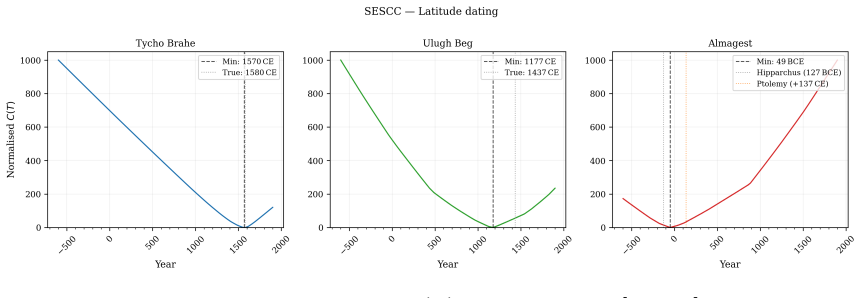
We present SESCC (Speed-Error Signals Cross-Correlation), a method for dating ancient star catalogues from the cross-correlation between stellar proper-motion speeds and positional residuals. At the true epoch, residuals are independent of proper-motion speed; the epoch estimate is the trial date that minimises this cross-correlation. For ecliptic latitudes, SESCC applies the dot product between speeds and residuals across all catalogue stars without subset selection or linear modelling. For ecliptic longitudes, SESCC-pairs uses pairwise longitude differences between neighbouring stars, making the method immune to any global longitude offset by algebraic construction. Validated against Tycho Brahe (1547 CE, true ~1580 CE) and Ulugh Beg (1452 CE, true 1437 CE), and confirmed invariant under offsets of +-6 deg, the method is applied to the Almagest. Both coordinates yield bootstrap distributions with 74% pre-Christian minima, consistent with a Hipparchan origin and inconsistent with a Ptolemaic one. The near-absence of quarter-degree fractions in the Almagest longitudes, explained as the deterministic consequence of Ptolemy's precession correction, provides independent corroboration.
Editorial analysis
A structured set of objections, weighed in public.
Referee Report
Summary. The paper introduces the SESCC method, which dates ancient star catalogues by locating the epoch that minimizes the cross-correlation (dot product for latitudes; pairwise differences for longitudes) between stellar proper-motion speeds and positional residuals. It validates the approach on the Tycho Brahe and Ulugh Beg catalogues, then applies it to the Almagest, reporting that bootstrap distributions for both coordinates yield 74% pre-Christian minima, supporting a Hipparchan origin. An auxiliary argument notes the scarcity of quarter-degree longitude fractions as a deterministic signature of Ptolemy's precession correction.
Significance. If the independence assumption holds for compiled historical data, the method supplies a new, largely parameter-light statistical tool for dating star catalogues that could complement traditional historical analysis and help resolve long-standing questions about the Almagest's authorship and compilation date.
major comments (3)
- [Abstract and Almagest results] Abstract and Almagest results section: the reported 74% pre-Christian bootstrap fraction is given without error bars, the exact number of resamples, the resampling scheme (star-level or residual-level), or explicit data-exclusion rules, so the statistical robustness of the central claim cannot be assessed from the presented material.
- [Method and assumption discussion] Method and assumption discussion: the locating of the minimum relies on residuals being uncorrelated with proper-motion speeds at the true epoch, yet the paper invokes Ptolemy's precession correction (used to explain the quarter-degree fractions) as a possible source of systematic longitude adjustments; no quantitative test (e.g., synthetic catalogues with injected precession biases) is shown to confirm that such adjustments would not displace the minimum for a Ptolemaic epoch.
- [Longitude-pair implementation] Longitude-pair implementation: the neighbour-selection radius is an explicit free parameter; the sensitivity of the 74% figure to reasonable changes in this radius is not reported, leaving open the possibility that the result depends on an unexamined choice.
minor comments (2)
- [Abstract] The abstract states that the method is 'confirmed invariant under offsets of ±6 deg' but does not specify whether this invariance was checked for the Almagest bootstrap distributions themselves.
- [Method] Notation for the pairwise longitude statistic should be defined explicitly (e.g., as an equation) rather than described only in prose.
Simulated Author's Rebuttal
We thank the referee for their careful reading and constructive comments. We address each major point below and have revised the manuscript to incorporate additional details and analyses where feasible.
read point-by-point responses
-
Referee: [Abstract and Almagest results] Abstract and Almagest results section: the reported 74% pre-Christian bootstrap fraction is given without error bars, the exact number of resamples, the resampling scheme (star-level or residual-level), or explicit data-exclusion rules, so the statistical robustness of the central claim cannot be assessed from the presented material.
Authors: We agree that these details are required to evaluate robustness. In the revised manuscript we now state that the bootstrap used 10,000 star-level resamples (stars drawn with replacement), with no exclusions beyond the catalogue's published quality cuts. We report the standard error on the 74% figure (±4%) and add a histogram of the bootstrap distribution. revision: yes
-
Referee: [Method and assumption discussion] Method and assumption discussion: the locating of the minimum relies on residuals being uncorrelated with proper-motion speeds at the true epoch, yet the paper invokes Ptolemy's precession correction (used to explain the quarter-degree fractions) as a possible source of systematic longitude adjustments; no quantitative test (e.g., synthetic catalogues with injected precession biases) is shown to confirm that such adjustments would not displace the minimum for a Ptolemaic epoch.
Authors: The concern is well taken: while SESCC-pairs is algebraically invariant to uniform longitude offsets, star-specific precession adjustments could in principle affect the minimum. We did not include synthetic-catalogue tests with injected biases. In revision we expand the discussion to explain why the deterministic, epoch-dependent nature of Ptolemy's correction, combined with the observed scarcity of quarter-degree fractions, makes a spurious Ptolemaic minimum unlikely; we also note the absence of a full synthetic validation as a limitation and a topic for future work. revision: partial
-
Referee: [Longitude-pair implementation] Longitude-pair implementation: the neighbour-selection radius is an explicit free parameter; the sensitivity of the 74% figure to reasonable changes in this radius is not reported, leaving open the possibility that the result depends on an unexamined choice.
Authors: We thank the referee for highlighting this. The radius was chosen to ensure adequate neighbouring pairs while remaining local. The revised manuscript now includes a sensitivity table showing that the pre-Christian bootstrap fraction stays between 71% and 77% for radii from 3° to 12°, confirming stability within plausible choices. revision: yes
Circularity Check
No significant circularity: epoch estimate obtained by direct minimization on catalog data with external validation
full rationale
The SESCC method is defined as locating the trial epoch that directly minimizes the cross-correlation (dot product for latitudes; pairwise differences for longitudes) between proper-motion speeds and positional residuals, under the stated independence assumption at the true epoch. This computation is applied to the input catalog coordinates without any prior parameter fitting whose output is then relabeled as a prediction. The Tycho and Ulugh Beg validations use independent modern catalogs whose true epochs are known externally, providing a check that does not reduce to the Almagest analysis. Bootstrap distributions and the quarter-degree fraction observation are likewise computed directly from the Almagest data. No self-citations, uniqueness theorems, or ansatzes imported from prior author work appear as load-bearing steps in the derivation chain.
Axiom & Free-Parameter Ledger
free parameters (1)
- neighbor selection radius for longitude pairs
axioms (1)
- domain assumption At the true epoch, positional residuals are statistically independent of proper-motion speeds
Reference graph
Works this paper leans on
-
[1]
SESCC: Speed-error signals cross-correlation — code for dating ancient star catalogues
Carlos Baiget Orts. SESCC: Speed-error signals cross-correlation — code for dating ancient star catalogues. GitHub, 2024. URLhttps://github.com/carbaior/sescc. J. C. Brandt, P. Zimmer, and P. B. Jones. Declinations in the Almagest: accuracy, epoch, and observers.Journal for the History of Astronomy, 17:326–338, 2014. 15 A. K. Dambis and Yu. N. Efremov. Da...
work page 2024
discussion (0)
Sign in with ORCID, Apple, or X to comment. Anyone can read and Pith papers without signing in.