Recognition: 2 theorem links
· Lean TheoremMaximally Random Sortition
Pith reviewed 2026-05-13 18:59 UTC · model grok-4.3
The pith
Sampling from maximum-entropy distributions over panels yields higher diversity and better constraint satisfaction in citizens' assemblies.
A machine-rendered reading of the paper's core claim, the machinery that carries it, and where it could break.
Core claim
We design algorithms that sample from maximum-entropy distributions over possible panels, possibly subject to constraints on individual selection probabilities, and show that the resulting panels achieve favorable intersectional diversity and unseen-constraint satisfaction on real assembly data while remaining resistant to manipulation and transparent.
What carries the argument
Maximum-entropy distribution over the combinatorial set of admissible panels, sampled subject to per-person probability bounds.
If this is right
- Panels drawn this way show measurably higher intersectional diversity on historical assembly data.
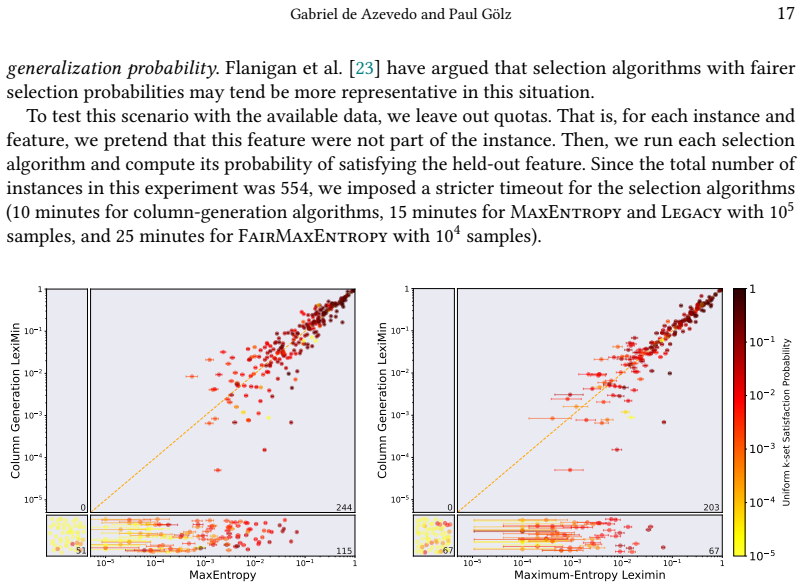
- They satisfy a larger fraction of representation constraints that were not imposed during sampling.
- The sampling procedures resist manipulation by any single participant or small coalition.
- The selection process can be explained to participants without revealing private information.
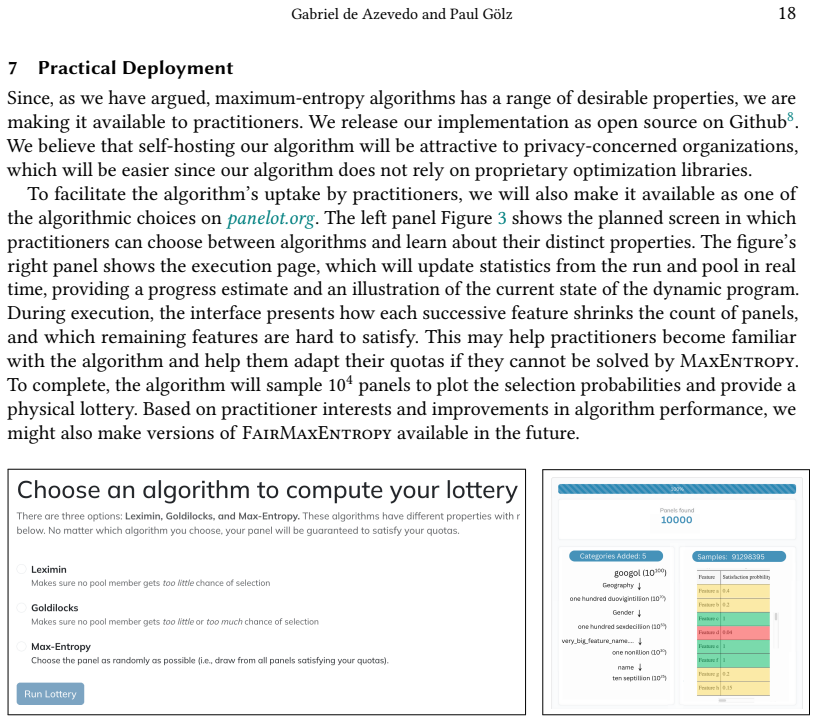
- One version of the algorithm is already deployed for use by assembly practitioners.
Where Pith is reading between the lines
- The same entropy-maximization approach could be adapted to other large-scale random-selection tasks such as jury pools or participatory budgeting committees.
- It offers a concrete way to trade off explicit fairness constraints against implicit diversity without requiring exhaustive enumeration of all panels.
- Future deployments could test whether different entropy formulations (e.g., conditional on demographic margins) produce stable improvements across multiple elections.
- Open-source implementations would let organizers rerun selections with new constraints and immediately observe the effect on entropy and diversity metrics.
Load-bearing premise
Maximizing entropy under the chosen constraints produces panels that are meaningfully fairer or more diverse without introducing hidden biases from the entropy objective itself.
What would settle it
A side-by-side run on a real assembly lottery in which a maximum-entropy panel scores lower on measured diversity or satisfies fewer post-hoc representation constraints than a uniform random draw from the same pool.
Figures


read the original abstract
Citizens' assemblies are a form of democratic innovation in which a randomly selected panel of constituents deliberates on questions of public interest. We study a novel goal for the selection of panel members: maximizing the entropy of the distribution over possible panels. We design algorithms that sample from maximum-entropy distributions, potentially subject to constraints on the individual selection probabilities. We investigate the properties of these algorithms theoretically, including in terms of their resistance to manipulation and transparency. We benchmark our algorithms on a large set of real assembly lotteries in terms of their intersectional diversity and the probability of satisfying unseen representation constraints, and we obtain favorable results on both measures. We deploy one of our algorithms on a website for citizens' assembly practitioners.
Editorial analysis
A structured set of objections, weighed in public.
Referee Report
Summary. The manuscript proposes sampling panels for citizens' assemblies from maximum-entropy distributions, possibly subject to constraints on individual selection probabilities. It develops algorithms for this task, analyzes their theoretical properties including resistance to manipulation and transparency, benchmarks them on a large set of real assembly lotteries for intersectional diversity and probability of satisfying unseen representation constraints (reporting favorable results), and deploys one algorithm on a practitioner website.
Significance. If the central empirical claims hold after isolating the contribution of the entropy objective, the work offers a principled information-theoretic framework for sortition that can improve diversity and fairness in democratic innovations while preserving randomness. The combination of theoretical analysis, real-data benchmarks, and practical deployment strengthens its potential impact in the field of algorithmic fairness for public decision-making.
major comments (2)
- [Empirical evaluation] Empirical evaluation (benchmarks section): All reported algorithms operate under explicit constraints on individual selection probabilities, yet the headline claim attributes gains in intersectional diversity and unseen-constraint satisfaction to entropy maximization. An ablation that holds the marginal probabilities fixed and compares only the objective (maximum-entropy versus uniform sampling) is required to establish that the reported improvements are due to the entropy criterion rather than the constraints themselves.
- [Theoretical analysis] Theoretical properties (analysis section): The manuscript states that the algorithms are resistant to manipulation and transparent, but the precise statements, assumptions, and proofs for these properties under the constrained maximum-entropy distributions are not clearly delineated; without them it is difficult to assess whether the properties survive the addition of probability constraints.
minor comments (1)
- [Notation and definitions] Notation for the maximum-entropy objective and the constraint sets should be introduced once with a single consistent symbol set to avoid ambiguity when moving between the algorithmic descriptions and the benchmark results.
Simulated Author's Rebuttal
We thank the referee for the constructive and detailed review. We address the major comments point by point below and will revise the manuscript to incorporate the suggested improvements.
read point-by-point responses
-
Referee: [Empirical evaluation] Empirical evaluation (benchmarks section): All reported algorithms operate under explicit constraints on individual selection probabilities, yet the headline claim attributes gains in intersectional diversity and unseen-constraint satisfaction to entropy maximization. An ablation that holds the marginal probabilities fixed and compares only the objective (maximum-entropy versus uniform sampling) is required to establish that the reported improvements are due to the entropy criterion rather than the constraints themselves.
Authors: We agree that a direct ablation isolating the entropy objective is needed. The current benchmarks compare algorithms that may differ in both their objective and constraint sets; we did not explicitly hold marginal probabilities fixed while contrasting maximum-entropy sampling against uniform sampling. We will add this ablation to the benchmarks section, reporting results on intersectional diversity and unseen-constraint satisfaction under identical marginal constraints. revision: yes
-
Referee: [Theoretical analysis] Theoretical properties (analysis section): The manuscript states that the algorithms are resistant to manipulation and transparent, but the precise statements, assumptions, and proofs for these properties under the constrained maximum-entropy distributions are not clearly delineated; without them it is difficult to assess whether the properties survive the addition of probability constraints.
Authors: We appreciate the request for greater precision. The analysis section discusses resistance to manipulation and transparency, but the formal statements and assumptions for the constrained case are not stated as explicitly as they should be. We will revise the section to provide clear formal statements, list all assumptions, and include proof sketches showing that the properties continue to hold when individual selection probabilities are constrained. revision: yes
Circularity Check
No significant circularity; derivation applies standard max-entropy to new domain
full rationale
The paper's core contribution is the application of maximum-entropy sampling (a standard information-theoretic objective) to panel selection under marginal probability constraints. Theoretical properties follow directly from convex optimization and entropy definitions without self-referential reduction. Benchmarks compare implemented samplers on real data but do not rely on fitted parameters renamed as predictions or load-bearing self-citations. No equations or claims reduce by construction to inputs; the derivation chain remains independent of the target results.
Axiom & Free-Parameter Ledger
Lean theorems connected to this paper
-
IndisputableMonolith/Cost/FunctionalEquation.leanwashburn_uniqueness_aczel unclear?
unclearRelation between the paper passage and the cited Recognition theorem.
We design algorithms that sample from maximum-entropy distributions, potentially subject to constraints on the individual selection probabilities... dynamic program (DP) for counting valid panels... dual entropy-regularized convex programs
-
IndisputableMonolith/Foundation/ArithmeticFromLogic.leanLogicNat recovery / embed_injective unclear?
unclearRelation between the paper passage and the cited Recognition theorem.
Theorem 3.3. ... samples a panel uniformly from the set of all panels.
What do these tags mean?
- matches
- The paper's claim is directly supported by a theorem in the formal canon.
- supports
- The theorem supports part of the paper's argument, but the paper may add assumptions or extra steps.
- extends
- The paper goes beyond the formal theorem; the theorem is a base layer rather than the whole result.
- uses
- The paper appears to rely on the theorem as machinery.
- contradicts
- The paper's claim conflicts with a theorem or certificate in the canon.
- unclear
- Pith found a possible connection, but the passage is too broad, indirect, or ambiguous to say the theorem truly supports the claim.
Reference graph
Works this paper leans on
-
[1]
Alekh Agarwal, Martin J Wainwright, Peter Bartlett, and Pradeep Ravikumar. 2009. Information-theoretic lower bounds on the oracle complexity of convex optimization. InAdvances in Neural Information Processing Systems, Y. Bengio, D. Schuurmans, J. Lafferty, C. Williams, and A. Culotta (Eds.), Vol. 22. Curran Associates, Inc. https: //proceedings.neurips.cc...
-
[2]
Goemans, Aleksander Mądry, Shayan Oveis Gharan, and Amin Saberi
Arash Asadpour, Michel X. Goemans, Aleksander Mądry, Shayan Oveis Gharan, and Amin Saberi. 2017. An O (Log n/Log Log n)-Approximation Algorithm for the Asymmetric Traveling Salesman Problem.Operations Research65, 4 (2017), 1043–1061. https://doi.org/10/gbq7fd
work page 2017
-
[3]
Arash Asadpour and Amin Saberi. 2010. An Approximation Algorithm for Max-Min Fair Allocation of Indivisible Goods.SIAM J. Comput.39, 7 (2010), 2970–2989. https://doi.org/10/d8p7wr
work page 2010
-
[4]
Angelos Assos, Carmel Baharav, Bailey Flanigan, and Ariel Procaccia. 2025. Alternates, Assemble! Selecting Optimal Alternates for Citizens’ Assemblies. InProceedings of the ACM Conference on Economics and Computation (EC). 719–738. https://doi.org/10.1145/3736252.3742614
-
[5]
Carmel Baharav and Bailey Flanigan. 2024. Fair, Manipulation-Robust, and Transparent Sortition. InProceedings of the ACM Conference on Economics and Computation (EC). 756–775. https://doi.org/10.1145/3670865.3673606
-
[6]
Alexander I. Barvinok. 1994. A Polynomial Time Algorithm for Counting Integral Points in Polyhedra When the Dimension Is Fixed.Mathematics of Operations Research19, 4 (Nov. 1994), 769–779. https://doi.org/10.1287/moor.19.4. 769
- [7]
-
[8]
Stephen P. Boyd and Lieven Vandenberghe. 2004.Convex Optimization. Cambridge University Press, Cambridge, UK; New York
work page 2004
- [9]
-
[10]
Ioannis Caragiannis, Evi Micha, and Jannik Peters. 2024. Can a Few Decide for Many? The Metric Distortion of Sortition. https://doi.org/10.48550/ARXIV.2406.02400
-
[11]
1999.Random Selection in Politics
Lyn Carson and Brian Martin. 1999.Random Selection in Politics. Praeger
work page 1999
-
[12]
Committee of Ministers of the Council of Europe. 2023.Recommendation CM/Rec(2023)6 of the Committee of Ministers to member States on deliberative democracy. Recommendation CM/Rec(2023)6. Council of Europe. https://search.coe. int/cm?i=0900001680ac627a Adopted by the Committee of Ministers on 6 September 2023 at the 1473rd meeting of the Ministers’ Deputies
work page 2023
-
[13]
Dimitri Courant. 2021. Citizens’ Assemblies for Referendums and Constitutional Reforms: Is There an “Irish Model” for Deliberative Democracy?Frontiers in Political Science2 (Jan. 2021). https://doi.org/10.3389/fpos.2020.591983
-
[14]
Thomas M. Cover and Joy A. Thomas. 2006.Elements of Information Theory(second edition ed.). Wiley-Interscience, Hoboken, N.J. https://doi.org/10.1002/047174882X
-
[15]
De Loera, Raymond Hemmecke, Jeremiah Tauzer, and Ruriko Yoshida
Jesús A. De Loera, Raymond Hemmecke, Jeremiah Tauzer, and Ruriko Yoshida. 2004. Effective lattice point counting in rational convex polytopes.Journal of Symbolic Computation38, 4 (2004), 1273–1302. https://doi.org/10.1016/j.jsc. 2003.04.003 Symbolic Computation in Algebra and Geometry
-
[16]
Virginie Do, Jamal Atif, Jérôme Lang, and Nicolas Usunier. 2021. Online Selection of Diverse Committees. InProceedings of the International Joint Conference on Artificial Intelligence (IJCAI). 154–160. https://doi.org/10/gn78qg
work page 2021
-
[17]
Oliver Dowlen. 2008.The Political Potential of Sortition: A Study of the Random Selection of Citizens for Public Office. Imprint Academic
work page 2008
-
[18]
Soroush Ebadian, Gregory Kehne, Evi Micha, Ariel D. Procaccia, and Nisarg Shah. 2022. Is Sortition Both Representative and Fair?Advances in Neural Information Processing Systems (NeurIPS)35 (2022), 3431–3443
work page 2022
-
[19]
Soroush Ebadian and Evi Micha. 2025. Boosting Sortition via Proportional Representation. InProceedings of the International Conference on Autonomous Agents and Multi-Agent Systems (AAMAS). 667–675
work page 2025
-
[20]
Fredrik Engelstad. 1989. The Assignment of Political Office by Lot.Social Science Information28, 1 (March 1989), 23–50. https://doi.org/10/cggrj2
work page 1989
-
[21]
James S. Fishkin. 2009.When the People Speak: Deliberative Democracy and Public Consultation. Oxford University Press. Gabriel de Azevedo and Paul Gölz20
work page 2009
- [22]
-
[23]
2023.Mini-Public Selection: Ask What Randomness Can Do for You
Bailey Flanigan, Paul Gölz, and Ariel Procaccia. 2023.Mini-Public Selection: Ask What Randomness Can Do for You. Policy Brief. Ash Center for Democratic Governance and Innovation, Harvard Kennedy School, Cambridge, MA. https://ash.harvard.edu/wp-content/uploads/2024/02/mini-public_selection_final_report.pdf
work page 2023
- [24]
-
[25]
Bailey Flanigan, Jennifer Liang, Ariel D. Procaccia, and Sven Wang. 2024. Manipulation-Robust Selection of Citizens’ Assemblies.Proceedings of the AAAI Conference on Artificial Intelligence38, 9 (mar 2024), 9696–9703. https://doi.org/ 10.1609/aaai.v38i9.28827
-
[26]
Flanigan, Paul Gölz, Anupam Gupta, and Ariel D
Bailey G. Flanigan, Paul Gölz, Anupam Gupta, and Ariel D. Procaccia. 2020. Neutralizing Self-Selection Bias in Sampling for Sortition. (2020)
work page 2020
-
[27]
Adela Gąsiorowska. 2023. Sortition and Its Principles: Evaluation of the Selection Processes of Citizens’ Assemblies. Journal of Deliberative Democracy19, 1 (Jan. 2023). https://doi.org/10.16997/jdd.1310
-
[28]
Marcin Gerwin, Nikodem Mroek, Grzegorz Kuriata, Paulina Pospieszna, and Andalexander M. Geisler. 2025. Designing the Process of Random Selection of Citizens’ Assemblies.Journal of Sortition1, 1 (2025), 48–59
work page 2025
-
[29]
Nick Gill and Tom Lord. 2022.Diversity, inclusion and intersectionality: analysing education attainment level and ethnicity in responses to citizens’ assembly recruitment processes. Technical Report. Sortition Foundation. https://assets. nationbuilder.com/sortitionfoundation/pages/906/attachments/original/1663663146/dii_study.pdf?1663663146=
-
[30]
Louis-Gaëtan Giraudet, Bénédicte Apouey, Hazem Arab, Simon Baeckelandt, Philippe Bégout, Nicolas Berghmans, Nathalie Blanc, Jean-Yves Boulin, Eric Buge, and Dimitri Courant. 2022. “Co-construction” in Deliberative Democracy: Lessons from the French Citizens’ Convention for Climate.Humanities and Social Sciences Communications9, 1 (2022), 1–16
work page 2022
-
[31]
Paul Gölz, Jan Maly, Ulrike Schmidt-Kraepelin, Markus Utke, and Philipp C. Verpoort. 2025. City Sampling for Citizens’ Assemblies. https://doi.org/10.48550/arXiv.2509.07557 arXiv:2509.07557 [cs]
- [32]
-
[33]
Nagaraj, and Praneeth Netrapalli
Prateek Jain, Dheeraj M. Nagaraj, and Praneeth Netrapalli. 2021. Making the Last Iterate of SGD Information Theoretically Optimal.SIAM Journal on Optimization31, 2 (Jan. 2021), 1108–1130. https://doi.org/10.1137/19M128908X
-
[34]
E. T. Jaynes. 1957. Information Theory and Statistical Mechanics.Physical Review106, 4 (May 1957), 620–630. https://doi.org/10.1103/PhysRev.106.620
-
[35]
E. T. Jaynes. 1957. Information Theory and Statistical Mechanics. II.Physical Review108, 2 (Oct. 1957), 171–190. https://doi.org/10.1103/PhysRev.108.171
-
[36]
Mark Jerrum, Alistair Sinclair, and Eric Vigoda. 2004. A polynomial-time approximation algorithm for the permanent of a matrix with nonnegative entries.J. ACM51, 4 (jul 2004), 671–697. https://doi.org/10.1145/1008731.1008738
-
[37]
Mark R. Jerrum, Leslie G. Valiant, and Vijay V. Vazirani. 1986. Random generation of combinatorial structures from a uniform distribution.Theoretical Computer Science43 (1986), 169–188. https://doi.org/10.1016/0304-3975(86)90174-X
-
[38]
Ravi Kannan and Santosh Vempala. 1997. Sampling Lattice Points. InProceedings of the Annual ACM Symposium on Theory of Computing (STOC). 696–700. https://doi.org/10.1145/258533.258665
-
[39]
Adam: A Method for Stochastic Optimization
Diederik P. Kingma and Jimmy Ba. 2015. Adam: A Method for Stochastic Optimization. InInternational Conference on Learning Representations (ICLR). https://arxiv.org/abs/1412.6980
work page internal anchor Pith review Pith/arXiv arXiv 2015
-
[40]
MASS LBP. 2017. How to Run a Civic Lottery: Designing Fair Selection Mechanisms for Deliberative Public Processes
work page 2017
-
[41]
Oren Matar. 2025. Diversimax: Maximizing Intersectional Diversity in Sortition. https://orenmatar.github.io/ diversimax_algorithm/ Accessed: 2026-02-09
work page 2025
-
[42]
Reshef Meir, Fedor Sandomirskiy, and Moshe Tennenholtz. 2021. Representative Committees of Peers.Journal of Artificial Intelligence Research71 (July 2021), 401–429. https://doi.org/10/gqcq8m
work page 2021
-
[43]
Ben Morris and Alistair Sinclair. 2004. Random Walks on Truncated Cubes and Sampling 0-1 Knapsack Solutions. SIAM J. Comput.34, 1 (Jan. 2004), 195–226. https://doi.org/10.1137/S0097539702411915
-
[44]
Albert Nijenhuis and Herbert S. Wilf. 1978.Combinatorial Algorithms for Computers and Calculators(2nd ed ed.). Academic press, Orlando San Diego San Francisco [etc.]
work page 1978
- [45]
-
[46]
Organisation for Economic Co-operation and Development. 2020.Innovative Citizen Participation and New Democratic Institutions: Catching the Deliberative Wave. OECD. https://doi.org/10.1787/339306da-en Gabriel de Azevedo and Paul Gölz21
-
[47]
2021.Eight Ways to Institutionalise Deliberative Democracy
Organisation for Economic Co-operation and Development. 2021.Eight Ways to Institutionalise Deliberative Democracy. OECD Public Governance Policy Papers 12. https://doi.org/10.1787/4fcf1da5-en
-
[48]
Christos H. Papadimitriou. 1981. On the Complexity of Integer Programming.Journal of the ACM (JACM)28, 4 (1981), 765–768. https://doi.org/10/dmgs9t
work page 1981
-
[49]
R. Tyrrell Rockafellar. 1970.Convex Analysis. Princeton Mathematical Series, Vol. 28. Princeton University Press, Princeton, NJ. xviii+451 pages
work page 1970
-
[50]
C. E. Shannon. 1948. A Mathematical Theory of Communication.Bell System Technical Journal27, 3 (July 1948), 379–423. https://doi.org/10.1002/j.1538-7305.1948.tb01338.x
-
[51]
Mohit Singh and Nisheeth K. Vishnoi. 2014. Entropy, Optimization and Counting. InProceedings of the Forty-Sixth Annual ACM Symposium on Theory of Computing(New York, New York)(STOC ’14). Association for Computing Machinery, New York, NY, USA, 50–59. https://doi.org/10.1145/2591796.2591803
-
[52]
Daniel Steel, Naseeb Bolduc, Kristina Jenei, and Michael Burgess. 2020. Rethinking Representation and Diversity in Deliberative Minipublics.Journal of Deliberative Democracy16, 1 (Aug. 2020), 46–57. https://doi.org/10/gm7wnc
work page 2020
-
[53]
2011.The Luck of the Draw: The Role of Lotteries in Decision Making
Peter Stone. 2011.The Luck of the Draw: The Role of Lotteries in Decision Making. Oxford University Press
work page 2011
-
[54]
2016.Against Elections: The Case for Democracy(first us edition ed.)
David Van Reybrouck. 2016.Against Elections: The Case for Democracy(first us edition ed.). Seven Stories Press, New York
work page 2016
-
[55]
Satosi Watanabe. 1960. Information Theoretical Analysis of Multivariate Correlation.IBM Journal of research and development4, 1 (1960), 66–82
work page 1960
-
[56]
Marta Wojciechowska. 2019. Towards Intersectional Democratic Innovations.Political Studies67, 4 (2019), 895–911. https://doi.org/10.1177/0032321718814165 Gabriel de Azevedo and Paul Gölz22 APPENDIX A Deferred Details forMaxEntropy: Sampling Uniformly among Possible Panels A.1 The Generalized Counting Problem In this appendix, we provide proofs and general...
discussion (0)
Sign in with ORCID, Apple, or X to comment. Anyone can read and Pith papers without signing in.