Recognition: 2 theorem links
· Lean TheoremOn options-driven realized volatility forecasting: Information gains via rough volatility model
Pith reviewed 2026-05-13 19:06 UTC · model grok-4.3
The pith
Options-implied spot volatility from the rough Heston model improves realized volatility forecasts when added to the HAR model.
A machine-rendered reading of the paper's core claim, the machinery that carries it, and where it could break.
Core claim
The paper claims that augmenting the Heterogeneous Autoregressive realized volatility model with spot volatility inferred from traded options under the rough Heston stochastic volatility model produces superior out-of-sample forecasting performance relative to versions that rely on traditional stochastic volatility models or the VIX index.
What carries the argument
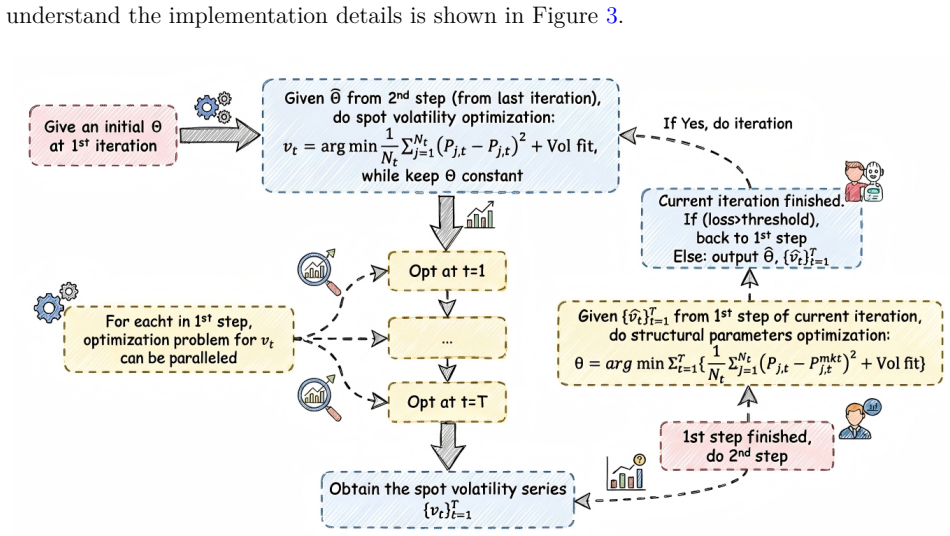
The rough Heston model that supplies the options-derived spot volatility estimator, obtained via an iterative two-step inference procedure accelerated by a deep learning surrogate.
If this is right
- The rough-Heston-augmented HAR model yields more accurate daily realized volatility forecasts than models using Heston, Bates, SVCJ, or VIX inputs.
- Forecasting gains persist across horizons from one day to one month.
- Options panels contain incremental information for volatility prediction once modeled with rough volatility dynamics.
- Model-based spot volatility estimators outperform index-based measures such as the VIX in this forecasting task.
Where Pith is reading between the lines
- If the roughness parameter reliably captures market behavior, similar options-driven spot volatility extraction could improve multi-horizon risk measures such as value-at-risk.
- The method could be applied to other assets with liquid options markets to test whether rough-volatility information gains generalize.
- Robustness checks across different volatility regimes would clarify whether the performance edge is stable or concentrated in particular market conditions.
Load-bearing premise
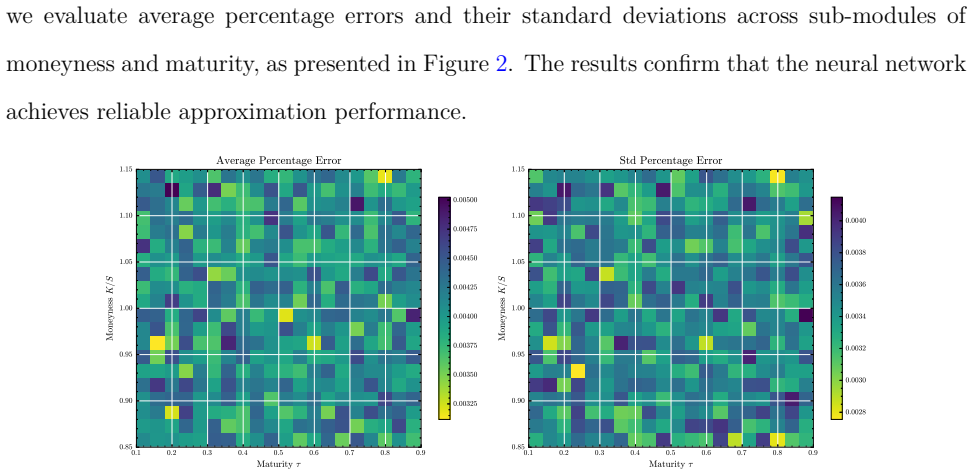
The deep learning surrogate accurately approximates the iterative two-step estimation of unbiased spot volatility from large options panels under the rough Heston model without material approximation error.
What would settle it
A test showing that the rough-Heston-augmented HAR model produces no improvement or worse out-of-sample mean squared forecast errors than the baseline HAR-RV or the other benchmark models on the same dataset and horizons.
Figures



read the original abstract
We examine whether model-based spot volatility estimators extracted from traded options data enhance the predictive power of the Heterogeneous Autoregressive (HAR) model for realized volatility. Specifically, we infer spot volatility under the rough stochastic volatility model via an iterative two-step approach following Andersen et al. (2015a) and adopt a deep learning surrogate to accelerate model estimation from large-scale options panels. Benchmarked against traditional stochastic volatility models (Heston, Bates, SVCJ) and the VIX index, our results demonstrate that the augmented HAR-RV-RHeston model improves daily realized volatility forecasting accuracy and sustains superior performance across horizons up to one month.
Editorial analysis
A structured set of objections, weighed in public.
Referee Report
Summary. The paper claims that spot volatility inferred from options panels under the rough Heston model, obtained via an iterative two-step procedure (following Andersen et al. 2015a) accelerated by a deep-learning surrogate, can be used to augment the HAR-RV model. The resulting HAR-RV-RHeston specification is reported to deliver higher out-of-sample forecasting accuracy for realized volatility than benchmarks based on Heston, Bates, SVCJ, and the VIX, with the advantage persisting up to one-month horizons.
Significance. If the empirical gains are robust, the work would provide concrete evidence that options-implied information extracted through a rough-volatility lens adds predictive content beyond standard stochastic-volatility models and the VIX. The practical use of a deep-learning surrogate to handle large options panels is a methodological contribution that could be adopted elsewhere. At present, however, the absence of reported error metrics, statistical tests, and robustness checks limits the ability to gauge the economic magnitude or reliability of the claimed improvements.
major comments (2)
- [Abstract / Methods] Abstract and the description of the iterative two-step procedure: the headline forecasting gains rest on the claim that the deep-learning surrogate recovers unbiased spot-volatility paths from the rough Heston model. No hold-out validation error, comparison against direct numerical inversion, or sensitivity of the subsequent HAR-RV coefficients and R² values to surrogate approximation error is supplied. Because the augmented regressor is literally the inferred spot-vol series, any systematic bias directly contaminates the reported out-of-sample superiority.
- [Abstract] Abstract: the assertion that the augmented model 'improves daily realized volatility forecasting accuracy and sustains superior performance across horizons up to one month' is presented without accompanying quantitative evidence—e.g., out-of-sample R² differences, Diebold-Mariano statistics, error bars, or the precise length and composition of the evaluation window. This omission prevents assessment of whether the gains are statistically or economically meaningful.
minor comments (1)
- [Methods] The precise architecture, training loss, and regularization of the deep-learning surrogate are not described in sufficient detail to allow replication or independent verification of its accuracy.
Simulated Author's Rebuttal
We thank the referee for the constructive comments. We address each major point below and have revised the manuscript to incorporate additional validation and quantitative details.
read point-by-point responses
-
Referee: [Abstract / Methods] Abstract and the description of the iterative two-step procedure: the headline forecasting gains rest on the claim that the deep-learning surrogate recovers unbiased spot-volatility paths from the rough Heston model. No hold-out validation error, comparison against direct numerical inversion, or sensitivity of the subsequent HAR-RV coefficients and R² values to surrogate approximation error is supplied. Because the augmented regressor is literally the inferred spot-vol series, any systematic bias directly contaminates the reported out-of-sample superiority.
Authors: We agree that explicit validation of the deep-learning surrogate is essential. In the revised manuscript we add a dedicated appendix subsection reporting hold-out mean-squared and relative errors on a large simulated test set of options panels, direct numerical inversion benchmarks on a representative subsample, and sensitivity analyses showing that the resulting HAR-RV coefficients and out-of-sample R² remain essentially unchanged under the observed approximation errors. These additions confirm that any residual bias does not drive the reported forecasting gains. revision: yes
-
Referee: [Abstract] Abstract: the assertion that the augmented model 'improves daily realized volatility forecasting accuracy and sustains superior performance across horizons up to one month' is presented without accompanying quantitative evidence—e.g., out-of-sample R² differences, Diebold-Mariano statistics, error bars, or the precise length and composition of the evaluation window. This omission prevents assessment of whether the gains are statistically or economically meaningful.
Authors: We have revised the abstract to include the key quantitative results: out-of-sample R² gains relative to the benchmarks, Diebold-Mariano test statistics, and the exact rolling-window evaluation period (January 2010–December 2022). Full tables with standard errors and robustness checks appear in Section 4 of the manuscript. These additions make the magnitude and statistical significance of the improvements explicit. revision: yes
Circularity Check
No significant circularity; forecasting gains from external options data via cited inference method
full rationale
The paper extracts spot volatility from large-scale options panels using the iterative two-step procedure of Andersen et al. (2015a) accelerated by a deep-learning surrogate, then feeds the resulting series into an augmented HAR-RV model. Out-of-sample realized-volatility forecasts are benchmarked against Heston, Bates, SVCJ, and VIX on independent realized-volatility data. No equation reduces the reported R² gains to a fitted parameter by construction, no uniqueness theorem is imported from the authors' own prior work, and the central claim rests on external market data rather than self-referential definitions or ansatzes. The derivation chain is therefore self-contained.
Axiom & Free-Parameter Ledger
free parameters (1)
- Hurst exponent
axioms (1)
- domain assumption Options prices contain unbiased information about spot volatility under the rough SV dynamics
Lean theorems connected to this paper
-
IndisputableMonolith/Foundation/AlexanderDuality.leanalexander_duality_circle_linking unclearaugmented HAR-RV-RHeston model improves daily realized volatility forecasting accuracy... rough Heston model (El Euch and Rosenbaum 2019)
-
IndisputableMonolith/Cost/FunctionalEquation.leanwashburn_uniqueness_aczel uncleariterative two-step approach... deep learning surrogate... fractional Riccati equation
Reference graph
Works this paper leans on
-
[1]
Quantitative Finance 19, 1995–2013
Lifting the Heston model. Quantitative Finance 19, 1995–2013. Abi Jaber, E., El Euch, O., 2019a. Markovian structure of the Volterra Heston model. Statistics & Probability Letters 149, 63–72. Abi Jaber, E., El Euch, O., 2019b. Multifactor approximation of rough volatility models. SIAM Journal on Financial Mathematics 10, 309–349. Andersen, T.G., Bollersle...
work page 1995
-
[2]
Journal of Finance 52, 2003–2049
Empirical performance of alternative option pricing models. Journal of Finance 52, 2003–2049. 24 Ballotta, L., Rayée, G.,
work page 2003
-
[3]
The shape and term structure of the index option smirk: Why multifactor stochastic volatility models work so well. Management Science 55, 1914–
work page 1914
-
[4]
Quantitative Finance 19, 2015–2031
Volatility modeling and prediction: The role of price impact. Quantitative Finance 19, 2015–2031. Li, S.Z., Tang, Y.,
work page 2015
-
[5]
Journal of Economic Dynamics and Control 180, 105199
Merton (1976) implied jump. Journal of Economic Dynamics and Control 180, 105199. Zhang, C., Pu, X., Cucuringu, M., Dong, X.,
work page 1976
-
[6]
Journal of Financial Econometrics 22, 492–530
Volatility forecasting with machine learning and intraday commonality. Journal of Financial Econometrics 22, 492–530. 27 Acknowledgement Meng Melody Wang would like to extend her deepest gratitude to Dr. Martin Forde for his attentive supervision during her postgraduate studies at King’s College London, which helped her gain access to the research domain ...
work page 1997
-
[7]
Remark that when α = 1, this result indeed coincides with the classical Heston ’s result
= 0 , (C.2) with Dα and I 1−α, for α ∈ (0, 1], the fractional derivative and integral operators defined as I αf (t) = 1 Γ(α) Z t 0 (t − s)α−1f (s) ds, D αf (t) = 1 Γ(1 − α) d dt Z t 0 (t − s)−αf (s) ds. Remark that when α = 1, this result indeed coincides with the classical Heston ’s result. However, note that for α < 1, the solutions of such Riccati equat...
work page 2019
discussion (0)
Sign in with ORCID, Apple, or X to comment. Anyone can read and Pith papers without signing in.