pith. machine review for the scientific record. sign in

q-fin.PR

Pricing of Securities

Valuation and hedging of financial securities, their derivatives, and structured products

0
q-fin.PR 2026-05-13 2 theorems

Deep learning prices path-dependent convertible bonds

A deep learning approach for pricing convertible bonds with path-dependent reset and call provisions

Contract terms outweigh asset models, with calls truncating upside and resets lowering call thresholds.
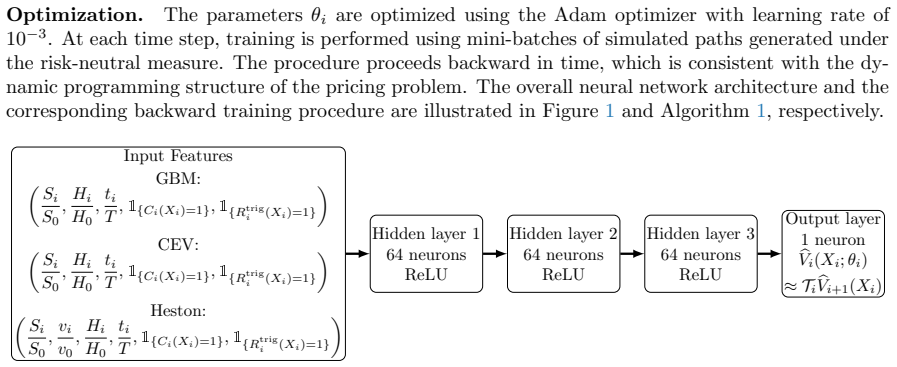
Figure from the paper full image
abstract click to expand
This paper develops a deep learning-based framework for pricing convertible bonds with path-dependent contractual features, namely downward conversion price reset and issuer call clauses under rolling-window trigger rules, which are widespread in the convertible bond market. We formulate the valuation problem as a path-dependent partial differential equation (PPDE), which explicitly captures the dependence of the convertible bond value on the historical path of the underlying asset and the dynamic evolution of the conversion price. We derive consistent PPDE formulations for three canonical underlying dynamics: geometric Brownian motion (GBM), constant elasticity of variance (CEV) and Heston stochastic volatility. We then construct a discrete-time dynamic programming scheme in which conditional expectations are approximated by neural networks, which remains tractable in such high-dimensional path-dependent setting. Empirical tests on China CITIC Bank Convertible Bond show that our framework produces stable and accurate prices and sensitivity patterns across all model specifications. Three key economic insights emerge: 1. Contractual features dominate underlying dynamics in determining convertible bond values. 2. The call provision decreases convertible bonds prices by truncating upside gains. 3. Counterintuitively, despite improving conversion terms, the downward reset provision further decreases the price of convertible bonds by lowering the effective call threshold and making early redemption more likely. The proposed PPDE-deep learning approach provides an efficient, flexible tool for pricing convertible bonds with complex path-dependent structures.
0
0
q-fin.PR 2026-05-04 2 theorems

Product Hunt signals predict Series A at 4.7x random baseline

PHBench: A Benchmark for Predicting Startup Series A Funding from Product Hunt Launch Signals

Ensemble on 67k launches reaches AP 0.037 on blind test, beats logistic regression and zero-shot LLMs while following market cycles.

abstract click to expand
Structured launch signals on Product Hunt contain statistically significant predictive information for Series A funding outcomes. We construct PHBench from 67,292 featured Product Hunt posts spanning 2019-2025, linked to Crunchbase funding records via deterministic domain matching, identifying 528 verified Series A raises within 18 months of launch (positive rate: 0.78%). Our best-performing model, a three-component ensemble (ENS_avg, ENS_ISO, XGB) selected by validation F0.5, achieves F0.5 = 0.097 and AP = 0.037 (95% CI: 0.024-0.072; 4.7x lift over random) on the private held-out test set (103 positives). A paired bootstrap confirms a statistically credible advantage over the logistic regression baseline (AP delta: +0.013, 95% CI: [0.004, 0.039], p < 0.001; F0.5 delta: +0.056, 95% CI: [0.006, 0.122], p = 0.016). Validation-set metrics (F0.5 = 0.284, AP = 0.126) reflect best-of-144 selection bias on 53 positives and are reported for benchmark reproducibility only. We further evaluate three zero-shot Gemini models (Gemini 2.5 Flash, Gemini 3 Flash, and Gemini 3.1 Pro) in an anonymized numerical setting. The best LLM achieves AP = 0.034 (Gemini 3 Flash), below the LR baseline AP of 0.044. Notably, the most capable Gemini variant (Gemini 3.1 Pro, AP = 0.023) performs worst -- an unexpected pattern that warrants further investigation across providers and prompting strategies. Both ML and LLM models show the same temporal performance decay tracking the 2020-2021 funding boom and subsequent contraction, confirming the dataset captures genuine market structure rather than noise. PHBench provides a reproducible framework comprising public training, validation, and blind test splits; 61 engineered features; a five-metric evaluation harness; and a public leaderboard at https://phbench.com. All code, baseline models, and anonymized dataset splits are publicly available.
0
0
q-fin.PR 2026-04-29

Regime switching improves Chinese corporate bond curve fit

Corporate Bond Yield Curve Modeling: A Rating-Based Regime-Switching Generalized CIR Approach

Two-state RS-GCIR model separates rate regimes from credit factors and sharpens yield decomposition on 2014-2025 data.

Figure from the paper full image
abstract click to expand
Persistent shifts in term-structure dynamics undermine the stability of single-regime models in long samples. We develop an arbitrage-free regime-switching generalized CIR (RS-GCIR) model that jointly prices the Chinese government bond (CGB) curve and corporate bond curves. To capture the systematic transmission from interest-rate conditions to credit spreads, we structure the model into two blocks and price corporate bonds conditional on the prevailing rate regime. The rate block features a two-state RS-GCIR short-rate process estimated from CGB zero-coupon curves, while the credit block embeds CIR-type credit factors in an intensity-based framework for rating migration and default. We implement a block-recursive Unscented Kalman Filter (UKF) procedure--filtering the rate block first and the credit block next--using weekly data from 2014--2025, a period that begins with the onset of China's modern corporate default cycle. We identify two persistent rate regimes with distinct level--volatility profiles. Relative to single-regime benchmarks, regime switching improves joint curve fit, delivers economically interpretable filtered regime probabilities, and sharpens the decomposition of corporate yields into discounting and credit compensation.
0
0
q-fin.PR 2026-04-27

ML models forecast stock asymmetric betas better than linear ones

Machine Learning Forecasts of Asymmetric Betas Using Firm-Specific Information

Nonlinear effects from firm data like trading frictions raise forecast accuracy and boost valuation and portfolio results.

abstract click to expand
We demonstrate that machine learning methods provide a powerful framework for modelling conditional asymmetric risk. Using a large cross-section of US stocks and a comprehensive set of firm characteristics, we show that allowing for nonlinearities significantly increases the out-of-sample performance across a wide range of asymmetric beta measures and forecasting horizons. Trading frictions, followed by characteristics related to intangibles, momentum and growth, emerge as the most important drivers of future risk dynamics. Reconstructing CAPM beta from forecasts of asymmetric beta components indicates that a more granular decomposition of systematic risk yields a more accurate representation of market beta. We also find that incorporating conditional beta forecasts into discounted cash flow models that account for the term structure of betas enhances equity valuation accuracy. Finally, we show that the statistical outperformance of conditional betas translates into economically significant benefits for market-neutral portfolio investors.
0
0
q-fin.PR 2026-04-22

Funding sensitivities fix liquidity forecasts by matching replication

Replication-Consistent Liquidity Forecasting for Derivatives -- Forward Funding Sensitivities and a Liquidity Valuation Adjustment for Settlement Lags

Hedge ratios replace expected cash flows to remove measure inconsistencies and add an adjustment for settlement lags.

abstract click to expand
We study cash-flow forecasting for derivatives used in liquidity management and clarify its relation to risk-neutral valuation and replication. While it is well known that expectations under different measures (e.g., $\mathbb{P}$ vs. $\mathbb{Q}$) can yield different undiscounted cash-flows, further inconsistencies arise when payment times are stochastic. We show that using discounting sensitivities (funding-curve hedge ratios) instead of "expected cash-flows" aligns forecasting with the self-financing replication strategy and avoids measure-mixing/aggregation issues. We then illustrate how a standard valuation model delivers pathwise funding requirements and propose a simple liquidity valuation adjustment to capture settlement lags and related timing frictions. The note provides implementation hints (American Monte Carlo with adjoint differentiation) and clarifies when "expected cash-flows" are informative and when sensitivities should be used instead.
0
0
q-fin.PR 2026-04-16

CGMY ATM call prices expand as d1 t^{1/Y} plus d2 t plus higher terms

Higher-order ATM asymptotics for the CGMY model via the characteristic function

Rescaling the characteristic function into the Y-stable domain produces the first two coefficients; a dynamic cutoff extracts the rest with

Figure from the paper full image
abstract click to expand
Using only the characteristic function, we derive short-time at-the-money (ATM) call-price asymptotics for the exponential CGMY model with activity parameter $Y\in(1,2)$. The Lipton--Lewis formula expresses the normalized ATM call price, denoted $c(t,0)$, in terms of the characteristic exponent, which, upon rescaling at the rate $t^{-1/Y}$ from the $Y$-stable domain of attraction, yields $c(t,0) = d_{1} t^{1/Y} + d_{2} t + o(t)$ as $t\downarrow 0$. The first-order coefficient $d_{1}$ is the known stable limit from the domain of attraction of a symmetric $Y$-stable law, and $d_{2}$ is given by an explicit integral involving the characteristic exponent and the limiting stable exponent. We then extract closed-form higher-order coefficients by keeping the full Lipton--Lewis integrand intact and introducing a dynamic cutoff that partitions the domain into inner, core, and tail regions, establishing the expansion with controlled remainder. All coefficients are verified numerically against existing closed-form expressions where available.
0
0
q-fin.PR 2026-04-13

LLMs for stock forecasts hit practical trading pitfalls

A Review of Large Language Models for Stock Price Forecasting from a Hedge-Fund Perspective

Hedge fund review maps uses from news sentiment to agent systems while flagging leakage, liquidity effects, and predictability limits.

abstract click to expand
Large language models (LLMs) are increasingly deployed in quantitative finance for stock price forecasting. This review synthesizes recent applications of LLMs in this domain, including extracting sentiment from financial news and social media, analyzing financial reports and earnings-call transcripts, tokenizing or symbolizing stock price series, and constructing multi-agent trading systems. Particular attention is paid to practical pitfalls that are often understated in the literature, such as fragility in sentiment analysis, dataset and horizon design, performance evaluation metrics, data leakage, illiquidity premia, and limits of stock price predictability. Organized from a hedge-fund perspective, the review is intended to guide both academic researchers and hedge fund managers in integrating LLMs into real-world trading pipelines and in stress-testing their robustness under realistic market frictions.
0
0
q-fin.PR 2026-04-10 3 theorems

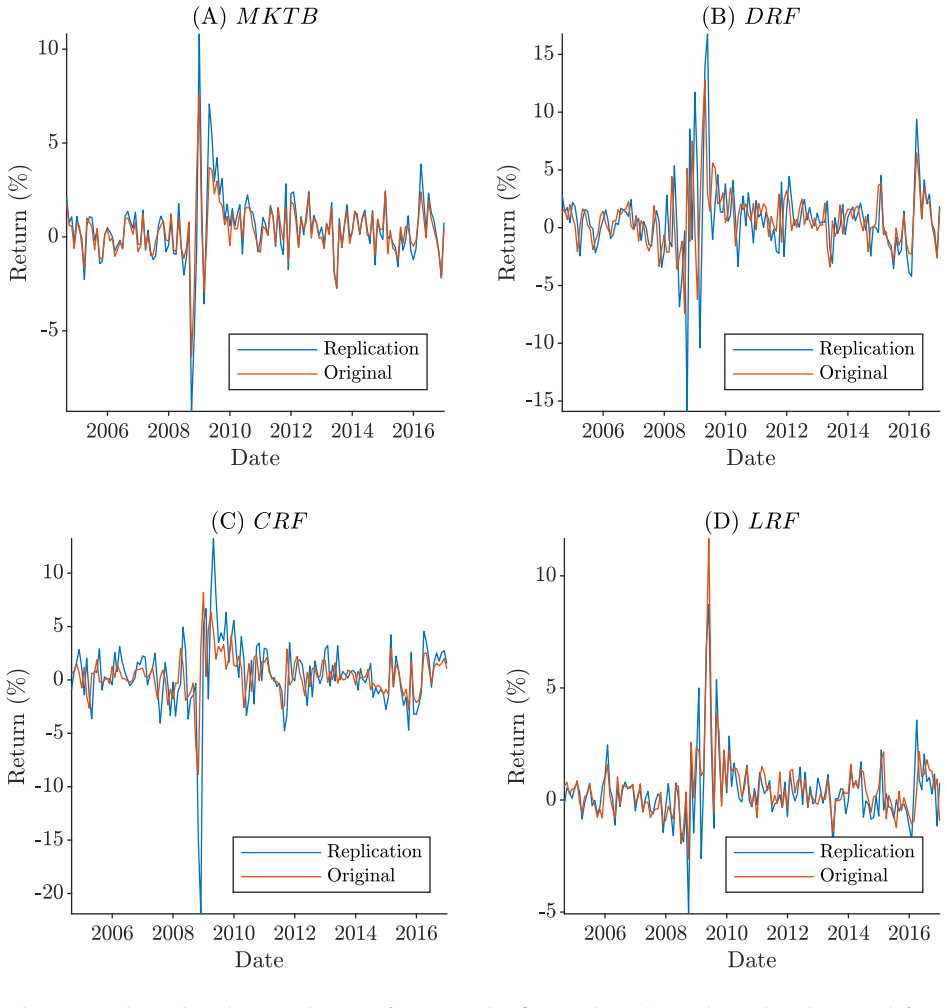
Most corporate bond factors fail after bias correction

The Corporate Bond Factor Replication Crisis

Price measurement errors and lookahead biases in 108 signals erase most reported alphas relative to the bond CAPM

Figure from the paper full image
abstract click to expand
Corporate bond factor research faces a replication crisis. The crisis stems from two sources that inflate reported factor premia: transaction prices whose measurement error enters both sorting signals and return denominators, creating a correlated errors-in-variables bias, and asymmetric ex-post return filtering that embeds future information into factor construction. Applying our framework to a 'factor zoo' of 108 signals across nine thematic clusters, we show that the majority of previously documented factors do not produce statistically significant bond CAPM alphas after correction. We provide an open source framework via Open Bond Asset Pricing, including error-corrected TRACE data, bias corrected factors, and software for reproducible research.
0
0
q-fin.PR 2026-04-08 Recognition

Bond market factor explains returns as well as multifactor models

Priced risk in corporate bonds

Portfolio and bond-level tests find other factors add no incremental power beyond the market.

Figure from the paper full image
abstract click to expand
Recent studies document strong empirical support for multifactor models that aim to explain the cross-sectional variation in corporate bond expected excess returns. We revisit these findings and provide evidence that common factor pricing in corporate bonds is exceedingly difficult to establish. Based on portfolio- and bond-level analyses, we demonstrate that previously proposed bond risk factors, with traded liquidity as the only marginal exception, do not have any incremental explanatory power over the corporate bond market factor. Consequently, this implies that the bond CAPM is not dominated by either traded- or nontraded-factor models in pairwise and multiple model comparison tests.
0
0
q-fin.PR 2026-04-07 2 theorems

Equity factors explain corporate bond premia after Treasury adjustment

The Co-Pricing Factor Zoo

Joint analysis of 18 quadrillion models finds bond-specific factors add little once stock and nontradable risks are included with term curve

Figure from the paper full image
abstract click to expand
We analyze 18 quadrillion models for the joint pricing of corporate bond and stock returns. Strikingly, we find that equity and nontradable factors alone suffice to explain corporate bond risk premia once their Treasury term structure risk is accounted for, rendering the extensive bond factor literature largely redundant for this purpose. While only a handful of factors, behavioral and nontradable, are likely robust sources of priced risk, the true latent stochastic discount factor is dense in the space of observable factors. Consequently, a Bayesian Model Averaging Stochastic Discount Factor explains risk premia better than all low-dimensional models, in- and out-of-sample, by optimally aggregating dozens of factors that serve as noisy proxies for common underlying risks, yielding an out-of-sample Sharpe ratio of 1.5 to 1.8. This SDF, as well as its conditional mean and volatility, are persistent, track the business cycle and times of heightened economic uncertainty, and predict future asset returns.
0

browse all of q-fin.PR → full archive · search · sub-categories