Recognition: 2 theorem links
· Lean TheoremWave-appropriate reconstruction of compressible flows: physics-constrained acoustic dissipation and rank-1 entropy wave correction
Pith reviewed 2026-05-13 18:25 UTC · model grok-4.3
The pith
Optimizing one acoustic upwind parameter yields values that generalize without retuning from subsonic turbulence to hypersonic shocks.
A machine-rendered reading of the paper's core claim, the machinery that carries it, and where it could break.
Core claim
Treating the solver as a black box in bounded minimization finds an optimal acoustic upwind parameter that generalizes across flow regimes from subsonic inviscid TGV to hypersonic flows with shocks, while a rank-1 entropy wave correction using the Ducros sensor removes the need for contact-discontinuity detectors and reduces wall time by 29-41% compared to full decomposition.
What carries the argument
Characteristic wave-family decomposition with a single tunable acoustic upwind parameter and a rank-1 update along the entropy right eigenvector.
If this is right
- The optimal acoustic parameter requires no retuning when moving from subsonic turbulence to hypersonic flows with shocks and contacts.
- The rank-1 entropy correction is limiter-agnostic and integrates directly into other schemes such as WENO.
- Wall time drops by 29-41 percent relative to full characteristic decomposition.
- Controlled acoustic bias applied only to normal momentum in KEP schemes removes spurious vortices in periodic shear layers.
Where Pith is reading between the lines
- The framework independence from specific limiters or discretizations suggests the approach can be inserted into many existing CFD codes with limited code changes.
- Similar black-box optimization on other reconstruction parameters could extend robustness to additional multi-physics or reacting-flow settings.
Load-bearing premise
The bounded optimization performed on two Taylor-Green vortex cases is sufficient to guarantee robustness and accuracy in all other regimes including those with strong shocks and arbitrary limiters.
What would settle it
A hypersonic simulation containing strong shocks and contact discontinuities that becomes unstable or loses accuracy when the optimized acoustic parameter and rank-1 entropy correction are used without further adjustment.
Figures







read the original abstract
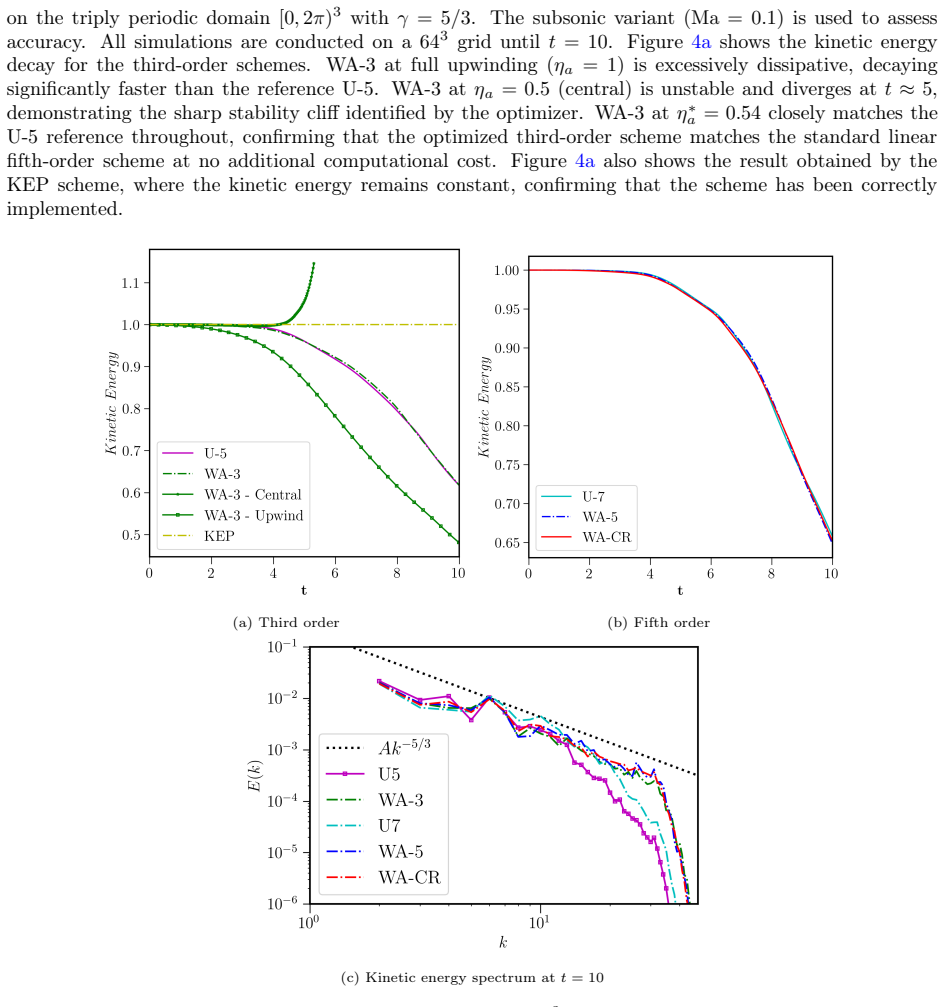
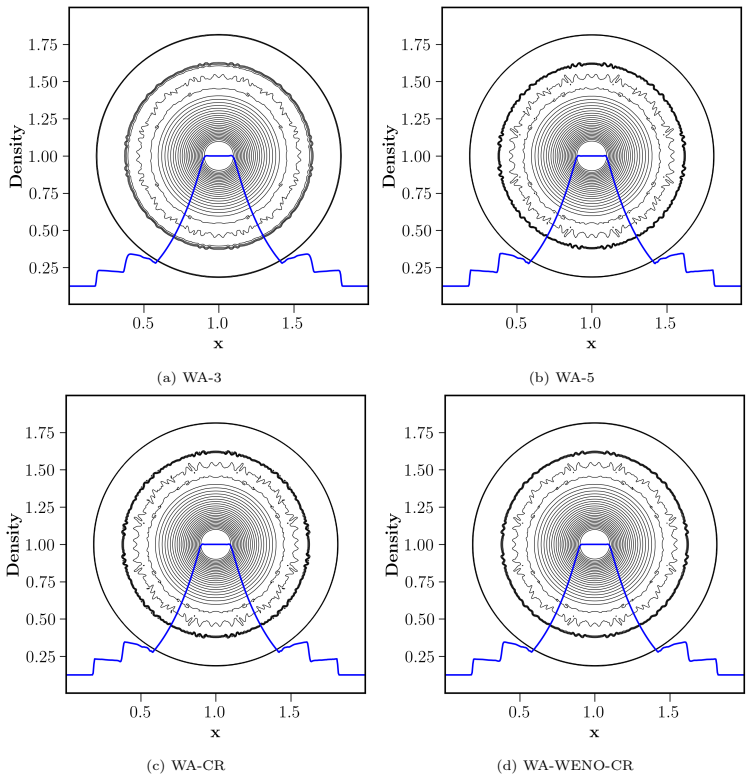
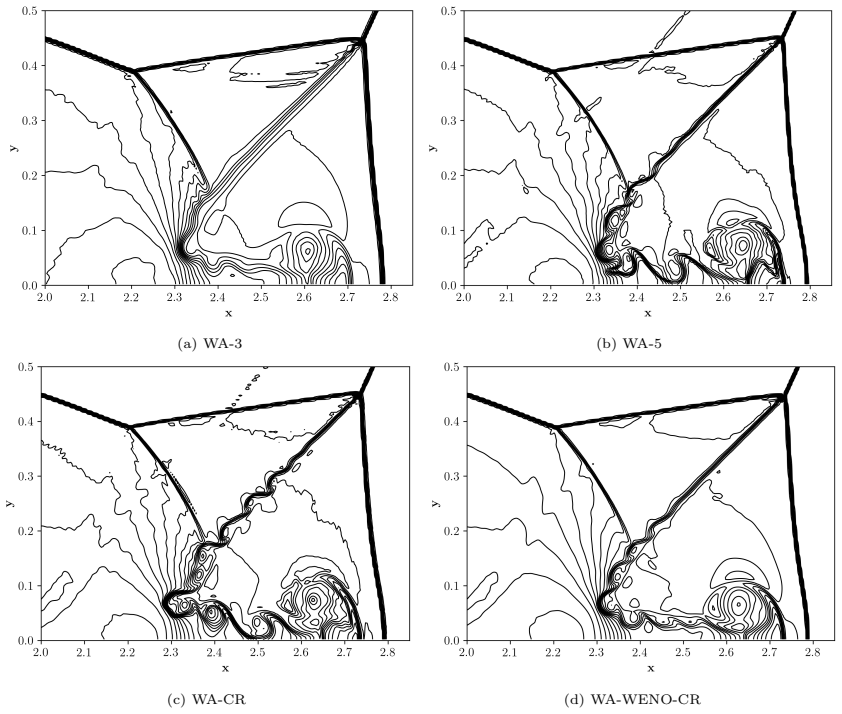
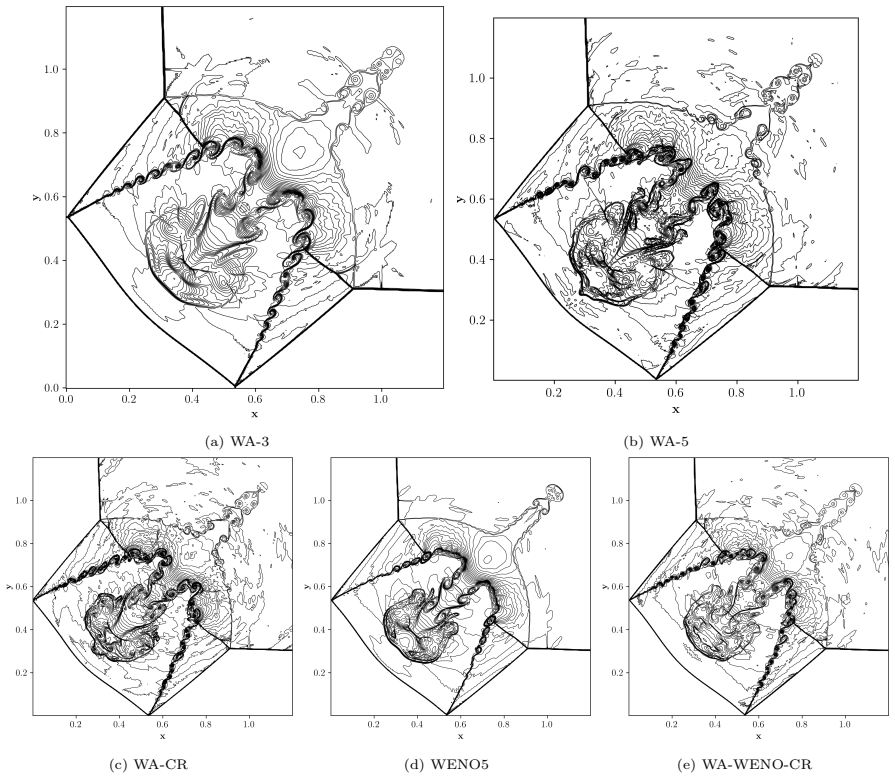
The wave-appropriate reconstruction approach decomposes the reconstruction procedure into characteristic wave families, centralizing non-acoustic waves to minimize dissipation while retaining an upwind bias for acoustic waves. In previous implementations, the acoustic upwind parameter $\eta_a$ was fixed at its maximum value of $1.0$; however, this choice is conservative and motivated a systematic search for the minimum value that is robust across flow regimes. To this end, the CFD solver is treated as a black box within a bounded scalar minimization, which minimizes an accuracy objective for the subsonic inviscid TGV subject to a stability constraint enforced by the supersonic viscous TGV. Because the wave-appropriate framework leaves $\eta_a$ as the sole degree of freedom, the optimization converges in approximately 25 evaluations. The resulting optimal values generalize without retuning across a wide range from subsonic turbulence to hypersonic flows with shocks and contact discontinuities. The second contribution focuses on eliminating the need for an explicit contact-discontinuity detector, which is commonly required in flows involving both shock waves and contact discontinuities. In such cases, the reconstruction deficiency appears solely within the entropy characteristic wave and can be corrected by a rank-1 update along the entropy right eigenvector. The proposed algorithm relies only on the Ducros sensor and is limiter-agnostic, facilitating direct use in other schemes, such as WENO. This approach reduces wall time by $29$--$41\%$ compared to full characteristic decomposition. To further demonstrate the method's generality, introducing a controlled acoustic bias exclusively to the normal momentum in a KEP scheme eliminates spurious vortices in periodic shear layers, confirming that the acoustic stability mechanism operates independently of the discretization framework.
Editorial analysis
A structured set of objections, weighed in public.
Referee Report
Summary. The manuscript introduces a wave-appropriate reconstruction for compressible flows by decomposing into characteristic waves, optimizing the acoustic parameter η_a via bounded minimization on two Taylor-Green vortex (TGV) cases (accuracy on subsonic inviscid, stability on supersonic viscous), and proposing a rank-1 entropy wave correction using only the Ducros sensor to handle contacts without explicit detectors. It claims the optimized η_a generalizes without retuning from subsonic turbulence to hypersonic shocks, reducing wall time by 29-41%, and demonstrates acoustic bias in KEP schemes.
Significance. If the generalization of the optimized η_a holds, the method offers a practical way to reduce dissipation on non-acoustic waves and computational cost in multi-regime compressible simulations, with the rank-1 correction simplifying implementation across schemes like WENO. The black-box optimization approach is efficient, converging in ~25 evaluations.
major comments (2)
- [Results / generalization claim] The central claim that the optimal η_a obtained from the two TGV cases generalizes without retuning to hypersonic flows with strong shocks and contacts is load-bearing but unsupported by quantitative evidence; the abstract reports time savings and the optimization procedure but provides no error tables, L2 norms, or stability metrics for hypersonic test cases, leaving open whether the acoustic dissipation requirement grows with shock strength as the skeptic analysis indicates.
- [Optimization procedure] The bounded minimization enforces stability only via the supersonic viscous TGV; § on optimization does not report the achieved stability margin, the objective function values at convergence, or a sensitivity study showing that the minimal η_a remains sufficient when acoustic amplitudes increase in untested hypersonic regimes.
minor comments (2)
- [Abstract] The 29-41% wall-time reduction is stated relative to full characteristic decomposition but the specific test cases, grid sizes, and timing methodology are not detailed in the abstract or results summary.
- [Methods / rank-1 correction] Clarify the precise form of the rank-1 entropy correction (right eigenvector update) and its interaction with the Ducros sensor when limiters are present; this would aid reproducibility in other schemes such as WENO.
Simulated Author's Rebuttal
We thank the referee for the constructive feedback on our manuscript. We address each major comment below and will revise the paper to strengthen the quantitative support for our claims where appropriate.
read point-by-point responses
-
Referee: [Results / generalization claim] The central claim that the optimal η_a obtained from the two TGV cases generalizes without retuning to hypersonic flows with strong shocks and contacts is load-bearing but unsupported by quantitative evidence; the abstract reports time savings and the optimization procedure but provides no error tables, L2 norms, or stability metrics for hypersonic test cases, leaving open whether the acoustic dissipation requirement grows with shock strength as the skeptic analysis indicates.
Authors: We agree that explicit quantitative metrics for the hypersonic cases would strengthen the generalization claim. While the results section demonstrates stable and accurate performance on hypersonic flows with shocks and contacts (including reduced dissipation on non-acoustic waves), we did not include tabulated L2 norms or direct comparisons of acoustic dissipation growth. We will add a new table in the results section reporting L2 errors, stability indicators, and wall-time savings for the hypersonic test cases, along with a brief discussion addressing whether acoustic bias requirements increase with shock strength. revision: yes
-
Referee: [Optimization procedure] The bounded minimization enforces stability only via the supersonic viscous TGV; § on optimization does not report the achieved stability margin, the objective function values at convergence, or a sensitivity study showing that the minimal η_a remains sufficient when acoustic amplitudes increase in untested hypersonic regimes.
Authors: We acknowledge that the optimization section focuses on the procedure and convergence in ~25 evaluations but omits explicit reporting of the stability margin, final objective values, and sensitivity to higher acoustic amplitudes. We will revise the optimization section to include the converged objective function value, the achieved stability margin from the supersonic TGV constraint, and a short sensitivity study (e.g., perturbing acoustic amplitudes by factors of 2–5) confirming that the minimal η_a remains robust for hypersonic regimes. revision: yes
Circularity Check
No significant circularity; derivation remains self-contained
full rationale
The optimization of η_a is performed explicitly via bounded scalar minimization on two TGV cases (subsonic inviscid for accuracy, supersonic viscous for stability constraint), after which the resulting scalar is applied to other regimes. This constitutes an empirical generalization claim rather than a mathematical reduction in which the target performance is forced by construction from the fitted value. The rank-1 entropy correction is obtained directly from the characteristic decomposition of the Euler equations (entropy right eigenvector) and the Ducros sensor; it does not rely on any fitted parameter or self-citation chain. No load-bearing step equates a derived prediction to its own input by definition, and the framework treats the CFD solver as a black box without smuggling ansatzes or uniqueness theorems from prior author work. The central claims are therefore independent of the optimization inputs and can be falsified by external test cases.
Axiom & Free-Parameter Ledger
free parameters (1)
- η_a
axioms (1)
- domain assumption The CFD solver can be treated as a black-box function for scalar minimization subject to stability constraints.
Lean theorems connected to this paper
-
IndisputableMonolith/Cost/FunctionalEquation.leanwashburn_uniqueness_aczel unclear?
unclearRelation between the paper passage and the cited Recognition theorem.
the optimization converges in approximately 25 evaluations... η∗a=0.54 for the third-order scheme and η∗a=0.6010 for the fifth-order scheme
-
IndisputableMonolith/Foundation/RealityFromDistinction.leanreality_from_one_distinction unclear?
unclearRelation between the paper passage and the cited Recognition theorem.
wave-appropriate reconstruction... decomposes the reconstruction procedure into characteristic wave families
What do these tags mean?
- matches
- The paper's claim is directly supported by a theorem in the formal canon.
- supports
- The theorem supports part of the paper's argument, but the paper may add assumptions or extra steps.
- extends
- The paper goes beyond the formal theorem; the theorem is a base layer rather than the whole result.
- uses
- The paper appears to rely on the theorem as machinery.
- contradicts
- The paper's claim conflicts with a theorem or certificate in the canon.
- unclear
- Pith found a possible connection, but the passage is too broad, indirect, or ambiguous to say the theorem truly supports the claim.
Forward citations
Cited by 2 Pith papers
-
On Reconstructing Conservative and Primitive Variables: An Eigenvector Analysis on Curvilinear Grids
Conservative curvilinear eigenvectors isolate contact discontinuities in a single metric-independent entropy direction while primitive ones mix metric-dependent density and velocity terms, enabling exact rank-one corr...
-
Wave-Appropriate Reconstruction of Compressible Multiphase and Multicomponent Flows: Fully Conservative and Semi-Conservative Eigenstructures
Derives explicit left and right eigenvectors for the Allaire model that enforce pressure-velocity equilibrium at interfaces via a thermodynamic jump term in the conservative form and a structural zero in the semi-cons...
Reference graph
Works this paper leans on
-
[1]
A. S. Chamarthi, N. Hoffmann, S. Frankel, A wave appropriate discontinuity sensor approach for compressible flows, Physics of Fluids 35 (6) (2023)
work page 2023
-
[2]
N. Hoffmann, A. S. Chamarthi, S. H. Frankel, Centralized gradient-based reconstruction for wall mod- elled large eddy simulations of hypersonic boundary layer transition, Journal of Computational Physics (2024) 113128
work page 2024
-
[3]
A. S. Chamarthi, Wave-appropriate multidimensional upwinding approach for compressible multiphase flows, Journal of Computational Physics 538 (2025) 114157
work page 2025
- [4]
-
[5]
A. S. Chamarthi, Physics appropriate interface capturing reconstruction approach for viscous compress- ible multicomponent flows, Computers & Fluids 303 (2025) 106858
work page 2025
- [6]
-
[7]
N. Sandham, E. Schuelein, A. Wagner, S. Willems, J. Steelant, Transitional shock-wave/boundary-layer interactions in hypersonic flow, Journal of Fluid Mechanics 752 (2014) 1–33
work page 2014
-
[8]
G. K. Batchelor, An introduction to fluid dynamics, Cambridge university press, 1967
work page 1967
-
[9]
J. C. Meng, T. Colonius, Numerical simulation of the aerobreakup of a water droplet, Journal of Fluid Mechanics 835 (2018) 1108–1135
work page 2018
-
[10]
F. De Vanna, F. Picano, E. Benini, A sharp-interface immersed boundary method for moving objects in compressible viscous flows, Computers & Fluids 201 (2020) 104415
work page 2020
-
[11]
P. K. Subbareddy, G. V. Candler, A fully discrete, kinetic energy consistent finite-volume scheme for compressible flows, Journal of Computational Physics 228 (5) (2009) 1347–1364. 39
work page 2009
-
[12]
W. van Noordt, S. Ganju, C. Brehm, An immersed boundary method for wall-modeled large-eddy simulation of turbulent high-mach-number flows, Journal of Computational Physics 470 (2022) 111583
work page 2022
-
[13]
F. De Vanna, F. Avanzi, M. Cogo, S. Sandrin, M. Bettencourt, F. Picano, E. Benini, Uranos: A gpu ac- celerated navier-stokes solver for compressible wall-bounded flows, Computer Physics Communications 287 (2023) 108717
work page 2023
- [14]
-
[15]
L. Sciacovelli, D. Passiatore, P. Cinnella, G. Pascazio, Assessment of a high-order shock-capturing central-difference scheme for hypersonic turbulent flow simulations, Computers & Fluids 230 (2021) 105134
work page 2021
-
[16]
F. S. Schranner, X. Y. Hu, N. A. Adams, A physically consistent weakly compressible high-resolution approach to underresolved simulations of incompressible flows, Computers & Fluids 86 (2013) 109–124
work page 2013
-
[17]
F. S. Schranner, V. Rozov, N. A. Adams, Optimization of an implicit large-eddy simulation method for underresolved incompressible flow simulations, AIAA Journal 54 (5) (2016) 1567–1577
work page 2016
-
[18]
J. M. Winter, F. S. Schranner, N. A. Adams, Iterative bayesian optimization of an implicit les method for under-resolved simulations of incompressible flows, in: en. In: 10th International Symposium on Turbulence and Shear Flow Phenomena, TSFP, Vol. 10, 2016
work page 2016
-
[19]
Y. Feng, F. S. Schranner, J. Winter, N. A. Adams, A multi-objective bayesian optimization environment for systematic design of numerical schemes for compressible flow, Journal of Computational Physics 468 (2022) 111477
work page 2022
-
[20]
Y. Feng, J. Winter, N. A. Adams, F. S. Schranner, A general multi-objective bayesian optimization framework for the design of hybrid schemes towards adaptive complex flow simulations, Journal of Computational Physics 510 (2024) 113088
work page 2024
-
[21]
Y.Feng, F.S.Schranner, J.Winter, N.A.Adams, Adeepreinforcementlearningframeworkfordynamic optimization of numerical schemes for compressible flow simulations, Journal of Computational Physics 493 (2023) 112436
work page 2023
-
[22]
D. A. Bezgin, A. B. Buhendwa, S. J. Schmidt, N. A. Adams, Ml-iles: End-to-end optimization of data-driven high-order godunov-type finite-volume schemes for compressible homogeneous isotropic turbulence, Journal of Computational Physics 522 (2025) 113560
work page 2025
-
[23]
B. Van Leer, Upwind and high-resolution methods for compressible flow: From donor cell to residual- distribution schemes, in: 16th AIAA Computational Fluid Dynamics Conference, 2003, p. 3559
work page 2003
-
[24]
P. L. Roe, Discrete models for the numerical analysis of time-dependent multidimensional gas dynamics, Journal of Computational Physics 63 (2) (1986) 458–476
work page 1986
-
[25]
P. Chandrashekar, Kinetic energy preserving and entropy stable finite volume schemes for compressible euler and navier-stokes equations, Communications in Computational Physics 14 (5) (2013) 1252–1286
work page 2013
-
[26]
H. Nishikawa, Beyond Interface Gradient: A General Principle for Constructing Diffusion Schemes, 40th Fluid Dynamics Conference and Exhibit (2010)
work page 2010
-
[27]
E. F. Toro, M. Spruce, W. Speares, Restoration of the contact surface in the hll-riemann solver, Shock waves 4 (1) (1994) 25–34
work page 1994
- [28]
-
[29]
A. S. Chamarthi, Gradient based reconstruction: Inviscid and viscous flux discretizations, shock cap- turing, and its application to single and multicomponent flows, Computers & Fluids 250 (2023) 105706. 40
work page 2023
-
[30]
A. S. Chamarthi, Efficient high-order gradient-based reconstruction for compressible flows, Journal of Computational Physics 486 (2023) 112119
work page 2023
-
[31]
A. S. Chamarthi, N. Hoffmann, H. Nishikawa, S. H. Frankel, Implicit gradients based conservative numerical scheme for compressible flows, Journal of Scientific Computing 95 (1) (2023) 17
work page 2023
-
[32]
C.-W. Shu, Essentially non-oscillatory and weighted essentially non-oscillatory schemes for hyperbolic conservation laws, in: Advanced Numerical Approximation of Nonlinear Hyperbolic Equations: Lec- tures given at the 2nd Session of the Centro Internazionale Matematico Estivo (CIME) held in Cetraro, Italy, June 23–28, 1997, Springer, 2006, pp. 325–432
work page 1997
-
[33]
S.K.Godunov, Adifferencemethodfornumericalcalculationofdiscontinuoussolutionsoftheequations of hydrodynamics, Matematicheskii Sbornik 89 (3) (1959) 271–306
work page 1959
-
[34]
Van Leer, Towards the ultimate conservative difference scheme
B. Van Leer, Towards the ultimate conservative difference scheme. iv. a new approach to numerical convection, Journal of Computational Physics 23 (3) (1977) 276–299
work page 1977
-
[35]
Van Leer, Towards the ultimate conservative difference scheme
B. Van Leer, Towards the ultimate conservative difference scheme. v. a second-order sequel to godunov’s method, Journal of computational Physics 32 (1) (1979) 101–136
work page 1979
- [36]
-
[37]
S. Pirozzoli, On the spectral properties of shock-capturing schemes, Journal of Computational Physics 219 (2) (2006) 489–497
work page 2006
-
[38]
D. J. Lusher, N. D. Sandham, Assessment of low-dissipative shock-capturing schemes for the compress- ible taylor–green vortex, AIAA Journal 59 (2) (2021) 533–545
work page 2021
-
[39]
P. Virtanen, R. Gommers, T. E. Oliphant, M. Haberland, T. Reddy, D. Cournapeau, E. Burovski, P. Peterson, W. Weckesser, J. Bright, et al., Scipy 1.0: fundamental algorithms for scientific computing in python, Nature methods 17 (3) (2020) 261–272
work page 2020
- [40]
-
[41]
G.-S. Jiang, C.-W. Shu, Efficient Implementation of Weighted ENO Schemes, Journal of Computational Physics 126 (126) (1995) 202–228
work page 1995
-
[42]
M. E. Brachet, D. I. Meiron, S. A. Orszag, B. Nickel, R. H. Morf, U. Frisch, Small-scale structure of the taylor–green vortex, Journal of Fluid Mechanics 130 (1983) 411–452
work page 1983
- [43]
-
[44]
T.Liang, L.Fu, Anewhigh-ordershock-capturingtenoschemecombinedwithskew-symmetric-splitting method for compressible gas dynamics and turbulence simulation, Computer Physics Communications 302 (2024) 109236
work page 2024
-
[45]
F. F. Grinstein, L. G. Margolin, W. J. Rider, Implicit large eddy simulation, Vol. 10, Cambridge university press Cambridge, 2007
work page 2007
-
[46]
M. L. Minion, D. L. Brown, Performance of under-resolved two-dimensional incompressible flow simu- lations, ii, Journal of Computational Physics 138 (2) (1997) 734–765
work page 1997
-
[47]
N. Fleischmann, S. Adami, N. A. Adams, Numerical symmetry-preserving techniques for low-dissipation shock-capturing schemes, Computers & Fluids 189 (2019) 94–107
work page 2019
-
[48]
E. Toro, Riemann Solvers and Numerical Methods for Fluid Dynamics: A Practical Introduction, Springer Berlin Heidelberg, 2009. 41
work page 2009
- [49]
-
[50]
X. Deng, Y. Shimizu, F. Xiao, A fifth-order shock capturing scheme with two-stage boundary variation diminishing algorithm, Journal of Computational Physics 386 (2019) 323–349
work page 2019
-
[51]
P. Woodward, P. Colella, The numerical simulation of two-dimensional fluid flow with strong shocks, Journal of Computational Physics 54 (1) (1984) 115–173
work page 1984
-
[52]
C. W. Schulz-Rinne, J. P. Collins, H. M. Glaz, Numerical solution of the riemann problem for two- dimensional gas dynamics, SIAM Journal on Scientific Computing 14 (6) (1993) 1394–1414
work page 1993
-
[53]
V. Daru, C. Tenaud, Numerical simulation of the viscous shock tube problem by using a high resolution monotonicity-preserving scheme, Computers & Fluids 38 (3) (2009) 664–676
work page 2009
-
[54]
A. S. Chamarthi, S. Bokor, S. H. Frankel, On the importance of high-frequency damping in high- order conservative finite-difference schemes for viscous fluxes, Journal of Computational Physics (2022) 111195
work page 2022
- [55]
-
[56]
M.Macklin, Warp: Ahigh-performancepythonframeworkforgpusimulationandgraphics, in: NVIDIA GPU Technology Conference (GTC), Vol. 3, 2022. 42
work page 2022
discussion (0)
Sign in with ORCID, Apple, or X to comment. Anyone can read and Pith papers without signing in.