Recognition: unknown
Wave-Appropriate Reconstruction of Compressible Multiphase and Multicomponent Flows: Fully Conservative and Semi-Conservative Eigenstructures
Pith reviewed 2026-05-10 00:47 UTC · model grok-4.3
The pith
Characteristic reconstruction using the derived eigenstructures of the Allaire model enforces pressure and velocity equilibrium at material interfaces.
A machine-rendered reading of the paper's core claim, the machinery that carries it, and where it could break.
Core claim
The complete left and right eigenvectors for the Allaire system are derived explicitly. In the fully conservative variables the eigenvectors contain an explicit thermodynamic jump term Ψ that compensates for compressibility differences so that dp and du remain zero across material contacts. In the semi-conservative variables the volume-fraction eigenvector has a zero in the pressure slot, enforcing the same equilibrium without any additional correction term. Both sets therefore satisfy Abgrall's condition whenever reconstruction occurs in characteristic space.
What carries the argument
The derived right and left eigenvectors for the fully conservative and semi-conservative variable sets of the Allaire five-equation model, which embed either the thermodynamic jump Ψ or a structural zero in the pressure slot to enforce equilibrium.
If this is right
- Reconstruction in characteristic space satisfies Abgrall equilibrium for both fully conservative and semi-conservative variable sets.
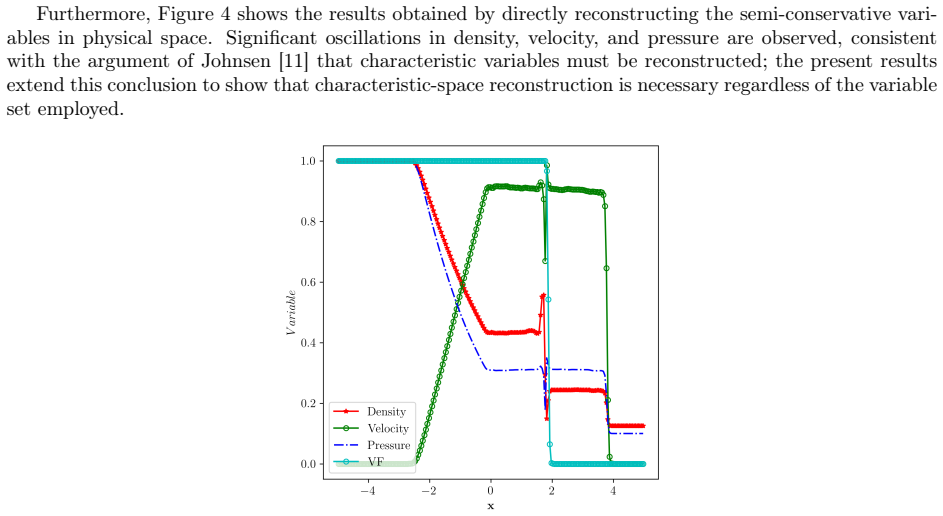
- Reconstruction in physical space produces O(1) pressure and velocity errors at interfaces irrespective of the variable set.
- The shear wave is decoupled from thermodynamic and interface fields, extending the single-species property to compressible multiphase flows.
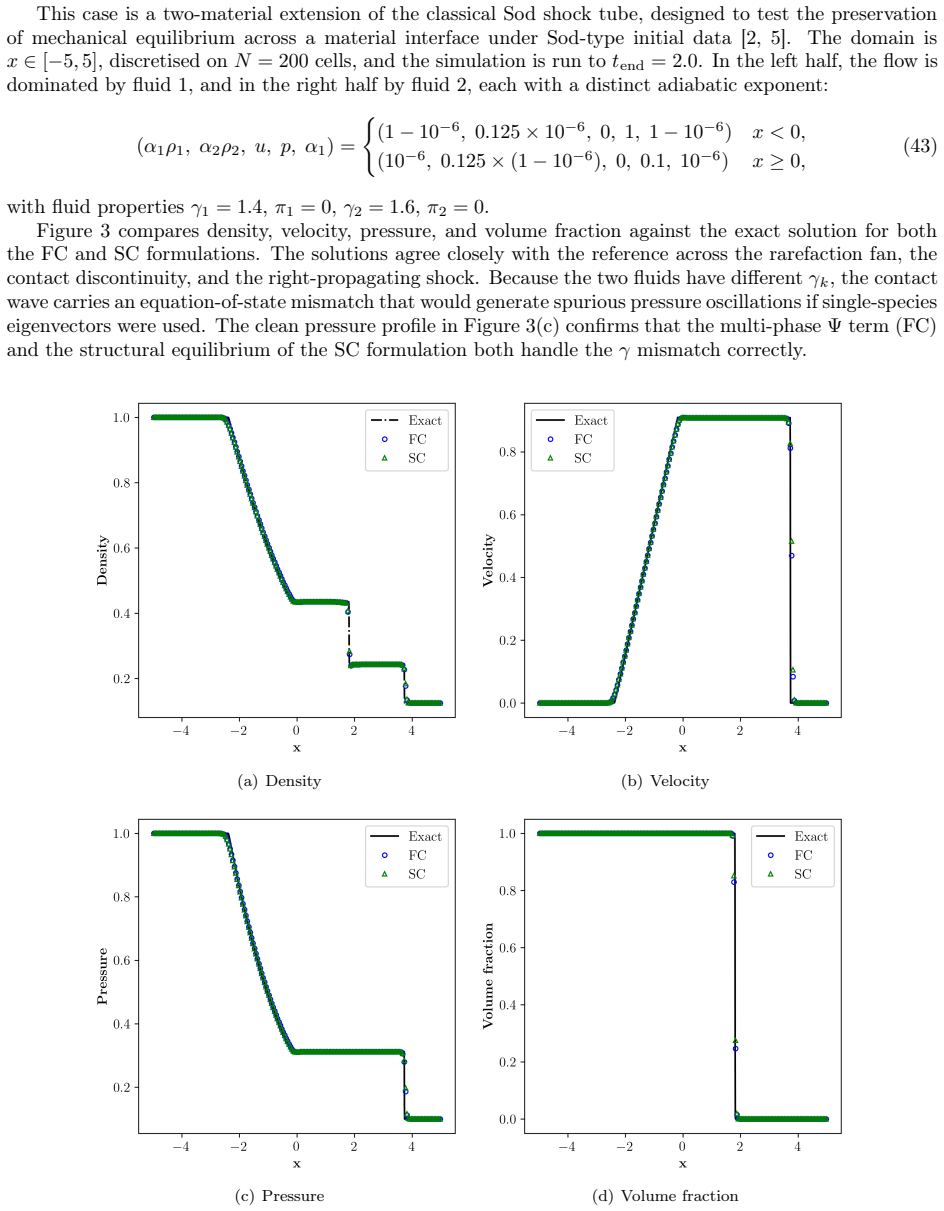
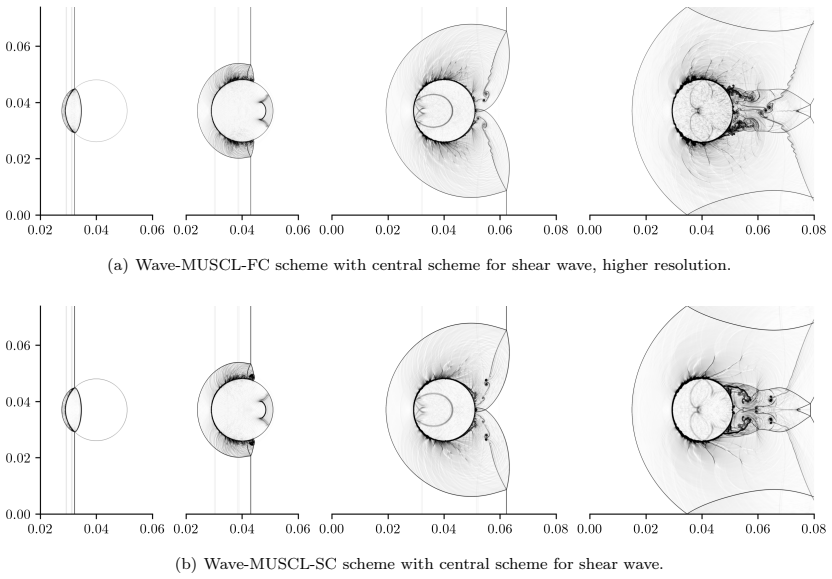
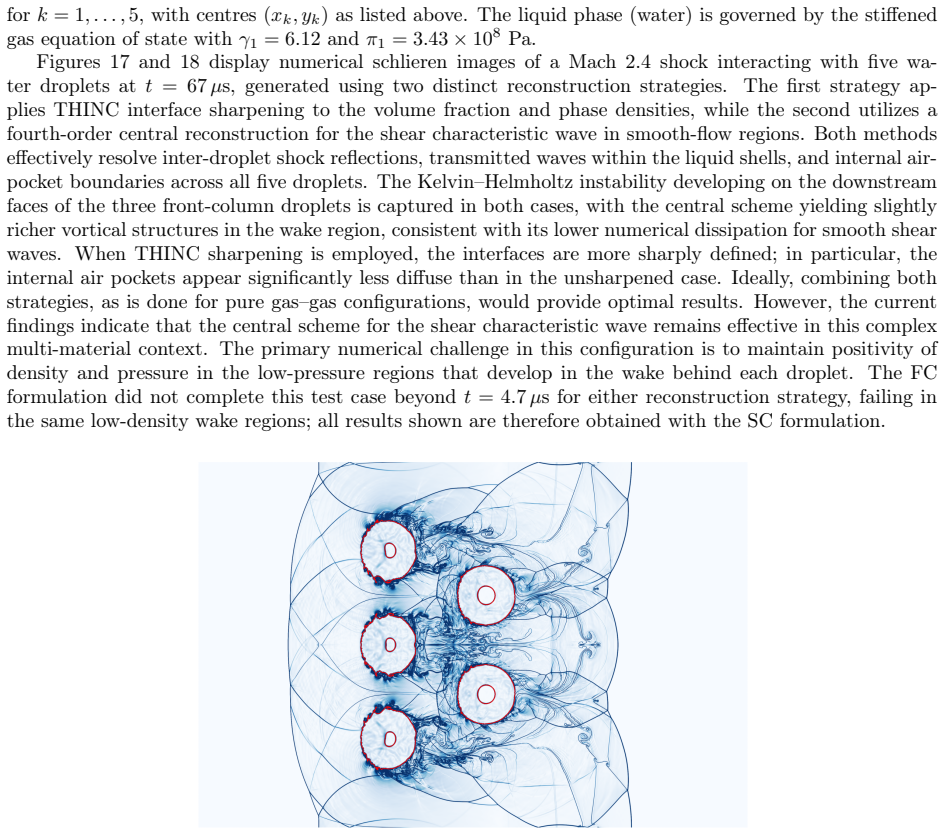
- The approach yields oscillation-free results on one- and two-dimensional gas-gas and gas-liquid test problems with stiffened-gas thermodynamics.
Where Pith is reading between the lines
- Similar eigenvector derivations could be performed for other equations of state or reduced multiphase models to obtain the same equilibrium-preserving property.
- The explicit decoupling of the shear wave suggests that high-order characteristic schemes may preserve interface sharpness even in the presence of vorticity.
- The structural difference between the two variable sets offers a route to choose the formulation that simplifies boundary-condition implementation without sacrificing equilibrium preservation.
Load-bearing premise
The derivation assumes the flow obeys the Allaire five-equation model with a stiffened-gas equation of state and that the system remains hyperbolic for the chosen variable sets.
What would settle it
A one-dimensional material-interface advection test in which characteristic reconstruction with the stated eigenvectors still produces pressure or velocity oscillations of order one would falsify the equilibrium claim.
Figures





read the original abstract
Compressible multiphase and multicomponent solvers require accurate interface representation without spurious pressure oscillations. At material interfaces, pressure and velocity are continuous while density and the equation of state exhibit abrupt discontinuities. Standard approaches reconstruct primitive or characteristic variables to capture these properties, but do not clarify the failure mechanisms of conservative reconstruction or fully leverage the wave-decoupling advantages of characteristic decomposition. This work derives the complete eigenstructure of the Allaire five-equation model for two variable sets. In the fully conservative~(FC) formulation, $\mathbf{U} = [\alpha_1\rho_1,\,\alpha_2\rho_2,\,\rho u,\,\rho v,\,\rho E,\,\alpha_1]^T$, eigenvectors contain a thermodynamic jump term~$\Psi$ that enforces $dp=0$ and $du=0$ at material contacts by compensating for compressibility mismatches. In the semi-conservative~(SC) formulation, $\mathbf{V} = [\alpha_1\rho_1,\,\alpha_2\rho_2,\,\rho u,\,\rho v,\,p,\,\alpha_1]^T$, the volume-fraction eigenvector carries a structural zero in the pressure slot, enforcing equilibrium without thermodynamic correction. Explicit left and right eigenvectors are derived for one- and two-dimensional stiffened-gas flows. Both formulations satisfy Abgrall's equilibrium condition when reconstruction is performed in characteristic space; reconstruction in physical space yields $\mathcal{O}(1)$ pressure and velocity errors at interfaces regardless of the variable set. The eigenvector structure further reveals that the shear wave is decoupled from all thermodynamic and interface fields in both formulations, extending this result from single-species to compressible multiphase flows including gas-liquid configurations. One- and two-dimensional gas-gas and gas-liquid test cases confirm oscillation-free, accurate results.
Editorial analysis
A structured set of objections, weighed in public.
Referee Report
Summary. The manuscript derives the complete left and right eigenstructure of the Allaire five-equation model for stiffened-gas flows in both the fully conservative variable set U = [α1ρ1, α2ρ2, ρu, ρv, ρE, α1]^T and the semi-conservative set V = [α1ρ1, α2ρ2, ρu, ρv, p, α1]^T. It shows that characteristic-space reconstruction using these eigenvectors satisfies Abgrall's equilibrium condition (continuous pressure and velocity across material interfaces) via a thermodynamic jump term Ψ in the FC eigenvectors and a structural zero in the pressure slot of the volume-fraction eigenvector in the SC case, while physical-space reconstruction produces O(1) pressure and velocity errors independent of the variable choice. The work further establishes decoupling of the shear wave from all thermodynamic and interface fields and validates the approach with 1D and 2D gas-gas and gas-liquid test cases.
Significance. If the explicit eigenvector derivations hold, the paper supplies a parameter-free, wave-appropriate reconstruction strategy that guarantees equilibrium preservation for compressible multiphase and multicomponent flows. The identification of the compensating term Ψ in the FC formulation and the structural zero in the SC formulation, together with the shear-wave decoupling result that extends single-species findings to gas-liquid cases, offers concrete implementation guidance for high-order schemes. The numerical confirmation on both gas-gas and gas-liquid configurations adds practical value for interface-capturing methods in fluid dynamics.
minor comments (3)
- The abstract states that explicit eigenvectors are supplied, but a compact table listing the key non-zero components of the right eigenvectors for the contact and shear waves in both FC and SC formulations would improve readability and allow immediate comparison of the Ψ term versus the structural zero.
- In the description of the numerical tests, quantitative measures (e.g., L1 or L∞ errors in pressure and velocity at the interface for characteristic versus primitive reconstruction) should be reported alongside the qualitative oscillation-free statements to make the O(1) error claim precise.
- The hyperbolicity assumption for the chosen variable sets is stated but not verified numerically for the gas-liquid cases; a brief check that all eigenvalues remain real across the tested density and pressure jumps would strengthen the supporting evidence.
Simulated Author's Rebuttal
We thank the referee for the detailed summary of our work and the positive assessment of its significance. The recommendation for minor revision is noted. No specific major comments were provided in the report, so we have no point-by-point responses to address.
Circularity Check
No significant circularity: eigenstructure derived directly from Jacobian
full rationale
The paper computes the complete eigenstructure of the Allaire five-equation model by forming the flux Jacobian for the two stated variable sets (FC: U = [α1ρ1, α2ρ2, ρu, ρv, ρE, α1]^T; SC: V = [α1ρ1, α2ρ2, ρu, ρv, p, α1]^T) and extracting explicit left/right eigenvectors for the stiffened-gas EOS. The thermodynamic jump term Ψ in the FC eigenvectors and the structural zero in the SC volume-fraction eigenvector are obtained by direct solution of the eigenvalue problem; Abgrall equilibrium then follows algebraically from these forms when characteristic reconstruction is used. No fitted parameters, self-referential definitions, or load-bearing self-citations appear in the derivation chain. The shear-wave decoupling result is likewise a direct consequence of the eigenvector structure. The construction is therefore self-contained against the governing PDEs and does not reduce to its inputs by construction.
Axiom & Free-Parameter Ledger
axioms (2)
- domain assumption The Allaire five-equation model governs the compressible multiphase flow.
- domain assumption Stiffened-gas equation of state applies to the flows considered.
Reference graph
Works this paper leans on
-
[1]
Saurel, C
R. Saurel, C. Pantano, Diffuse-interface capturing methods for compressible two-phase flows, Annual Review of Fluid Mechanics 50 (2018) 105–130. 34
2018
-
[2]
Karni, Multicomponent flow calculations by a consistent primitive algorithm, Journal of Computa- tional Physics 112 (1) (1994) 31–43
S. Karni, Multicomponent flow calculations by a consistent primitive algorithm, Journal of Computa- tional Physics 112 (1) (1994) 31–43
1994
-
[3]
Abgrall, How to prevent pressure oscillations in multicomponent flow calculations: a quasi conser- vative approach, Journal of Computational Physics 125 (1) (1996) 150–160
R. Abgrall, How to prevent pressure oscillations in multicomponent flow calculations: a quasi conser- vative approach, Journal of Computational Physics 125 (1) (1996) 150–160
1996
-
[4]
Shyue, An efficient shock-capturing algorithm for compressible multicomponent problems, Jour- nal of Computational Physics 142 (1) (1998) 208–242
K.-M. Shyue, An efficient shock-capturing algorithm for compressible multicomponent problems, Jour- nal of Computational Physics 142 (1) (1998) 208–242
1998
-
[5]
Abgrall, S
R. Abgrall, S. Karni, Computations of compressible multifluids, Journal of computational physics 169 (2) (2001) 594–623
2001
-
[6]
M. R. Baer, J. W. Nunziato, A two-phase mixture theory for the deflagration-to-detonation transition (ddt) in reactive granular materials, International Journal of Multiphase Flow 12 (6) (1986) 861–889
1986
-
[7]
Saurel, R
R. Saurel, R. Abgrall, A multiphase godunov method for compressible multifluid and multiphase flows, Journal of Computational Physics 150 (2) (1999) 425–467
1999
-
[8]
A. K. Kapila, R. Menikoff, J. B. Bdzil, S. F. Son, D. S. Stewart, Two-phase modeling of deflagration- to-detonation transition in granular materials: Reduced equations, Physics of Fluids 13 (10) (2001) 3002–3024
2001
-
[9]
G.Allaire, S.Clerc, S.Kokh, Afive-equationmodelforthesimulationofinterfacesbetweencompressible fluids, Journal of Computational Physics 181 (2) (2002) 577–616
2002
-
[10]
Johnsen, T
E. Johnsen, T. Colonius, Implementation of weno schemes in compressible multicomponent flow prob- lems, Journal of Computational Physics 219 (2) (2006) 715–732
2006
-
[11]
Johnsen, On the treatment of contact discontinuities using weno schemes, Journal of Computational Physics 230 (24) (2011) 8665–8668
E. Johnsen, On the treatment of contact discontinuities using weno schemes, Journal of Computational Physics 230 (24) (2011) 8665–8668
2011
-
[12]
A. S. Chamarthi, Gradient based reconstruction: Inviscid and viscous flux discretizations, shock cap- turing, and its application to single and multicomponent flows, Computers & Fluids 250 (2023) 105706
2023
-
[13]
Nonomura, S
T. Nonomura, S. Morizawa, H. Terashima, S. Obayashi, K. Fujii, Numerical (error) issues on com- pressible multicomponent flows using a high-order differencing scheme: Weighted compact nonlinear scheme, Journal of Computational Physics 231 (8) (2012) 3181–3210
2012
-
[14]
S. Kokh, F. Lagoutiére, An anti-diffusive numerical scheme for the simulation of interfaces between compressible fluids, Journal of Computational Physics 229 (8) (2010) 2773–2809
2010
-
[15]
K. K. So, X. Y. Hu, N. A. Adams, Anti-diffusion interface sharpening technique for two-phase com- pressible flow simulations, Journal of Computational Physics 231 (11) (2012) 4304–4323
2012
-
[16]
R.K.Shukla, C.Pantano, J.B.Freund, Aninterfacecapturingmethodforthesimulationofmulti-phase compressible flows, Journal of Computational Physics 229 (19) (2010) 7411–7439
2010
-
[17]
F. Xiao, Y. Honma, T. Kono, A simple algebraic interface capturing scheme using hyperbolic tangent function, International Journal for Numerical Methods in Fluids 48 (9) (2005) 1023–1040
2005
-
[18]
Shyue, F
K.-M. Shyue, F. Xiao, An eulerian interface sharpening algorithm for compressible two-phase flow: The algebraic thinc approach, Journal of Computational Physics 268 (2014) 326–354
2014
-
[19]
Hoffmann, A
N. Hoffmann, A. S. Chamarthi, S. H. Frankel, Centralized gradient-based reconstruction for wall mod- elled large eddy simulations of hypersonic boundary layer transition, Journal of Computational Physics (2024) 113128
2024
-
[20]
A. S. Chamarthi, Physics appropriate interface capturing reconstruction approach for viscous compress- ible multicomponent flows, Computers & Fluids 303 (2025) 106858. 35
2025
-
[21]
A. S. Chamarthi, Wave-appropriate multidimensional upwinding approach for compressible multiphase flows, Journal of Computational Physics 538 (2025) 114157
2025
-
[22]
A. S. Chamarthi, Wave-appropriate reconstruction of compressible flows: physics-constrained acoustic dissipation and rank-1 entropy wave correction, arXiv preprint arXiv:2604.02757 (2026)
work page internal anchor Pith review Pith/arXiv arXiv 2026
-
[23]
S. S. Jain, A. Mani, P. Moin, A conservative diffuse-interface method for compressible two-phase flows, Journal of Computational Physics 418 (2020) 109606
2020
-
[24]
S. S. Jain, P. Moin, A kinetic energy–and entropy-preserving scheme for compressible two-phase flows, Journal of Computational Physics 464 (2022) 111307
2022
-
[25]
S.K.Godunov, Adifferencemethodfornumericalcalculationofdiscontinuoussolutionsoftheequations of hydrodynamics, Matematicheskii Sbornik 89 (3) (1959) 271–306
1959
-
[26]
E. F. Toro, M. Spruce, W. Speares, Restoration of the contact surface in the hll-riemann solver, Shock waves 4 (1) (1994) 25–34
1994
-
[27]
Jiang, C.-W
G.-S. Jiang, C.-W. Shu, Efficient Implementation of Weighted ENO Schemes, Journal of Computational Physics 126 (126) (1995) 202–228
1995
-
[28]
Ducros, V
F. Ducros, V. Ferrand, F. Nicoud, C. Weber, D. Darracq, C. Gacherieu, T. Poinsot, Large-eddy simu- lation of the shock/turbulence interaction, Journal of Computational Physics 152 (2) (1999) 517–549
1999
-
[29]
Van Leer, Towards the ultimate conservative difference scheme
B. Van Leer, Towards the ultimate conservative difference scheme. iv. a new approach to numerical convection, Journal of Computational Physics 23 (3) (1977) 276–299
1977
-
[30]
Baumgart, G
A. Baumgart, G. Blanquart, Ensuring ys= 1 in transport of species mass fractions, Journal of Compu- tational Physics 513 (2024) 113199
2024
-
[31]
Suresh, H
A. Suresh, H. Huynh, Accurate monotonicity-preserving schemes with runge-kutta time stepping, Jour- nal of Computational Physics 136 (1) (1997) 83–99
1997
-
[32]
M. L. Wong, J. B. Angel, M. F. Barad, C. C. Kiris, A positivity-preserving high-order weighted compact nonlinearschemeforcompressiblegas-liquidflows, JournalofComputationalPhysics444(2021)110569
2021
-
[33]
Coralic, T
V. Coralic, T. Colonius, Finite-volume weno scheme for viscous compressible multicomponent flows, Journal of Computational Physics 274 (2014) 95–121
2014
-
[34]
G. K. Batchelor, An introduction to fluid dynamics, Cambridge university press, 1967
1967
-
[35]
J. C. Meng, T. Colonius, Numerical simulation of the aerobreakup of a water droplet, Journal of Fluid Mechanics 835 (2018) 1108–1135
2018
-
[36]
Harten, P
A. Harten, P. D. Lax, B. v. Leer, On upstream differencing and godunov-type schemes for hyperbolic conservation laws, SIAM review 25 (1) (1983) 35–61
1983
-
[37]
X. Deng, S. Inaba, B. Xie, K.-M. Shyue, F. Xiao, High fidelity discontinuity-resolving reconstruction for compressible multiphase flows with moving interfaces, Journal of Computational Physics 371 (2018) 945–966
2018
-
[38]
Sembian, M
S. Sembian, M. Liverts, N. Tillmark, N. Apazidis, Plane shock wave interaction with a cylindrical water column, Physics of Fluids 28 (5) (2016)
2016
-
[39]
A. S. Chamarthi, N. Hoffmann, S. Frankel, A wave appropriate discontinuity sensor approach for compressible flows, Physics of Fluids 35 (6) (2023). 36
2023
discussion (0)
Sign in with ORCID, Apple, or X to comment. Anyone can read and Pith papers without signing in.