Recognition: no theorem link
GRADE: Probing Knowledge Gaps in LLMs through Gradient Subspace Dynamics
Pith reviewed 2026-05-13 20:11 UTC · model grok-4.3
The pith
GRADE measures LLM knowledge gaps using the cross-layer rank ratio of gradients versus hidden state subspaces.
A machine-rendered reading of the paper's core claim, the machinery that carries it, and where it could break.
Core claim
GRADE quantifies the knowledge gap via the cross-layer rank ratio of the gradient to that of the corresponding hidden state subspace. This follows from the property that gradients estimate the knowledge updates needed for a given target, so their subspace alignment with activated hidden states reveals how much required knowledge is missing.
What carries the argument
The cross-layer rank ratio of the gradient subspace to the hidden state subspace, which estimates missing knowledge by showing how far the required update direction diverges from currently activated representations.
If this is right
- The method distinguishes required knowledge from stylistic or length-related activations that hidden-state probes may capture.
- GRADE remains reliable when inputs receive small perturbations that do not change the underlying knowledge demand.
- Gradient chains derived from the same subspaces can produce step-by-step explanations of specific knowledge shortfalls in long-form generations.
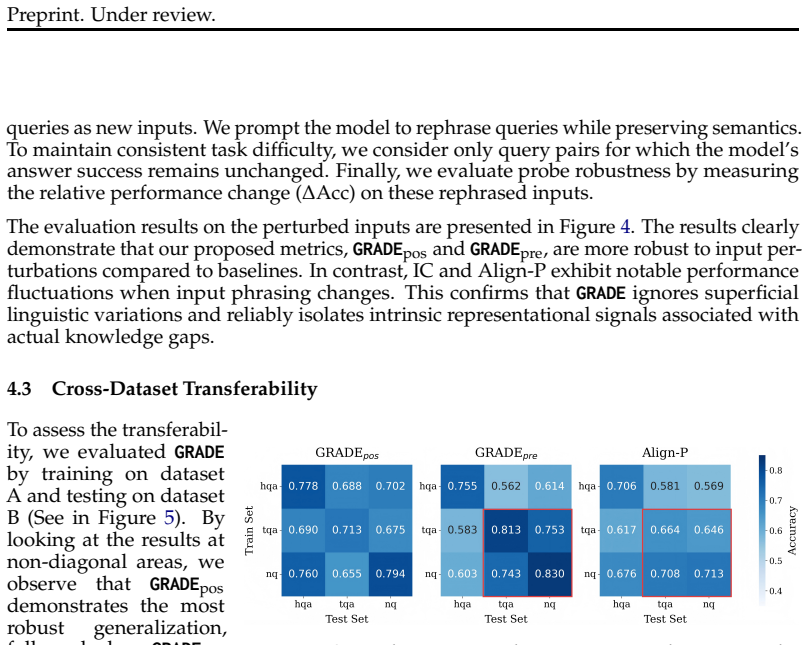
- The measure applies consistently across six separate benchmarks covering varied question types.
Where Pith is reading between the lines
- The ratio could be tracked during training to flag layers where knowledge injection would most efficiently close gaps.
- Combining the ratio with activation patching experiments would test whether low ratios truly correspond to factual omissions rather than reasoning failures.
- In deployment the metric might serve as an early warning for queries likely to produce hallucinations by quantifying the size of the update needed.
Load-bearing premise
Gradients serve as accurate estimators of the knowledge updates needed to produce the correct answer for the query.
What would settle it
A direct test in which the rank ratio stays high after the model is fine-tuned on the missing facts yet still fails to answer correctly, or drops when the model continues to lack the knowledge.
Figures






read the original abstract
Detecting whether a model's internal knowledge is sufficient to correctly answer a given question is a fundamental challenge in deploying responsible LLMs. In addition to verbalising the confidence by LLM self-report, more recent methods explore the model internals, such as the hidden states of the response tokens, to capture how much knowledge is activated. We argue that such activated knowledge may not align with what the query requires, e.g., capturing the stylistic and length-related features that are uninformative for answering the query. To fill the gap, we propose GRADE (Gradient Dynamics for knowledge gap detection), which quantifies the knowledge gap via the cross-layer rank ratio of the gradient to that of the corresponding hidden state subspace. This is motivated by the property of gradients as estimators of the required knowledge updates for a given target. We validate GRADE on six benchmarks, demonstrating its effectiveness and robustness to input perturbations. In addition, we present a case study showing how the gradient chain can generate interpretable explanations of knowledge gaps for long-form answers.
Editorial analysis
A structured set of objections, weighed in public.
Referee Report
Summary. The paper proposes GRADE, a method to detect knowledge gaps in LLMs by quantifying the cross-layer rank ratio between the gradient subspace and the corresponding hidden-state subspace. It is motivated by the claim that gradients estimate the required knowledge updates for a target query, and is validated on six benchmarks with reported robustness to input perturbations; a case study also illustrates interpretable explanations via gradient chains for long-form answers.
Significance. If the core assumption holds and the rank-ratio measure can be shown to isolate missing knowledge from other loss contributors, GRADE would offer a useful internal probe that avoids reliance on self-reported confidence or potentially uninformative hidden-state features. The approach could support more reliable deployment of LLMs on factual queries, but its value depends on independent evidence that the gradient subspace specifically tracks knowledge gaps rather than generic optimization signals.
major comments (3)
- [Abstract, §3] Abstract and §3 (motivation): The central claim that 'gradients act as estimators of the required knowledge updates' is asserted without derivation or isolation experiment. Standard next-token cross-entropy gradients can be large due to stylistic mismatch, token uncertainty, or loss curvature even when factual knowledge is present; no section demonstrates that the rank ratio remains invariant when knowledge is fixed but surface form or loss weighting changes.
- [§4] §4 (validation): The abstract states that GRADE was validated on six benchmarks and is robust to perturbations, yet provides no quantitative results, error bars, exact definition of the rank ratio, or threshold-selection procedure. Without these details it is impossible to verify that the reported effectiveness supports the knowledge-gap interpretation rather than a generic sensitivity to gradient magnitude.
- [§5] §5 (case study): The gradient-chain explanation for long-form answers is presented as interpretable, but the paper does not show that the identified subspaces correspond to missing factual content rather than other gradient directions; an ablation that perturbs only the factual content while holding style fixed would be needed to establish this link.
minor comments (2)
- [§3] Notation for the rank ratio (e.g., how the subspace dimension is chosen and how cross-layer aggregation is performed) should be formalized with an equation in §3.
- [Abstract, §4] The six benchmarks should be named explicitly in the abstract and §4, along with the precise metrics used to claim 'effectiveness'.
Simulated Author's Rebuttal
We thank the referee for the detailed and constructive report. The comments highlight important areas for improving the clarity of our claims and the presentation of results. We respond to each major comment below and indicate the revisions made to the manuscript.
read point-by-point responses
-
Referee: [Abstract, §3] Abstract and §3 (motivation): The central claim that 'gradients act as estimators of the required knowledge updates' is asserted without derivation or isolation experiment. Standard next-token cross-entropy gradients can be large due to stylistic mismatch, token uncertainty, or loss curvature even when factual knowledge is present; no section demonstrates that the rank ratio remains invariant when knowledge is fixed but surface form or loss weighting changes.
Authors: We appreciate this point on the need for stronger grounding of the central motivation. Section 3 motivates the claim from the perspective of gradient-based optimization, where the gradient direction for a target response indicates the parameter update required to reduce loss. To address the concern directly, we have revised §3 to include a brief derivation under the cross-entropy loss showing how the dominant gradient component aligns with factual mismatch for knowledge queries. We have also expanded the discussion of robustness experiments in §4 to note that input perturbations include stylistic rephrasings, and the rank ratio exhibits stability in those cases. However, we do not have a dedicated isolation experiment that holds knowledge fixed while varying only surface form and loss weighting. revision: partial
-
Referee: [§4] §4 (validation): The abstract states that GRADE was validated on six benchmarks and is robust to perturbations, yet provides no quantitative results, error bars, exact definition of the rank ratio, or threshold-selection procedure. Without these details it is impossible to verify that the reported effectiveness supports the knowledge-gap interpretation rather than a generic sensitivity to gradient magnitude.
Authors: We agree that the abstract was insufficiently detailed. The main text in §4 already contains the exact definition of the cross-layer rank ratio (Equation 2), quantitative results across the six benchmarks, error bars from multiple runs, and the threshold selection procedure (chosen via validation-set F1 optimization). We have revised the abstract to include a concise summary of these quantitative findings and added a reference to the relevant equations and tables so that readers can immediately locate the supporting details. These revisions clarify that the measure is not merely sensitive to gradient magnitude but shows differential behavior aligned with knowledge sufficiency. revision: yes
-
Referee: [§5] §5 (case study): The gradient-chain explanation for long-form answers is presented as interpretable, but the paper does not show that the identified subspaces correspond to missing factual content rather than other gradient directions; an ablation that perturbs only the factual content while holding style fixed would be needed to establish this link.
Authors: We concur that an explicit factual-content ablation would strengthen the interpretive claim in the case study. The current §5 presents the gradient-chain analysis as an illustrative demonstration of how the method can surface layer-specific gaps. Existing robustness results to input perturbations provide supporting evidence that the subspaces are not driven solely by stylistic factors. We have added a limitations paragraph in the revised §5 acknowledging the absence of a controlled factual-only perturbation study and outlining how such an ablation could be conducted in future work. revision: partial
- Dedicated isolation experiment holding knowledge fixed while varying surface form and loss weighting (first comment)
- Controlled ablation perturbing only factual content while holding style fixed in the case study (third comment)
Circularity Check
No significant circularity; GRADE is a directly defined metric with an external motivational premise
full rationale
The paper explicitly defines GRADE as the cross-layer rank ratio of the gradient subspace to the hidden-state subspace and validates it on external benchmarks. No equation or derivation step reduces this quantity to its own inputs by construction, nor does any self-citation chain supply a load-bearing uniqueness theorem or ansatz that is itself unverified within the paper. The premise that gradients estimate required knowledge updates is stated as motivation rather than derived internally, but this is an interpretive assumption, not a definitional loop. Per the analysis rules, concerns about the premise's independent verification belong to correctness risk, not circularity. The central claim therefore remains self-contained against external checks.
Axiom & Free-Parameter Ledger
axioms (1)
- domain assumption Gradients act as estimators of the required knowledge updates for a given target
Reference graph
Works this paper leans on
-
[1]
Training Verifiers to Solve Math Word Problems
Association for Computational Linguistics. doi: 10.18653/v1/2024.findings-acl.383. URLhttps://aclanthology.org/2024.findings-acl.383/. Amos Azaria and Tom Mitchell. The internal state of an LLM knows when it’s lying. InThe 2023 Conference on Empirical Methods in Natural Language Processing, 2023. URL https://openreview.net/forum?id=y2V6YgLaW7. Collin Burn...
work page internal anchor Pith review Pith/arXiv arXiv doi:10.18653/v1/2024.findings-acl.383 2024
-
[2]
Association for Computational Linguistics. doi: 10.18653/v1/2024.eacl-long.143. URLhttps://aclanthology.org/2024.eacl-long.143/. Mor Geva, Jasmijn Bastings, Katja Filippova, and Amir Globerson. Dissecting recall of factual associations in auto-regressive language models. In Houda Bouamor, Juan Pino, and Kalika Bali (eds.),Proceedings of the 2023 Conferenc...
work page internal anchor Pith review Pith/arXiv arXiv doi:10.18653/v1/2024.eacl-long.143 2024
-
[3]
Association for Computational Linguistics. doi: 10.18653/v1/2023.emnlp-main.330. URLhttps://aclanthology.org/2023.emnlp-main.330/. Xuezhi Wang, Jason Wei, Dale Schuurmans, Quoc V Le, Ed H. Chi, Sharan Narang, Aakanksha Chowdhery, and Denny Zhou. Self-consistency improves chain of thought reasoning in language models. InThe Eleventh International Conferenc...
work page internal anchor Pith review Pith/arXiv arXiv doi:10.18653/v1/2023.emnlp-main.330 2023
-
[4]
\<Question\>: \{question\} \</Question\>
URLhttps://aclanthology.org/2024.acl-long.198/. 14 Preprint. Under review. A Appendix A.1 Implementation details A.1.1 Data Setup For open-domain QA datasets (NQ, TriviaQA, HotpotQA), we evaluate both no-context and with-doc settings. In the with-doc setting, we employ the Contriever (Izacard et al., 2022) dense retriever to retrieve relevant evidence pas...
work page 2024
discussion (0)
Sign in with ORCID, Apple, or X to comment. Anyone can read and Pith papers without signing in.