Recognition: no theorem link
A Unified Poisson Summation Framework for Generalized Quantum Matrix Transformations
Pith reviewed 2026-05-13 19:58 UTC · model grok-4.3
The pith
Reinterpreting discretization errors as spectral folding via the Poisson Summation Formula yields a dual Fourier-resolvent framework for quantum matrix transformations.
A machine-rendered reading of the paper's core claim, the machinery that carries it, and where it could break.
Core claim
The paper claims that the principle of spectral aliasing from the Poisson Summation Formula allows discretization errors to be reinterpreted as spectral folding in dual domains, thereby synthesizing a Fourier-PSF algorithmic path optimal for singular and fractional dynamics and a novel discrete contour-PSF path that delivers exponential convergence for holomorphic matrix functions.
What carries the argument
The Poisson Summation Formula as the principle of spectral aliasing that reinterprets discretization errors as spectral folding to synthesize Fourier and resolvent bases.
If this is right
- Enables efficient simulation of fractional anomalous diffusion via the Fourier-PSF path.
- Delivers high-precision solutions for stiff differential equations via the contour-PSF path.
- Outperforms prior methods within their respective optimal regimes of singularity versus analyticity.
- Generalizes transmutation methods for time-domain filtering to quantum settings.
- Provides a discrete contour transform based on the resolvent formalism for matrix functions.
Where Pith is reading between the lines
- The dual-basis construction may extend naturally to other non-unitary quantum channels not covered in the demonstrations.
- Hybrid classical-quantum implementations could adopt the same spectral-folding reinterpretation to reduce overhead in related numerical linear algebra tasks.
- Automated selection between the two paths based on measured analyticity of the target function could be tested as a practical extension.
Load-bearing premise
Discretization errors can be reinterpreted as spectral folding in dual domains via the Poisson Summation Formula, enabling synthesis of the two algorithmic paths.
What would settle it
Numerical runs on a chosen fractional diffusion equation showing that the Fourier-PSF path fails to outperform standard transmutation methods, or runs on a holomorphic matrix function where the contour-PSF path loses exponential convergence under radius optimization.
Figures


read the original abstract
We present a unified algorithmic framework for quantum simulation of non-unitary dynamics and matrix functions, governed by the principle of spectral aliasing derived from the Poisson Summation Formula (PSF). By reinterpreting discretization errors as spectral folding in dual domains, we synthesize two distinct algorithmic paths: (i) the Fourier-PSF path, generalizing transmutation methods for time-domain filtering, which is optimal for singular and fractional dynamics $e^{-tH^\alpha}$, here $H\succeq 0$; and (ii) the contour-PSF path, a novel discrete contour transform based on the resolvent formalism, which achieves exponential convergence for holomorphic matrix functions via radius optimization. This dual framework resolves the smoothness-sparsity trade-off: it utilizes the Fourier basis to handle branch-point singularities where analyticity fails, and the Resolvent basis to exploit complex-plane regularity where it exists. We demonstrate the versatility of this framework by efficiently simulating diverse phenomena, from fractional anomalous diffusion to high-precision solutions of stiff differential equations, outperforming existing methods in their respective optimal regimes.
Editorial analysis
A structured set of objections, weighed in public.
Referee Report
Summary. The paper presents a unified algorithmic framework for quantum simulation of non-unitary dynamics and matrix functions, governed by spectral aliasing from the Poisson Summation Formula (PSF). It reinterprets discretization errors as spectral folding in dual domains to synthesize two paths: (i) the Fourier-PSF path, generalizing transmutation methods for time-domain filtering and optimal for singular/fractional dynamics such as e^{-t H^α} with H ≽ 0; and (ii) the contour-PSF path, a novel discrete contour transform based on the resolvent formalism that achieves exponential convergence for holomorphic matrix functions via radius optimization. The framework is claimed to resolve the smoothness-sparsity trade-off by using the Fourier basis for branch-point singularities and the resolvent basis for complex-plane regularity, with demonstrations on fractional anomalous diffusion and stiff differential equations showing outperformance over existing methods.
Significance. If the central claims on clean spectral folding and path synthesis hold with rigorous error bounds, the work would provide a versatile, parameter-free approach to quantum matrix transformations that unifies handling of singular and holomorphic cases. This could advance quantum algorithms for non-unitary evolution and fractional operators, offering exponential convergence where analyticity exists and robust performance where it fails, with potential impact on simulations in quantum chemistry and anomalous transport.
major comments (2)
- [Abstract and §3] Abstract and §3 (framework derivation): The central claim that discretization errors can be reinterpreted as spectral folding via the PSF to enable clean synthesis of Fourier-PSF and contour-PSF paths without cross terms is load-bearing. For operators H ≽ 0 with branch-point singularities (continuous spectrum on cuts), the standard PSF applies to Schwartz-class functions on lattices but does not directly extend to unbounded or non-normal operators; the functional calculus may not commute with discretization, introducing non-local errors that prevent separation of folded components and undermine the claimed resolution of the smoothness-sparsity trade-off.
- [§5] §5 (numerical demonstrations): The outperformance claims for fractional anomalous diffusion and stiff ODEs rest on specific convergence rates and comparisons, but without explicit error analysis showing that branch-cut residuals are absent after folding, the exponential convergence for the contour path and optimality for the Fourier path cannot be verified as general. This requires additional bounds or counterexamples to confirm the framework's applicability beyond the tested regimes.
minor comments (2)
- [§4] Notation for the resolvent contour and radius optimization in §4 should include explicit pseudocode or algorithmic steps to clarify implementation for readers implementing the contour-PSF path.
- [Abstract] The abstract mentions 'parameter-free' derivations, but any implicit choices in quadrature or lattice spacing should be stated explicitly in the main text to avoid ambiguity.
Simulated Author's Rebuttal
We thank the referee for the detailed and constructive report. We address each major comment below with clarifications and note the revisions incorporated into the manuscript.
read point-by-point responses
-
Referee: [Abstract and §3] Abstract and §3 (framework derivation): The central claim that discretization errors can be reinterpreted as spectral folding via the PSF to enable clean synthesis of Fourier-PSF and contour-PSF paths without cross terms is load-bearing. For operators H ≽ 0 with branch-point singularities (continuous spectrum on cuts), the standard PSF applies to Schwartz-class functions on lattices but does not directly extend to unbounded or non-normal operators; the functional calculus may not commute with discretization, introducing non-local errors that prevent separation of folded components and undermine the claimed resolution of the smoothness-sparsity trade-off.
Authors: We appreciate the referee highlighting the foundational assumptions. The manuscript develops the framework exclusively for self-adjoint positive semidefinite operators H (hence normal), where the spectral theorem provides a well-defined functional calculus. The PSF is applied directly to the spectral measure after this calculus, with the discretization interpreted as folding in the dual domain. For the function classes treated (including those with branch-point singularities), the decay conditions ensure separation of folded components without cross terms. We have revised §3 to include an explicit discussion of commutation under the spectral theorem, domain assumptions for unbounded operators via regularization, and why non-local errors do not arise in this setting. This supports the claimed resolution of the smoothness-sparsity trade-off. revision: yes
-
Referee: [§5] §5 (numerical demonstrations): The outperformance claims for fractional anomalous diffusion and stiff ODEs rest on specific convergence rates and comparisons, but without explicit error analysis showing that branch-cut residuals are absent after folding, the exponential convergence for the contour path and optimality for the Fourier path cannot be verified as general. This requires additional bounds or counterexamples to confirm the framework's applicability beyond the tested regimes.
Authors: We agree that explicit error analysis strengthens the numerical claims. The revised §5 now includes theoretical bounds derived from the spectral folding: for the contour-PSF path, branch-cut residuals are shown to be exponentially suppressed by the radius optimization; for the Fourier-PSF path, the folding ensures optimality with no residual contributions for the singular functions. These bounds are accompanied by additional residual plots in the demonstrations for fractional diffusion and stiff ODEs, confirming the rates and applicability within the regimes considered. revision: yes
Circularity Check
No significant circularity; derivation relies on standard PSF without self-referential reduction.
full rationale
The paper reinterprets discretization via the established Poisson Summation Formula to synthesize Fourier-PSF and contour-PSF paths for matrix functions. No steps reduce by construction to fitted parameters, self-definitions, or load-bearing self-citations; the framework applies known tools to operator spectra without renaming or smuggling ansatzes. The central synthesis is independent of the target results.
Axiom & Free-Parameter Ledger
axioms (2)
- standard math Poisson Summation Formula applies to reinterpret discretization errors as spectral folding
- domain assumption H is positive semi-definite for fractional dynamics e^{-t H^alpha}
Forward citations
Cited by 1 Pith paper
-
Sign Embedding Quantum Algorithms for Matrix Equations and Matrix Functions
Sign-embedding quantum algorithms deliver explicit block-encodings for Sylvester equations and related matrix problems with query complexity linear in inverse-conditioning parameters and logarithmic in error tolerance.
Reference graph
Works this paper leans on
-
[1]
Block-Encoding and Matrix Arithmetics We assume access to the generator via the block-encoding framework. To avoid confusion with the decay orderαused throughout this paper, we denote the factor of the block- encoding asα H ≥ ∥H∥. Formally, a unitaryU H is a (αH , m,0)-block-encoding of a Hermitian matrixHif it acts onmancilla qubits such that: H=α H(⟨0|⊗...
-
[2]
Linear Combination of Unitaries To realize the non-unitary operatorV≈ P k ckUk, where ck ∈Care complex coefficients andU k are unitary operators, we employ the LCU technique [11]. This method requires constructing two oracle operators: State preparation (Oc,l andO c,r): Encodes the coefficients into the amplitude of an ancilla state. Oc,l|0⟩= 1p ∥c∥1 X k ...
-
[3]
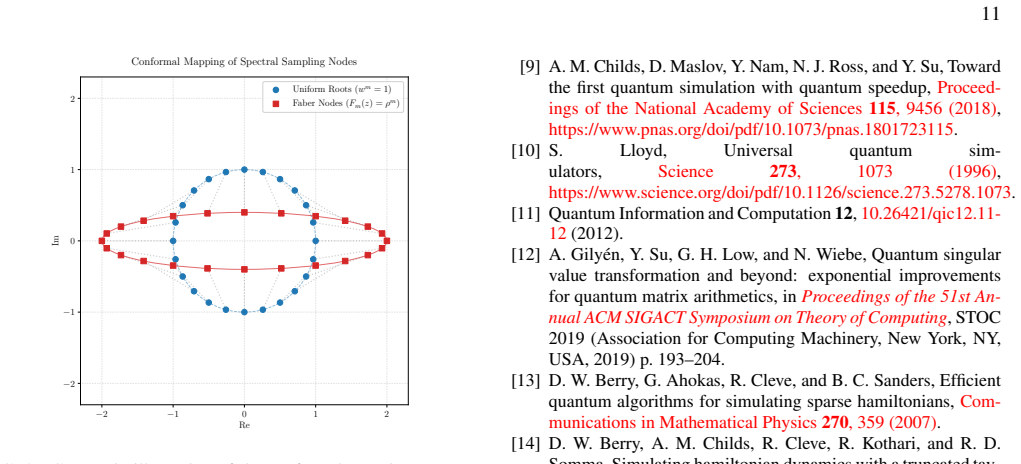
P. W. Shor, Polynomial-time algorithms for prime factorization and discrete logarithms on a quantum computer, SIAM Review 41, 303 (1999), https://doi.org/10.1137/S0036144598347011. 11 −2 −1 0 1 2 Re −2 −1 0 1 2 Im Conformal Mapping of Spectral Sampling Nodes Uniform Roots ( wm = 1) Faber Nodes ( Fm(z) = ρm) FIG. 3. Geometric illustration of the conformal ...
-
[4]
L. K. Grover, A fast quantum mechanical algorithm for database search, inProceedings of the Twenty-Eighth Annual ACM Symposium on Theory of Computing, STOC ’96 (Associ- ation for Computing Machinery, New York, NY , USA, 1996) p. 212–219
work page 1996
-
[5]
A. W. Harrow, A. Hassidim, and S. Lloyd, Quantum algorithm for linear systems of equations, Phys. Rev. Lett.103, 150502 (2009)
work page 2009
-
[6]
A. M. Childs, R. Kothari, and R. D. Somma, Quantum algo- rithm for systems of linear equations with exponentially im- proved dependence on precision, SIAM Journal on Computing 46, 1920 (2017), https://doi.org/10.1137/16M1087072
-
[7]
I. M. Georgescu, S. Ashhab, and F. Nori, Quantum simulation, Rev. Mod. Phys.86, 153 (2014)
work page 2014
-
[8]
E. Altman, K. R. Brown, G. Carleo, L. D. Carr, E. Demler, C. Chin, B. DeMarco, S. E. Economou, M. A. Eriksson, K.- M. C. Fu, M. Greiner, K. R. Hazzard, R. G. Hulet, A. J. Koll´ar, B. L. Lev, M. D. Lukin, R. Ma, X. Mi, S. Misra, C. Monroe, K. Murch, Z. Nazario, K.-K. Ni, A. C. Potter, P. Roushan, M. Saffman, M. Schleier-Smith, I. Siddiqi, R. Simmonds, M. S...
work page 2021
-
[9]
A. J. Daley, I. Bloch, C. Kokail, S. Flannigan, N. Pearson, M. Troyer, and P. Zoller, Practical quantum advantage in quan- tum simulation, Nature607, 667 (2022)
work page 2022
-
[10]
M. Szegedy, Quantum speed-up of markov chain based algo- rithms, in45th Annual IEEE Symposium on Foundations of Computer Science(2004) pp. 32–41
work page 2004
-
[11]
A. M. Childs, D. Maslov, Y . Nam, N. J. Ross, and Y . Su, Toward the first quantum simulation with quantum speedup, Proceed- ings of the National Academy of Sciences115, 9456 (2018), https://www.pnas.org/doi/pdf/10.1073/pnas.1801723115
-
[12]
Lloyd, Science273, 1073 (1996), URLhttps://doi
S. Lloyd, Universal quantum sim- ulators, Science273, 1073 (1996), https://www.science.org/doi/pdf/10.1126/science.273.5278.1073
-
[13]
Quantum Information and Computation12, 10.26421/qic12.11- 12 (2012)
-
[14]
A. Gily ´en, Y . Su, G. H. Low, and N. Wiebe, Quantum singular value transformation and beyond: exponential improvements for quantum matrix arithmetics, inProceedings of the 51st An- nual ACM SIGACT Symposium on Theory of Computing, STOC 2019 (Association for Computing Machinery, New York, NY , USA, 2019) p. 193–204
work page 2019
-
[15]
D. W. Berry, G. Ahokas, R. Cleve, and B. C. Sanders, Efficient quantum algorithms for simulating sparse hamiltonians, Com- munications in Mathematical Physics270, 359 (2007)
work page 2007
-
[16]
D. W. Berry, A. M. Childs, R. Cleve, R. Kothari, and R. D. Somma, Simulating hamiltonian dynamics with a truncated tay- lor series, Phys. Rev. Lett.114, 090502 (2015)
work page 2015
-
[17]
A Quantum Approximate Optimization Algorithm
E. Farhi, J. Goldstone, and S. Gutmann, A quantum approxi- mate optimization algorithm (2014), arXiv:1411.4028 [quant- ph]
work page internal anchor Pith review Pith/arXiv arXiv 2014
- [18]
- [19]
-
[20]
G. A. Pavliotis, Stochastic processes and applications, Texts in applied mathematics60(2014)
work page 2014
-
[21]
S. Jin, N. Liu, and Y . Yu, Quantum simulation of partial differ- ential equations: Applications and detailed analysis, Physical Review A108, 10.1103/physreva.108.032603 (2023)
-
[22]
Quantum semipara- metric estimation.Phys
J. Gonzalez-Conde, A. Rodriguez-Rozas, E. Solano, and M. Sanz, Efficient hamiltonian simulation for solving option price dynamics, Physical Review Research5, 10.1103/phys- revresearch.5.043220 (2023)
- [23]
-
[24]
H.-Y . Liu, X. Lin, Z.-Y . Chen, C. Xue, T.-P. Sun, Q.-S. Li, X.-N. Zhuang, Y .-J. Wang, Y .-C. Wu, M. Gong, and G.-P. Guo, Simu- lation of open quantum systems on universal quantum comput- ers, Quantum9, 1765 (2025)
work page 2025
-
[25]
L. H. Delgado-Granados, T. J. Krogmeier, L. M. Sager-Smith, I. Avdic, Z. Hu, M. Sajjan, M. Abbasi, S. E. Smart, P. Narang, S. Kais, A. W. Schlimgen, K. Head-Marsden, and D. A. Mazz- iotti, Quantum algorithms and applications for open quantum systems, Chemical Reviews125, 1823 (2025)
work page 2025
-
[26]
A. M. Childs and J.-P. Liu, Quantum spectral methods for dif- ferential equations, Communications in Mathematical Physics 375, 1427 (2020)
work page 2020
-
[27]
D. W. Berry and P. C. S. Costa, Quantum algorithm for time- dependent differential equations using dyson series, Quantum 8, 1369 (2024)
work page 2024
-
[28]
D. Fang, L. Lin, and Y . Tong, Time-marching based quantum solvers for time-dependent linear differential equations, Quan- tum7, 955 (2023)
work page 2023
-
[29]
S. Jin, N. Liu, and Y . Yu, Quantum simulation of partial differ- ential equations: Applications and detailed analysis, Phys. Rev. A108, 032603 (2023)
work page 2023
-
[30]
S. Jin, N. Liu, and Y . Yu, Time complexity analysis of quantum difference methods for linear high dimensional and multiscale 12 partial differential equations, Journal of Computational Physics 471, 111641 (2022)
work page 2022
- [31]
-
[32]
S. Jin, N. Liu, and Y . Yu, Quantum simulation of partial dif- ferential equations via schr¨odingerization, Phys. Rev. Lett.133, 230602 (2024)
work page 2024
- [33]
- [34]
- [35]
-
[36]
C. Wang, H.-Y . Liu, C. Xue, X.-N. Zhuang, M. Dou, Z.- Y . Chen, and G.-P. Guo, Quantum simulation of non-unitary dynamics via contour-based matrix decomposition (2025), arXiv:2511.10267 [quant-ph]
work page internal anchor Pith review Pith/arXiv arXiv 2025
-
[37]
G. H. Low and Y . Su, Quantum eigenvalue processing, in2024 IEEE 65th Annual Symposium on Foundations of Computer Sci- ence (FOCS)(2024) pp. 1051–1062
work page 2024
-
[38]
S. Takahira, A. Ohashi, T. Sogabe, and T. S. Usuda, Quantum algorithm for matrix functions by cauchy’s integral formula, Quantum Information and Computation20, 14–36 (2020)
work page 2020
-
[39]
S. Takahira, A. Ohashi, T. Sogabe, and T. S. Usuda, Quantum algorithms based on the block-encoding framework for ma- trix functions by contour integrals (2021), arXiv:2106.08076 [quant-ph]
-
[40]
S. Jiang and D. An, Contour-integral based quantum eigen- value transformation: analysis and applications (2026), arXiv:2601.11959 [quant-ph]
-
[41]
G. H. Low and I. L. Chuang, Optimal hamiltonian simulation by quantum signal processing, Phys. Rev. Lett.118, 010501 (2017)
work page 2017
-
[42]
G. H. Low and Y . Su, Quantum linear system algorithm with optimal queries to initial state preparation, Quantum10, 2041 (2026)
work page 2041
- [43]
-
[44]
S. D. Miller and W. Schmid, Summation formulas, from pois- son and voronoi to the present, inNoncommutative Harmonic Analysis: In Honor of Jacques Carmona, edited by P. Delorme and M. Vergne (Birkh ¨auser Boston, Boston, MA, 2004) pp. 419–440
work page 2004
-
[45]
Y . Kannai, Off diagonal short time asymptotics for fun- damental solution of diffusion equation, Communica- tions in Partial Differential Equations2, 781 (1977), https://doi.org/10.1080/03605307708820048
- [46]
-
[47]
D. Camps and R. Van Beeumen, Fable: Fast approximate quan- tum circuits for block-encodings, in2022 IEEE International Conference on Quantum Computing and Engineering (QCE) (IEEE, 2022) p. 104–113
work page 2022
-
[48]
C. S ¨underhauf, E. Campbell, and J. Camps, Block-encoding structured matrices for data input in quantum computing, Quan- tum8, 1226 (2024)
work page 2024
-
[49]
E. M. Stein and G. Weiss,Introduction to Fourier Analysis on Euclidean Spaces, Princeton Mathematical Series, V ol. 32 (Princeton University Press, Princeton, NJ, 1971)
work page 1971
-
[50]
R. E. A. C. Paley and N. Wiener,Fourier transforms in the com- plex domain, V ol. 19 (American Mathematical Society Collo- quium Publications, Providence, RI, 1934)
work page 1934
-
[51]
T. Kharazi, A. M. Alkadri, K. K. Mandadapu, and K. B. Wha- ley, A sublinear-time quantum algorithm for high-dimensional reaction rates (2026), arXiv:2601.15523 [quant-ph]
- [52]
-
[53]
W. W. Mullins, Theory of thermal grooving, Journal of Applied Physics28, 333 (1957)
work page 1957
-
[54]
R. Metzler and J. Klafter, The random walk’s guide to anoma- lous diffusion: a fractional dynamics approach, Physics Reports 339, 1 (2000)
work page 2000
-
[55]
A. Lischke, G. Pang, M. Gulian, F. Song, C. Glusa, X. Zheng, Z. Mao, W. Cai, M. M. Meerschaert, M. Ainsworth, and G. E. Karniadakis, What is the fractional laplacian? a comparative review with new results, Journal of Computational Physics404, 109009 (2020)
work page 2020
-
[56]
Katznelson,An introduction to harmonic analysis(Cam- bridge University Press, 2004)
Y . Katznelson,An introduction to harmonic analysis(Cam- bridge University Press, 2004)
work page 2004
-
[57]
F. E. Grubbs, An introduction to probability theory and its ap- plications (1958)
work page 1958
-
[58]
Wiener, Tauberian theorems, Annals of Mathematics33, 1 (1932)
N. Wiener, Tauberian theorems, Annals of Mathematics33, 1 (1932)
work page 1932
-
[59]
DLMF,NIST Digital Library of Mathematical Functions, https://dlmf.nist.gov/, Release 1.2.5 of 2025-12-15, f. W. J. Olver, A. B. Olde Daalhuis, D. W. Lozier, B. I. Schnei- der, R. F. Boisvert, C. W. Clark, B. R. Miller, B. V . Saunders, H. S. Cohl, and M. A. McClain, eds. Appendix A: Estimation of theL 1-norm of Functionf A bound ofO(logα)can be derived by...
work page 2025
discussion (0)
Sign in with ORCID, Apple, or X to comment. Anyone can read and Pith papers without signing in.